

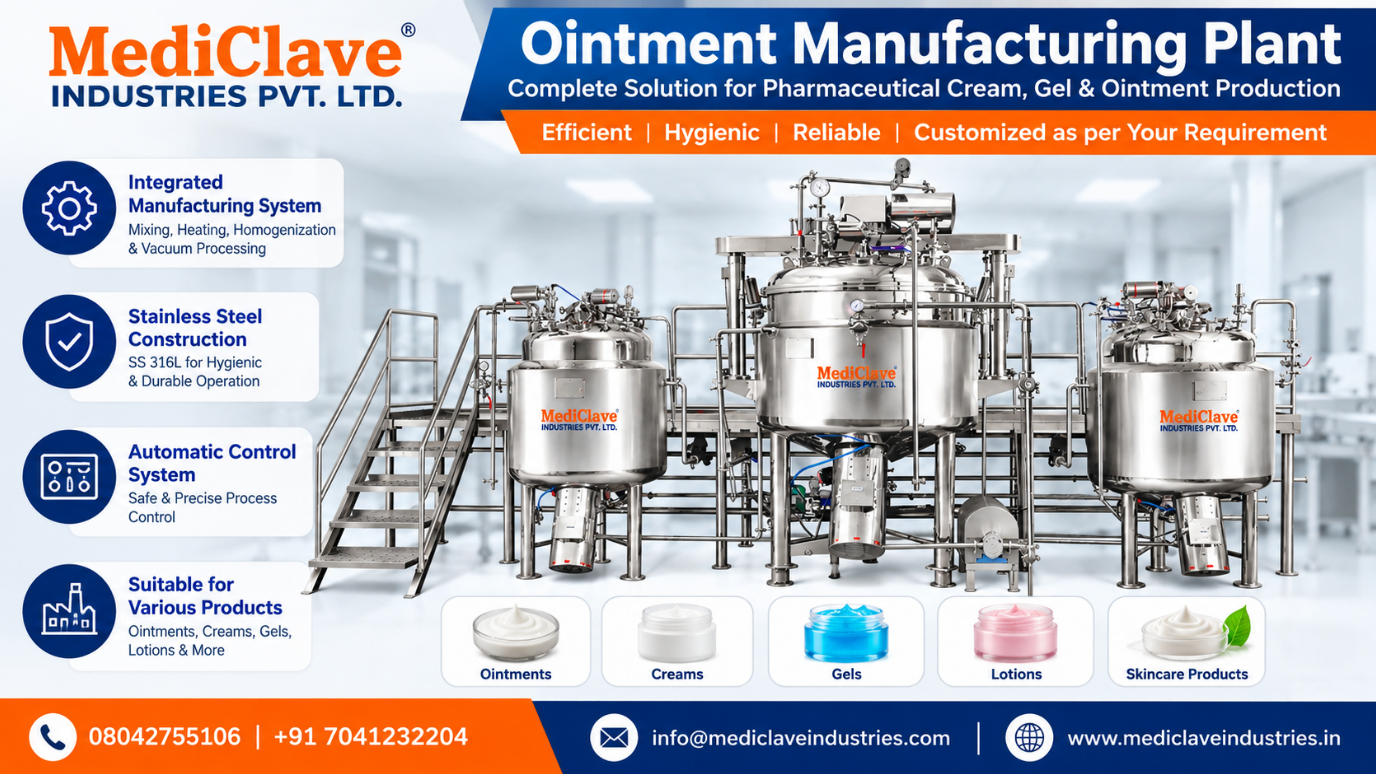
The
pharmaceutical industry requires reliable manufacturing equipment to produce
safe, consistent, and high-quality topical formulations. Products such as
ointments, creams, gels, lotions, and medicated skincare preparations require
controlled mixing, heating, homogenization, and hygienic processing conditions.
An Ointment
Manufacturing Plant plays an important role in producing these formulations
efficiently while maintaining consistency throughout the manufacturing process.
From
small pharmaceutical production units to large-scale manufacturing facilities,
selecting the right ointment manufacturing equipment is essential for achieving
product uniformity, reducing manual handling, and supporting efficient production.
Mediclave Industries Private Limited, a pharmaceutical processing
equipment manufacturer in India, provides manufacturing solutions for
pharmaceutical and healthcare applications.
In this
blog, we explore the working principle, components, features, applications, and
benefits of an ointment manufacturing plant and discuss how to select suitable
equipment for your production requirements.
What Is an Ointment Manufacturing Plant?
An Ointment
Manufacturing Plant is an integrated pharmaceutical processing system
designed to manufacture semisolid formulations such as ointments, creams, and
certain gels.
The
system combines multiple processing operations, including heating, melting,
mixing, emulsification, homogenization, and product transfer.
Depending
on the formulation and equipment configuration, the plant may include jacketed
manufacturing vessels, agitators, homogenizers, vacuum systems, transfer pumps,
and storage vessels.
The
primary objective is to produce a consistent formulation with the required texture,
viscosity, appearance, and ingredient distribution.
Modern
ointment manufacturing plants are commonly designed to support hygienic
operation, controlled processing, and efficient product handling.
How Does an Ointment Manufacturing Plant Work?
The manufacturing
process depends on the product formulation and the specific equipment used.
However, a typical cream or ointment production process includes several
important stages.
1. Raw Material Preparation
The
manufacturing process begins with the preparation and verification of raw
materials.
Ingredients
such as oils, waxes, emulsifiers, purified water, active pharmaceutical
ingredients, and other formulation components are measured according to the
approved manufacturing formula.
2. Heating and Melting
For
formulations containing waxes or solid fatty materials, heating may be required
to melt the ingredients.
Jacketed
manufacturing vessels allow controlled heating to achieve the desired
processing temperature.
3. Mixing and Emulsification
The
prepared ingredients are combined using suitable agitators and mixing systems.
For
emulsion-based creams, controlled mixing helps disperse one phase into another
and develop the required formulation structure.
4. Homogenization
Homogenization
helps achieve uniform distribution of ingredients and improve product
consistency.
Depending
on the formulation, a high-shear homogenizer may be used to reduce droplet size
and improve emulsion uniformity.
5. Vacuum Processing
Some
ointment manufacturing plants include vacuum processing arrangements.
Vacuum
operation can help reduce entrapped air and support the production of smooth,
uniform formulations.
6. Cooling and Final Mixing
After the
required processing stages, the product is cooled under controlled conditions.
Temperature-sensitive
ingredients may be added during suitable stages according to the approved
manufacturing procedure.
7. Product Transfer
The
finished bulk formulation is transferred to a storage vessel or filling system
using appropriate pumps and pipelines.
The product
is then ready for further quality checks and packaging operations.
Main Components of an Ointment Manufacturing Plant
A
pharmaceutical ointment manufacturing system may include the following
components.
Ointment Manufacturing Vessel
The main
manufacturing vessel is used for mixing, heating, cooling, and processing the
formulation.
Depending
on the design, the vessel may include a jacket, agitator, homogenizer, and
vacuum arrangement.
Oil Phase Vessel
The oil
phase vessel is used to prepare and heat oil-based ingredients such as waxes,
emulsifiers, and other compatible materials.
Water Phase Vessel
The water
phase vessel is used for preparing the aqueous phase of suitable cream and
emulsion formulations.
Homogenizer
A
homogenizer helps achieve uniform ingredient distribution and the desired
product texture.
Vacuum System
A vacuum
system can help remove entrapped air during suitable processing stages.
Transfer Pump
A
suitable transfer pump moves the processed formulation between vessels and
toward downstream equipment.
Control Panel
The
control panel allows operators to monitor and manage process parameters such as
temperature, mixing speed, and other configured functions.
Storage Vessel
A storage
vessel may be used to hold the finished bulk product before transfer to the
filling and packaging line.
Key Features of an Ointment Manufacturing Plant
Modern
pharmaceutical manufacturing facilities require equipment that supports
controlled production and convenient operation.
Important
features may include:
- Stainless
Steel Construction: Product-contact components can be
manufactured using suitable stainless steel grades, including SS 316L
where required.
- Jacketed
Processing Vessels: Support controlled heating and cooling of
pharmaceutical formulations.
- Efficient
Mixing Systems: Help achieve uniform distribution of
formulation ingredients.
- High-Shear
Homogenization: Supports the development of consistent
emulsions and suitable product textures.
- Vacuum
Processing: Helps minimize entrapped air in compatible
formulations.
- Automatic
or Semi-Automatic Controls: Allow monitoring and adjustment of selected
processing parameters.
- Hygienic
Equipment Design: Supports effective cleaning and controlled
product handling.
- Configurable
Production Capacity: Equipment can be selected according to batch
size and manufacturing requirements.
- CIP-Compatible
Design: Suitable configurations may support
cleaning-in-place operations.
- Process
Monitoring: Enables operators to monitor important
manufacturing parameters.
The
availability of these features depends on the selected model and equipment
specifications.
Applications of Ointment Manufacturing Plants
Ointment
manufacturing plants are used in industries that manufacture semisolid
products.
Pharmaceutical Industry
These
plants are commonly used for manufacturing compatible pharmaceutical ointments,
creams, and topical formulations.
Dermatological Product Manufacturing
Dermatological
manufacturers use suitable processing equipment for medicated creams, gels, and
other skin-applied preparations.
Cosmetic Industry
Similar
processing systems may be used for cosmetic creams, moisturizers, skincare
products, and selected lotions.
Personal Care Industry
Ointment
and cream processing equipment can support the production of suitable personal
care formulations.
Contract Manufacturing Facilities
Pharmaceutical
contract manufacturers may use these systems to produce different formulations
for multiple customers, subject to cleaning validation and changeover
requirements.
Benefits of Using an Ointment Manufacturing Plant
Consistent Product Quality
Controlled
mixing and homogenization help manufacturers achieve uniform ingredient
distribution and repeatable product characteristics.
Improved Production Efficiency
Integrated
processing systems can reduce manual material handling and support more
organized production workflows.
Hygienic Manufacturing
Appropriately
designed stainless steel equipment supports cleaning, maintenance, and hygienic
processing.
Reduced Product Handling
Closed or
partially closed transfer arrangements can help minimize unnecessary product
exposure during processing.
Flexible Manufacturing Capacity
Plants
can be designed for different batch sizes, allowing manufacturers to select
equipment suitable for their production requirements.
Better Process Control
Monitoring
temperature, agitation, and other important parameters helps operators maintain
the required manufacturing conditions.
Ointment Manufacturing Plant vs Cream Manufacturing
Plant
Ointment
and cream manufacturing systems share several processing technologies, but
their exact configurations depend on the formulation.
|
Feature |
Ointment Manufacturing |
Cream Manufacturing |
|
Product
Type |
Often
oil-rich or semisolid formulations |
Commonly
emulsion-based formulations |
|
Mixing |
Agitation
and suitable blending |
Agitation
and emulsification |
|
Homogenization |
Depends
on formulation |
Often
important for emulsion uniformity |
|
Heating |
May be
required |
Commonly
required for phase preparation |
|
Vacuum
Processing |
Optional,
formulation-dependent |
Often
useful for deaeration |
|
Equipment
Design |
Based
on viscosity and ingredients |
Based
on emulsion type and viscosity |
A
properly configured manufacturing plant may be suitable for producing multiple
semisolid formulations, provided the equipment and processes are validated for
each product.
How to Choose the Right Ointment Manufacturing
Plant
Selecting
an ointment manufacturing plant requires careful evaluation of the product and
production process.
Production Capacity: Determine the required batch size and expected daily
production volume.
Product Viscosity: Select mixing systems and transfer pumps suitable
for the formulation's viscosity.
Material of Construction: Confirm the required stainless steel grade,
surface finish, and product-contact material compatibility.
Homogenization Requirements: Evaluate whether the formulation
requires high-shear mixing or specialized homogenization.
Heating and Cooling: Consider the temperature control requirements of
the ingredients and manufacturing process.
Automation: Decide whether manual, semi-automatic, or fully
automatic operation is appropriate.
Cleaning Requirements: Review equipment accessibility, cleaning
arrangements, and compatibility with validated cleaning procedures.
Documentation: Pharmaceutical manufacturers should consider
applicable GMP requirements, qualification documentation, and process
validation needs.
Technical Support: Evaluate installation assistance, operator
training, spare parts availability, and maintenance support.
Choosing
the right configuration helps manufacturers balance product quality, production
efficiency, and long-term operational costs.
Why Choose Mediclave Industries for Ointment
Manufacturing Plants?
Mediclave Industries Private Limited, based in Ahmedabad, Gujarat,
India, provides pharmaceutical processing and sterilization equipment
solutions.
We
understand that pharmaceutical manufacturers require equipment that supports
consistent processing, hygienic product handling, and efficient production.
Our focus
is on providing suitable equipment solutions based on production capacity,
formulation requirements, automation preferences, and manufacturing processes.
Customers
can explore our pharmaceutical processing equipment
solutions and learn more about our pharmaceutical
manufacturing equipment range.
For
equipment specifications, manufacturing requirements, and quotation enquiries,
visit the official Mediclave
Industries website.
Frequently Asked Questions (FAQs)
1. What is an Ointment Manufacturing Plant?
An
ointment manufacturing plant is pharmaceutical processing equipment used to
manufacture semisolid formulations through controlled mixing, heating,
homogenization, and other suitable processing operations.
2. What products can be manufactured using an
ointment manufacturing plant?
Depending
on the equipment configuration and validated process, it can be used for
ointments, creams, gels, lotions, and other compatible semisolid formulations.
3. What is the purpose of a homogenizer in ointment
manufacturing?
A
homogenizer helps improve ingredient distribution and can support the desired
texture and consistency of suitable formulations.
4. What is the price of an Ointment Manufacturing
Plant in India?
The price
depends on production capacity, vessel construction, automation, homogenization
system, vacuum arrangement, and additional features. Contact Mediclave
Industries for a quotation based on your requirements.
5. What material is used for pharmaceutical
ointment manufacturing vessels?
Stainless
steel is commonly used. SS 316L may be selected for product-contact components
depending on process requirements and material compatibility.
6. Can the same plant manufacture creams and
ointments?
Yes, a
suitably configured plant may manufacture different semisolid products.
However, each formulation requires appropriate process development, cleaning
procedures, and validation.
7. How do I select the right ointment manufacturing
plant capacity?
Capacity
should be selected based on batch size, production demand, product
characteristics, available space, and manufacturing workflow.
Conclusion
An Ointment
Manufacturing Plant is an important part of pharmaceutical semisolid
manufacturing. From controlled heating and mixing to homogenization and product
transfer, the right equipment supports efficient processing and consistent
product quality.
Whether
you are establishing a new pharmaceutical manufacturing unit or upgrading an
existing production line, selecting suitable ointment manufacturing equipment
is essential for meeting your operational requirements.
Mediclave Industries Private Limited provides pharmaceutical
processing equipment solutions for manufacturers seeking practical and
efficient production systems.
Contact
our team to discuss your ointment, cream, or gel manufacturing requirements.
Contact Mediclave Industries Private Limited
Ointment Manufacturing Plant Manufacturer & Supplier in India
Phone: 08042755106
Mobile: +91 7041232204
Email: info@mediclaveindustries.com
Website: https://www.mediclaveindustries.in/
Location: Ahmedabad, Gujarat, India
Contact Mediclave Industries today for Ointment Manufacturing Plant
specifications and quotation enquiries.



