
Introduction
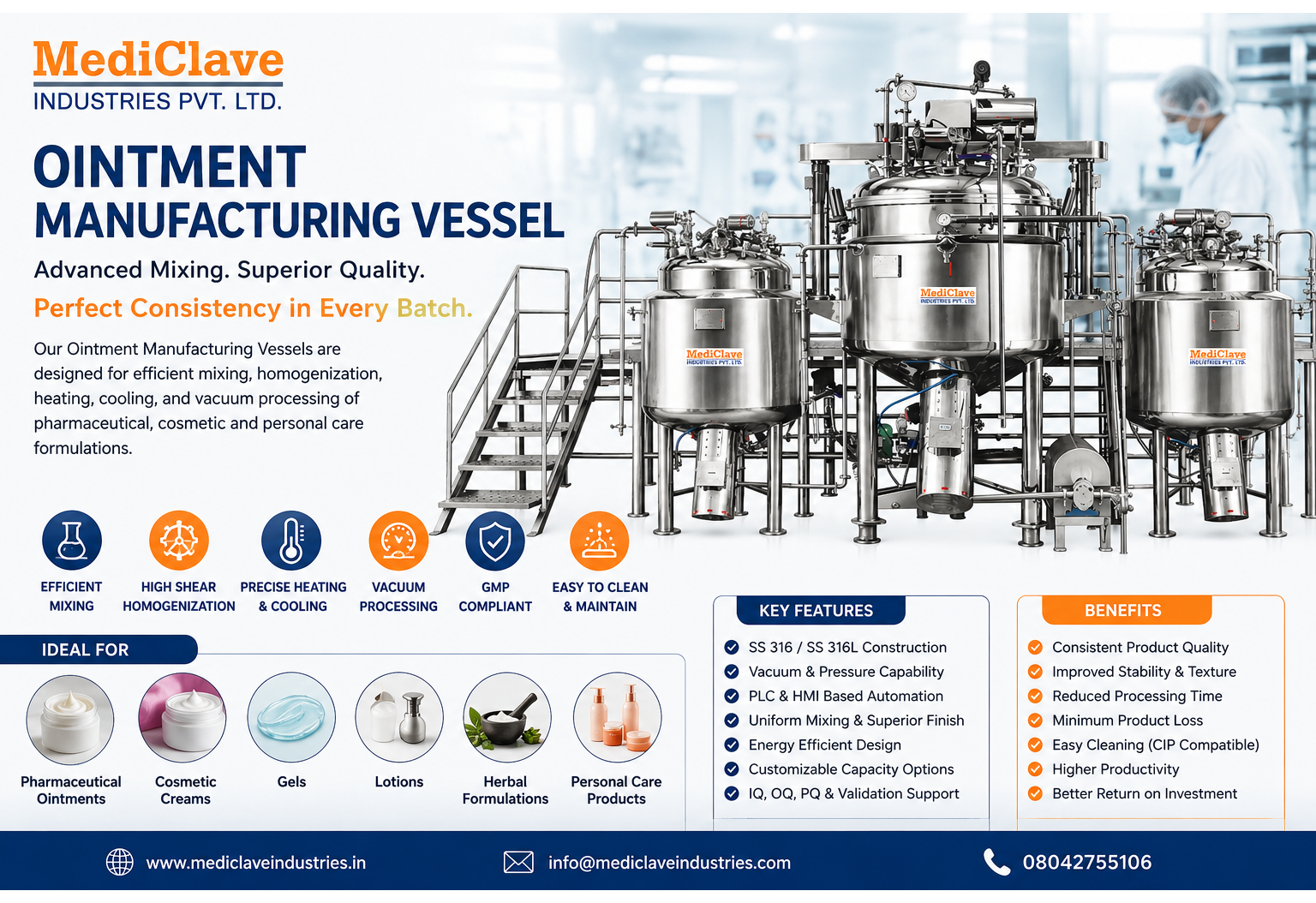
The pharmaceutical and cosmetic industries are evolving rapidly, with increasing demand for high-quality ointments, creams, gels, lotions, and topical formulations. Consumers expect products that are smooth, stable, effective, and consistent in every batch. Achieving this level of quality requires advanced manufacturing equipment capable of precise mixing, homogenization, heating, cooling, and process control.
One of the most important pieces of equipment in topical product manufacturing is the Ointment Manufacturing Vessel.
Whether producing pharmaceutical ointments, medicated creams, herbal formulations, cosmetic creams, moisturizing lotions, antiseptic products, or dermatological preparations, manufacturers rely on Ointment Manufacturing Vessels to achieve uniform product quality and maintain GMP compliance.
Modern Ointment Manufacturing Vessels are designed to handle complex formulations while ensuring efficient production, reduced processing time, and superior product consistency.
At Mediclave Industries Pvt. Ltd., we manufacture advanced Ointment Manufacturing Vessels engineered for pharmaceutical, cosmetic, nutraceutical, and personal care industries worldwide.
For more pharmaceutical manufacturing solutions, visit:
Mediclave Industries Homepage
https://www.mediclaveindustries.in/
Complete Product Portfolio
https://www.mediclaveindustries.in/all-products/1
Pharmaceutical Equipment Range
https://www.mediclaveindustries.in/all-products/2
Industrial Processing Solutions
https://www.mediclaveindustries.in/all-products/3
Latest Industry Updates
https://www.mediclaveindustries.in/latest-updates/1/
About Mediclave Industries
https://www.mediclaveindustries.in/pages/1
What is an Ointment Manufacturing Vessel?
An Ointment Manufacturing Vessel is a specialized processing system used for manufacturing semi-solid products such as:
- Pharmaceutical ointments
- Creams
- Gels
- Lotions
- Moisturizers
- Cosmetic products
- Dermatological formulations
- Herbal creams
- Personal care products
The vessel combines multiple manufacturing functions into a single integrated system, including:
- Mixing
- Heating
- Cooling
- Homogenization
- Emulsification
- Vacuum processing
These functions help produce smooth, homogeneous, and stable formulations.
Why Ointment Manufacturing Vessels are Essential
Modern formulations contain multiple ingredients that must be uniformly dispersed.
These ingredients may include:
- Active pharmaceutical ingredients (APIs)
- Oils
- Waxes
- Emulsifiers
- Stabilizers
- Preservatives
- Herbal extracts
- Fragrances
Without proper processing, manufacturers may face:
- Product separation
- Uneven consistency
- Poor texture
- Reduced stability
- Batch failures
An advanced Ointment Manufacturing Vessel eliminates these challenges through controlled processing.
Importance of Uniform Product Consistency
Product consistency directly impacts:
- Product effectiveness
- Customer satisfaction
- Regulatory compliance
- Brand reputation
Consumers expect every tube, jar, or container to provide the same experience.
Ointment Manufacturing Vessels help achieve:
- Uniform texture
- Smooth appearance
- Consistent viscosity
- Stable formulation
- Superior product quality
Working Principle of an Ointment Manufacturing Vessel
The manufacturing process generally consists of multiple stages.
Stage 1: Ingredient Charging
Raw materials are loaded into the vessel.
These may include:
- Oil phase ingredients
- Water phase ingredients
- Active ingredients
- Additives
The vessel design ensures safe and hygienic material handling.
Stage 2: Controlled Heating
Many formulations require controlled heating to:
- Melt waxes
- Dissolve ingredients
- Improve mixing efficiency
The vessel jacket provides precise temperature control.
Benefits include:
- Better ingredient incorporation
- Improved process consistency
- Reduced product degradation
Stage 3: Mixing Operation
The mixing system creates uniform distribution of ingredients.
Proper mixing helps:
- Eliminate lumps
- Improve consistency
- Enhance formulation quality
Different agitator designs can be used depending on formulation requirements.
Stage 4: Homogenization
Homogenization is one of the most critical stages.
It helps:
- Reduce particle size
- Improve stability
- Create smooth texture
- Enhance product appearance
This process is particularly important for pharmaceutical creams and cosmetic emulsions.
Stage 5: Vacuum Processing
Advanced vessels operate under vacuum conditions.
Vacuum processing provides several advantages:
- Removes trapped air
- Improves product appearance
- Prevents oxidation
- Enhances stability
- Produces smoother formulations
Stage 6: Cooling Process
Controlled cooling helps:
- Stabilize emulsions
- Maintain product structure
- Improve filling performance
This stage is essential for achieving final product quality.
Major Components of an Ointment Manufacturing Vessel
Modern systems include several integrated components.
Main Manufacturing Vessel
The primary vessel performs:
- Mixing
- Heating
- Cooling
- Processing
Typically manufactured using pharmaceutical-grade stainless steel.
Homogenizer System
The homogenizer ensures:
- Fine particle distribution
- Smooth texture
- Improved stability
High-shear homogenization is widely used in pharmaceutical and cosmetic applications.
Agitator Assembly
The agitator provides:
- Uniform mixing
- Product circulation
- Efficient blending
Different agitator designs are selected according to product viscosity.
Vacuum System
The vacuum system:
- Removes entrapped air
- Improves product quality
- Enhances appearance
Vacuum processing is particularly important for premium formulations.
Heating and Cooling Jacket
The jacket enables:
- Temperature control
- Process optimization
- Consistent product quality
This improves manufacturing efficiency.
Applications of Ointment Manufacturing Vessels
Ointment Manufacturing Vessels are used across multiple industries.
Pharmaceutical Industry
Used for manufacturing:
- Antibiotic ointments
- Pain relief creams
- Antifungal creams
- Dermatological products
- Medicated gels
- Antiseptic formulations
Cosmetic Industry
Used for producing:
- Beauty creams
- Face creams
- Moisturizers
- Sunscreens
- Body lotions
- Anti-aging products
Personal Care Industry
Applications include:
- Skin care products
- Hair care formulations
- Wellness products
- Specialty creams
Herbal Product Industry
Used for manufacturing:
- Ayurvedic creams
- Herbal ointments
- Natural cosmetic products
- Botanical formulations
Advantages of Modern Ointment Manufacturing Vessels
Improved Product Quality
Advanced processing ensures:
- Uniform texture
- Better stability
- Consistent appearance
Faster Production
Integrated systems reduce:
- Processing time
- Handling requirements
- Production delays
Reduced Product Loss
Efficient vessel design minimizes:
- Material wastage
- Batch losses
- Production inefficiencies
Better Process Control
Operators can precisely manage:
- Temperature
- Mixing speed
- Vacuum levels
- Processing time
GMP Compliance Support
Designed to meet pharmaceutical manufacturing requirements.
Benefits include:
- Easy cleaning
- Hygienic construction
- Validation support
-
Regulatory compliance
GMP, FDA, and WHO Compliance in Ointment Manufacturing
In pharmaceutical and cosmetic manufacturing, compliance is not optional. Every product that reaches the market must be manufactured under controlled and validated conditions to ensure safety, efficacy, and consistency.
Modern Ointment Manufacturing Vessels are designed to support:
- GMP (Good Manufacturing Practices)
- WHO Guidelines
- FDA Requirements
- EU GMP Standards
- PIC/S Compliance
- International Quality Standards
A properly designed vessel helps manufacturers maintain hygienic processing conditions while ensuring repeatable batch quality.
Why Compliance Matters
Failure to comply with pharmaceutical standards can result in:
- Product recalls
- Regulatory observations
- Batch rejection
- Financial losses
- Customer complaints
- Brand reputation damage
Therefore, selecting GMP-compliant equipment is a critical investment.
The Role of Vacuum Homogenization Technology
One of the most important advancements in ointment manufacturing is vacuum homogenization technology.
Modern pharmaceutical creams and ointments require:
- Smooth texture
- Uniform consistency
- Stable emulsions
- Enhanced appearance
Vacuum homogenization helps achieve these objectives.
What is Vacuum Homogenization?
Vacuum homogenization combines:
- Mixing
- Emulsification
- Particle size reduction
- Air removal
under controlled vacuum conditions.
This creates a highly stable and visually appealing product.
Benefits of Vacuum Homogenization
Improved Product Stability
Vacuum processing reduces the risk of:
- Phase separation
- Ingredient settling
- Product instability
Better Texture
The technology helps create:
- Smooth creams
- Fine emulsions
- Uniform gels
which improve user experience.
Air-Free Product
Entrapped air can cause:
- Oxidation
- Product degradation
- Reduced shelf life
Vacuum processing eliminates these issues.
Enhanced Appearance
Products manufactured under vacuum conditions often exhibit:
- Better gloss
- Improved consistency
- Premium appearance
Pharmaceutical Ointments vs Cosmetic Creams
Although both products are semi-solid formulations, their manufacturing requirements differ.
Pharmaceutical Ointments
Typically contain:
- Active pharmaceutical ingredients (APIs)
- Medicinal compounds
- Antibacterial agents
- Anti-inflammatory ingredients
Key priorities include:
- Dose uniformity
- Product stability
- Regulatory compliance
- Therapeutic effectiveness
Cosmetic Creams
Generally contain:
- Moisturizers
- Botanical extracts
- Fragrances
- Skin conditioning agents
Primary focus areas include:
- Appearance
- Texture
- Consumer experience
- Product aesthetics
Why Advanced Vessels Are Suitable for Both
Modern Ointment Manufacturing Vessels provide flexibility for:
- Pharmaceutical products
- Cosmetic products
- Herbal formulations
- Personal care products
This versatility improves equipment utilization and return on investment.
Validation Requirements for Pharmaceutical Manufacturing
Validation ensures that the equipment consistently produces products meeting predetermined specifications.
Installation Qualification (IQ)
IQ verifies:
- Equipment installation
- Utility connections
- Material specifications
- Documentation accuracy
This confirms the vessel is installed correctly.
Operational Qualification (OQ)
OQ verifies:
- Agitator performance
- Temperature control
- Vacuum performance
- Homogenizer operation
- Safety systems
This demonstrates that the equipment functions according to design specifications.
Performance Qualification (PQ)
PQ verifies:
- Actual production performance
- Product consistency
- Batch repeatability
- Process reliability
This confirms the vessel performs effectively under production conditions.
Importance of Stainless Steel Construction
Pharmaceutical-grade stainless steel is essential for hygienic manufacturing.
Common materials include:
- SS 304
- SS 316
- SS 316L
Benefits of Stainless Steel
Corrosion Resistance
Provides long equipment life and product protection.
Easy Cleaning
Smooth surfaces simplify:
- CIP Cleaning
- Sanitization
- Maintenance
Hygienic Processing
Reduces contamination risks and supports GMP compliance.
Cleaning and Maintenance Advantages
Efficient cleaning is essential in pharmaceutical manufacturing.
Modern vessels are designed for:
- Easy cleaning
- Minimal downtime
- Reduced contamination risks
CIP (Clean-In-Place) Systems
Many vessels support CIP systems that allow cleaning without disassembly.
Benefits include:
- Faster cleaning
- Reduced labor
- Improved hygiene
- Consistent results
Reduced Downtime
Quick cleaning procedures improve:
- Equipment availability
- Production efficiency
- Operational productivity
Automation and Digital Control Systems
Modern manufacturing facilities increasingly demand automation.
Advanced Ointment Manufacturing Vessels feature:
- PLC Control Systems
- HMI Touch Screens
- Recipe Management
- Batch Recording
- Alarm Systems
- Data Logging
Advantages of Automation
Improved Consistency
Automated controls reduce operator-dependent variations.
Enhanced Productivity
Automation simplifies manufacturing processes and reduces manual intervention.
Better Traceability
Electronic records support:
- Regulatory compliance
- Audit readiness
- Data integrity
Energy Efficiency and Sustainability
Manufacturers are increasingly focused on reducing operational costs.
Energy-efficient vessel designs help reduce:
- Steam consumption
- Utility expenses
- Production costs
Sustainable Manufacturing
Modern equipment contributes to:
- Lower energy usage
- Reduced environmental impact
- Improved operational efficiency
This supports long-term sustainability goals.
Return on Investment (ROI)
Although advanced manufacturing vessels require capital investment, the benefits often outweigh the costs.
Reduced Product Losses
Improved mixing and homogenization reduce:
- Batch failures
- Product rejection
- Material wastage
Higher Productivity
Integrated systems improve:
- Throughput
- Manufacturing efficiency
- Batch consistency
Improved Product Quality
Consistent quality enhances:
- Customer satisfaction
- Brand reputation
- Market competitiveness
How to Select the Right Ointment Manufacturing Vessel
Choosing the correct vessel requires careful evaluation.
Production Capacity
Consider:
- Current production requirements
- Future expansion plans
- Batch sizes
The correct capacity improves operational efficiency.
Product Type
Different products may require:
- High-shear homogenization
- Specialized mixing
- Vacuum processing
Equipment should match formulation requirements.
Automation Requirements
Evaluate the need for:
- PLC controls
- SCADA integration
- Electronic records
- Advanced monitoring
Compliance Requirements
Ensure equipment supports:
- GMP compliance
- Validation activities
- Audit readiness
Service and Support
Reliable suppliers provide:
- Installation support
- Validation assistance
- Spare parts
- Technical service
Why Choose Mediclave Industries?
Mediclave Industries Pvt. Ltd. delivers advanced pharmaceutical processing solutions designed for modern manufacturing environments.
Our strengths include:
- GMP-oriented design
- Advanced engineering
- High-quality materials
- Custom manufacturing
- Validation support
- After-sales service
- Global supply capabilities
We help manufacturers achieve:
- Better product quality
- Regulatory compliance
- Increased productivity
- Long-term operational success
Explore More from Mediclave Industries
Homepage
https://www.mediclaveindustries.in/
All Products
https://www.mediclaveindustries.in/all-products/1
Pharmaceutical Equipment
https://www.mediclaveindustries.in/all-products/2
Industrial Processing Solutions
https://www.mediclaveindustries.in/all-products/3
Latest Industry Updates
https://www.mediclaveindustries.in/latest-updates/1/
About Mediclave Industries
https://www.mediclaveindustries.in/pages/1
Future Trends in Ointment Manufacturing
The pharmaceutical and cosmetic industries continue to evolve rapidly.
Future manufacturing trends include:
Industry 4.0 Integration
- Smart monitoring
- Predictive maintenance
- Real-time analytics
Advanced Automation
- Automated recipes
- Process optimization
- Reduced human intervention
Sustainable Manufacturing
- Energy-efficient equipment
- Resource optimization
- Environmental responsibility
Data Integrity Focus
- Electronic records
- Secure audit trails
- Enhanced compliance
These developments will further improve manufacturing quality and efficiency.
Key Benefits Summary
✔ Smooth and Uniform Product Texture
✔ Superior Homogenization
✔ Vacuum Processing Capability
✔ GMP Compliance
✔ Pharmaceutical and Cosmetic Applications
✔ Better Product Stability
✔ Faster Production Cycles
✔ Reduced Product Losses
✔ Enhanced Automation
✔ Easy Cleaning and Maintenance
✔ Long Equipment Life
✔ Excellent Return on Investment
What is an Ointment Manufacturing Vessel?
An Ointment Manufacturing Vessel is a specialized pharmaceutical and cosmetic processing system used for manufacturing ointments, creams, gels, lotions, and semi-solid formulations. It combines mixing, homogenization, heating, cooling, and vacuum processing in a single unit to ensure smooth texture, uniform consistency, and GMP-compliant production.
What is the Purpose of an Ointment Manufacturing Vessel?
The primary purpose of an Ointment Manufacturing Vessel is to:
- Mix ingredients uniformly
- Produce stable emulsions
- Eliminate lumps and air bubbles
- Improve product consistency
- Ensure GMP-compliant manufacturing
- Increase production efficiency
Which Industries Use Ointment Manufacturing Vessels?
These vessels are widely used in:
- Pharmaceutical Industry
- Cosmetic Industry
- Personal Care Industry
- Herbal Product Manufacturing
- Veterinary Pharmaceutical Industry
- Ayurvedic Product Manufacturing
- Nutraceutical Industry
Frequently Asked Questions (FAQs)
1. What is an Ointment Manufacturing Vessel?
It is a processing vessel used to manufacture ointments, creams, gels, lotions, and other semi-solid products.
2. What products can be manufactured?
- Pharmaceutical ointments
- Cosmetic creams
- Moisturizers
- Gels
- Herbal creams
- Dermatological products
- Personal care products
3. Why is homogenization important?
Homogenization improves:
- Product texture
- Stability
- Appearance
- Ingredient distribution
4. What is vacuum processing?
Vacuum processing removes trapped air and improves product quality and shelf life.
5. What materials are used for vessel construction?
Typically:
- SS 304
- SS 316
- SS 316L
6. Is the vessel GMP compliant?
Yes. Modern pharmaceutical vessels are designed according to GMP requirements.
7. What is the role of heating?
Heating helps:
- Melt waxes
- Dissolve ingredients
- Improve mixing efficiency
8. Why is cooling necessary?
Cooling stabilizes emulsions and prepares products for filling.
9. What is a vacuum homogenizer?
A vacuum homogenizer combines mixing and vacuum processing to produce smooth and stable formulations.
10. Can cosmetic creams be manufactured?
Yes. These vessels are widely used in cosmetic manufacturing.
11. Can pharmaceutical ointments be produced?
Yes. They are specifically designed for pharmaceutical applications.
12. Is automation available?
Yes. PLC and HMI-based systems are commonly used.
13. What is CIP cleaning?
CIP (Clean-In-Place) allows cleaning without dismantling the equipment.
14. What is the benefit of stainless steel construction?
It provides corrosion resistance, hygiene, and long equipment life.
15. Can herbal products be manufactured?
Yes. Herbal and Ayurvedic products can be processed efficiently.
16. Is validation required?
For pharmaceutical applications, IQ, OQ, and PQ validation are highly recommended.
17. What capacity options are available?
Capacities vary from laboratory scale to large industrial production systems.
18. How does vacuum improve product quality?
Vacuum removes air bubbles and prevents oxidation.
19. What industries benefit the most?
Pharmaceutical, cosmetic, personal care, and herbal product manufacturers.
20. Why choose Mediclave Industries?
Because Mediclave offers GMP-compliant, high-quality, customized manufacturing solutions with strong technical support and validation assistance.