
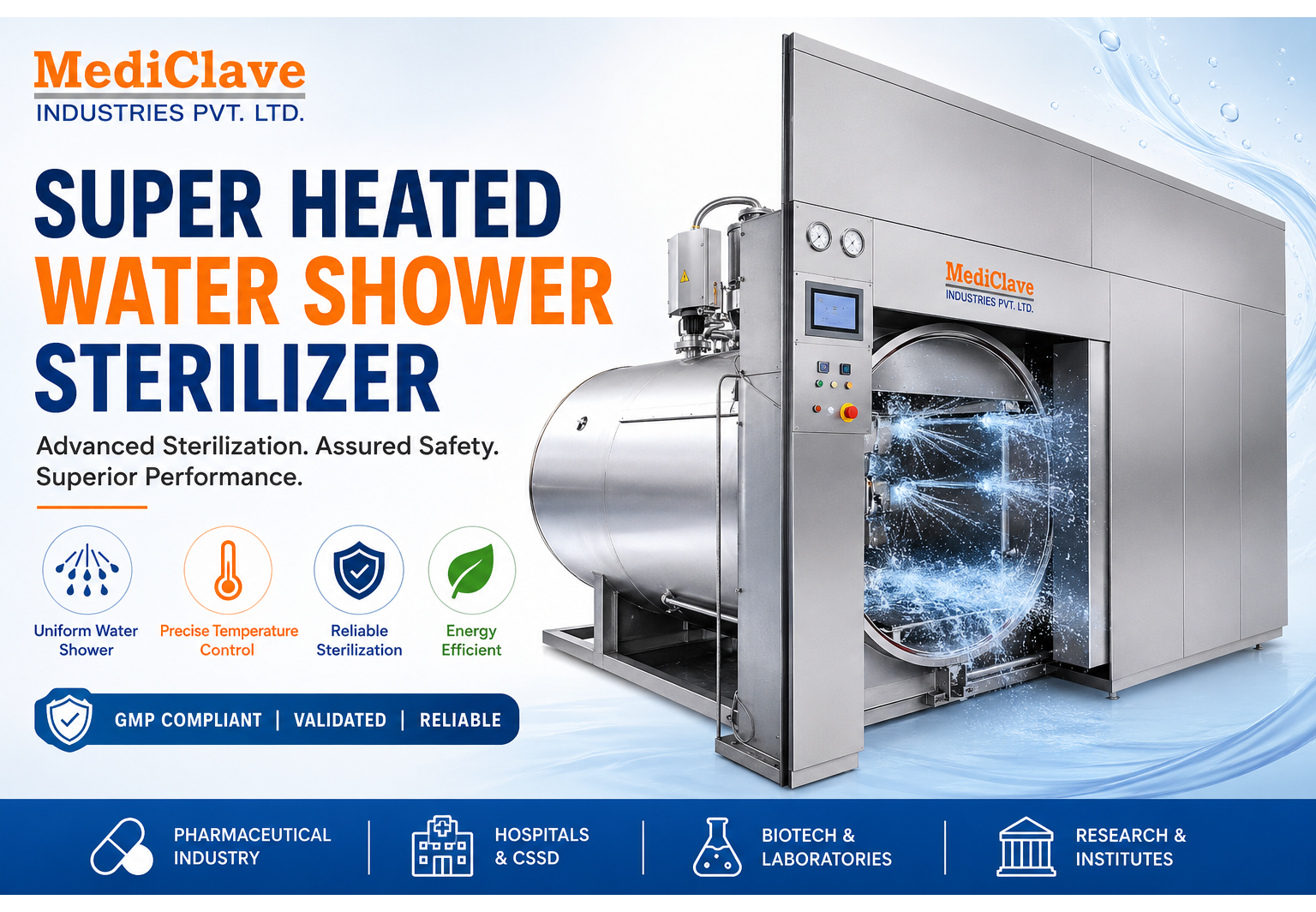
Why Super Heated Water Shower Sterilizers Are Revolutionizing Pharmaceutical Sterilization Processes
Introduction
In the pharmaceutical industry, sterilization is not merely a production step—it is a critical quality assurance process that directly impacts patient safety, product integrity, and regulatory compliance. As pharmaceutical formulations become increasingly sophisticated, manufacturers require sterilization systems capable of handling sensitive products without compromising efficacy or packaging quality.
Among the advanced sterilization technologies available today, the Super Heated Water Shower Sterilizer has emerged as one of the most reliable and efficient solutions for terminal sterilization of heat-sensitive pharmaceutical products. Its ability to provide uniform heat distribution, controlled pressure management, and superior process reliability makes it an ideal choice for pharmaceutical manufacturing facilities, biotechnology companies, healthcare institutions, and research organizations worldwide.
At Mediclave Industries, we understand the evolving requirements of modern pharmaceutical production. Our commitment to innovation, engineering excellence, and regulatory compliance has enabled us to develop sterilization solutions that meet international quality standards while delivering outstanding operational performance.
For organizations seeking advanced sterilization equipment and pharmaceutical processing solutions, Mediclave offers a comprehensive range of systems designed to support efficient and compliant manufacturing operations.
What Is a Super Heated Water Shower Sterilizer?
A Super Heated Water Shower Sterilizer is a specialized sterilization system that utilizes recirculated superheated water sprayed uniformly over products during the sterilization cycle. The process combines precisely controlled temperature, pressure, and water circulation to achieve effective microbial destruction while protecting product containers from damage.
Unlike conventional steam sterilizers that rely primarily on saturated steam penetration, water shower sterilizers employ high-velocity water distribution systems to ensure consistent heat transfer throughout the sterilization chamber.
This technology is particularly suitable for:
Glass vials
Plastic containers
IV fluids
Ampoules
Pre-filled syringes
Injectable pharmaceuticals
Biotechnology products
Liquid formulations
Nutraceutical products
The system's ability to maintain chamber pressure independently of temperature provides a significant advantage when sterilizing products packaged in delicate or flexible containers.
Why Pharmaceutical Companies Prefer Water Shower Sterilization
Pharmaceutical manufacturers operate in an environment where even minor process deviations can lead to significant financial losses, regulatory observations, or product recalls.
Super Heated Water Shower Sterilizers address these challenges through advanced process control and superior heat distribution.
Uniform Temperature Distribution
One of the most important aspects of pharmaceutical sterilization is maintaining consistent temperature throughout the load.
Water shower technology ensures:
Even heat penetration
Reduced cold spots
Improved sterilization reliability
Consistent F0 values
Enhanced batch repeatability
As a result, manufacturers can achieve dependable sterilization outcomes across different load configurations.
Protection of Sensitive Packaging
Modern pharmaceutical packaging often includes:
Plastic bottles
Flexible containers
IV bags
Polymeric materials
Composite packaging systems
These containers can deform under improper pressure conditions.
A Super Heated Water Shower Sterilizer maintains controlled counter-pressure during the sterilization cycle, helping prevent:
Container collapse
Shape distortion
Seal damage
Leakage issues
Product wastage
This capability significantly improves overall product quality and yield.
The Working Principle of Super Heated Water Shower Sterilizers
Understanding how these systems operate helps explain their growing popularity in pharmaceutical manufacturing.
Phase 1: Preheating
The sterilization chamber is prepared for operation by circulating heated water through the system.
During this stage:
Process parameters are verified.
Sensors are calibrated.
Temperature stability is established.
Phase 2: Water Heating
Water is heated using steam energy through a heat exchanger.
This creates:
Uniform thermal energy
Controlled temperature rise
Efficient heat transfer
The water temperature is carefully regulated according to validated sterilization recipes.
Phase 3: Water Distribution
The heated water is sprayed through specially engineered nozzles positioned throughout the chamber.
This ensures:
Complete product coverage
Uniform heat exposure
Consistent sterilization performance
The recirculation process continuously maintains temperature uniformity throughout the load.
Phase 4: Sterilization Hold
The required sterilization temperature is maintained for a predefined period.
During this phase:
Microbial destruction occurs.
Spores are eliminated.
Sterility assurance requirements are achieved.
Advanced PLC controls continuously monitor critical process parameters.
Phase 5: Cooling
Following sterilization, controlled cooling begins.
Benefits include:
Product protection
Container stability
Reduced thermal shock
Improved packaging integrity
Controlled cooling is especially important for pharmaceutical products sensitive to temperature fluctuations.
Key Features of Modern Super Heated Water Shower Sterilizers
Today's pharmaceutical facilities require advanced sterilization systems that integrate seamlessly into automated production environments.
Stainless Steel Construction
High-grade stainless steel provides:
Corrosion resistance
Hygienic surfaces
Long equipment life
Easy cleaning
PLC-Based Automation
Modern systems feature:
Recipe management
Process monitoring
Alarm systems
Data logging
Batch recording
Automation improves process consistency while reducing operator intervention.
HMI Touchscreen Interface
User-friendly interfaces enable operators to:
Monitor cycles
View process data
Access reports
Adjust validated parameters
This simplifies operation and improves productivity.
Advanced Safety Systems
Safety features typically include:
Pressure protection
Emergency stop systems
Door interlocks
Temperature monitoring
Alarm notifications
These systems protect both personnel and products.
Industries That Use Super Heated Water Shower Sterilizers
Pharmaceutical Manufacturing
Pharmaceutical companies use these sterilizers for:
Injectable products
Liquid medicines
Sterile formulations
Biological products
Biotechnology Industry
Biotechnology applications include:
Cell culture media
Research materials
Biopharmaceutical products
Healthcare Sector
Hospitals and healthcare institutions utilize advanced sterilization systems for critical applications requiring dependable microbial control.
Internal Resources From Mediclave Industries
To learn more about advanced pharmaceutical equipment and sterilization solutions, explore:
Mediclave Industries Homepage: https://www.mediclaveindustries.in/
Product Portfolio: https://www.mediclaveindustries.in/all-products/1
Pharmaceutical Equipment Range: https://www.mediclaveindustries.in/all-products/2
Sterilization Systems: https://www.mediclaveindustries.in/all-products/3
Latest Industry Insights: https://www.mediclaveindustries.in/latest-updates/1/
About Mediclave Industries: https://www.mediclaveindustries.in/pages/1
GMP and Regulatory Compliance Requirements
In pharmaceutical manufacturing, sterilization equipment must comply with stringent international regulations. Regulatory agencies expect manufacturers to demonstrate that every sterilization cycle consistently achieves the required sterility assurance level.
Modern Super Heated Water Shower Sterilizers are designed to support compliance with:
GMP (Good Manufacturing Practices)
FDA Guidelines
WHO Standards
EU GMP Requirements
PIC/S Guidelines
ISO Quality Standards
Pharmaceutical Validation Protocols
The ability to accurately monitor, record, and control process parameters makes water shower sterilizers highly suitable for regulated pharmaceutical environments.
Why Validation Is Critical
Validation proves that a sterilization system consistently performs according to predefined specifications.
Without validation:
Product quality cannot be guaranteed.
Regulatory audits become difficult.
Batch rejection risks increase.
Compliance issues may arise.
This is why pharmaceutical companies place significant emphasis on sterilizer validation.
IQ, OQ, and PQ Validation Explained
Installation Qualification (IQ)
IQ confirms that the sterilizer has been installed correctly according to manufacturer specifications.
This includes:
Utility verification
Mechanical inspection
Instrument verification
Material certification review
Documentation verification
Operational Qualification (OQ)
OQ demonstrates that the equipment operates correctly under defined operating conditions.
Testing typically includes:
Temperature mapping
Alarm verification
Safety interlock testing
Control system verification
Pressure monitoring evaluation
Performance Qualification (PQ)
PQ confirms that the sterilizer consistently delivers effective sterilization under actual production conditions.
Activities include:
Biological indicator studies
Heat penetration studies
Load pattern validation
Repeatability testing
Sterility assurance verification
Understanding F0 Value in Sterilization
One of the most important concepts in pharmaceutical sterilization is the F0 value.
The F0 value represents the equivalent sterilization effect achieved at 121.1°C.
A properly designed Super Heated Water Shower Sterilizer helps achieve:
Accurate F0 calculations
Uniform heat penetration
Consistent lethality
Reliable sterilization assurance
Because temperature distribution is highly uniform, pharmaceutical manufacturers can achieve target F0 values without exposing products to unnecessary thermal stress.
Advantages Over Conventional Steam Sterilizers
Although saturated steam sterilizers remain highly effective for many applications, Super Heated Water Shower Sterilizers offer several unique advantages.
Better Container Protection
Water shower technology provides:
Controlled pressure regulation
Reduced deformation risk
Improved packaging protection
This is especially beneficial for:
Plastic bottles
Flexible IV bags
Polymeric containers
Pre-filled syringes
Improved Temperature Uniformity
Uniform water circulation ensures:
Consistent heat transfer
Reduced cold spots
Better sterilization performance
This improves batch reliability and validation confidence.
Lower Product Damage Risk
Sensitive pharmaceutical products benefit from:
Controlled heating rates
Controlled cooling rates
Reduced thermal shock
As a result, manufacturers experience fewer rejected batches.
Enhanced Process Flexibility
Water shower sterilizers can accommodate:
Multiple container types
Various product viscosities
Different packaging materials
This flexibility makes them suitable for diverse pharmaceutical production lines.
Applications in the Pharmaceutical Industry
Injectable Products
Injectable medicines require the highest level of sterility.
Water shower sterilizers are commonly used for:
Injectable drugs
Antibiotic solutions
Vaccines
Biologics
Intravenous Fluids
IV fluid manufacturers benefit from:
Uniform sterilization
Packaging protection
Reduced product loss
Ophthalmic Products
Eye care formulations demand exceptional sterility control.
Super Heated Water Shower Sterilizers help ensure:
Product safety
Regulatory compliance
Packaging integrity
Veterinary Pharmaceuticals
Veterinary manufacturers increasingly utilize advanced sterilization systems to improve product quality and production efficiency.
Key Components of a Super Heated Water Shower Sterilizer
Sterilization Chamber
The chamber serves as the primary processing area.
Features include:
Stainless steel construction
Pressure resistance
Hygienic design
Long operational life
Water Circulation Pump
The circulation pump ensures:
Uniform water flow
Consistent temperature distribution
Reliable process performance
Heat Exchanger
The heat exchanger transfers thermal energy from steam to process water.
Benefits include:
Efficient heating
Energy savings
Faster cycle times
Spray Nozzles
Engineered spray nozzles distribute heated water evenly throughout the chamber.
This contributes significantly to:
Heat uniformity
Sterilization consistency
Product protection
PLC and HMI System
Modern control systems enable:
Automatic operation
Recipe storage
Data recording
Process monitoring
These capabilities support regulatory compliance and operational efficiency.
Energy Efficiency Benefits
As energy costs continue to rise, pharmaceutical companies increasingly prioritize energy-efficient manufacturing systems.
Modern water shower sterilizers help reduce:
Steam consumption
Water consumption
Utility expenses
Operational costs
Energy-efficient operation contributes to improved sustainability and reduced production costs.
Return on Investment (ROI)
Although advanced sterilization systems may require higher initial investment, the long-term benefits often justify the cost.
Reduced Batch Rejections
Uniform sterilization minimizes:
Product loss
Packaging damage
Process deviations
Increased Productivity
Benefits include:
Faster cycle execution
Improved reliability
Reduced downtime
Lower Maintenance Costs
High-quality construction and robust engineering contribute to:
Longer equipment life
Reduced repair frequency
Lower maintenance expenses
How to Select the Right Super Heated Water Shower Sterilizer
Selecting the correct sterilizer requires careful evaluation of operational requirements.
Consider Product Type
Evaluate:
Product sensitivity
Container material
Packaging design
Sterility requirements
Evaluate Production Capacity
Consider:
Daily production volume
Future expansion plans
Batch sizes
Choosing the correct chamber size helps optimize productivity.
Review Automation Requirements
Modern pharmaceutical facilities increasingly demand:
SCADA integration
21 CFR Part 11 compliance
Electronic batch records
Data integrity support
Automation features should align with operational objectives.
Assess Regulatory Requirements
Ensure the selected equipment supports:
GMP compliance
Validation requirements
Audit readiness
Documentation needs
Why Choose Mediclave Industries?
Mediclave Industries has established itself as a trusted manufacturer of pharmaceutical sterilization and processing equipment.
Our strengths include:
Advanced engineering expertise
Custom manufacturing solutions
GMP-oriented design
Comprehensive validation support
Reliable after-sales service
International quality standards
Explore our solutions:
Homepage:
https://www.mediclaveindustries.in/
Product Range:
https://www.mediclaveindustries.in/all-products/1
Pharmaceutical Equipment:
https://www.mediclaveindustries.in/all-products/2
Sterilization Solutions:
https://www.mediclaveindustries.in/all-products/3
Latest Industry Updates:
https://www.mediclaveindustries.in/latest-updates/1/
About Mediclave:
https://www.mediclaveindustries.in/pages/1
Future of Pharmaceutical Sterilization
The pharmaceutical industry continues to evolve rapidly.
Future sterilization trends include:
Industry 4.0 integration
Smart process monitoring
Predictive maintenance
AI-assisted validation
Enhanced data analytics
Sustainable manufacturing practices
Super Heated Water Shower Sterilizers are well-positioned to support these advancements due to their flexibility, automation capabilities, and superior process control.
Conclusion
As pharmaceutical manufacturing standards continue to become more demanding, organizations require sterilization systems that provide exceptional reliability, product protection, and regulatory compliance.
Super Heated Water Shower Sterilizers deliver all of these advantages while supporting efficient production, improved product quality, and long-term operational success.
Their ability to provide uniform heat distribution, controlled pressure management, packaging protection, and advanced automation makes them one of the most effective sterilization technologies available today.
For pharmaceutical manufacturers seeking dependable sterilization solutions, Mediclave Industries offers advanced systems engineered to meet modern industry requirements while supporting compliance, productivity, and business growth.
What Is a Super Heated Water Shower Sterilizer?
A Super Heated Water Shower Sterilizer is an advanced pharmaceutical sterilization system that uses recirculated superheated water sprayed uniformly over products to achieve reliable sterilization. The technology provides excellent temperature distribution, controlled pressure management, superior product protection, and GMP-compliant sterilization performance for pharmaceutical, biotechnology, healthcare, and research applications.
Why Is a Super Heated Water Shower Sterilizer Used?
A Super Heated Water Shower Sterilizer is used because it offers:
- Uniform heat distribution
- Consistent sterilization results
- Better container protection
- Reduced thermal shock
- GMP compliance
- Enhanced product quality
- Lower batch rejection rates
- Improved process reliability
Advantages of Super Heated Water Shower Sterilizers
1. Excellent Temperature Uniformity
Uniform temperature distribution helps achieve reliable sterilization throughout the entire load.
2. Packaging Protection
Ideal for:
- Plastic bottles
- IV bags
- Flexible containers
- Pre-filled syringes
3. High Sterility Assurance
Provides dependable microbial destruction and validated sterilization cycles.
4. Energy Efficient Operation
Optimized water circulation and heat transfer reduce utility consumption.
5. Regulatory Compliance
Supports GMP, FDA, WHO, and international pharmaceutical requirements.
6. Improved Product Quality
Reduces risks associated with packaging deformation and product degradation.
Frequently Asked Questions (FAQ)
1. What is a Super Heated Water Shower Sterilizer?
It is a sterilization system that uses superheated circulating water to sterilize pharmaceutical products while maintaining packaging integrity.
2. How does a Water Shower Sterilizer work?
The system heats water through a heat exchanger and sprays it over products inside the chamber to achieve uniform sterilization.
3. What products can be sterilized?
- Injectable medicines
- IV fluids
- Vaccines
- Biological products
- Liquid pharmaceuticals
- Ophthalmic products
4. Why is it better for plastic containers?
Because chamber pressure can be controlled independently, preventing container deformation.
5. Is it suitable for pharmaceutical industries?
Yes, it is widely used in pharmaceutical manufacturing facilities worldwide.
6. Does it comply with GMP requirements?
Yes, properly validated systems support GMP compliance.
7. What is F0 value?
F0 value represents the sterilization effectiveness equivalent at 121.1°C.
8. What is terminal sterilization?
Terminal sterilization is performed after products are completely packaged.
9. Can IV fluids be sterilized?
Yes, IV fluids are one of the most common applications.
10. What chamber materials are used?
Generally high-grade stainless steel construction.
11. Is validation required?
Yes, IQ, OQ, and PQ validation are essential.
12. What industries use these sterilizers?
- Pharmaceutical
- Biotechnology
- Healthcare
- Research laboratories
- Medical manufacturing
13. Are automated systems available?
Yes, modern systems include PLC and HMI-based automation.
14. Does it reduce product damage?
Yes, controlled heating and cooling reduce thermal stress.
15. Is it suitable for exports?
Absolutely. Many pharmaceutical exporters use water shower sterilization systems.
16. What is the typical sterilization temperature?
Typically between 121°C and 134°C depending on validation requirements.
17. How is temperature monitored?
Using calibrated sensors integrated into PLC control systems.
18. Can cycle data be recorded?
Yes, advanced systems provide complete data logging and reporting.
19. What are the major benefits?
- Product safety
- Uniform sterilization
- Regulatory compliance
- Packaging protection
- Operational efficiency
20. Why choose Mediclave Industries?
Because Mediclave provides advanced pharmaceutical sterilization equipment engineered for reliability, compliance, performance, and long-term value.