
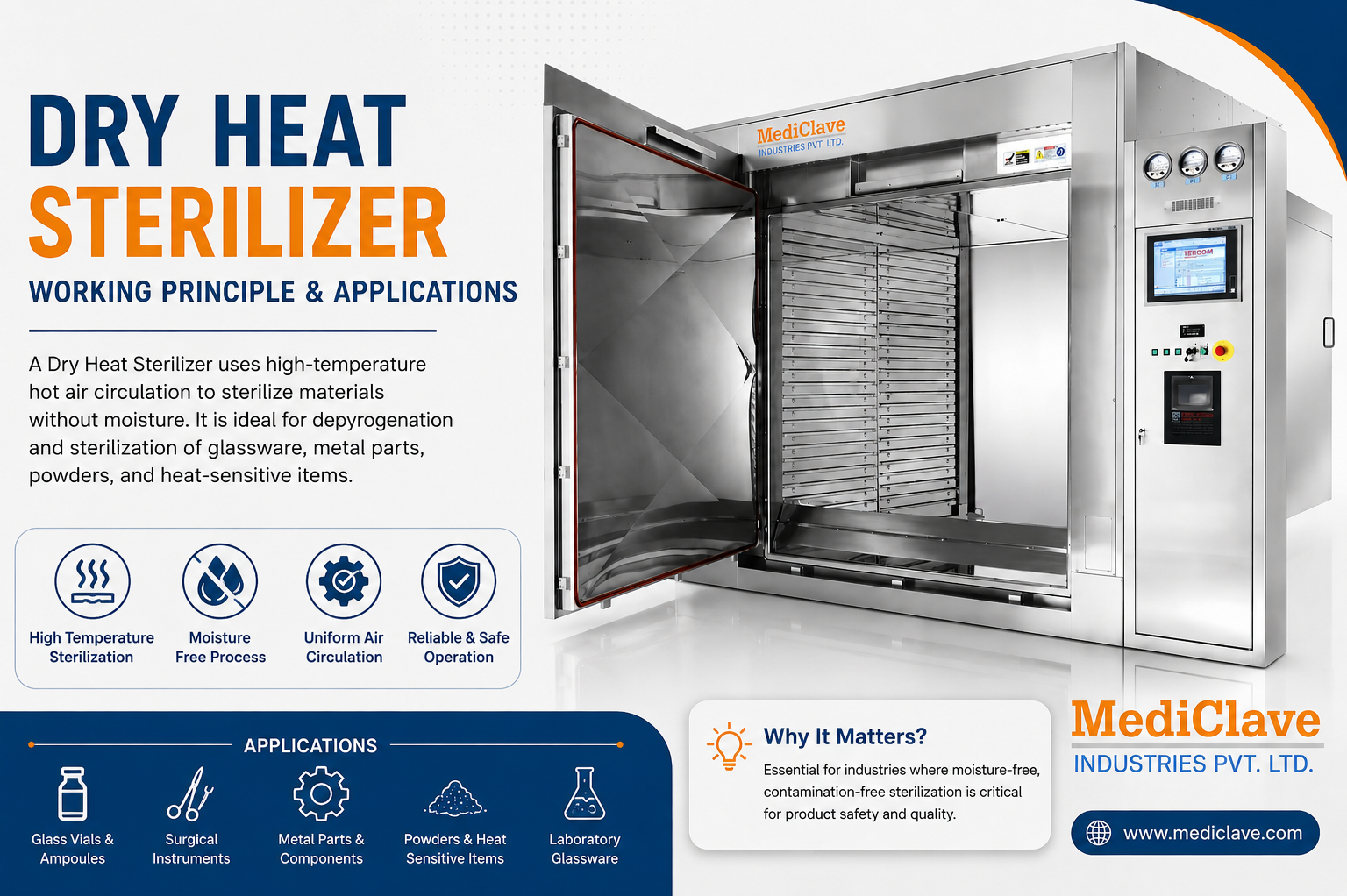
Learn how a Dry Heat Sterilizer works, its applications, advantages, validation requirements, and importance in pharmaceutical manufacturing.
Introduction
Sterilization is one of the most critical processes in pharmaceutical, healthcare, biotechnology, and laboratory industries. The effectiveness of sterilization directly impacts product quality, patient safety, and regulatory compliance. While steam sterilization is widely used, certain materials cannot tolerate moisture and require an alternative method. This is where a Dry Heat Sterilizer becomes essential.
A Dry Heat Sterilizer uses high-temperature hot air circulation to destroy microorganisms, bacterial spores, and contaminants without the use of moisture. It is particularly useful for sterilizing glassware, metal instruments, powders, oils, and heat-resistant materials.
In pharmaceutical manufacturing facilities, dry heat sterilization is often employed for depyrogenation processes where endotoxins must be removed from containers before filling operations.
What is a Dry Heat Sterilizer?
A Dry Heat Sterilizer is a specialized equipment designed to sterilize materials using heated air under controlled conditions. Unlike steam sterilization, which relies on moisture, dry heat sterilization kills microorganisms through oxidation and protein denaturation.
The process is suitable for materials that may be damaged by moisture or steam exposure.
Commonly sterilized items include:
- Glass vials
- Ampoules
- Stainless steel instruments
- Metal components
- Powders
- Oils
- Heat-resistant containers
Working Principle of Dry Heat Sterilizer
The sterilization process is based on the transfer of heat energy through convection and conduction.
Step 1: Heating Phase
Electric heaters generate thermal energy inside the chamber.
Step 2: Air Circulation
A blower system circulates hot air uniformly throughout the chamber.
Step 3: Sterilization Hold Time
The chamber maintains a predetermined temperature for a specific duration.
Typical cycles include:
| Temperature | Time |
|---|---|
| 160°C | 120 Minutes |
| 170°C | 60 Minutes |
| 180°C | 30 Minutes |
Step 4: Cooling Phase
Controlled cooling prevents thermal shock and protects sterilized materials.
Main Components
Sterilization Chamber
Provides a controlled environment.
Electric Heating System
Generates required temperatures.
Air Circulation Fan
Ensures uniform heat distribution.
HEPA Filtration System
Maintains contamination-free airflow.
Control System
Monitors process parameters.
Data Logger
Records cycle information for validation.
Applications of Dry Heat Sterilizer
Pharmaceutical Industry
- Glass vial sterilization
- Depyrogenation
- Metal component sterilization
Healthcare Sector
- Surgical instruments
- Medical devices
Biotechnology
- Laboratory glassware
- Research equipment
Chemical Industry
- Powder sterilization
- Heat-resistant materials
Advantages
Moisture-Free Sterilization
Suitable for moisture-sensitive products.
Endotoxin Reduction
Effective for depyrogenation applications.
Corrosion Prevention
No moisture means reduced corrosion risks.
Reliable Validation
Easy monitoring and documentation.
Regulatory Compliance
Supports GMP requirements.
Industry Standards
A pharmaceutical Dry Heat Sterilizer should comply with:
- GMP Guidelines
- FDA Requirements
- WHO Standards
- ISPE Recommendations
Reference:
How to Select the Right Dry Heat Sterilizer
Consider:
- Chamber size
- Temperature range
- Validation support
- Airflow uniformity
- Automation level
- Energy efficiency
Maintenance Tips
- Regular temperature mapping
- Filter replacement
- Calibration
- Sensor verification
- Chamber cleaning
Frequently Asked Questions
What is dry heat sterilization?
A process using hot air to eliminate microorganisms.
Why is it used in pharmaceuticals?
For sterilizing moisture-sensitive materials and depyrogenation.
Is it suitable for glassware?
Yes, it is one of the most common applications.
Can it remove endotoxins?
Yes, when operated under validated depyrogenation conditions.
Conclusion
Dry Heat Sterilizers play a vital role in pharmaceutical and healthcare industries by providing reliable moisture-free sterilization. Their ability to sterilize glassware, metal instruments, and heat-resistant materials while supporting depyrogenation processes makes them indispensable for modern manufacturing facilities.