

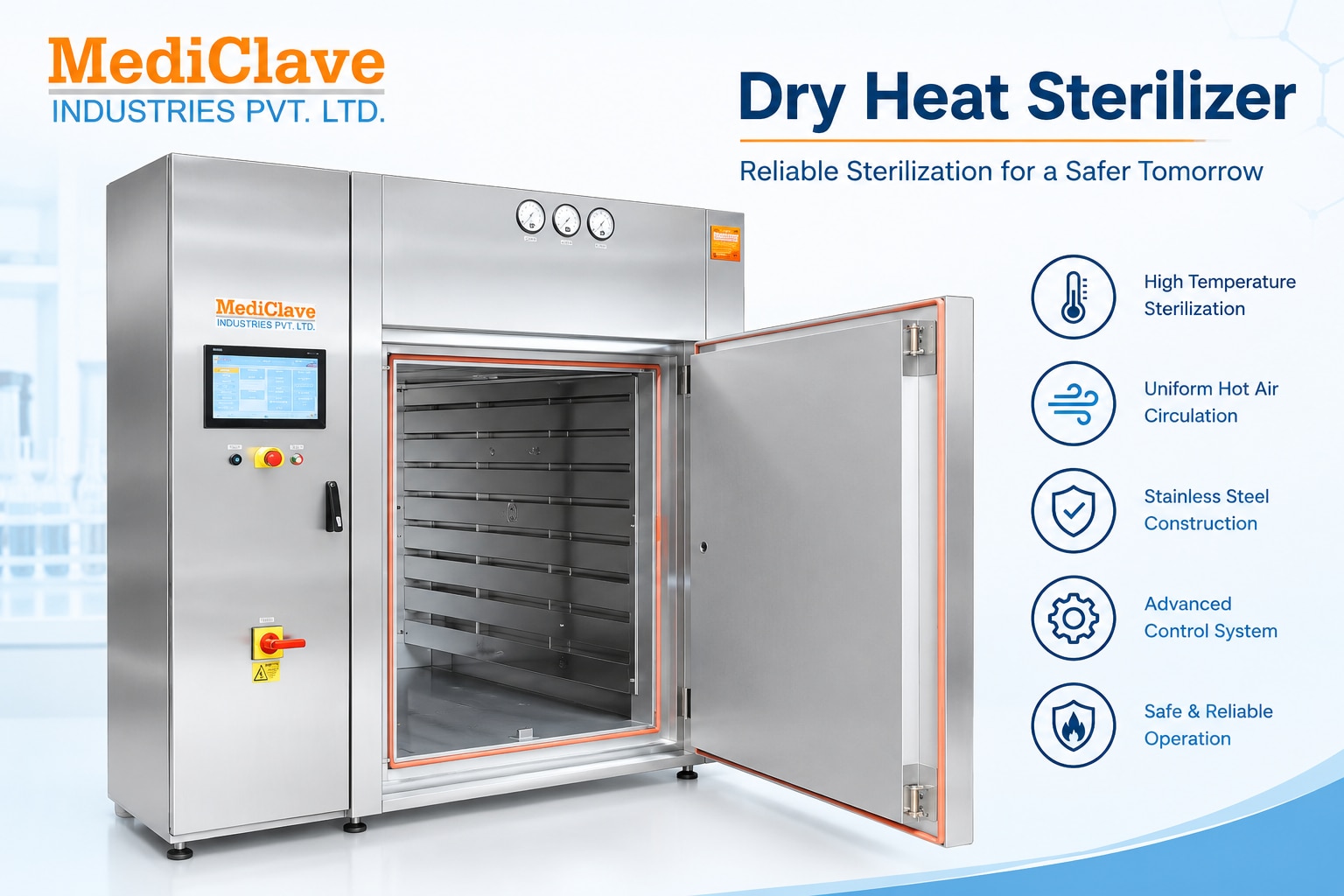
Why a Dry Heat Sterilizer Is Essential for Reliable Sterilization
Sterilization is one of the most important processes in pharmaceutical manufacturing, laboratories, hospitals, and research facilities. Proper sterilization helps eliminate microorganisms and protects products, equipment, containers, and materials from contamination. Among the different sterilization technologies available today, the Dry Heat Sterilizer is widely used for materials that require high-temperature sterilization without moisture.
A Dry Heat Sterilizer uses controlled hot air to destroy microorganisms through oxidation and thermal damage. Its simple operating principle, reliable performance, and suitability for moisture-sensitive materials make it an important piece of equipment for pharmaceutical and laboratory applications.
What Is a Dry Heat Sterilizer?
A Dry Heat Sterilizer is a sterilization system designed to expose products or equipment to high-temperature dry air for a controlled period. Unlike steam sterilization, this process does not use water or saturated steam.
The equipment generally consists of a well-insulated sterilization chamber, heating elements, air circulation arrangements, temperature sensors, control systems, and safety features. Depending on the application and capacity, the sterilizer can be designed in different configurations and sizes.
The controlled circulation of hot air helps maintain a uniform temperature throughout the chamber, ensuring consistent sterilization conditions.
Why Is Dry Heat Sterilization Important?
Some pharmaceutical and laboratory materials cannot be effectively sterilized using steam because moisture may damage them or affect their quality. Dry heat sterilization provides an alternative method for these applications.
It is particularly useful when the material needs:
High-temperature treatment
Moisture-free sterilization
Controlled heating
Uniform temperature distribution
Reproducible sterilization cycles
Dry heat sterilization can also be used for depyrogenation applications when the process is appropriately validated and qualified.
How Does a Dry Heat Sterilizer Work?
The working principle of a Dry Heat Sterilizer is relatively straightforward.
First, the material to be sterilized is properly loaded into the chamber. The chamber is then closed, and the programmed sterilization cycle begins. Heating elements increase the chamber temperature while the air circulation system distributes heated air throughout the chamber.
Temperature sensors continuously monitor the process. The control system maintains the required temperature for the programmed holding time. After completion of the sterilization phase, the equipment proceeds through the programmed cooling or other cycle stages, depending on the system design.
The effectiveness of the process depends on factors such as temperature, exposure time, airflow, load configuration, and proper validation.
Key Features of a Modern Dry Heat Sterilizer
A professionally designed Dry Heat Sterilizer can include several features intended to improve safety, efficiency, and process consistency.
1. Stainless Steel Construction
The sterilization chamber is commonly manufactured from stainless steel to provide durability, corrosion resistance, and ease of cleaning.
2. Uniform Temperature Distribution
An effective air circulation system helps distribute heated air throughout the chamber and minimizes temperature variation.
3. Digital Temperature Control
Modern control systems allow operators to set and monitor sterilization parameters accurately.
4. Temperature Monitoring
Multiple temperature sensors or probes can be incorporated for process monitoring and validation.
5. Programmable Cycles
Depending on the model, operators can use programmable recipes for different sterilization requirements.
6. Safety Systems
Door interlocks, alarms, over-temperature protection, and other safety mechanisms can help reduce operational risks.
Applications of Dry Heat Sterilizers
Dry Heat Sterilizers are used across a variety of industries and applications.
Pharmaceutical Industry
Pharmaceutical manufacturers use dry heat systems for suitable glassware, containers, metal components, instruments, and other heat-resistant materials. They can also be incorporated into controlled manufacturing processes where validated dry heat treatment is required.
Laboratories
Research and testing laboratories may use dry heat sterilizers for suitable laboratory equipment and heat-resistant materials.
Healthcare Applications
Certain medical and laboratory instruments that are compatible with dry heat can be processed using this technology, subject to the applicable sterilization requirements.
Glassware and Containers
Dry heat is particularly useful for suitable glass containers and other moisture-sensitive materials where high-temperature dry processing is preferred.
Dry Heat Sterilizer vs. Steam Sterilizer
Both technologies are used for sterilization, but they work differently.
A steam sterilizer, commonly known as an autoclave, uses moist heat under pressure. It is highly effective for many heat- and moisture-resistant materials.
A Dry Heat Sterilizer uses hot air without steam. It is therefore better suited to applications where moisture is undesirable.
The selection between these technologies should be based on the material, product requirements, validated process parameters, and applicable industry standards.
Benefits of Using a Dry Heat Sterilizer
A properly designed and validated system can provide several advantages:
Moisture-free sterilization
Suitable for heat-resistant materials
Controlled temperature and exposure time
Uniform hot-air circulation
Easy monitoring of process parameters
Robust stainless-steel construction
Programmable operation on advanced models
Suitable for pharmaceutical and laboratory applications
The actual performance of a sterilizer depends on its design, installation, operation, maintenance, and validation.
Why Choose the Right Manufacturer?
Selecting the right manufacturer is important when purchasing pharmaceutical or laboratory sterilization equipment. The sterilizer should be selected according to chamber capacity, load type, operating temperature, cycle requirements, automation level, construction materials, control system, and validation requirements.
A reliable manufacturer can also provide support for installation, commissioning, qualification, maintenance, and operator training.
For pharmaceutical and industrial sterilization equipment, you can explore solutions from Mediclave Industries Pvt. Ltd. at Mediclave Industries.
Frequently Asked Questions
1. What is a Dry Heat Sterilizer?
A Dry Heat Sterilizer is equipment that uses controlled high-temperature dry air to sterilize suitable heat-resistant materials without using steam or moisture.
2. What materials can be sterilized using dry heat?
Suitable glassware, metal components, instruments, containers, and other heat-resistant materials can be processed, depending on the validated application.
3. What is the difference between dry heat and steam sterilization?
Dry heat uses hot air, while steam sterilization uses moist heat, typically under pressure. The appropriate method depends on the material and sterilization requirements.
4. Is a Dry Heat Sterilizer suitable for pharmaceutical manufacturing?
Yes. Dry heat systems are widely used for suitable pharmaceutical manufacturing applications, particularly where moisture-free processing or high-temperature treatment is required.
5. Why is temperature uniformity important?
Uniform temperature distribution helps ensure that all parts of the load receive the required thermal exposure during the sterilization cycle.
Conclusion
A Dry Heat Sterilizer is an important sterilization solution for pharmaceutical, laboratory, healthcare, and research applications where controlled high-temperature dry processing is required. Its ability to sterilize suitable heat-resistant materials without moisture makes it a valuable alternative to steam-based sterilization.
Choosing a properly designed system with reliable temperature control, uniform air circulation, safety features, and appropriate monitoring capabilities can help support consistent and efficient sterilization operations. Most importantly, sterilization cycles should be properly developed, validated, and monitored according to the intended application and applicable standards.
