

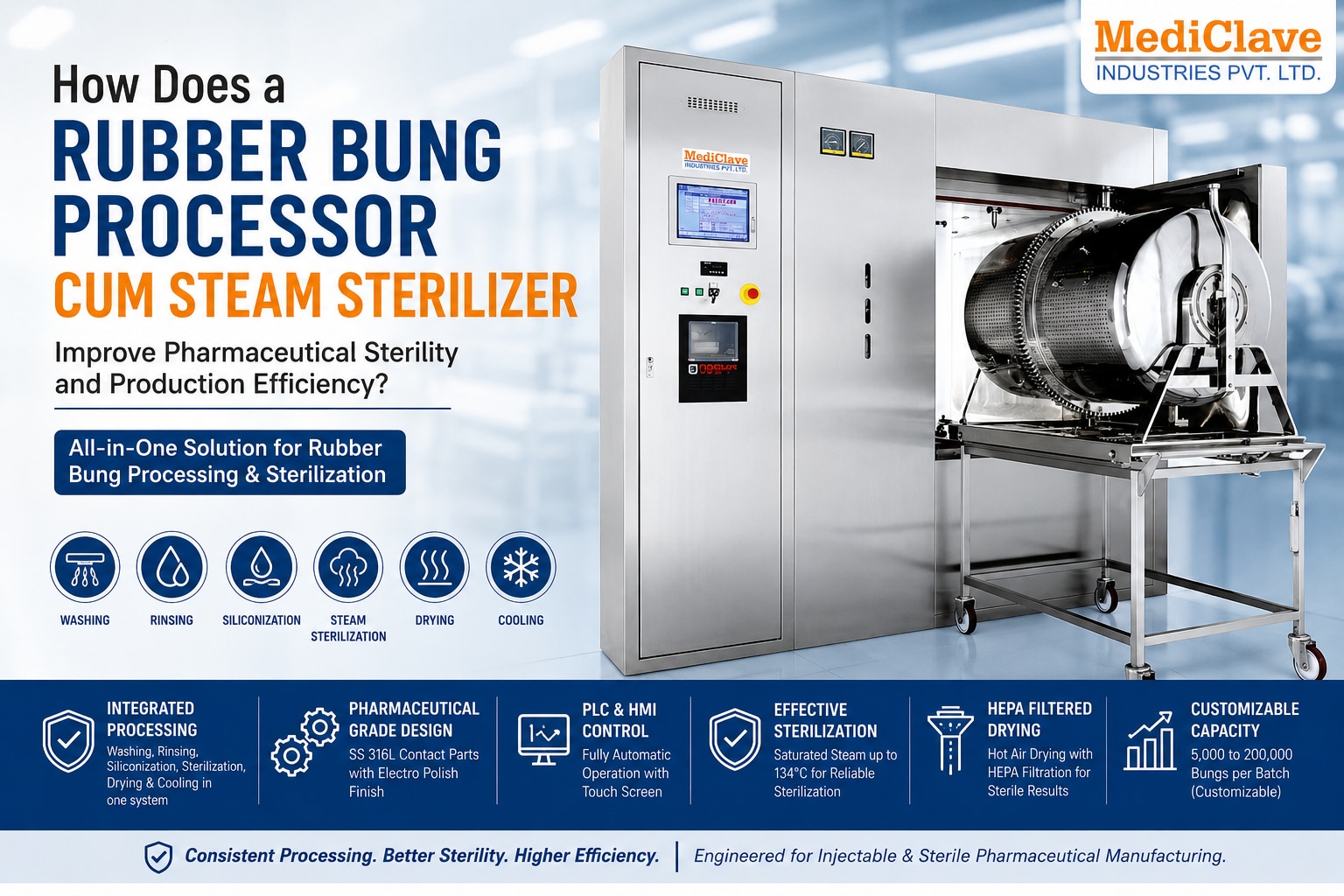
How Does a Rubber Bung Processor Cum Steam Sterilizer Improve Pharmaceutical
Sterility and Production Efficiency?
In pharmaceutical manufacturing, especially in injectable and sterile drug production, even a small amount of contamination can create serious quality and safety concerns. Every component that comes into contact with a sterile product must therefore be properly cleaned, processed, sterilized, and prepared before it enters the aseptic manufacturing area. Rubber bungs, rubber stoppers, and elastomeric closures are among the most important components in this process because they form a protective barrier between the pharmaceutical product and the external environment.
This is where a Rubber Bung Processor Cum Steam Sterilizer becomes an important part of a modern pharmaceutical manufacturing facility. Instead of depending on separate equipment and multiple manual handling steps, this integrated system can combine washing, rinsing, siliconization, steam sterilization, drying, and other processing stages within a controlled system. Mediclave Industries offers this equipment for pharmaceutical, biotechnology, and injectable manufacturing applications, with customizable configurations according to production requirements.
Explore the Rubber Bung Processor Cum Steam Sterilizer by Mediclave Industries
Why Is a Rubber Bung Processor Cum Steam Sterilizer?
A Rubber Bung Processor Cum Steam Sterilizer is a specialized pharmaceutical processing machine designed to prepare rubber closures used in sterile drug manufacturing. The equipment integrates several important operations into one controlled processing cycle.
Depending on the selected configuration, the process may include pre-washing, multiple washing stages, rinsing with purified water or Water for Injection, siliconization, saturated steam sterilization, drying, and cooling. This integrated approach reduces unnecessary handling and helps manufacturers maintain better control over the condition of rubber closures before they are transferred to aseptic filling operations.
The basic processing sequence can be understood as:
Washing → Rinsing → Siliconization → Sterilization → Drying → Cooling
Instead of moving rubber bungs manually from one machine or processing station to another, the closures can be processed in a controlled environment. This can help reduce handling-related contamination risks while improving repeatability from batch to batch.
For pharmaceutical manufacturers, this is particularly valuable because rubber closures may come into direct or indirect contact with sterile pharmaceutical products. A well-designed processing system therefore needs to address not only sterilization but also cleaning, uniform processing, drying, and controlled transfer.
Why Is Rubber Bung Processing So Important in Injectable Manufacturing?
Rubber closures may appear to be small components, but they have an important role in maintaining the integrity of injectable pharmaceutical products. After an injectable vial is filled, the rubber stopper helps protect the product from environmental contamination.
If a closure is not adequately cleaned or sterilized, contaminants may potentially compromise the quality of the finished product. Pharmaceutical manufacturers therefore need a controlled process for preparing closures before they are used.
Traditional manual processing can involve several individual steps. Each additional handling stage may increase the possibility of variation or contamination. An integrated Rubber Bung Processor Cum Steam Sterilizer helps address this challenge by bringing several critical processing operations together.
The objective is not simply to expose rubber bungs to steam. Effective processing should begin with proper cleaning and continue through rinsing, siliconization, sterilization, drying, and controlled preparation for the next manufacturing stage.
This makes the equipment particularly useful for pharmaceutical plants producing injectable medicines, vaccines, biotechnology products, and other sterile formulations.
How Does a Rubber Bung Processor Cum Steam Sterilizer Work?
The working principle can vary according to the machine design, rubber closure specification, production requirement, and validated process cycle. However, the overall operation can be understood through several important stages.
1. Loading of Rubber Bungs
The first stage involves loading the required quantity of rubber bungs or closures into the designated processing basket, drum, or loading arrangement.
The loading configuration should provide sufficient movement and exposure of the closures so that cleaning and sterilization can take place uniformly. Mediclave's system can be configured for manual or automatic loading and unloading, depending on the customer's requirements.
For high-volume pharmaceutical production, appropriate loading arrangements can be particularly important because they influence batch capacity, handling time, and overall production efficiency.
2. Washing
The washing stage removes visible and process-related contaminants from the rubber closures.
A modern processor can use multi-stage washing with spray nozzles to ensure that the surfaces of the closures receive adequate cleaning. Proper washing is essential because sterilization should not be treated as a substitute for cleaning.
Removing contaminants before sterilization helps establish a more controlled processing environment and supports consistent downstream operations.
3. Rinsing
After washing, the rubber bungs can undergo multiple rinsing stages. Pharmaceutical-grade processing may use purified water or Water for Injection, depending on the validated process and application.
The purpose of rinsing is to remove residual cleaning agents and other unwanted substances while preparing the closures for subsequent processing.
For sterile pharmaceutical applications, water quality is an important consideration. This is one reason why a complete pharmaceutical manufacturing setup often includes dedicated water-generation and purification systems.
4. Siliconization
Siliconization is another important stage in rubber closure processing.
A controlled silicone coating can improve the handling characteristics of rubber closures and support smoother interaction with filling and sealing equipment. Uniform siliconization is important because excessive or insufficient coating may affect processing performance.
An automated dosing and coating arrangement can provide more consistent application than highly manual methods. Mediclave's Rubber Bung Processor Cum Steam Sterilizer can incorporate automatic siliconization for uniform processing.
5. Steam Sterilization
Following cleaning and siliconization, the rubber bungs undergo sterilization using saturated steam.
Steam sterilization is widely used in pharmaceutical manufacturing because properly controlled saturated steam can provide effective microbial inactivation. Mediclave's Rubber Bung Processor Cum Steam Sterilizer is designed for saturated steam sterilization, with operating temperatures listed in the range of approximately 121°C to 134°C, depending on the selected process and configuration.
The actual sterilization cycle should always be established and validated according to the specific rubber closure, load configuration, equipment design, and applicable pharmaceutical requirements.
6. Drying
After sterilization, drying is necessary so that processed closures can be prepared for further sterile manufacturing operations.
Mediclave's system can incorporate hot-air drying with HEPA filtration. Proper drying helps prevent residual moisture from interfering with subsequent handling and filling processes.
A controlled drying stage can therefore be just as important as washing and sterilization when the objective is to deliver closures in a ready-to-use condition.
7. Cooling and Unloading
Once the required processing cycle is complete, the rubber bungs may undergo controlled cooling before unloading.
The final objective is to obtain processed closures that are suitable for transfer to the next stage of sterile manufacturing while minimizing unnecessary exposure and manual intervention.
What Are the Major Features of a Modern Rubber Bung Processor?
A pharmaceutical manufacturer should evaluate the equipment according to its complete processing capability rather than focusing only on chamber size or sterilization temperature.
Mediclave's Rubber Bung Processor Cum Steam Sterilizer can be configured with several features intended for pharmaceutical processing applications. These include stainless-steel construction, multi-stage washing, purified-water or WFI rinsing, automatic siliconization, saturated steam sterilization, HEPA-filtered drying, PLC-based control, HMI operation, and customizable batch capacities.
Stainless-Steel Construction
Product-contact components can be manufactured using SS 316L, while the outer body can use SS 304. The internal surfaces can also be electropolished to achieve a smooth finish suitable for hygienic pharmaceutical applications.
Material selection is important because pharmaceutical equipment must withstand repeated cleaning, washing, sterilization, and production cycles.
PLC and HMI-Based Control
Automation provides operators with a centralized way to monitor and control processing parameters.
A PLC-based control system with an HMI touchscreen can help manage different stages of the processing cycle and reduce unnecessary manual intervention. Automated operation can also improve repeatability when validated recipes and process parameters are used.
Integrated Processing
One of the biggest advantages of the system is its integrated design.
Instead of requiring separate machines for every processing stage, manufacturers can perform several operations within one coordinated system. This can simplify material movement, reduce manual handling, and improve process flow.
Customizable Capacity
Production requirements vary significantly between pharmaceutical manufacturers. A small development facility may need a different capacity from a large-scale injectable manufacturing plant.
Mediclave lists customizable batch capacities ranging from approximately 5,000 to 200,000 bungs per batch, depending on configuration.
This flexibility can make it easier for manufacturers to select a machine according to present production requirements and future expansion plans.
How Does Automation Improve Rubber Bung Processing?
Automation can have a major impact on pharmaceutical manufacturing because consistent processing is difficult to maintain when too many steps depend on manual operation.
A fully automatic processor can coordinate washing, rinsing, siliconization, sterilization, drying, and other stages according to programmed process requirements. This reduces the amount of operator intervention needed between stages.
Automation can also help improve batch-to-batch consistency. When process parameters are controlled electronically, operators are less dependent on manual timing and repetitive actions.
Another advantage is process monitoring. A PLC-HMI system can provide information about operating conditions and help operators identify alarms or deviations during a cycle.
However, automation should not be considered a replacement for validation. Pharmaceutical equipment still needs appropriate qualification, process validation, maintenance, calibration, and documented operating procedures.
What Role Does Steam Quality Play in Sterilization?
Steam quality is extremely important in pharmaceutical sterilization.
For applications where steam comes into contact with pharmaceutical equipment, components, or critical surfaces, manufacturers must carefully consider the quality and source of steam. Ordinary industrial steam may not always be suitable for direct pharmaceutical sterilization applications.
This is where a dedicated Pure Steam Generator can become an important part of a broader pharmaceutical utility system. A Pure Steam Generator is designed to produce high-purity steam from suitable feed water for applications such as sterilization and SIP.
Explore Mediclave's Pure Steam Generator solutions
A properly designed pure-steam system can support sterilization applications where steam quality is critical. The Rubber Bung Processor and Pure Steam Generator can therefore form part of a larger integrated pharmaceutical production infrastructure.
How Does the Rubber Bung Processor Fit Into a Larger Pharmaceutical System?
A sterile pharmaceutical manufacturing facility rarely depends on one machine alone.
The rubber bung processing system may work alongside water systems, clean utilities, manufacturing vessels, filling equipment, sterilizers, and cleaning systems.
For example, pharmaceutical process equipment may require regular cleaning and sterilization without extensive dismantling. In such cases, a CIP & SIP System can provide automated Clean-In-Place and Sterilize-In-Place capabilities for tanks, pipelines, vessels, and related equipment.
Explore Mediclave's CIP & SIP System
Similarly, a pharmaceutical facility may need high-purity water for manufacturing and cleaning operations. A Multi Column Distillation Plant can be considered when Water for Injection and high-purity pharmaceutical water production is required.
Explore Mediclave's Multi Column Distillation Plant solutions
Together, these systems can contribute to a more coordinated pharmaceutical manufacturing environment in which process equipment, water quality, steam quality, cleaning, and sterilization are considered as interconnected requirements.
What Are the Main Benefits of Using a Rubber Bung Processor Cum Steam Sterilizer?
The benefits extend beyond sterilization itself.
Reduced Manual Handling: Integrating several operations into one system can reduce the number of times rubber closures need to be manually transferred between processing stages.
Better Process Consistency: Automated control can help maintain repeatable processing conditions from one batch to another.
Integrated Washing and Sterilization: Cleaning and sterilization are performed as connected stages rather than treating sterilization as an isolated operation.
Controlled Siliconization: Automated siliconization can help achieve more uniform coating.
Efficient Drying: HEPA-filtered hot-air drying can help prepare closures for subsequent sterile operations.
Improved Production Efficiency: Automated processing can reduce repetitive operator tasks and streamline material movement.
Reduced Contamination Risk: Less manual intervention can support better contamination control.
Scalable Production: Customizable batch capacities can accommodate different production requirements.
Pharmaceutical-Grade Construction: Stainless-steel product-contact surfaces and hygienic design can support demanding pharmaceutical environments.
Process Monitoring: PLC and HMI controls can provide centralized operation and monitoring.
These benefits make the equipment particularly attractive to manufacturers that are looking to improve process integration while maintaining strict quality expectations.
What Should You Consider Before Buying a Rubber Bung Processor?
Choosing the right machine requires more than comparing prices.
First, consider the required batch capacity. The equipment should be able to process your current production volume without creating unnecessary bottlenecks.
Next, evaluate the rubber closure type and dimensions. Different stopper designs may require different processing arrangements, loading systems, agitation methods, and cycle parameters.
The washing system should also be carefully reviewed. Ask how many washing stages are provided, how spray distribution is achieved, and what type of water is used.
The siliconization system deserves attention as well. Consistent dosing and distribution are important for repeatable processing.
Manufacturers should also evaluate the sterilization cycle, including temperature, pressure, exposure time, steam distribution, and load configuration.
Another important area is drying performance. The equipment should be capable of delivering the required drying conditions without compromising the processed closures.
The control system is equally important. PLC and HMI-based automation can simplify operation, but pharmaceutical manufacturers may also require data recording, alarms, recipe management, audit trails, SCADA integration, or other documentation features depending on the application.
Finally, consider validation and after-sales support. Equipment used in regulated pharmaceutical environments may require documentation and support for installation, operational qualification, performance qualification, calibration, and process validation.
Who Can Benefit From This Equipment?
A Rubber Bung Processor Cum Steam Sterilizer is particularly relevant to organizations involved in sterile pharmaceutical manufacturing.
Typical applications include:
Injectable pharmaceutical manufacturing plants
Vaccine manufacturing facilities
Biotechnology companies
Sterile formulation facilities
Pharmaceutical research and development facilities
Contract manufacturing organizations
Facilities processing rubber stoppers and elastomeric closures
Aseptic filling operations
The equipment can be particularly valuable where large quantities of rubber closures need to be consistently cleaned, siliconized, sterilized, dried, and prepared for sterile filling operations.
Why Choose Mediclave Industries for Pharmaceutical Sterilization Equipment?
Selecting pharmaceutical processing equipment is an important investment, and manufacturers should look for a supplier capable of understanding the complete application rather than supplying only a standard machine.
Mediclave Industries provides pharmaceutical sterilization, process equipment, and water-system solutions, including Rubber Bung Processor Cum Steam Sterilizers, Pure Steam Generators, CIP & SIP Systems, and other pharmaceutical manufacturing equipment.
The company's Rubber Bung Processor Cum Steam Sterilizer can be customized with horizontal cylindrical or rectangular chamber configurations, different loading arrangements, automated controls, and production capacities according to application requirements.
This approach allows pharmaceutical manufacturers to consider the machine as part of their overall process instead of purchasing an isolated sterilization unit.
Conclusion: How Can the Right Rubber Bung Processor Strengthen Sterile Manufacturing?
Rubber closures are a small but critical part of injectable and sterile pharmaceutical manufacturing. Their condition directly affects the protection of the finished pharmaceutical product, making proper washing, rinsing, siliconization, sterilization, drying, and handling essential.
A Rubber Bung Processor Cum Steam Sterilizer brings these important operations together in a controlled and automated system. By reducing manual handling, supporting consistent processing, and integrating multiple stages into one machine, it can help pharmaceutical manufacturers improve efficiency while strengthening contamination-control practices.
The right equipment should be selected according to batch capacity, rubber stopper specifications, washing requirements, siliconization needs, sterilization parameters, drying requirements, automation level, validation expectations, and overall plant utilities.
For manufacturers planning a new sterile facility or upgrading an existing production line, it is also useful to evaluate supporting systems such as a Pure Steam Generator, CIP & SIP System, and pharmaceutical water-generation equipment. A coordinated approach can help create a more efficient and controlled manufacturing environment.
Mediclave Industries can help pharmaceutical manufacturers evaluate suitable configurations based on their production capacity and process requirements. For customized requirements, technical specifications, and quotations, contact Mediclave Industries Pvt. Ltd.
Mediclave Industries Pvt. Ltd.
Email: info@mediclaveindustries.com
Phone: 08042755106
Location: Ahmedabad, India
When sterile manufacturing depends on reliable component preparation, investing in the right processing technology is not simply about purchasing equipment—it is about building a controlled, repeatable, and efficient pharmaceutical production process.
