

How Does an Ointment, Gel & Toothpaste Manufacturing Plant Improve Modern
Pharmaceutical Production?
In pharmaceutical, cosmetic, personal care, and healthcare manufacturing, product quality depends on much more than the ingredients used. The way those ingredients are mixed, heated, homogenized, emulsified, cooled, transferred, and stored can have a major effect on the final product. This is especially true for semi-solid products such as ointments, gels, creams, and toothpaste, where texture, consistency, stability, appearance, and hygiene are critical.
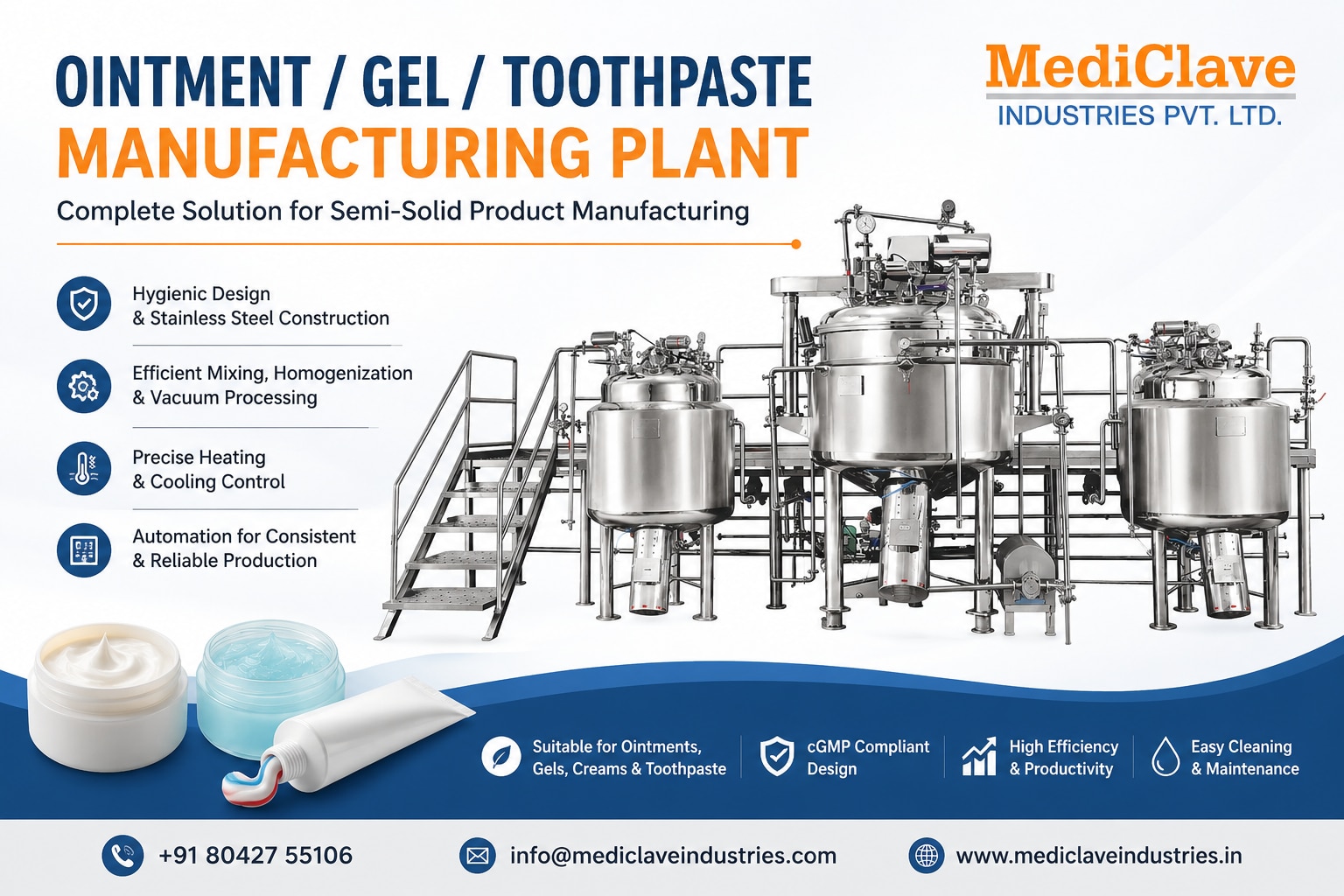
An Ointment/Gel/Toothpaste Manufacturing Plant is designed to bring these important processing steps together in one controlled manufacturing system. Instead of depending on separate manual operations, modern plants can combine manufacturing vessels, agitators, homogenizers, vacuum systems, heating and cooling arrangements, transfer systems, and automation to create a more consistent and efficient production process.
Mediclave Industries Pvt. Ltd. develops pharmaceutical process equipment for manufacturers looking for reliable and hygienic production solutions. Its Ointment/Cream/Tooth Paste/Gel Manufacturing Plant is designed for applications where controlled processing, uniformity, hygienic construction, and efficient production are important.
Understanding the Ointment/Gel/Toothpaste Manufacturing Plant
An Ointment/Gel/Toothpaste Manufacturing Plant is a complete processing solution used to manufacture different types of semi-solid formulations. Depending on the product and production requirement, the system can be configured for pharmaceutical ointments, dermatological creams, topical gels, toothpaste, cosmetic creams, lotions, herbal products, and other similar formulations.
The main purpose of the plant is to provide controlled processing conditions throughout the batch. Ingredients must be combined properly, heated or cooled to the required temperature, homogenized to achieve the desired consistency, and processed without unnecessary contamination or air entrapment.
A modern system may include a manufacturing vessel, anchor agitator, high-speed homogenizer, vacuum system, heating and cooling arrangement, storage vessel, transfer pump, sanitary pipelines, control panel, and other accessories according to the application.
The exact configuration depends on factors such as formulation characteristics, batch size, viscosity, production capacity, required automation, temperature requirements, cleaning method, and filling arrangement.
Why Are Ointments, Gels and Toothpaste Difficult to Manufacture?
At first glance, producing an ointment, gel, or toothpaste may appear to be a simple mixing process. In reality, semi-solid manufacturing can involve several carefully controlled stages.
A formulation may contain oils, water, active pharmaceutical ingredients, emulsifiers, thickeners, preservatives, powders, fragrances, sweeteners, abrasives, or other ingredients. These materials may have very different physical properties.
Some ingredients need to be dissolved before being added. Others need controlled dispersion. Certain products require emulsification, while others need high-shear homogenization. Temperature can also affect viscosity and stability.
For example, if mixing is inadequate, the final product may contain lumps or unevenly distributed ingredients. If air becomes trapped during processing, the appearance and filling performance may be affected. If temperature is not properly controlled, the formulation may not develop the required consistency.
This is why a properly engineered manufacturing plant is important.
How Does the Manufacturing Process Work?
Although the exact process differs according to the formulation, an ointment, gel, or toothpaste manufacturing operation generally follows a controlled sequence.
1. Preparation of Raw Materials
The first stage is preparation and weighing of the raw materials according to the approved formulation. Ingredients are normally checked and prepared before entering the manufacturing vessel.
Correct weighing and controlled addition are essential because even small variations can influence the final product.
2. Charging of Ingredients
The prepared ingredients are charged into the appropriate manufacturing vessel. The sequence of addition depends on the formulation.
Some products require water-phase preparation, while others require an oil phase or separate premixing of powders and active ingredients.
3. Heating and Mixing
Heating may be required to dissolve or melt certain ingredients. The vessel's heating arrangement helps maintain controlled process temperatures.
At the same time, an agitator keeps the material moving and supports uniform heat distribution.
Controlled heating is particularly important for formulations where excessive temperature could affect ingredients or product characteristics.
4. Emulsification and Homogenization
For many creams and ointments, emulsification is a key step. Two phases that normally do not mix easily must be combined into a stable formulation.
A high-speed homogenizer can help reduce particle or droplet size and improve product uniformity. Homogenization can contribute to a smoother and more consistent final product.
Mediclave's manufacturing plant designs can incorporate homogenization systems according to the formulation and production requirements.
5. Vacuum Processing
Vacuum processing is another important feature in modern semi-solid manufacturing.
During mixing and homogenization, air can become trapped in the product. Excessive air may affect appearance, texture, density, filling, and product stability.
A vacuum system can help reduce entrapped air during processing. It can also support the production of smooth and uniform semi-solid formulations.
This is particularly useful for products where a clean appearance and consistent texture are important.
6. Cooling
After heating and homogenization, the product may need to be cooled under controlled conditions.
Cooling is not simply about reducing temperature. The cooling profile can influence the final structure, viscosity, and texture of the formulation.
A controlled heating and cooling system therefore gives manufacturers greater control over the manufacturing process.
7. Final Mixing and Product Transfer
Once the formulation reaches the required condition, final mixing may be carried out before transfer.
The finished product can then be transferred through hygienic pipelines to a storage vessel or filling machine.
A well-designed transfer arrangement helps reduce unnecessary manual handling and supports a cleaner production workflow.
Key Components of an Ointment/Gel/Toothpaste Manufacturing Plant
A manufacturing plant can be customized according to the product and production capacity. Common components may include:
Manufacturing Vessel:
The main vessel where ingredients are processed. It can be designed with suitable agitation, heating, cooling, and hygienic features.
Anchor Agitator:
An anchor-type agitator is commonly used for semi-solid and viscous products. It helps maintain product movement and supports uniform mixing.
High-Speed Homogenizer:
The homogenizer helps achieve a more uniform product by providing high-shear mixing where required.
Vacuum System:
The vacuum system helps minimize air entrapment and supports smooth product processing.
Heating and Cooling System:
Controlled temperature management is important for melting, mixing, emulsification, and cooling operations.
Storage Vessel:
A separate storage vessel can be used to hold the finished formulation before filling or further processing.
Transfer Pump:
A suitable pump helps transfer viscous products efficiently while minimizing product loss and manual handling.
Control Panel and Automation:
Automation can help operators monitor and control important process parameters such as temperature, mixing, vacuum, and processing time.
The final configuration should always be selected according to the formulation, production scale, and manufacturing requirements rather than simply choosing the largest available system.
What Products Can Be Manufactured?
One of the biggest advantages of this type of plant is its flexibility.
Depending on the equipment configuration and validated manufacturing process, the system can be used for a wide variety of semi-solid products, including:
Pharmaceutical ointments
Dermatological creams
Antiseptic creams
Pain-relief ointments
Topical gels
Herbal gels
Cosmetic creams
Moisturizing creams
Lotions
Petroleum jelly
Personal care formulations
Toothpaste
Ayurvedic products
Other semi-solid pharmaceutical formulations
This flexibility makes the plant suitable for pharmaceutical companies as well as cosmetic, herbal, personal care, and contract manufacturing organizations.
Why Hygienic Design Matters
Hygiene is one of the most important considerations in pharmaceutical manufacturing.
The equipment comes into contact with the product, so the design should support effective cleaning and minimize areas where product residues can accumulate.
Pharmaceutical processing equipment commonly uses stainless-steel construction and sanitary product-contact arrangements. The actual material grade, surface finish, welding quality, fittings, valves, and piping design should be selected according to the application and applicable manufacturing requirements.
A hygienic design can make cleaning easier, reduce contamination risks, and support consistent production.
For facilities that require automated cleaning and sterilization, the manufacturing system can also be considered alongside a dedicated CIP & SIP System. CIP, or Clean-In-Place, allows equipment to be cleaned without extensive dismantling, while SIP, or Sterilize-In-Place, can support steam-based sterilization where appropriate.
How Automation Improves Production
Automation has become increasingly important in modern pharmaceutical manufacturing.
In a manually operated system, operators may need to monitor several process parameters continuously. This can increase the possibility of variations between batches.
An automated system can help control and record important parameters such as:
Mixing speed
Product temperature
Heating time
Cooling time
Vacuum level
Homogenization time
Processing sequence
Batch duration
PLC and HMI-based controls can provide a more organized way to operate the equipment.
Automation does not replace the need for trained operators and proper procedures. Instead, it provides better process control and repeatability when correctly designed, commissioned, operated, and maintained.
The Importance of Vacuum Homogenization
Vacuum homogenization deserves special attention because it combines several important processing functions.
In semi-solid manufacturing, manufacturers often want a smooth, uniform product with minimal air entrapment. A vacuum homogenizing system can support these objectives by combining controlled mixing, homogenization, and vacuum processing.
For creams and ointments, this can be especially valuable because the final product often needs to have a consistent texture and appearance.
For toothpaste, effective mixing and dispersion are equally important because the formulation may contain abrasive materials, humectants, binders, flavors, sweeteners, and other components.
The precise processing parameters should always be established according to the specific formulation rather than assuming one set of conditions will work for every product.
Integration With Other Pharmaceutical Systems
An Ointment/Gel/Toothpaste Manufacturing Plant is often only one part of a larger manufacturing facility.
Modern pharmaceutical plants may integrate process equipment with purified water, cleaning, sterilization, storage, and transfer systems.
For facilities with demanding pharmaceutical water requirements, a Multi Column Distillation Plant can be used as part of a pharmaceutical water system for producing high-purity Water for Injection.
Similarly, a Pure Steam Generator can support pharmaceutical steam requirements for suitable sterilization and SIP applications.
A WFI Storage & Distribution System can also form part of a complete pharmaceutical water infrastructure, helping store and distribute WFI hygienically throughout the facility.
The advantage of considering these systems together is that the overall manufacturing workflow can be planned from the beginning. Equipment capacity, piping, utilities, cleaning requirements, and future expansion can be considered as one integrated project.
Benefits of Using a Modern Manufacturing Plant
Investing in a properly designed manufacturing plant can provide several operational advantages.
Consistent Product Quality:
Controlled mixing, temperature, homogenization, and vacuum processing can help improve batch-to-batch consistency.
Improved Production Efficiency:
Integrated equipment reduces the need for multiple manual processing steps.
Better Hygiene:
Sanitary equipment design and appropriate cleaning systems can support better contamination control.
Reduced Manual Handling:
Automated processing and closed transfer arrangements can reduce unnecessary operator intervention.
Better Process Control:
PLC/HMI automation can provide improved control of important manufacturing parameters.
Flexible Production:
With the right configuration, one plant may support different formulations and product types.
Reduced Product Loss:
Proper transfer and vessel design can help minimize residual product and processing losses.
Scalability:
Manufacturers can select equipment based on current production requirements while considering future capacity needs.
Choosing the Right Manufacturing Plant
Selecting an Ointment/Gel/Toothpaste Manufacturing Plant should not be based on price alone.
Before purchasing, manufacturers should consider several important factors.
First, define the products that will be manufactured. An ointment, toothpaste, and gel may have very different viscosity and processing requirements.
Next, determine the required batch capacity and expected production volume. A plant designed for a small laboratory or pilot batch may not be appropriate for large-scale commercial production.
The type of agitator and homogenizer is also important. Mixing requirements depend heavily on viscosity, formulation, and desired product characteristics.
Manufacturers should also consider heating and cooling requirements, vacuum capability, automation level, cleaning method, material of construction, surface finish, utility requirements, and available installation space.
Documentation and after-sales support should also be evaluated. A reliable equipment manufacturer should be able to understand the process requirements and recommend an appropriate configuration instead of offering a one-size-fits-all machine.
Why Choose Mediclave Industries?
Mediclave Industries Pvt. Ltd. focuses on pharmaceutical, process, sterilization, and water-system equipment.
Its pharmaceutical process equipment portfolio includes solutions for different manufacturing applications, allowing customers to evaluate individual machines as well as integrated systems.
The company's Ointment/Cream/Tooth Paste/Gel Manufacturing Plant is intended for controlled production of semi-solid formulations and can be configured around manufacturing requirements such as mixing, homogenization, vacuum processing, heating, cooling, storage, transfer, and automation.
For a pharmaceutical manufacturer, this approach can be useful when developing a new production line or upgrading an existing facility.
The right equipment is not simply a machine that mixes ingredients. It should support the complete manufacturing objective: consistent batches, controlled processing, hygienic operation, efficient production, and practical maintenance.
Frequently Asked Questions
What is an Ointment/Gel/Toothpaste Manufacturing Plant?
It is a pharmaceutical process system designed for controlled manufacturing of semi-solid products such as ointments, gels, creams, and toothpaste. It can include mixing, homogenization, vacuum processing, heating, cooling, storage, and transfer systems.
Can the same plant manufacture ointment and gel?
A suitably configured plant may be used for multiple semi-solid formulations. However, compatibility depends on the formulation, viscosity, processing conditions, cleaning requirements, and equipment configuration.
Why is a homogenizer used?
A homogenizer provides high-shear mixing that can improve dispersion and uniformity. It is particularly useful for formulations requiring fine and consistent mixing.
What is the purpose of vacuum processing?
Vacuum processing can help reduce trapped air in the formulation and support smoother product appearance and consistency.
Is the plant suitable for toothpaste manufacturing?
Yes. Appropriately configured systems can be used for toothpaste manufacturing, subject to the formulation and process requirements.
Can the plant be automated?
Yes. Automation can be incorporated to control parameters such as temperature, mixing speed, vacuum, processing time, and other process functions.
Can CIP be integrated with the manufacturing plant?
Yes. Where appropriate, the manufacturing system can be integrated with a CIP system to support automated cleaning and reduce manual dismantling.
How do I select the correct batch capacity?
Batch capacity should be selected according to production demand, formulation characteristics, vessel working volume, expected future expansion, and filling requirements.
Conclusion
The demand for high-quality ointments, gels, toothpaste, creams, and other semi-solid formulations continues to grow across pharmaceutical, cosmetic, herbal, personal care, and healthcare markets. With this growth comes the need for manufacturing systems that provide better consistency, hygiene, process control, and production efficiency.
An Ointment/Gel/Toothpaste Manufacturing Plant brings critical operations such as mixing, heating, homogenization, vacuum processing, cooling, storage, and transfer into a controlled production environment. When correctly engineered for the formulation, it can help manufacturers improve batch consistency while reducing unnecessary manual intervention.
For larger pharmaceutical projects, the manufacturing plant can also be integrated with supporting systems such as CIP & SIP, pharmaceutical water systems, WFI storage and distribution, and pure steam generation.
Mediclave Industries Pvt. Ltd. provides pharmaceutical process and utility equipment designed around different manufacturing requirements. Whether you are establishing a new production facility, expanding capacity, or upgrading an existing manufacturing line, selecting the right equipment configuration is an important step toward efficient and reliable production.
To explore pharmaceutical process equipment and manufacturing solutions, visit Mediclave Industries and discuss your application, batch size, formulation, automation requirements, and project objectives with the equipment manufacturer.
