

What Makes a Liquid Syrup Manufacturing Process Plant Essential for Modern
Pharmaceutical Production?
The pharmaceutical industry is continuously growing, and the demand for safe, consistent, and high-quality liquid medicines is increasing with it. Products such as cough syrups, pediatric medicines, antacids, vitamin formulations, herbal syrups, nutraceutical liquids, and oral suspensions require carefully controlled manufacturing processes to deliver reliable quality from one batch to the next.
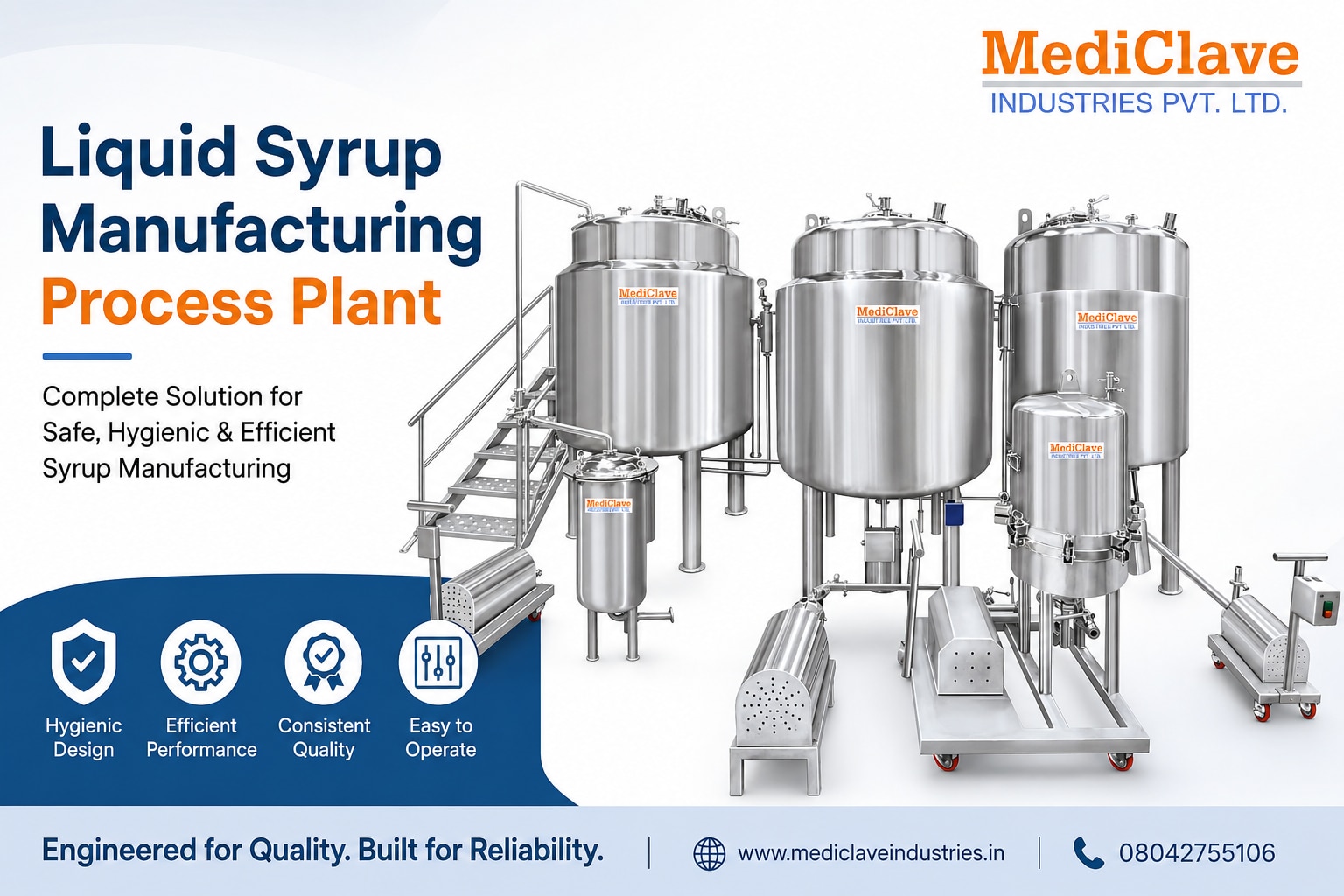
This is where a Liquid Syrup Manufacturing Process Plant becomes an important part of a modern pharmaceutical manufacturing facility. Unlike a simple mixing tank, a complete syrup manufacturing plant brings together several operations such as purified water charging, sugar dissolution, ingredient addition, mixing, heating, cooling, homogenization, filtration, storage, and hygienic transfer.
A properly designed system can help manufacturers improve batch consistency, reduce unnecessary manual handling, maintain hygienic processing conditions, and achieve better control over important production parameters. Mediclave Industries Pvt. Ltd. manufactures pharmaceutical process equipment designed around these requirements, with customized solutions for pharmaceutical, nutraceutical, herbal, Ayurvedic, and healthcare applications.
For manufacturers planning a new production facility or upgrading an existing one, understanding how a Liquid Syrup Manufacturing Process Plant works—and what features should be considered before purchase—is essential.
What Is a Liquid Syrup Manufacturing Process Plant?
A Liquid Syrup Manufacturing Process Plant is an integrated pharmaceutical processing system used for preparing and manufacturing oral liquid formulations. Depending on the formulation and production requirement, the system can include preparation vessels, sugar melting vessels, manufacturing vessels, storage tanks, pumps, filtration systems, homogenizers, pipelines, control systems, and cleaning arrangements.
The primary purpose of the plant is to create a controlled environment in which ingredients can be accurately processed and uniformly mixed.
Common products manufactured using such systems include:
Cough syrups
Pediatric syrups
Antacid syrups
Vitamin and mineral syrups
Iron tonics
Herbal and Ayurvedic syrups
Nutraceutical liquids
Oral solutions
Oral suspensions
Other suitable pharmaceutical liquid formulations
Because different formulations have different viscosities, ingredients, temperatures, mixing requirements, and filtration needs, the plant should be selected and engineered according to the actual product and manufacturing process.
Why Is a Modern Syrup Manufacturing Plant Important?
Liquid formulations can appear simple, but achieving consistent quality on a commercial scale requires careful process control. Small variations in ingredient addition, temperature, mixing speed, or processing time can affect the final product.
A professionally designed plant helps bring these variables under better control.
One of the biggest advantages is batch-to-batch consistency. When the same process parameters can be repeated accurately, manufacturers can produce a more uniform product.
Another important advantage is hygiene. Pharmaceutical production requires equipment and process pathways that can be cleaned effectively and maintained in a sanitary condition. Stainless-steel construction, hygienic piping, suitable valves, and cleaning systems can all contribute to better manufacturing practices.
Automation can also reduce unnecessary manual intervention. PLC and HMI-based systems can help operators monitor and control parameters such as temperature, mixing speed, and process sequences. Mediclave's syrup manufacturing solutions can be configured with automation according to the customer's requirements.
How Does a Liquid Syrup Manufacturing Process Plant Work?
The exact process varies according to the formulation, but a typical liquid syrup manufacturing process follows a logical sequence.
1. Purified Water Charging
The process normally begins with the charging of pharmaceutical-grade water into the appropriate preparation vessel.
Water is one of the most important raw materials in liquid pharmaceutical manufacturing, so its quality and handling must be appropriate for the formulation and applicable manufacturing requirements.
For facilities requiring advanced pharmaceutical water generation, a Multi Column Distillation Plant can be an important part of the wider utility infrastructure. Mediclave Industries offers multi-column distillation solutions designed for high-purity pharmaceutical water and WFI applications.
2. Sugar Dissolution
For formulations containing sugar, the required quantity is added to the preparation vessel and dissolved under controlled conditions.
A sugar melting or syrup preparation vessel may use an agitator and controlled heating arrangement to support proper dissolution.
The objective is to achieve a uniform syrup base without unwanted undissolved material.
3. Ingredient Addition
Once the syrup base is prepared, other formulation ingredients can be added according to the validated manufacturing procedure.
Depending on the product, these may include APIs, preservatives, flavors, colors, sweeteners, stabilizers, vitamins, minerals, or other excipients.
The order and method of addition are important because different ingredients can have different solubility and processing requirements.
4. Mixing and Homogenization
After ingredient addition, the mixture is processed using an appropriate agitator or homogenization system.
Efficient mixing helps distribute ingredients throughout the batch and supports uniformity.
For products such as suspensions or formulations requiring a more controlled particle distribution, homogenization may also be incorporated into the process.
The mixing system should therefore be selected based on factors such as viscosity, batch size, formulation characteristics, and required product quality.
5. Heating and Cooling
Temperature control can be an important part of syrup production.
Some ingredients require controlled heating for proper dissolution, while other formulations may need cooling before subsequent processing stages.
Jacketed vessels can be designed to provide controlled heating or cooling around the product vessel. The appropriate temperature range depends on the formulation and validated process.
6. Filtration
After processing, the syrup may pass through a suitable filtration system.
Filtration can help remove unwanted particulate matter and improve the clarity and quality of appropriate liquid formulations.
The filtration method should be selected according to the product, formulation characteristics, required filtration level, and validated process requirements.
7. Storage and Holding
Once the manufacturing process is complete, the finished syrup can be transferred to a hygienic storage or holding vessel.
Storage vessels allow the batch to be held under controlled conditions before it moves to the filling and packaging stage.
Properly designed transfer lines and sanitary pumps are important because the product should move between stages without unnecessary contamination risk or product loss.
8. Quality Testing and Filling
Before filling, the finished batch can undergo the required quality checks according to the manufacturer's approved procedures.
Typical checks may include parameters such as appearance, pH, viscosity, assay, and microbiological quality, depending on the formulation and applicable specifications.
Once the batch has been approved, it can be transferred to the appropriate filling and packaging equipment.
What Are the Main Components of a Liquid Syrup Manufacturing Plant?
A complete plant may contain several interconnected components. The exact configuration depends on the customer's product, capacity, process, automation level, and facility layout.
Sugar Melting or Syrup Preparation Vessel
This vessel is used for preparing the initial sugar syrup or liquid base. It can incorporate heating and agitation arrangements for controlled processing.
Manufacturing Vessel
The manufacturing vessel is the primary processing unit where ingredients are combined and mixed.
Depending on the process, it may include an agitator, heating/cooling jacket, temperature sensors, spray arrangements, or other process features.
Storage Vessel
The storage vessel provides hygienic holding capacity for the prepared product before filling.
Transfer Pumps
Sanitary transfer pumps help move liquid between vessels and process stages while minimizing manual handling.
Filtration System
Filtration equipment can be incorporated to remove unwanted particulate matter according to the formulation and validated process.
Control Panel
A modern control panel can provide centralized operation and monitoring.
PLC and HMI systems can be configured to control process sequences, monitor parameters, and support repeatable batch operation.
Hygienic Piping
Product-contact piping should be designed with appropriate hygienic considerations. Smooth surfaces, suitable connections, and proper drainage can simplify cleaning and reduce contamination risks.
CIP System
Cleaning is a critical part of pharmaceutical manufacturing. A suitable Clean-In-Place system can help clean process vessels and pipelines without requiring complete dismantling.
Mediclave Industries provides dedicated [CIP & SIP Systems] for pharmaceutical and other hygienic processing applications. The systems can be configured with automatic or semi-automatic operation, PLC-based controls, and suitable tank configurations.
Why Is SS316L Stainless Steel Important?
Material selection is one of the most important considerations when purchasing pharmaceutical process equipment.
Product-contact components are commonly designed using pharmaceutical-grade stainless steel such as SS316L where appropriate. The material offers corrosion resistance, durability, cleanability, and suitability for hygienic applications.
A well-finished product-contact surface is also important because equipment should be easy to clean and maintain.
However, material selection should always be based on the formulation, cleaning chemicals, operating conditions, applicable standards, and engineering requirements rather than simply choosing a material based on a specification sheet.
How Does Automation Improve Syrup Manufacturing?
Automation is changing the way pharmaceutical liquid manufacturing facilities operate.
In a manually operated process, operators may need to monitor several parameters and perform multiple actions during a batch. This can increase the possibility of variation between batches.
An automated system can help provide:
Controlled process sequences
Temperature monitoring
Mixing-speed control
Reduced operator dependency
Improved repeatability
Batch monitoring
Easier process documentation
Better operational efficiency
PLC-based automation with an HMI touchscreen can give operators a convenient interface for monitoring the manufacturing process.
The appropriate automation level depends on the plant size, formulation, production requirements, budget, validation strategy, and customer preference. Both semi-automatic and fully automated configurations may be considered depending on the application.
Why Is Cleaning So Important in Syrup Manufacturing?
Cleaning is not simply a maintenance activity. It is an important part of pharmaceutical manufacturing.
If residues remain inside a vessel, pipeline, valve, pump, or transfer line, they may affect subsequent batches. This is particularly important when the same equipment is used for different formulations.
A suitable CIP approach can help make cleaning more repeatable while reducing the need for extensive manual dismantling.
The cleaning cycle should be developed according to the product residue, equipment design, cleaning agents, temperature, flow, time, and rinsing requirements. Mediclave's CIP & SIP solutions are designed for automated cleaning and sterilization applications in pharmaceutical and other hygienic industries.
For facilities where sterile utilities are required, a [Pure Steam Generator] can also form part of the wider pharmaceutical utility system. Pure steam is commonly used for sterilization-in-place and for sterilizing process equipment and critical systems.
What Industries Use Liquid Syrup Manufacturing Plants?
Liquid syrup manufacturing systems are primarily associated with pharmaceutical production, but their applications can extend to several related industries.
Pharmaceutical Industry
Pharmaceutical manufacturers use these plants for suitable oral liquid medicines, including cough syrups, pediatric formulations, antacids, vitamin formulations, and other liquid dosage forms.
Nutraceutical Industry
Nutraceutical manufacturers can use liquid processing systems for vitamin liquids, mineral supplements, nutritional formulations, and health-support products.
Herbal and Ayurvedic Industry
Herbal manufacturers may use these systems for suitable herbal extracts, Ayurvedic syrups, and liquid healthcare formulations.
Healthcare Products
Certain healthcare and wellness liquid products can also be manufactured using appropriately configured processing equipment.
The formulation should always determine the final equipment design rather than attempting to use one standard configuration for every type of product.
What Are the Major Benefits of a Liquid Syrup Manufacturing Process Plant?
Investing in a properly designed plant can provide several operational benefits.
Better product consistency: Controlled mixing, heating, cooling, and processing help manufacturers achieve more repeatable batches.
Improved hygiene: Stainless-steel construction, hygienic piping, and suitable cleaning systems support cleaner production.
Higher productivity: Integrated equipment reduces unnecessary movement between process stages.
Reduced manual handling: Pumps, automated controls, and integrated systems can reduce operator intervention.
Better process control: Operators can monitor critical parameters more efficiently.
Reduced production losses: Properly designed vessels and transfer systems can help minimize avoidable product losses.
Easier cleaning: CIP-compatible equipment can simplify cleaning procedures and reduce equipment dismantling.
Future expansion: Modular and customized systems can be planned around future production requirements.
How Should You Choose the Right Liquid Syrup Manufacturing Plant?
Choosing a plant should begin with the manufacturing process—not simply the desired tank capacity.
Before contacting a manufacturer, pharmaceutical companies should define their product and production requirements as clearly as possible.
Important considerations include:
Production Capacity
Determine the required batch size and expected daily or monthly production volume.
It is also wise to consider future growth. Selecting equipment solely according to current production can create limitations later.
Product Characteristics
The formulation's viscosity, ingredients, solids content, temperature requirements, and sensitivity should be considered when selecting agitators, vessels, pumps, and filtration systems.
Automation Level
Decide whether the process requires manual, semi-automatic, or fully automated operation.
Material of Construction
Product-contact materials should be selected according to formulation compatibility, cleaning requirements, and applicable pharmaceutical standards.
Cleaning Requirements
Discuss CIP requirements at the design stage rather than adding cleaning features later.
Utility Requirements
The plant may require utilities such as purified water, steam, electricity, compressed air, chilled water, or other services depending on its configuration.
Documentation and Validation
Pharmaceutical projects often require technical documentation and support for qualification and validation activities. Discuss the expected documentation package with the equipment manufacturer before finalizing the order.
Installation and After-Sales Support
Good equipment is only one part of a successful project. Installation, commissioning, operator training, troubleshooting, spare parts, and after-sales support can be equally important over the life of the plant.
How Can a Syrup Plant Fit Into a Complete Pharmaceutical Facility?
A modern pharmaceutical facility usually depends on several systems working together rather than one machine operating independently.
For example, the Liquid Syrup Manufacturing Process Plant handles the actual liquid formulation process. Pharmaceutical water systems support the required water quality. Cleaning systems maintain equipment hygiene, while filling and packaging systems complete the production cycle.
Mediclave's broader portfolio includes pharmaceutical process and utility equipment that can support different areas of a manufacturing facility. For example, its [Multi Column Distillation Plant] is designed for high-purity pharmaceutical water and WFI applications.
For semi-solid products, manufacturers can also consider the [Ointment/Cream/Tooth Paste/Gel Manufacturing Plant], which is designed for products such as creams, ointments, gels, lotions, and toothpaste and incorporates mixing, homogenization, heating/cooling, and other process functions.
This wider equipment portfolio can be useful for pharmaceutical companies developing multiple manufacturing capabilities within the same facility.
Why Choose Mediclave Industries for a Liquid Syrup Manufacturing Process Plant?
Selecting the right manufacturing partner is an important decision because pharmaceutical process equipment is a long-term investment.
Mediclave Industries Pvt. Ltd. focuses on pharmaceutical processing, sterilization, and utility equipment and provides customized solutions for pharmaceutical and related manufacturing industries.
Its Liquid Syrup Manufacturing Process Plant solutions can be designed around requirements such as:
Customized production capacities
Hygienic stainless-steel construction
Controlled mixing and processing
Automation options
CIP compatibility
Pharmaceutical manufacturing requirements
Installation and commissioning support
Documentation and validation assistance
After-sales technical support
The company's published information describes its syrup manufacturing systems as solutions for pharmaceutical, nutraceutical, herbal, Ayurvedic, and healthcare liquid production.
For manufacturers looking for a dependable pharmaceutical process equipment partner, you can [explore Mediclave Industries' complete product portfolio] to understand the range of systems available for process, sterilization, and pharmaceutical utility applications.
Frequently Asked Questions About Liquid Syrup Manufacturing Process Plants
What is a Liquid Syrup Manufacturing Process Plant?
It is an integrated pharmaceutical processing system used to prepare and manufacture liquid formulations such as syrups, oral liquids, and suitable suspensions. It can combine preparation, mixing, heating, cooling, filtration, storage, and transfer operations.
What products can be manufactured using a syrup manufacturing plant?
Depending on the configuration and formulation, the plant can be used for products such as cough syrups, pediatric syrups, antacids, vitamin formulations, herbal syrups, nutraceutical liquids, oral solutions, and other suitable liquid formulations.
Why is SS316L used in pharmaceutical process equipment?
SS316L is widely used for suitable pharmaceutical product-contact applications because of its corrosion resistance, durability, cleanability, and hygienic properties. The exact material should be selected according to the formulation and process requirements.
Is automation necessary for a syrup manufacturing plant?
Not every application requires the same automation level. Manual, semi-automatic, and fully automated systems can be considered depending on batch size, production volume, process complexity, documentation requirements, and customer preference.
Why is CIP important?
CIP, or Clean-In-Place, allows suitable process equipment and pipelines to be cleaned without extensive dismantling. It can improve cleaning consistency, reduce cleaning time, and support hygienic production when properly designed and validated.
What factors determine the capacity of a syrup manufacturing plant?
Capacity depends on batch size, production targets, formulation characteristics, process time, vessel configuration, storage requirements, and the expected future growth of the manufacturing facility.
Can the Liquid Syrup Manufacturing Process Plant be customized?
Yes. Pharmaceutical manufacturing processes vary significantly, so plant configuration, vessel capacity, agitator design, automation, heating/cooling arrangements, filtration, transfer systems, and cleaning arrangements can be customized according to project requirements.
Conclusion
A Liquid Syrup Manufacturing Process Plant is much more than a collection of tanks and pumps. It is an integrated manufacturing solution that brings together controlled processing, hygienic equipment design, efficient mixing, filtration, storage, transfer, cleaning, and automation.
For pharmaceutical manufacturers, the right plant can make a significant difference to production consistency, operational efficiency, hygiene, and long-term manufacturing performance. As demand for oral liquids, pediatric medicines, nutraceutical products, and herbal formulations continues to grow, modern and flexible liquid processing equipment is becoming increasingly important.
The best approach is to select a system based on the actual formulation, production capacity, process parameters, cleaning requirements, utility availability, automation needs, and future expansion plans.
With the right engineering partner, manufacturers can develop a syrup production system that is efficient, hygienic, reliable, and designed for their specific process requirements.
Looking for a Liquid Syrup Manufacturing Process Plant for your pharmaceutical facility? Contact Mediclave Industries Pvt. Ltd. for customized pharmaceutical process equipment solutions.
Mediclave Industries Pvt. Ltd.
Website: www.mediclaveindustries.in
Email: info@mediclaveindustries.com
Phone: 08042755106
Location: Ahmedabad, Gujarat, India
