

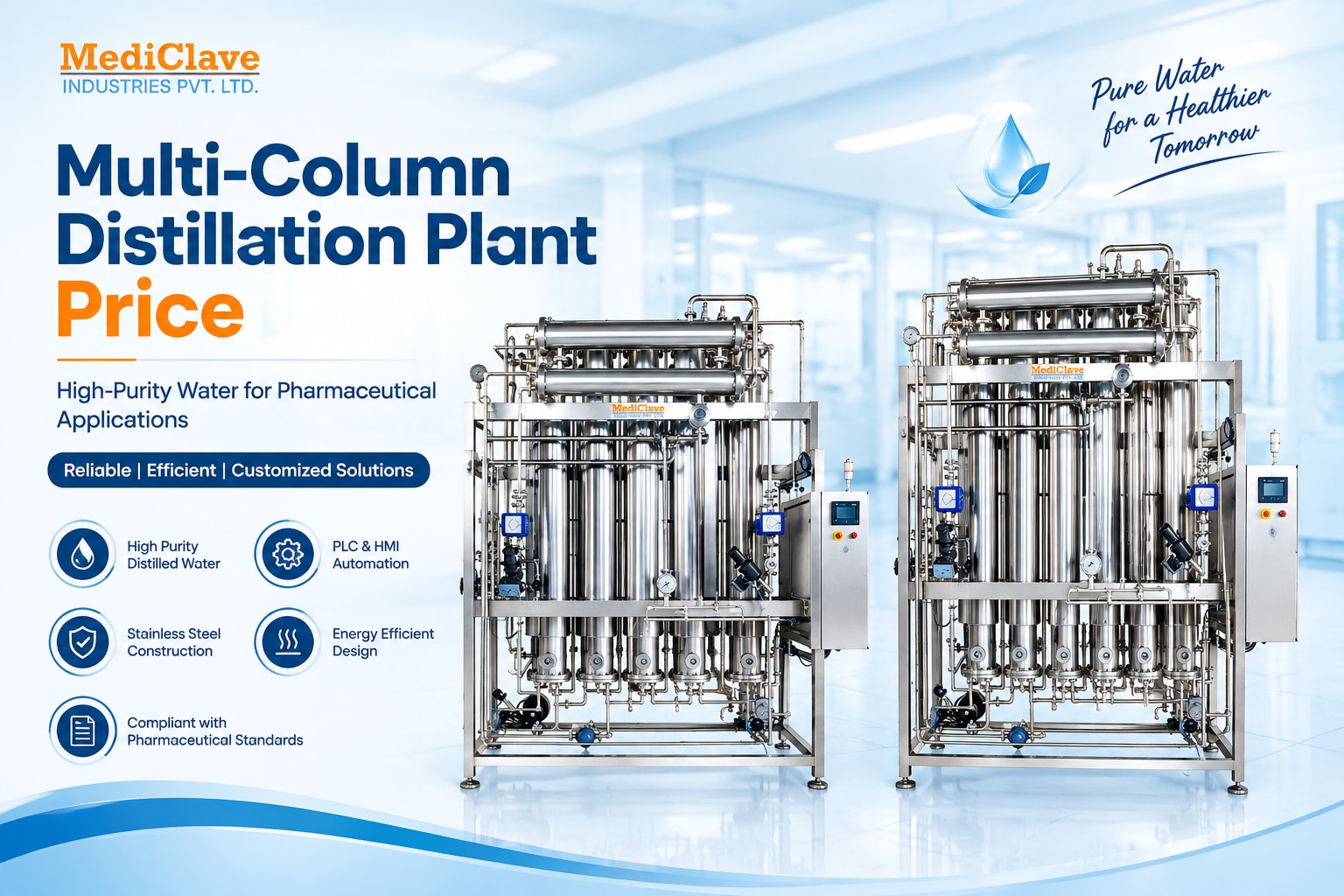
Multi-Column Distillation Plant Price – Complete Guide for Pharmaceutical
Industries
When pharmaceutical and healthcare manufacturers plan to establish or upgrade their purified water and Water for Injection (WFI) production systems, one of the most important considerations is the Multi-Column Distillation Plant Price. A multi-column distillation plant is an advanced pharmaceutical water-generation system designed to produce high-quality distilled water, particularly for applications where stringent water-quality requirements are essential.
The price of a Multi-Column Distillation Plant is not fixed because every pharmaceutical facility can have different production capacities, utility conditions, automation requirements, construction materials, and process specifications. Therefore, buyers should evaluate the complete technical configuration instead of selecting equipment only according to the lowest quoted price.
Mediclave Industries Pvt. Ltd. provides pharmaceutical processing and water-system equipment designed according to specific industrial requirements. A properly selected Multi-Column Distillation Plant can provide a reliable solution for pharmaceutical water production while supporting consistent operation and process control.
What Is a Multi-Column Distillation Plant?
A Multi-Column Distillation Plant is a pharmaceutical water-generation system that uses multiple interconnected distillation columns to purify water through evaporation and condensation. The process uses heat to convert water into vapor and subsequently condenses the vapor to obtain high-purity distilled water.
Multiple columns are arranged so that heat from one stage can be utilized in subsequent stages. This configuration can improve thermal efficiency compared with simpler single-stage distillation arrangements.
Multi-column distillation technology is commonly considered for pharmaceutical applications where high-purity water is required for manufacturing and other controlled processes.
The final system configuration depends on the required production capacity, feed-water quality, steam availability, cooling requirements, product-water specifications, and applicable process standards.
Multi-Column Distillation Plant Price in India
The Multi-Column Distillation Plant Price in India depends on the complete engineering configuration of the plant.
A small-capacity system with a relatively simple control arrangement will naturally have a different investment level from a high-capacity pharmaceutical plant equipped with automated controls, advanced instrumentation, sanitary piping, documentation, and customized utilities.
Some of the major factors affecting the price include:
- Production capacity
- Number of distillation columns
- Column dimensions
- Material of construction
- Stainless-steel grade
- Surface finish
- Feed-water quality
- Pure steam requirement
- Heating arrangement
- Cooling arrangement
- Product-water requirements
- Automation level
- PLC and HMI system
- Instrumentation
- Control valves
- Safety systems
- Piping configuration
- Data recording
- Installation requirements
- Qualification and documentation requirements
- Customized engineering
For this reason, an accurate Multi-Column Distillation Plant Price can generally be provided only after understanding the customer's process requirements.
Why Is the Multi-Column Distillation Plant Price Different for Different Models?
Pharmaceutical distillation plants are engineered systems rather than simple off-the-shelf machines. The configuration selected by one pharmaceutical manufacturer may not be suitable for another manufacturer.
For example, a facility requiring a higher output capacity may need larger columns, greater heating capacity, larger heat exchangers, higher utility consumption, and a more sophisticated control system.
Similarly, a plant designed for highly automated pharmaceutical production may include PLC-based controls, HMI monitoring, automated valves, alarms, data logging, and additional instrumentation.
Material selection can also influence the overall investment. Pharmaceutical systems generally require hygienic construction and suitable stainless-steel materials for process-contact areas.
Therefore, customers should compare technical specifications, capacity, construction, automation, and service support along with the quoted price.
How Does a Multi-Column Distillation Plant Work?
The basic principle of a multi-column distillation plant is based on evaporation and condensation.
Feed water enters the system and is heated under controlled conditions. Water is converted into vapor, while many non-volatile impurities and contaminants remain behind. The generated vapor is then condensed to produce distilled water.
In a multi-column configuration, the vapor and heat generated in one column can be used as part of the heating process for another column. This staged arrangement can improve energy utilization.
A typical process can include:
Feed Water Entry: Water enters the distillation system after suitable pretreatment.
Preheating: Feed water may be preheated using heat recovered from the process.
Evaporation: Heating converts the water into vapor.
Separation: Non-volatile impurities are separated from the vapor phase.
Multiple-Stage Operation: Vapor and heat are utilized through successive columns.
Condensation: Purified vapor is condensed to produce distilled water.
Collection: The final product water is collected and transferred to the designated storage or distribution system.
The actual arrangement and operating sequence depend on the plant design and customer specifications.
Main Components of a Multi-Column Distillation Plant
A Multi-Column Distillation Plant consists of several integrated components working together.
1. Distillation Columns
The columns are the central components of the system. Their number, dimensions, and arrangement depend on the required production capacity and process design.
2. Heat Exchangers
Heat exchangers are used for heating, cooling, and heat recovery within the system. Efficient heat transfer can help optimize utility consumption.
3. Condenser
The condenser converts purified vapor into liquid product water under controlled conditions.
4. Feed-Water System
The feed-water arrangement supplies the required water to the distillation plant.
5. Piping System
Sanitary piping connects the various components and provides controlled movement of feed water, steam, condensate, and distilled water.
6. Valves
Suitable valves regulate the movement of water, steam, and other process fluids throughout the system.
7. Instrumentation
Pressure, temperature, flow, level, and other instruments can be incorporated according to process requirements.
8. PLC and HMI
An automated plant can use PLC and HMI systems to monitor and control the distillation process.
Key Features of a Multi-Column Distillation Plant
Depending on the selected configuration, a pharmaceutical Multi-Column Distillation Plant may include:
- Multi-stage distillation technology
- Stainless-steel construction
- Hygienic process design
- Automated process control
- PLC-based operation
- HMI touchscreen interface
- Temperature monitoring
- Pressure monitoring
- Flow monitoring
- Level monitoring
- Automated valve operation
- Safety alarms
- Process interlocks
- Product-water monitoring
- Data recording
- Heat recovery arrangements
- Customized production capacity
The exact features should be specified according to the application and project requirements.
Multi-Column Distillation Plant for Pharmaceutical Industry
The pharmaceutical industry requires high-quality water for numerous manufacturing and cleaning applications. Depending on the manufacturing process, pharmaceutical facilities may require purified water or WFI-quality water.
A Multi-Column Distillation Plant can be integrated into a pharmaceutical water-generation system when distillation is the selected purification technology.
The plant can be designed according to:
- Required output
- Feed-water quality
- Steam availability
- Product-water specifications
- Storage capacity
- Distribution requirements
- Automation requirements
- Facility layout
- Documentation requirements
The complete water system should be designed according to the applicable pharmacopoeial and regulatory requirements for the intended application.
Multi-Column Distillation Plant for WFI Production
Water for Injection is a critical pharmaceutical utility used in applications where appropriate high-purity water is required.
A Multi-Column Distillation Plant may be used as part of a WFI generation system where the selected process and system design meet the applicable requirements.
When selecting a plant for WFI production, manufacturers should consider:
- Required WFI production rate
- Feed-water quality
- Distillation configuration
- Steam quality
- Product-water quality
- Storage and distribution system
- Sanitary design
- Temperature control
- Instrumentation
- Monitoring and documentation
The system should be appropriately qualified and validated for its intended pharmaceutical application.
Factors That Affect Multi-Column Distillation Plant Price
1. Production Capacity
Capacity is one of the most significant factors affecting the price.
A plant designed for a higher output generally requires larger process equipment and greater utility capacity.
2. Number of Columns
The number and arrangement of columns affect the engineering, fabrication, piping, heat-transfer area, instrumentation, and overall plant configuration.
3. Material of Construction
Pharmaceutical plants require suitable materials for hygienic and corrosion-resistant process applications. The selected stainless-steel grade and surface finish can affect the investment.
4. Automation
Manual or basic controls can have a different cost from a fully automated PLC-HMI system with process monitoring, alarms, data recording, and automatic valve control.
5. Instrumentation
The quantity and type of instruments required for monitoring temperature, pressure, flow, conductivity, level, and other parameters can influence the final quotation.
6. Customized Design
Customized dimensions, piping arrangements, special connections, additional instruments, and specific customer requirements can increase the engineering and manufacturing cost.
7. Documentation and Qualification
Pharmaceutical customers may require detailed documentation and qualification support. The scope of documentation can therefore influence the project cost.
How to Select the Right Multi-Column Distillation Plant
Choosing the right plant starts with understanding the actual water requirement.
Before contacting a manufacturer, customers should determine:
| Requirement | Information to Consider |
|---|---|
| Production Capacity | Required output per hour |
| Feed Water | Available feed-water quality |
| Product Water | Required water quality |
| Steam | Available steam pressure and quality |
| Cooling | Cooling-water/chilled-water availability |
| Automation | Manual, semi-automatic, or automatic |
| Construction | Required material and finish |
| Installation | Available plant area |
| Storage | Required storage capacity |
| Distribution | Existing or proposed distribution loop |
| Documentation | Required technical documents |
| Qualification | Required qualification scope |
Providing this information to the manufacturer can make the quotation process faster and more accurate.
Multi-Column Distillation Plant Operating Cost
The initial purchase price is only one part of the total investment. Buyers should also consider operating costs.
Important operating-cost factors include:
- Steam consumption
- Cooling-water consumption
- Electrical consumption
- Feed-water consumption
- Maintenance
- Spare parts
- Calibration
- Cleaning
- Preventive maintenance
- Operator requirements
An efficiently designed plant can help optimize heat utilization and utility consumption.
Therefore, customers should evaluate both initial Multi-Column Distillation Plant Price and long-term operating economics before making a purchasing decision.
Benefits of Multi-Column Distillation Technology
Multi-column distillation offers several potential advantages for suitable pharmaceutical applications.
High-Purity Water Production
Distillation can provide a high level of purification when appropriately designed and operated.
Multiple-Stage Heat Utilization
The multi-column arrangement can allow heat to be utilized across stages, improving thermal efficiency.
Industrial Scalability
The system can be designed for different production capacities according to the customer's requirement.
Automated Operation
PLC-based control can provide repeatable operation and centralized monitoring.
Pharmaceutical Application
The technology can be incorporated into pharmaceutical water-generation systems where distillation is appropriate.
Customizable Configuration
Plant capacity, controls, piping, instrumentation, and other features can be configured according to project requirements.
Multi-Column Distillation Plant Manufacturer in India
Choosing an experienced manufacturer is an important part of purchasing a pharmaceutical distillation system.
A capable manufacturer should understand process requirements, pharmaceutical hygienic design, material selection, instrumentation, automation, utility requirements, and installation considerations.
Mediclave Industries Pvt. Ltd. manufactures pharmaceutical machinery and process equipment for industrial applications. The company can provide Multi-Column Distillation Plant solutions according to customer requirements, including capacity, automation, construction, instrumentation, and other project specifications.
For pharmaceutical companies planning a new water-generation facility or upgrading an existing system, discussing the complete application with the manufacturer can help determine the appropriate plant configuration.
Why Choose a Customized Multi-Column Distillation Plant?
Every pharmaceutical facility has different production requirements. A customized plant can be designed around the available utilities, production capacity, facility layout, and process requirements.
Customization may include:
- Production capacity
- Number of columns
- Column dimensions
- Heat exchanger configuration
- Piping arrangement
- Instrumentation
- Automation
- PLC and HMI
- Valve configuration
- Product-water outlet
- Utility connections
- Skid arrangement
- Documentation
- Qualification requirements
This approach allows the equipment to be integrated more effectively into the customer's existing or planned pharmaceutical facility.
Multi-Column Distillation Plant Price: What Should Buyers Compare?
When comparing quotations from different manufacturers, buyers should avoid looking at price alone.
Compare:
- Production capacity
- Number of columns
- Material of construction
- Surface finish
- Heat-transfer system
- Steam consumption
- Cooling requirements
- Automation level
- PLC and HMI specifications
- Instrumentation
- Safety features
- Documentation
- Installation support
- Commissioning support
- Warranty and after-sales service
A detailed technical comparison can help buyers identify the actual value offered by each quotation.
Frequently Asked Questions
What is the Multi-Column Distillation Plant Price in India?
There is no single standard price because the cost depends on production capacity, number of columns, construction material, automation, instrumentation, utilities, and customization.
What is a Multi-Column Distillation Plant used for?
It is primarily used for producing high-purity distilled water in applications where distillation is an appropriate purification technology, including pharmaceutical water systems.
Can the plant be customized?
Yes. Capacity, column configuration, automation, instrumentation, piping, construction, and other technical parameters can be customized according to project requirements.
Is a Multi-Column Distillation Plant suitable for WFI production?
It can be used as part of a WFI generation system when properly designed, operated, qualified, and validated according to the applicable requirements.
Does automation affect the price?
Yes. PLC, HMI, automated valves, process instruments, alarms, data recording, and other automation features can affect the total plant cost.
What information is required for a quotation?
The manufacturer generally needs required production capacity, feed-water details, available steam and cooling utilities, desired automation, material requirements, installation conditions, and documentation or qualification requirements.
How can I get the exact Multi-Column Distillation Plant Price?
The best approach is to share your required production capacity and technical specifications with the manufacturer and request a detailed technical-commercial quotation.
Conclusion
The Multi-Column Distillation Plant Price depends on the complete design and technical configuration of the system. Production capacity, number of columns, material of construction, heat-transfer arrangement, automation, instrumentation, utility requirements, documentation, and customization can all influence the final investment.
For pharmaceutical manufacturers, the right plant should be selected based on water-quality requirements, production demand, utility availability, process requirements, reliability, and long-term operating costs rather than price alone.
If you are looking for a Multi-Column Distillation Plant Manufacturer in India, Mediclave Industries Pvt. Ltd. can help you evaluate your requirements and develop a suitable pharmaceutical distillation plant configuration.
For Multi-Column Distillation Plant Price, technical specifications, customized configuration, and quotation, contact Mediclave Industries Pvt. Ltd.
