

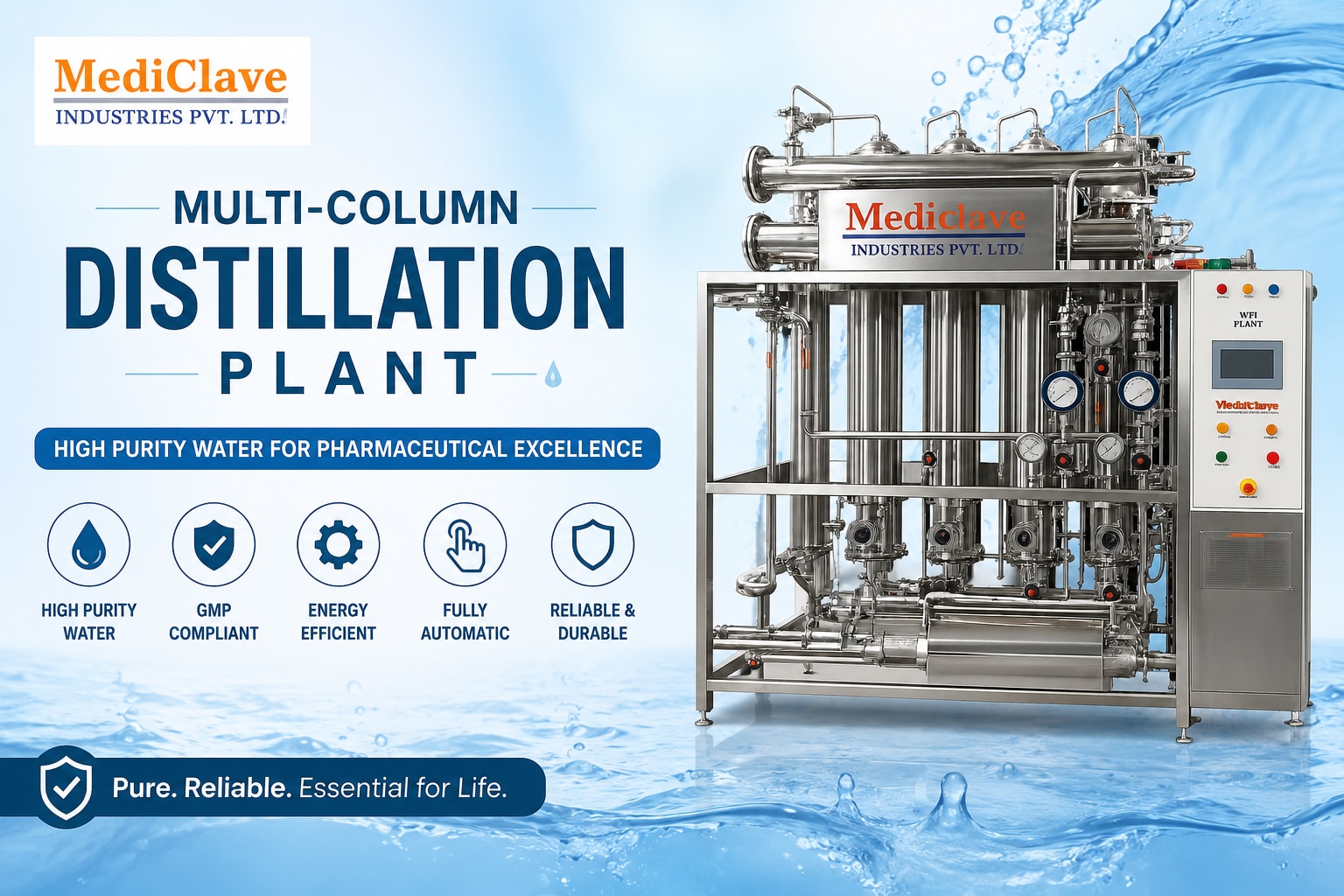
MultiColumn Distillation Plant for Reliable Pharmaceutical Water
Production
In pharmaceutical manufacturing, water is far more than a utility. It can become a critical raw material, a cleaning medium, a processing ingredient, and an essential part of sterile production. When the quality of that water is not properly controlled, it can affect product quality, manufacturing consistency, patient safety, and regulatory compliance.
This is why pharmaceutical manufacturers depend on specialized water-generation systems such as the MultiColumn Distillation Plant. Designed around multiple-effect distillation technology, this system helps produce highly purified water suitable for demanding pharmaceutical applications, particularly Water for Injection (WFI).
For companies involved in injectable manufacturing, biotechnology, vaccines, sterile products, APIs, and other sensitive processes, selecting the right pharmaceutical water system is an important investment. A properly engineered distillation plant can provide reliable water quality while also improving energy efficiency and reducing unnecessary operating costs.
Mediclave Industries Pvt. Ltd. manufactures pharmaceutical process and utility equipment, including the MultiColumn Distillation Plant, designed for high-purity water generation and continuous pharmaceutical production requirements.
What Is a MultiColumn Distillation Plant?
A MultiColumn Distillation Plant is an advanced pharmaceutical water-generation system that uses multiple interconnected distillation columns, also known as effects, to purify water through repeated evaporation and condensation.
The basic principle is simple. Feed water is heated to generate vapour. The vapour produced in one stage can then be used as the heating medium for the next stage. By reusing thermal energy across multiple columns, the system can achieve high purification efficiency with lower steam consumption than a conventional single-effect approach.
The final condensed water can be used for pharmaceutical applications where high levels of purity are required.
A modern MultiColumn Distillation Plant can be designed with pharmaceutical-grade stainless steel contact surfaces, automated controls, hygienic piping, monitoring systems, and other features necessary for controlled production environments.
According to Mediclave Industries' product information, its MultiColumn Distillation Plants can be supplied in capacities ranging from 50 LPH to 5000 LPH, with customized capacities available according to project requirements.
Why Is High-Purity Water Important in Pharmaceutical Manufacturing?
Water comes into contact with many products, equipment surfaces, containers, and manufacturing systems inside a pharmaceutical facility. This means that poor water quality can introduce unwanted contaminants into processes.
Depending on the application, pharmaceutical manufacturers may need water with controlled levels of microorganisms, dissolved substances, pyrogens, endotoxins, and other impurities.
This is particularly important when manufacturing injectable products. Water used in critical pharmaceutical processes must be produced, stored, monitored, and distributed through appropriately designed systems.
A MultiColumn Distillation Plant can therefore become an important part of the facility's clean utility infrastructure.
It can support applications such as:
Water for Injection production
Injectable drug manufacturing
Vaccine manufacturing
Biotechnology production
Sterile pharmaceutical processing
API manufacturing
Research laboratories
Medical and healthcare applications
Cosmetic manufacturing
Nutraceutical production
The exact water grade and quality requirements should always be determined according to the intended application, applicable pharmacopoeial requirements, and the facility's validated water system.
How Does a MultiColumn Distillation Plant Work?
Understanding the working principle makes it easier to appreciate why multiple-column distillation is widely used in pharmaceutical water systems.
1. Feed Water Enters the System
Properly treated or purified feed water is introduced into the first distillation column. The quality of the incoming water is important because the distillation system is designed to further purify suitable feed water rather than replace every stage of a complete water-treatment strategy.
2. Heating Takes Place
The feed water is heated using steam or another specified heating medium. As the water reaches the required operating conditions, vapour is generated.
3. Evaporation Separates Impurities
During evaporation, many non-volatile impurities remain behind while water vapour moves forward through the system.
This provides the fundamental separation mechanism of the distillation process.
4. Multiple Effects Reuse Heat
This is the key advantage of a MultiColumn Distillation Plant.
Instead of allowing the heat from the first stage to be wasted, the vapour generated in one column can provide heating energy for the next column. The process is repeated across multiple effects.
This heat-reuse concept improves thermal efficiency and can reduce overall steam consumption.
5. Condensation Produces Purified Water
The purified vapour is subsequently condensed. The resulting distilled water can then be collected as the desired pharmaceutical-grade water, depending on the system design and validated operating conditions.
6. Collection and Distribution
After generation, the water may be transferred to a suitable storage and distribution system so that it remains available to different production areas.
For pharmaceutical facilities, generation should therefore be considered as part of a larger water-management system rather than as an isolated machine.
Key Features to Look for in a MultiColumn Distillation Plant
When selecting a pharmaceutical distillation plant, buyers should look beyond basic production capacity. Construction quality, automation, hygienic design, energy consumption, maintenance requirements, documentation, and integration capabilities can all influence the long-term value of the equipment.
Pharmaceutical-Grade Stainless Steel Construction
Product-contact components are commonly manufactured using SS 316L, which is widely used for pharmaceutical applications because of its corrosion resistance, cleanability, and suitability for hygienic process environments.
Structural components may use SS 304 or other suitable materials depending on the design.
Multiple-Effect Distillation Technology
The multiple-effect configuration allows thermal energy to be reused between stages. This can improve energy utilization and help reduce steam consumption.
PLC and HMI-Based Automation
Automation can make operation easier and more consistent. A PLC-based system can monitor and control important operating parameters, while an HMI provides an operator-friendly interface.
Automation can also help reduce manual intervention and support process monitoring.
Hygienic Design
A pharmaceutical water system should be designed with cleanliness and contamination control in mind. Smooth surfaces, appropriate sanitary connections, suitable piping arrangements, and accessible components can simplify cleaning and maintenance.
Continuous Production
For larger pharmaceutical facilities, continuous WFI generation can provide a dependable water supply for ongoing manufacturing requirements.
CIP and SIP Compatibility
Where appropriate, compatibility with cleaning-in-place and sterilization-in-place processes can simplify facility operation and help maintain hygienic conditions.
Mediclave Industries also offers CIP & SIP Systems, which can complement pharmaceutical process and utility equipment.
Major Advantages of a MultiColumn Distillation Plant
A well-designed distillation system can provide several advantages to pharmaceutical manufacturers.
Consistent High-Purity Water Production
The primary benefit is the production of highly purified distilled water suitable for demanding pharmaceutical applications.
Better Thermal Efficiency
Multiple-effect distillation reuses heat generated during the process. This makes the system more energy-efficient than approaches that waste heat after a single distillation stage.
Reduced Steam Consumption
Because thermal energy is reused between effects, properly engineered systems can reduce steam requirements and associated utility costs.
Automated Operation
PLC and HMI controls can help operators monitor critical parameters and manage the system more efficiently.
Hygienic Construction
Pharmaceutical-grade stainless steel and sanitary design features can support contamination control and easier cleaning.
Reliable Long-Term Operation
When properly engineered, installed, operated, and maintained, a pharmaceutical distillation plant can provide reliable service for many years.
Customizable Capacity
Different pharmaceutical facilities have different water requirements. A small research facility may need a much lower output than a large injectable manufacturing plant.
Mediclave Industries lists capacities from 50 LPH through 5000 LPH, with customization available for project-specific requirements.
MultiColumn Distillation Plant and WFI Production
One of the most important applications of a MultiColumn Distillation Plant is the production of Water for Injection (WFI).
WFI is used in pharmaceutical manufacturing where highly controlled water quality is required, particularly for injectable products and other critical applications.
However, producing high-quality water is only one part of the overall system. Storage, circulation, monitoring, temperature management, sanitization, and distribution are also important.
For this reason, a distillation plant is often integrated with a dedicated WFI Storage & Distribution System.
A properly designed storage and distribution loop helps maintain water quality after generation and makes the water available at different points of use within the facility.
MultiColumn Distillation Plant vs Pure Steam Generator
Although both systems are important pharmaceutical utilities, they serve different primary purposes.
A MultiColumn Distillation Plant is primarily associated with the generation of highly purified distilled water or WFI.
A Pure Steam Generator, on the other hand, is used to generate clean or pure steam for applications such as sterilization and SIP, depending on the system design and validated requirements.
The two systems can work together in a modern pharmaceutical facility.
For example, a manufacturer may use distilled water for injectable production while using pure steam for sterilizing equipment and process systems.
Mediclave Industries provides Pure Steam Generators as part of its pharmaceutical utility equipment range.
Where Is a MultiColumn Distillation Plant Used?
The versatility of pharmaceutical water makes distillation plants useful across many industries.
Pharmaceutical Manufacturing
Pharmaceutical companies use high-purity water in formulation, cleaning, processing, and sterile manufacturing applications.
Injectable Manufacturing
Injectable products require particularly controlled manufacturing environments. A reliable WFI generation system can therefore become an essential part of the production infrastructure.
Vaccine Manufacturing
Vaccine production involves sensitive biological processes where controlled water quality is important.
Biotechnology
Biotechnology facilities may require high-purity water for production, cleaning, laboratory, and process applications.
API Manufacturing
Active pharmaceutical ingredient manufacturers can use pharmaceutical water systems as part of their process and utility infrastructure.
Research and Development
Laboratories and research facilities may require highly purified water for testing, development, and experimental processes.
Healthcare and Specialized Facilities
Depending on the application, high-purity water systems may also support specialized healthcare and laboratory requirements.
How to Choose the Right MultiColumn Distillation Plant
Buying a distillation plant should not be based only on the lowest initial price. A better approach is to evaluate the entire system according to present and future requirements.
Determine Required Capacity
Start by calculating your actual water demand.
Consider:
Current production requirements
Future expansion
Peak water consumption
Number of production lines
Cleaning requirements
Storage capacity
Distribution requirements
Choosing an undersized system can create production bottlenecks, while excessive capacity can increase unnecessary capital and operating costs.
Evaluate Material of Construction
For pharmaceutical applications, carefully review the materials used for product-contact components.
SS 316L is commonly preferred for critical pharmaceutical contact surfaces because of its hygienic properties and corrosion resistance.
Review Automation
A modern PLC/HMI-based system can make monitoring and operation easier. Ask the manufacturer what parameters are monitored, what alarms are available, and what level of automation is included.
Consider Utility Consumption
Steam, cooling water, electricity, and other utilities contribute to the total cost of ownership.
A system with efficient heat utilization can potentially provide significant savings during long-term operation.
Check Cleaning and Maintenance Requirements
The plant should be practical to inspect, clean, service, and maintain.
Easy access to important components can reduce downtime and make preventive maintenance more manageable.
Consider Integration
Your distillation plant should fit into the wider pharmaceutical utility architecture.
Integration with WFI storage, distribution, pure steam, CIP, SIP, and other systems can help create a more coordinated manufacturing environment.
Why Choose Mediclave Industries for a MultiColumn Distillation Plant?
Selecting the right manufacturer is just as important as selecting the right equipment.
Mediclave Industries Pvt. Ltd. manufactures pharmaceutical process equipment and water systems with a focus on hygienic construction, automation, customization, and industrial reliability.
The company's MultiColumn Distillation Plants are designed with features such as multiple-effect distillation technology, SS 316L product-contact construction, PLC/HMI automation, continuous production capability, hygienic design, and compatibility with pharmaceutical utility systems.
The company also provides equipment solutions that can complement a distillation plant, including Pure Steam Generators, WFI Storage & Distribution Systems, and CIP & SIP Systems.
This broader product capability can be useful for pharmaceutical manufacturers looking to coordinate multiple utility and process requirements with one experienced equipment manufacturer.
Maintenance Tips for Better Plant Performance
Even the best equipment requires proper maintenance.
A few practical maintenance habits can make a significant difference:
Use appropriate feed water: Always maintain the required feed-water quality specified for the system.
Monitor operating parameters: Temperature, pressure, conductivity, flow, and other relevant parameters should be monitored according to the equipment and validated process.
Inspect regularly: Routine inspections can help identify leaks, unusual noise, scaling, corrosion, or component deterioration before they become major problems.
Clean the system as required: Follow the manufacturer's recommended cleaning procedures and facility SOPs.
Calibrate instruments: Sensors and measuring instruments should be calibrated according to the site's established schedule.
Follow preventive maintenance: Replacing wear components and inspecting critical parts at planned intervals can reduce unexpected downtime.
Maintain documentation: Maintenance, calibration, cleaning, testing, and qualification records are important in pharmaceutical manufacturing environments.
Why Investing in the Right Distillation System Matters
A MultiColumn Distillation Plant is not simply a water-making machine. It is an important part of a pharmaceutical facility's clean utility infrastructure.
The right system can help manufacturers maintain consistent water quality, improve energy utilization, support continuous production, reduce operational inefficiencies, and build a more reliable manufacturing environment.
At the same time, the equipment should be selected according to the actual application, required water quality, production capacity, utilities, regulatory expectations, and facility design.
For a new pharmaceutical plant, the water system should ideally be considered during the early stages of facility planning. For an existing facility, upgrading the water-generation system can be an effective way to improve capacity and reliability as production requirements grow.
Frequently Asked Questions About MultiColumn Distillation Plants
What is a MultiColumn Distillation Plant used for?
A MultiColumn Distillation Plant is primarily used to produce highly purified distilled water, including Water for Injection for suitable pharmaceutical applications.
How does multiple-effect distillation save energy?
The system reuses vapour and thermal energy from one distillation effect as the heating source for subsequent effects, improving overall heat utilization and reducing steam consumption.
What capacity MultiColumn Distillation Plant should I choose?
Capacity depends on your current and future water demand, production volume, cleaning requirements, storage capacity, and distribution requirements. Mediclave Industries offers capacities from 50 LPH to 5000 LPH and can provide customized solutions.
Is SS 316L suitable for pharmaceutical water systems?
SS 316L is widely used for pharmaceutical product-contact surfaces because it offers good corrosion resistance and supports hygienic process design.
Can a MultiColumn Distillation Plant be integrated with a WFI distribution system?
Yes. A distillation plant can be integrated with suitable WFI storage and distribution infrastructure to provide continuous availability of generated water throughout the facility.
Can it work with a Pure Steam Generator?
Yes. A MultiColumn Distillation Plant and Pure Steam Generator can serve different pharmaceutical utility requirements and may be integrated into the same facility.
What industries use MultiColumn Distillation Plants?
Common applications include pharmaceutical manufacturing, injectable production, biotechnology, vaccines, API manufacturing, research laboratories, sterile manufacturing, cosmetics, and nutraceutical production.
Final Thoughts
In pharmaceutical manufacturing, water quality directly influences the reliability of critical processes. A properly designed MultiColumn Distillation Plant provides an efficient way to generate high-purity distilled water for demanding applications while taking advantage of multiple-effect technology to improve thermal efficiency.
From capacity and material selection to automation, maintenance, utility consumption, and system integration, every aspect deserves careful consideration before making a purchase.
For pharmaceutical companies planning a new facility, expanding production, or upgrading an existing water-generation system, working with an experienced manufacturer can make the selection and implementation process much easier.
Mediclave Industries Pvt. Ltd. offers customized MultiColumn Distillation Plants along with complementary pharmaceutical utility and process equipment. To discuss your capacity requirements, technical specifications, or project needs, contact the team at info@mediclaveindustries.com or 08042755106.
A well-engineered pharmaceutical water system is an investment not only in equipment, but also in product quality, process reliability, operational efficiency, and long-term manufacturing performance.
