

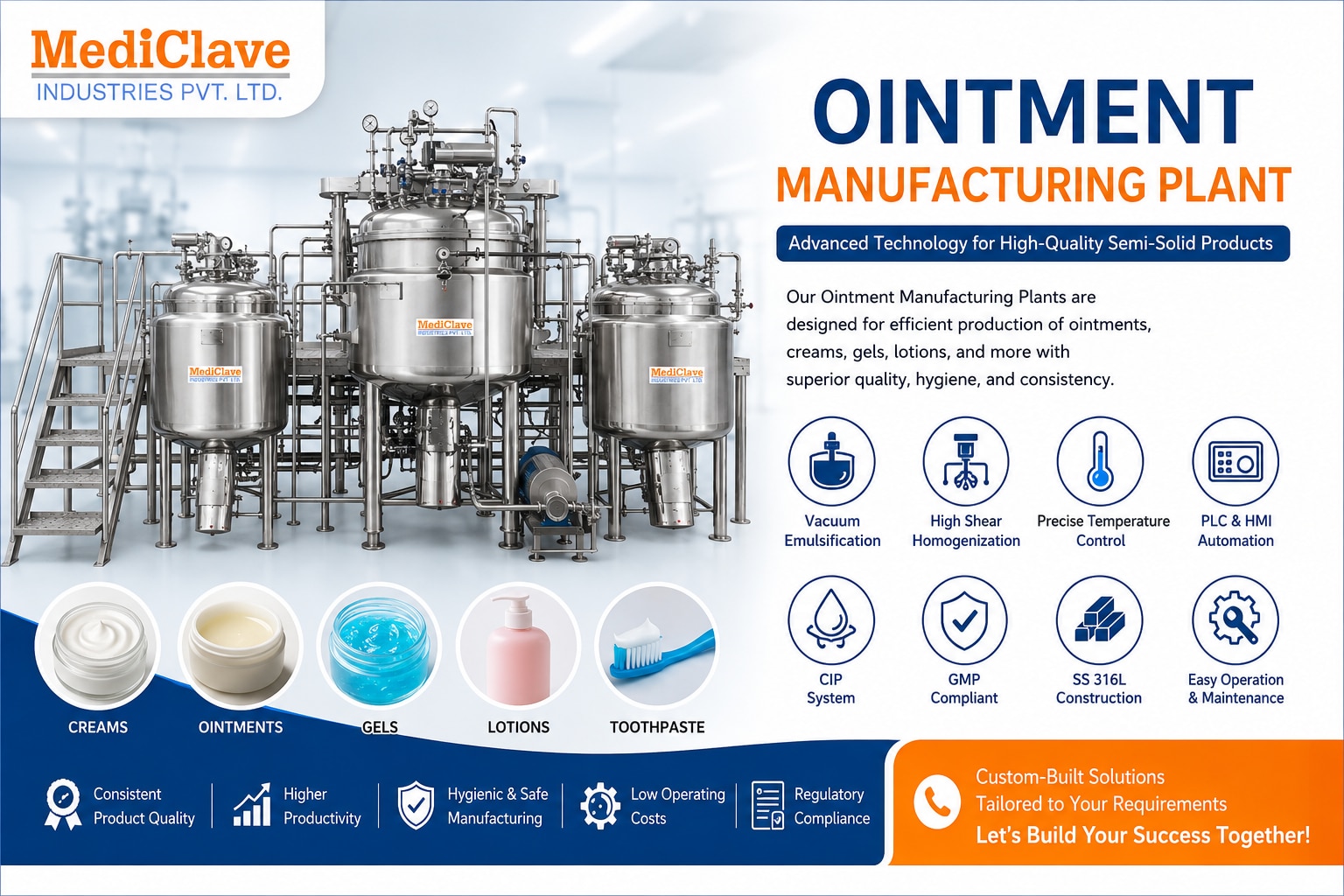
Ointment Manufacturing Plant: Complete Guide to Equipment, Process, Benefits,
Applications & GMP Compliance
The pharmaceutical and cosmetic industries are growing rapidly, increasing the demand for high-quality topical products such as ointments, creams, gels, lotions, and medicated pastes. These products require accurate formulation, uniform mixing, and hygienic manufacturing conditions to ensure safety and effectiveness. This is where an Ointment Manufacturing Plant becomes an essential part of the production process.
An Ointment Manufacturing Plant is a complete manufacturing system designed to produce semi-solid pharmaceutical and cosmetic products under controlled conditions. It combines various processing stages—including mixing, heating, homogenizing, cooling, vacuum processing, and storage—into one integrated solution. The result is a smooth, homogeneous product with excellent stability and consistent quality.
Modern pharmaceutical manufacturers must comply with strict regulatory standards such as GMP (Good Manufacturing Practices), cGMP, WHO-GMP, US FDA, and EU GMP guidelines. A well-designed ointment manufacturing plant helps manufacturers meet these requirements while improving production efficiency and reducing contamination risks.
Whether manufacturing antibiotic ointments, pain relief creams, moisturizing creams, cosmetic lotions, herbal gels, toothpaste, or medicated gels, the production equipment must maintain precise process control throughout every batch.
What is an Ointment Manufacturing Plant?
An Ointment Manufacturing Plant is an integrated processing system specially engineered for manufacturing semi-solid products. Instead of using multiple separate machines, the plant combines all major production processes into one automated system.
The manufacturing process generally includes:
- Raw material charging
- Heating of oil and water phases
- Mixing ingredients
- Vacuum emulsification
- High-speed homogenization
- Product cooling
- Product storage
- Product transfer to filling machines
The plant is designed to produce products with:
- Uniform consistency
- Smooth texture
- Stable formulation
- Excellent appearance
- Long shelf life
- High production efficiency
Because the entire process occurs inside a closed hygienic system, the chances of microbial contamination are significantly reduced.
Importance of Ointment Manufacturing Plants in Modern Industries
Today's pharmaceutical industry cannot rely on manual manufacturing methods. Customers expect products that are safe, effective, and consistent in every batch.
A modern ointment manufacturing plant offers several advantages over conventional production methods:
1. Consistent Product Quality
Every batch maintains the same viscosity, texture, color, and formulation.
2. Improved Hygiene
Closed processing systems prevent contamination from dust, air, and human contact.
3. Higher Productivity
Automated operations reduce manufacturing time while increasing batch output.
4. Better Process Control
Temperature, mixing speed, vacuum level, and homogenization can all be controlled automatically.
5. Regulatory Compliance
The equipment is designed according to GMP and cGMP requirements, making regulatory audits easier.
Products Manufactured Using an Ointment Manufacturing Plant
One of the biggest advantages of modern ointment plants is their versatility. A single system can manufacture a wide variety of pharmaceutical, cosmetic, and healthcare products.
Common products include:
Pharmaceutical Products
- Antibiotic ointments
- Antifungal creams
- Pain relief gels
- Burn ointments
- Steroid creams
- Antiseptic creams
- Medicated lotions
- Skin treatment gels
- Eye ointments
- Herbal ointments
Cosmetic Products
- Moisturizing creams
- Beauty creams
- Face creams
- Sunscreen creams
- Night creams
- Body lotions
- Hair creams
- Facial gels
- Aloe vera gel
- Anti-aging creams
Personal Care Products
- Toothpaste
- Herbal toothpaste
- Medicated toothpaste
- Petroleum jelly
- Lip balm base
- Baby care creams
- Hand creams
- Foot creams
- Massage gels
This flexibility allows manufacturers to produce multiple products using the same production line with minimal modifications.
Main Components of an Ointment Manufacturing Plant
A complete ointment manufacturing plant consists of several interconnected systems that work together to produce high-quality semi-solid products.
Manufacturing Vessel
The main vessel is where the product is processed under controlled temperature and vacuum conditions.
Its functions include:
- Mixing
- Heating
- Cooling
- Vacuum processing
- Product preparation
Oil Phase Vessel
Oil-soluble ingredients such as waxes, oils, emulsifiers, and fatty substances are melted here before being transferred to the main vessel.
Water Phase Vessel
Water-soluble ingredients are prepared separately in this vessel before being mixed with the oil phase.
Vacuum System
The vacuum system removes trapped air during mixing.
This helps:
- Prevent air bubbles
- Improve product stability
- Increase shelf life
- Produce a smooth finish
Homogenizer
The homogenizer is one of the most important components.
It breaks down particles into very fine sizes, ensuring:
- Smooth texture
- Uniform consistency
- Better product absorption
- Improved stability
Agitator
The agitator continuously mixes ingredients throughout the manufacturing process.
It ensures:
- Uniform mixing
- Even heat distribution
- No ingredient settling
Heating and Cooling System
The jacketed vessel allows controlled heating and cooling.
Proper temperature control is essential because different ingredients require different processing temperatures.
Product Transfer System
After manufacturing is complete, the finished product is transferred hygienically to storage tanks or filling machines using sanitary pumps.
This minimizes contamination and product loss.
Why Automation is Important
Modern ointment manufacturing plants are equipped with PLC and HMI-based automation systems.
Automation offers several benefits:
- Easy operation
- Recipe management
- Batch recording
- Reduced manual errors
- Faster production
- Improved product consistency
- Better process monitoring
Operators can monitor the complete production cycle through a user-friendly touchscreen interface.
Ointment Manufacturing Process, Working Principle & Critical Process Parameters
Producing high-quality ointments, creams, gels, and lotions requires much more than simply mixing ingredients together. Every stage of the manufacturing process must be carefully controlled to ensure the final product has the correct texture, stability, appearance, and therapeutic effectiveness. A modern Ointment Manufacturing Plant is designed to automate these processes while maintaining strict hygiene and regulatory standards.
By using advanced equipment such as vacuum emulsifiers, homogenizers, jacketed vessels, and automated control systems, manufacturers can consistently produce pharmaceutical and cosmetic products that meet international quality requirements.
Step-by-Step Ointment Manufacturing Process
The manufacturing process generally consists of several stages, each playing an important role in achieving a stable and homogeneous product.
Step 1: Raw Material Preparation
The process begins with the preparation of raw materials. Depending on the formulation, ingredients may include:
- Active Pharmaceutical Ingredients (API)
- Purified Water
- Mineral Oils
- Vegetable Oils
- Waxes
- Emulsifiers
- Preservatives
- Stabilizers
- Fragrances
- Colorants
- Thickening Agents
Before manufacturing starts, every raw material is inspected by the quality control department to ensure it meets the required specifications.
Step 2: Preparation of the Water Phase
Water-soluble ingredients are transferred into the Water Phase Vessel.
This vessel is equipped with:
- Agitator
- Heating Jacket
- Temperature Control System
The ingredients are heated to the required temperature while continuous mixing ensures complete dissolution.
Typical water phase ingredients include:
- Purified Water
- Glycerin
- Preservatives
- Water-soluble additives
Maintaining the correct temperature is essential because insufficient heating may prevent complete dissolution of ingredients.
Step 3: Preparation of the Oil Phase
Oil-soluble materials are processed separately in the Oil Phase Vessel.
These ingredients generally include:
- Paraffin Oil
- White Soft Paraffin
- Beeswax
- Emulsifying Wax
- Lanolin
- Petroleum Jelly
- Fatty Alcohols
The vessel heats these materials until they melt completely, producing a uniform oil mixture.
Step 4: Transfer to the Main Manufacturing Vessel
Once both phases reach the desired temperature, they are transferred into the Main Manufacturing Vessel.
The transfer takes place through sanitary pipelines to maintain product hygiene and prevent contamination.
The entire transfer process is carefully controlled to maintain the correct formulation ratio.
Step 5: Mixing Process
After both phases enter the manufacturing vessel, continuous mixing begins.
The agitator rotates at a controlled speed to blend all ingredients evenly.
This stage ensures:
- Uniform ingredient distribution
- Proper blending
- Consistent viscosity
- Stable formulation
The mixing speed depends on the product being manufactured.
For example:
- Thick ointments require slower mixing.
- Creams often require moderate agitation.
- Gels may need higher mixing speeds.
Step 6: Vacuum Processing
One of the most important stages is vacuum processing.
During mixing, air naturally enters the product. If this trapped air is not removed, it can create several problems:
- Air bubbles
- Foaming
- Oxidation
- Reduced shelf life
- Poor product appearance
- Inaccurate filling volumes
A vacuum system removes these unwanted air pockets, producing a smoother and more stable product.
Benefits of Vacuum Processing
- Bubble-free product
- Improved product stability
- Better appearance
- Longer shelf life
- Reduced oxidation
- Enhanced product quality
Step 7: Homogenization Process
Homogenization is one of the most critical steps in ointment manufacturing.
The homogenizer applies high shear force to break down particles into microscopic sizes.
This process creates a fine and uniform emulsion.
Advantages of Homogenization
- Smooth texture
- Uniform particle size
- Improved product stability
- Better skin absorption
- Reduced phase separation
- Attractive product appearance
Without proper homogenization, creams and ointments may become grainy or separate during storage.
Step 8: Heating and Temperature Control
Temperature plays a vital role throughout the manufacturing process.
The jacketed vessel allows controlled heating using steam or hot water.
Proper heating ensures:
- Complete melting of waxes
- Uniform mixing
- Stable emulsification
- Correct viscosity
Automatic temperature sensors continuously monitor the process to avoid overheating or underheating.
Step 9: Cooling Process
Once homogenization is complete, the product is gradually cooled.
Controlled cooling helps:
- Maintain emulsion stability
- Achieve the required consistency
- Prevent ingredient degradation
- Improve product appearance
Rapid cooling may cause instability, while slow and controlled cooling ensures the desired product characteristics.
Step 10: Product Transfer
After the manufacturing process is complete, the finished product is transferred to storage tanks or directly to the filling machine.
This transfer is performed using sanitary pumps and pipelines to prevent contamination and minimize product loss.
The product is then filled into:
- Tubes
- Bottles
- Jars
- Containers
- Sachets
depending on customer requirements.
Working Principle of an Ointment Manufacturing Plant
An ointment manufacturing plant works on the principle of controlled heating, mixing, vacuum emulsification, homogenization, and cooling.
The process begins by preparing the oil and water phases separately. These phases are then combined in the main manufacturing vessel under controlled conditions. Continuous agitation ensures proper mixing, while the homogenizer reduces particle size to create a smooth and stable emulsion.
The vacuum system removes entrapped air, improving product quality and shelf life. Finally, the product is cooled and transferred hygienically for filling and packaging.
This integrated process ensures every batch has the same quality, consistency, and performance.
Importance of Vacuum Emulsification
Vacuum emulsification is one of the defining features of modern ointment manufacturing plants.
It combines:
- Mixing
- Homogenization
- Air removal
- Emulsification
into a single controlled process.
Benefits include:
- Smooth cream texture
- No trapped air
- Stable emulsion
- Improved appearance
- Better spreadability
- Longer shelf life
- Consistent product quality
Vacuum emulsification is particularly important for pharmaceutical creams, cosmetic products, medicated gels, and high-value skincare formulations.
Critical Process Parameters
To achieve consistent product quality, manufacturers monitor several important process parameters throughout production.
These include:
- Temperature
- Mixing speed
- Homogenizer speed
- Vacuum level
- Processing time
- Cooling rate
- Batch size
- Ingredient addition sequence
- Product viscosity
- pH (where applicable)
Maintaining these parameters within specified limits ensures batch-to-batch consistency and compliance with quality standards.
Quality Control During Manufacturing
Quality control is integrated into every stage of the manufacturing process.
Common quality checks include:
- Raw material verification
- Temperature monitoring
- Mixing speed verification
- Homogenization efficiency
- Vacuum level monitoring
- Product appearance
- Viscosity testing
- pH testing
- Uniformity testing
- Microbiological testing
- Batch documentation
Regular quality inspections help ensure that every product meets regulatory requirements and customer expectations before it moves to the packaging stage.
Features, Components, Applications, Benefits & GMP Compliance of an Ointment
Manufacturing Plant
As pharmaceutical and cosmetic industries continue to grow, manufacturers require equipment that not only delivers consistent product quality but also complies with stringent international regulations. Modern Ointment Manufacturing Plants are designed with advanced automation, hygienic construction, and intelligent process control to meet these demands.
Whether you are manufacturing pharmaceutical ointments, cosmetic creams, herbal gels, or personal care products, selecting the right manufacturing plant can significantly improve production efficiency, product consistency, and operational reliability.
Key Features of a Modern Ointment Manufacturing Plant
Today's ointment manufacturing plants incorporate advanced technologies that simplify production while maintaining the highest quality standards.
Some of the key features include:
- Fully Automatic or Semi-Automatic Operation
- PLC & HMI Based Control System
- Vacuum Emulsification Technology
- High-Speed Homogenizer
- Anchor Type Agitator
- Jacketed Heating & Cooling Vessel
- CIP (Clean-In-Place) System
- Hygienic SS 316L Product Contact Parts
- Easy Maintenance
- Energy Efficient Design
- Compact Footprint
- Batch Recipe Management
- Data Logging & Process Monitoring
- Low Product Loss
- Easy Cleaning and Validation
These features help manufacturers achieve repeatable production results while reducing downtime and manual intervention.
Major Components of an Ointment Manufacturing Plant
An ointment manufacturing plant consists of several integrated units that work together to produce high-quality semi-solid formulations.
1. Main Manufacturing Vessel
The manufacturing vessel is the heart of the plant.
Its primary functions include:
- Mixing
- Heating
- Cooling
- Vacuum Processing
- Homogenization
- Product Preparation
The vessel is typically constructed from SS 316L stainless steel to ensure corrosion resistance, hygiene, and compliance with pharmaceutical standards.
2. Oil Phase Vessel
This vessel is used to prepare oil-based ingredients before they are transferred to the main vessel.
Typical materials processed include:
- Waxes
- Oils
- Petroleum Jelly
- Lanolin
- Emulsifiers
- Fatty Alcohols
The oil phase vessel ensures complete melting and uniform blending of oil-soluble ingredients.
3. Water Phase Vessel
The water phase vessel is used to dissolve water-soluble ingredients such as:
- Purified Water
- Glycerin
- Preservatives
- Stabilizers
- Water-soluble APIs
It is equipped with a heating jacket and agitator to ensure complete dissolution and proper temperature control.
4. Vacuum System
The vacuum system removes entrapped air from the product during manufacturing.
Its benefits include:
- Bubble-free product
- Improved shelf life
- Better appearance
- Reduced oxidation
- Uniform filling
Vacuum processing also improves the overall texture and consistency of creams and ointments.
5. Homogenizer
The homogenizer is responsible for reducing particle size and producing a fine, stable emulsion.
Benefits include:
- Smooth texture
- Better product stability
- Improved absorption
- Uniform consistency
- Enhanced product quality
High-shear homogenization is especially important for pharmaceutical creams and cosmetic emulsions.
6. Agitator
The agitator continuously mixes the product during manufacturing.
It ensures:
- Even ingredient distribution
- Uniform heating
- Consistent viscosity
- Prevention of sedimentation
Different formulations may require different agitator speeds depending on product viscosity.
7. Heating and Cooling System
The jacketed vessel allows precise temperature control throughout the manufacturing process.
Heating is required to melt waxes and dissolve ingredients, while controlled cooling helps stabilize the final product and achieve the desired consistency.
8. Transfer Pump and Pipeline System
Once production is complete, sanitary pumps transfer the finished product to storage tanks or filling machines through hygienic stainless-steel pipelines.
This minimizes product loss and prevents contamination.
Applications of an Ointment Manufacturing Plant
One of the biggest advantages of an ointment manufacturing plant is its ability to produce a wide variety of semi-solid products across multiple industries.
Pharmaceutical Industry
Pharmaceutical companies use these plants for manufacturing:
- Antibiotic Ointments
- Antifungal Creams
- Burn Creams
- Pain Relief Gels
- Steroid Creams
- Antiseptic Creams
- Medicated Gels
- Eye Ointments
- Herbal Medicines
- Dermatological Products
Cosmetic Industry
Cosmetic manufacturers produce:
- Face Creams
- Beauty Creams
- Moisturizers
- Sunscreens
- Anti-Aging Creams
- Fairness Creams
- Night Creams
- Body Lotions
- Hair Creams
- Aloe Vera Gel
Personal Care Industry
Common personal care products include:
- Toothpaste
- Herbal Toothpaste
- Petroleum Jelly
- Lip Balm Base
- Hand Cream
- Foot Cream
- Baby Care Cream
- Shaving Cream
- Massage Gel
Healthcare Industry
Hospitals and healthcare product manufacturers use ointment plants for producing:
- Antiseptic Products
- Surgical Creams
- Medical Lubricating Gels
- Wound Care Products
- Skin Protection Creams
Benefits of an Ointment Manufacturing Plant
Investing in a modern manufacturing plant offers long-term operational and financial benefits.
Superior Product Quality
Advanced homogenization and vacuum processing produce products with smooth texture, uniform consistency, and excellent stability.
Higher Production Efficiency
Automation reduces manufacturing time while increasing production capacity.
Manufacturers can complete more batches with fewer interruptions.
Reduced Human Error
PLC-controlled operations minimize manual intervention, resulting in consistent production and fewer processing mistakes.
Hygienic Manufacturing
Closed processing systems significantly reduce the risk of contamination from dust, air, and direct human contact.
This is especially important for pharmaceutical products.
Lower Operating Costs
Modern plants are designed for efficient use of:
- Steam
- Electricity
- Water
- Cleaning Chemicals
This helps reduce production costs over time.
Easy Cleaning and Maintenance
Most modern systems support CIP (Clean-In-Place), allowing equipment to be cleaned without complete dismantling.
Benefits include:
- Reduced cleaning time
- Lower water consumption
- Improved hygiene
- Faster production changeovers
GMP and cGMP Compliance
Regulatory compliance is essential in pharmaceutical manufacturing.
Modern ointment manufacturing plants are designed according to international standards, including:
- GMP (Good Manufacturing Practices)
- cGMP Guidelines
- WHO-GMP Requirements
- US FDA Recommendations
- EU GMP Standards
Compliance ensures:
- Product Safety
- Process Consistency
- Complete Batch Documentation
- Easy Validation
- Regulatory Approval Support
A GMP-compliant plant not only improves product quality but also builds trust with customers and regulatory authorities.
Automation and Smart Control Systems
Modern manufacturing plants feature advanced PLC and HMI-based automation systems that simplify operation and improve process control.
Automation features often include:
- Recipe Storage
- Batch Monitoring
- Automatic Temperature Control
- Vacuum Monitoring
- Alarm Systems
- Process Trend Display
- Production Reports
- User Access Control
These features improve efficiency while ensuring repeatable and reliable production.
Safety Features
Safety is a key consideration in pharmaceutical manufacturing.
Modern ointment manufacturing plants are equipped with several protective features, including:
- Pressure Relief Systems
- Emergency Stop Buttons
- Overload Protection
- Temperature Safety Controls
- Vacuum Protection
- Motor Safety Interlocks
- Electrical Protection Systems
- Hygienic Sealing Arrangements
These features help protect both operators and equipment while ensuring uninterrupted production.
Why Choose a Modern Ointment Manufacturing Plant?
A modern plant is more than just a production machine—it is a complete manufacturing solution. With advanced automation, vacuum emulsification, hygienic design, and energy-efficient operation, it enables manufacturers to produce high-quality ointments, creams, gels, and lotions consistently while meeting global regulatory standards.
Whether you are expanding production capacity, launching new products, or upgrading an existing facility, investing in a reliable ointment manufacturing plant helps improve productivity, maintain product quality, and strengthen your competitive position in the market.
Buying Guide, Maintenance, Challenges, Future Trends, FAQs & Conclusion
Selecting the right Ointment Manufacturing Plant is a long-term investment that directly affects production quality, operational efficiency, and regulatory compliance. Beyond purchasing advanced equipment, manufacturers should focus on factors such as plant design, automation, maintenance requirements, scalability, and after-sales support.
A well-designed manufacturing plant not only increases productivity but also reduces downtime, minimizes operating costs, and ensures consistent product quality for years to come.
Factors to Consider Before Buying an Ointment Manufacturing Plant
Before investing in a manufacturing plant, it is important to evaluate your production requirements carefully.
1. Production Capacity
Choose a plant that matches your current production needs while allowing room for future expansion.
Typical capacities include:
- 50 Liters
- 100 Liters
- 250 Liters
- 500 Liters
- 1000 Liters
- 2000 Liters
- 5000 Liters
Selecting the right capacity helps optimize production without unnecessary investment.
2. Product Range
Different manufacturers produce different types of products.
Ensure the plant is suitable for manufacturing:
- Ointments
- Creams
- Gels
- Lotions
- Toothpaste
- Cosmetic Creams
- Herbal Products
- Medicated Creams
A versatile plant offers greater flexibility and better return on investment.
3. Material of Construction
Always choose equipment manufactured using high-quality stainless steel.
Recommended materials include:
- SS 316L for all product contact parts
- SS 304 for non-product contact parts
These materials provide excellent corrosion resistance, easy cleaning, and long service life.
4. Automation Level
Modern manufacturing plants are available in:
- Manual
- Semi-Automatic
- Fully Automatic
Fully automatic systems offer:
- Better accuracy
- Faster production
- Lower manpower requirements
- Reduced human error
- Improved batch consistency
5. Regulatory Compliance
Ensure the equipment complies with international pharmaceutical standards such as:
- GMP
- cGMP
- WHO-GMP
- US FDA Guidelines
- EU GMP
Compliance simplifies audits and helps maintain product quality.
6. Energy Efficiency
Energy-efficient equipment reduces:
- Steam consumption
- Electricity usage
- Water consumption
- Maintenance costs
This lowers operating expenses over the lifetime of the plant.
7. After-Sales Service
Choose a manufacturer that provides:
- Installation Support
- Commissioning
- Operator Training
- Spare Parts Availability
- Annual Maintenance Services
- Technical Assistance
Reliable after-sales support ensures uninterrupted production and long-term equipment performance.
Maintenance Tips for Long-Term Performance
Regular maintenance is essential for maximizing equipment life and ensuring consistent product quality.
Recommended maintenance practices include:
- Inspect seals and gaskets regularly.
- Check agitator and homogenizer performance.
- Lubricate moving parts according to manufacturer recommendations.
- Verify temperature and pressure sensors periodically.
- Calibrate instruments on schedule.
- Clean pipelines after every production batch.
- Inspect pumps and valves for leakage.
- Replace worn-out components promptly.
- Maintain proper maintenance records.
- Perform preventive maintenance at scheduled intervals.
A preventive maintenance program significantly reduces unexpected breakdowns and production delays.
Cleaning and Hygiene
Maintaining cleanliness is one of the most critical aspects of pharmaceutical manufacturing.
Modern ointment manufacturing plants are designed for easy cleaning through CIP (Clean-In-Place) systems.
A typical cleaning process includes:
- Pre-rinsing with purified water.
- Washing with approved cleaning solutions.
- Intermediate rinsing.
- Final rinse using purified water or Water for Injection (WFI), if required.
- Drying and inspection before the next batch.
Proper cleaning prevents:
- Cross-contamination
- Product residue
- Microbial growth
- Batch rejection
- Regulatory non-compliance
Common Manufacturing Challenges and Their Solutions
Even with advanced equipment, manufacturers may encounter certain production challenges. Understanding these issues and implementing the right solutions helps maintain product quality and process efficiency.
| Challenge | Possible Cause | Recommended Solution |
|---|---|---|
| Air bubbles in product | Insufficient vacuum | Maintain the correct vacuum level throughout processing. |
| Phase separation | Improper emulsification | Optimize homogenization speed and processing time. |
| Inconsistent viscosity | Incorrect temperature or mixing | Monitor and control temperature and agitation accurately. |
| Product contamination | Poor cleaning practices | Follow validated CIP procedures and maintain hygiene. |
| Batch variation | Manual process deviations | Use PLC-based automation and standardized recipes. |
| Longer production cycles | Inefficient process planning | Optimize batch scheduling and preventive maintenance. |
By identifying and addressing these issues early, manufacturers can reduce waste, improve productivity, and ensure consistent product quality.
Future Trends in Ointment Manufacturing
The pharmaceutical industry is rapidly embracing automation and digital technologies. Future ointment manufacturing plants are expected to become smarter, more efficient, and highly connected.
Key trends include:
- Industry 4.0 Integration
- Smart PLC & SCADA Systems
- Remote Equipment Monitoring
- IoT-Enabled Manufacturing
- Predictive Maintenance
- AI-Based Process Optimization
- Digital Batch Records
- Energy-Efficient Equipment
- Sustainable Manufacturing Practices
- Advanced Data Analytics
- Paperless Production Documentation
These innovations will enable manufacturers to improve efficiency, reduce operational costs, and maintain high levels of product quality.
Why Choose Mediclave Industries Pvt. Ltd.?
At Mediclave Industries Pvt. Ltd., we specialize in designing and manufacturing high-quality pharmaceutical process equipment that meets the evolving needs of modern manufacturing facilities.
Our Ointment Manufacturing Plants are engineered for superior performance, reliability, and compliance with international standards.
Our Key Strengths
- GMP & cGMP Compliant Design
- SS 316L Product Contact Parts
- Vacuum Emulsification Technology
- High-Efficiency Homogenizers
- PLC & HMI Automation
- Customizable Plant Capacities
- Energy-Efficient Operation
- Easy Cleaning with CIP Compatibility
- Robust Construction
- Reliable After-Sales Support
- Installation & Commissioning Assistance
- Global Supply Capability
Whether you are setting up a new manufacturing facility or upgrading an existing production line, Mediclave Industries offers customized solutions tailored to your process requirements.
Frequently Asked Questions (FAQs)
1. What is an Ointment Manufacturing Plant?
An Ointment Manufacturing Plant is an integrated system used to manufacture ointments, creams, gels, lotions, toothpaste, and other semi-solid products under hygienic and controlled conditions.
2. Which industries use Ointment Manufacturing Plants?
These plants are widely used in the pharmaceutical, cosmetic, personal care, biotechnology, herbal, and healthcare industries.
3. What products can be manufactured?
The plant can produce ointments, creams, gels, lotions, medicated creams, herbal products, toothpaste, petroleum jelly, body lotions, skincare products, and more.
4. Why is vacuum emulsification important?
Vacuum emulsification removes trapped air, improves emulsion stability, creates a smooth texture, enhances product appearance, and extends shelf life.
5. What material is used for product contact parts?
Most pharmaceutical-grade plants use SS 316L stainless steel, which offers excellent corrosion resistance and meets GMP requirements.
6. Can the plant be customized?
Yes. Ointment Manufacturing Plants can be customized based on production capacity, automation level, product type, and customer-specific process requirements.
7. Is the plant suitable for GMP-compliant production?
Yes. Modern plants are designed to comply with GMP, cGMP, WHO-GMP, and other international pharmaceutical standards.
Conclusion
An Ointment Manufacturing Plant is a crucial investment for manufacturers seeking to produce high-quality semi-solid pharmaceutical and cosmetic products efficiently and consistently. Equipped with advanced features such as vacuum emulsification, high-shear homogenization, automated controls, and hygienic stainless-steel construction, these plants help ensure superior product quality, reduced contamination risk, and compliance with global regulatory standards.
As market demand for creams, ointments, gels, and personal care products continues to grow, choosing a reliable manufacturing solution becomes essential for long-term success. By investing in a modern, GMP-compliant plant, businesses can improve productivity, maintain consistent product quality, and stay competitive in a rapidly evolving industry.
If you're looking for a dependable partner to support your manufacturing goals, Mediclave Industries Pvt. Ltd. offers customized Ointment Manufacturing Plants designed for performance, reliability, and compliance. Contact our team today to explore the right solution for your production needs and take the next step toward efficient, high-quality manufacturing.
