

Ointment Manufacturing Plant Complete Guide: Process, Equipment, Benefits, and Buying Guide
In the pharmaceutical industry, product quality, consistency, and hygiene are more important than ever. Whether it is a medicated cream, antiseptic ointment, herbal gel, cosmetic cream, or petroleum jelly-based product, every formulation must be manufactured under controlled conditions while meeting GMP and regulatory standards. This is where an Ointment Manufacturing Plant becomes an essential part of pharmaceutical production.
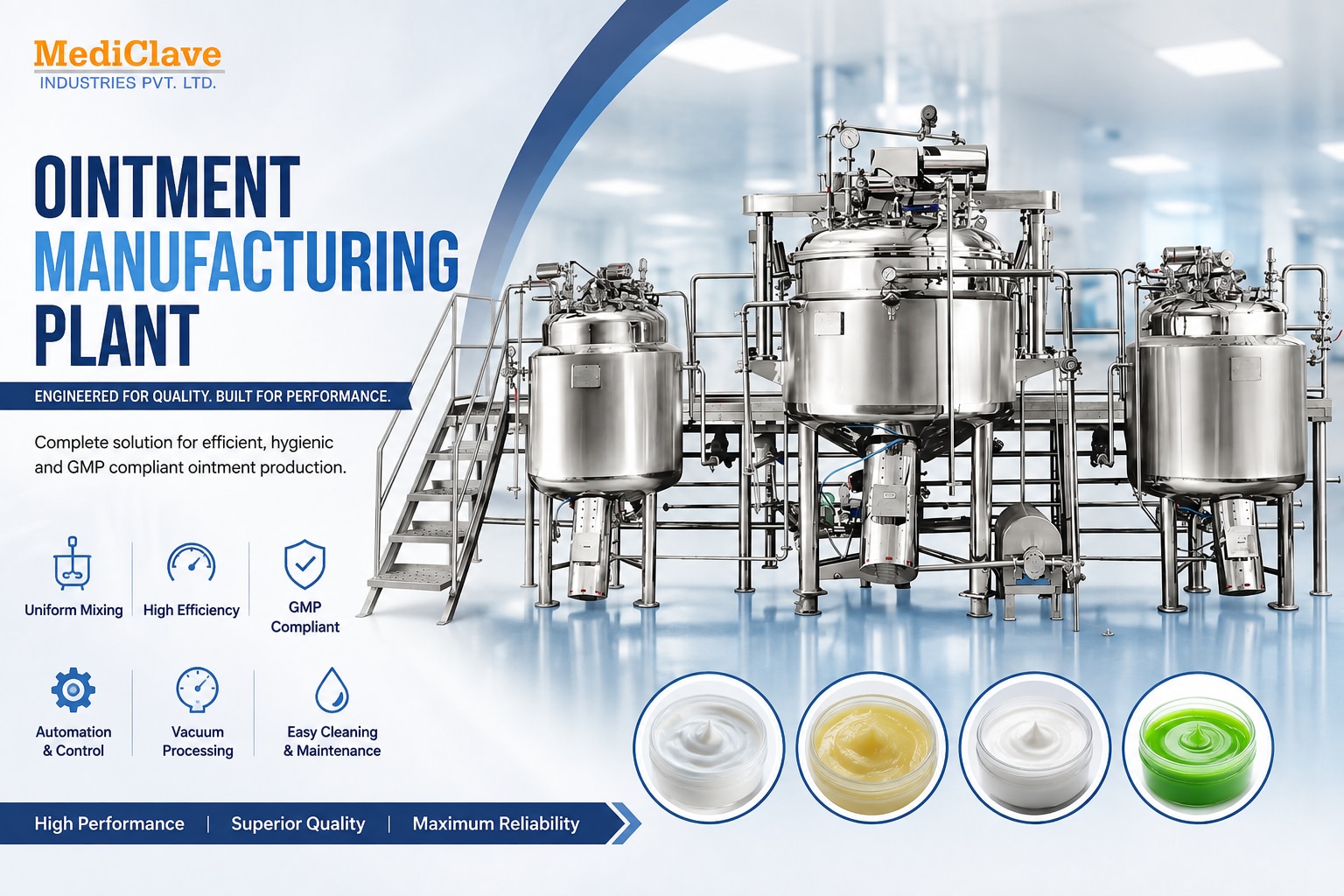
An ointment manufacturing plant is a complete processing system designed to manufacture different types of semi-solid pharmaceutical and cosmetic products efficiently. It combines mixing, heating, homogenization, vacuum processing, cooling, and storage into one integrated solution. Modern plants not only improve product quality but also reduce production time, minimize contamination risks, and increase manufacturing capacity.
For pharmaceutical companies, contract manufacturers, cosmetic industries, herbal product manufacturers, and research laboratories, investing in a reliable ointment manufacturing plant is a long-term decision that directly affects production efficiency, product quality, and customer satisfaction.
In this complete guide, we will explain everything you need to know about ointment manufacturing plants, including their working process, major components, applications, benefits, selection criteria, maintenance practices, and why Mediclave Industries is a trusted manufacturer of pharmaceutical process equipment.
What is an Ointment Manufacturing Plant?
An Ointment Manufacturing Plant is a fully integrated pharmaceutical processing system used for producing ointments, creams, gels, lotions, toothpaste, petroleum jelly products, cosmetic creams, and similar semi-solid formulations.
The plant performs multiple operations such as:
Heating of ingredients
Melting waxes and oils
Mixing raw materials
Vacuum homogenization
Emulsification
Cooling
Product transfer
Storage
The entire manufacturing process takes place inside hygienically designed stainless steel vessels that prevent contamination while maintaining product consistency.
Modern pharmaceutical plants comply with GMP guidelines and are manufactured using SS316L product contact parts for maximum hygiene and corrosion resistance.
Why is an Ointment Manufacturing Plant Important?
Producing pharmaceutical creams or ointments manually can create several challenges:
Uneven mixing
Air bubble formation
Product contamination
Batch inconsistency
Longer production time
Higher labor costs
A fully automatic ointment manufacturing plant solves these problems by ensuring:
Uniform mixing
Better homogenization
Controlled temperature
Vacuum processing
Higher productivity
Better product stability
The result is a smooth, homogeneous, high-quality product that meets pharmaceutical manufacturing standards.
Products Manufactured Using an Ointment Manufacturing Plant
One plant can manufacture a wide variety of products, including:
Antibiotic ointments
Antifungal creams
Pain relief gels
Burn creams
Skin care creams
Moisturizers
Cosmetic creams
Face gels
Sunscreen lotions
Petroleum jelly
Hair creams
Herbal ointments
Toothpaste
Cosmetic gels
Medicated creams
This versatility makes the machine suitable for pharmaceutical, cosmetic, herbal, veterinary, and personal care industries.
Main Components of an Ointment Manufacturing Plant
A complete pharmaceutical ointment manufacturing plant generally includes several integrated units.
Manufacturing Vessel
The manufacturing vessel is the heart of the system where ingredients are mixed and processed. It includes heating, cooling, insulation, anchor stirrer, scraper agitator, and homogenizer.
Oil Phase Vessel
This vessel is used for melting oils, waxes, and oil-soluble ingredients before transferring them into the main vessel.
Water Phase Vessel
Water-soluble ingredients are prepared separately inside this vessel under controlled heating conditions.
Vacuum System
The vacuum system removes trapped air from the product, improving texture and shelf life while preventing oxidation.
Homogenizer
A high-speed homogenizer produces fine particle size and creates a smooth, stable emulsion with excellent consistency.
Transfer Pump
The transfer system moves the finished product to storage tanks or filling machines without contamination.
Control Panel
Modern PLC or HMI-based control panels allow operators to monitor temperature, mixing speed, vacuum level, processing time, and batch parameters with ease.
Working Process of an Ointment Manufacturing Plant
The manufacturing process follows a carefully controlled sequence.
Step 1: Raw Material Preparation
All pharmaceutical ingredients are weighed according to the approved formulation.
Step 2: Oil Phase Preparation
Waxes, oils, and oil-soluble ingredients are heated in the oil phase vessel until completely melted.
Step 3: Water Phase Preparation
Water-soluble ingredients are heated separately in the water phase vessel.
Step 4: Mixing
Both phases are transferred into the main manufacturing vessel under controlled conditions.
Step 5: Homogenization
The homogenizer breaks down particles into microscopic sizes to produce a uniform and smooth cream or ointment.
Step 6: Vacuum Processing
Air bubbles are removed through vacuum processing, resulting in a dense and stable product.
Step 7: Cooling
The product is cooled while mixing continues to maintain consistency.
Step 8: Product Transfer
The finished product is transferred hygienically to storage tanks or automatic filling machines.
Industries That Use Ointment Manufacturing Plants
The system is widely used in:
Pharmaceutical companies
Cosmetic manufacturers
Ayurvedic medicine manufacturers
Herbal product manufacturers
Personal care industries
Veterinary pharmaceutical companies
Contract manufacturing organizations (CMOs)
Research laboratories
Biotechnology companies
Advantages of an Ointment Manufacturing Plant
Modern manufacturing plants provide numerous operational and commercial benefits.
Superior Product Quality
Vacuum homogenization produces smooth creams and ointments without lumps or air pockets.
High Productivity
Automated processing significantly reduces batch production time.
Better Hygiene
Closed manufacturing systems minimize contamination and comply with GMP requirements.
Energy Efficient
Optimized heating and cooling systems reduce energy consumption.
Batch Consistency
Every production batch maintains the same texture, viscosity, and quality.
Easy Cleaning
CIP-compatible designs simplify cleaning and reduce downtime.
Lower Labor Requirement
Automation reduces manual handling and operational costs.
Flexible Production
Different products can be manufactured using the same system with minimal adjustments.
Important Features to Look for Before Buying
When selecting an ointment manufacturing plant, buyers should evaluate:
GMP-compliant construction
SS316L product contact parts
Vacuum homogenizer
PLC automation
Variable speed mixing
Steam or electric heating
Efficient cooling system
CIP compatibility
Easy maintenance
Low power consumption
Reliable after-sales service
Spare parts availability
Common Challenges in Ointment Manufacturing
Even advanced pharmaceutical facilities may encounter production challenges.
Air Bubble Formation
Vacuum processing effectively eliminates entrapped air.
Product Separation
Proper homogenization prevents oil-water separation.
Temperature Fluctuation
Automatic temperature control ensures formulation stability.
Uneven Mixing
Anchor stirrers and scraper agitators maintain uniform blending.
Contamination
Closed processing systems significantly reduce contamination risks.
GMP Compliance and Quality Standards
A pharmaceutical ointment manufacturing plant should comply with:
GMP Guidelines
WHO GMP Standards
FDA Manufacturing Practices
ISO Quality Standards
Pharmaceutical Validation Requirements
Compliance helps manufacturers maintain product quality while meeting regulatory expectations.
Integration with Other Pharmaceutical Equipment
For a complete pharmaceutical production line, an ointment manufacturing plant is often integrated with complementary equipment from Mediclave Industries. A Liquid Syrup Manufacturing Process Plant can be used alongside semi-solid production facilities for manufacturers producing both liquid and topical formulations. You can explore this equipment here:
https://www.mediclaveindustries.in/liquid-syrup-manufacturing-process-plant
Manufacturers producing sterile products may also require a Saturated Steam Sterilizer (Autoclave) to sterilize equipment and accessories before production:
https://www.mediclaveindustries.in/saturated-steam-sterilizer
Facilities manufacturing injectable products frequently integrate a Pure Steam Generator to produce pharmaceutical-grade steam for sterilization processes:
https://www.mediclaveindustries.in/pure-steam-generator
Water quality is equally important in pharmaceutical manufacturing, making a Multi Column Distillation Plant an essential solution for producing Water for Injection (WFI):
https://www.mediclaveindustries.in/multi-column-distillation-plant
For maintaining hygienic process lines and minimizing contamination, many pharmaceutical plants also incorporate CIP & SIP Systems, which automate cleaning and sterilization of process equipment:
https://www.mediclaveindustries.in/cip-sip-system
By integrating these systems, manufacturers can build a complete pharmaceutical production facility that supports efficiency, compliance, and consistent product quality.
Maintenance Tips
Proper maintenance ensures long equipment life and reliable production.
Clean vessels after every batch.
Inspect seals and gaskets regularly.
Lubricate moving parts as recommended.
Calibrate temperature sensors periodically.
Check vacuum pump performance.
Verify homogenizer operation.
Maintain proper documentation.
Replace worn components promptly.
Follow preventive maintenance schedules.
Train operators on correct operating procedures.
Why Choose Mediclave Industries?
Mediclave Industries is committed to delivering advanced pharmaceutical process equipment designed for efficiency, reliability, and compliance. Every ointment manufacturing plant is engineered using premium-grade stainless steel, precision fabrication, and modern automation technologies to meet the needs of pharmaceutical, cosmetic, and herbal manufacturers.
Customers choose Mediclave Industries because of:
Robust GMP-compliant designs
High-quality SS316L construction
Custom-built capacities
Advanced vacuum homogenization technology
Energy-efficient systems
User-friendly controls
Reliable technical support
Comprehensive after-sales service
Competitive pricing
Proven industry expertise
Whether you are establishing a new pharmaceutical facility or expanding an existing production line, Mediclave Industries provides dependable solutions tailored to your manufacturing requirements.
Frequently Asked Questions (FAQs)
1. What is an ointment manufacturing plant used for?
It is used to manufacture pharmaceutical ointments, creams, gels, lotions, petroleum jelly products, cosmetic creams, toothpaste, and other semi-solid formulations.
2. What capacity options are available?
Plants are available in various capacities, ranging from small laboratory units to large-scale industrial production systems, depending on customer requirements.
3. Does the plant support vacuum processing?
Yes. Modern ointment manufacturing plants include vacuum systems to remove entrapped air and improve product quality.
4. Which industries benefit from this equipment?
Pharmaceutical, cosmetic, herbal, veterinary, biotechnology, and personal care industries commonly use ointment manufacturing plants.
5. Why is homogenization important?
Homogenization reduces particle size, improves emulsion stability, enhances texture, and ensures a smooth, uniform product.
6. Can the plant be customized?
Yes. Manufacturers can customize vessel capacity, automation level, heating method, mixing system, and additional features to match production needs.
7. Is the equipment GMP compliant?
Yes. High-quality ointment manufacturing plants are designed to meet GMP standards using hygienic construction and pharmaceutical-grade materials.
Conclusion
An Ointment Manufacturing Plant is much more than a mixing system—it is the foundation of consistent, high-quality semi-solid pharmaceutical production. By combining heating, mixing, homogenization, vacuum processing, and automated controls, it enables manufacturers to produce creams, ointments, gels, and related products efficiently while meeting strict quality and regulatory standards.
Choosing the right equipment can improve productivity, reduce operating costs, enhance product consistency, and support long-term business growth. When paired with complementary pharmaceutical process equipment such as sterilizers, water systems, and cleaning solutions, manufacturers can establish a fully integrated production facility capable of meeting the demands of today's pharmaceutical and cosmetic industries.
With its focus on innovation, quality, and customer support, Mediclave Industries continues to provide dependable pharmaceutical manufacturing solutions that help businesses achieve efficient production and deliver safe, high-quality products to the market.
