

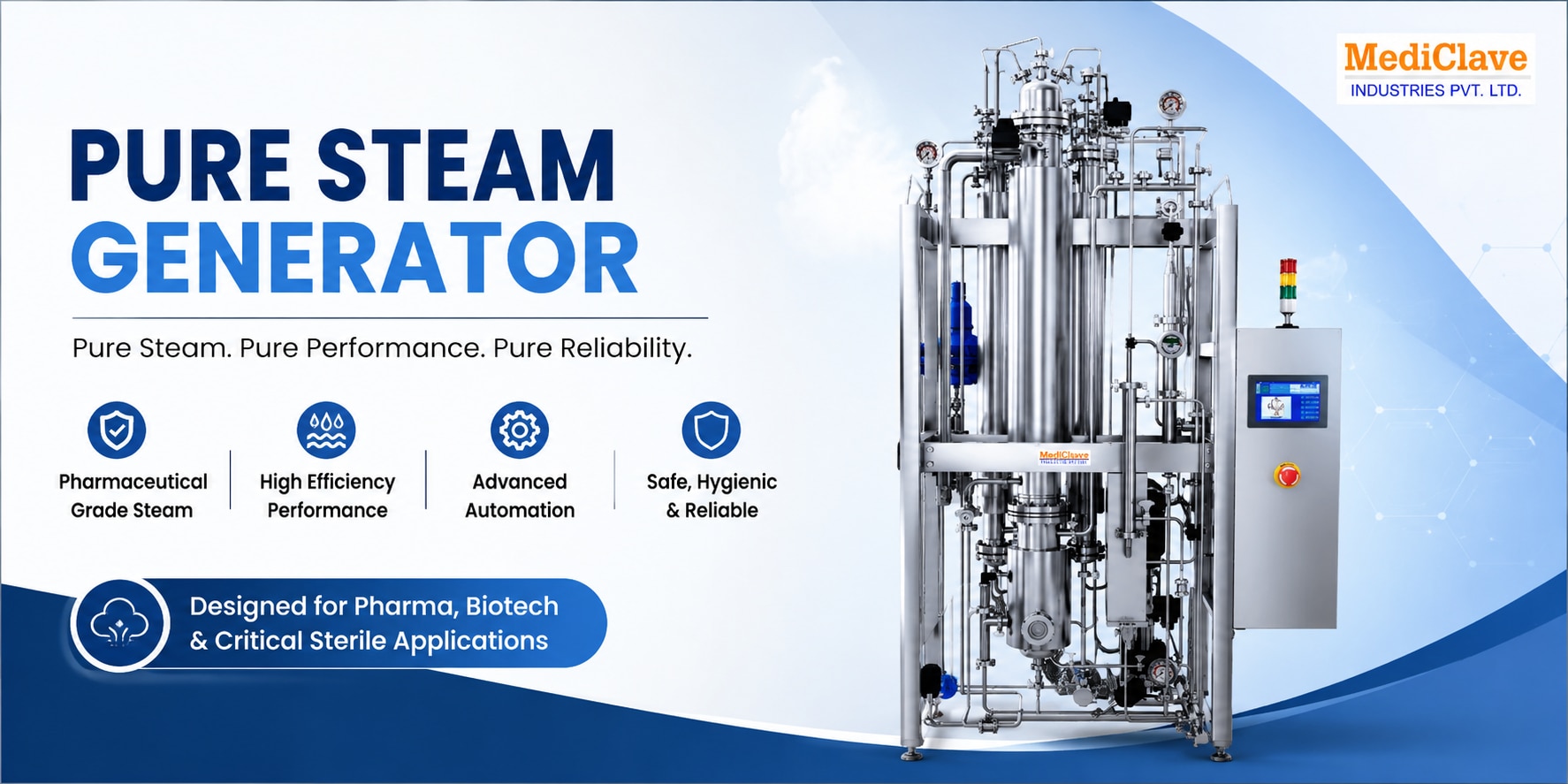
In the pharmaceutical and biotechnology industries, maintaining the highest standards of cleanliness and sterility is essential. Every product manufactured must meet strict quality requirements to ensure patient safety and comply with global regulatory standards. One of the most important utilities that supports these standards is a Pure Steam Generator (PSG).
Pure steam is not the same as ordinary industrial steam. It is specially produced using purified water or Water for Injection (WFI) and is free from contaminants, chemicals, and impurities that could compromise pharmaceutical production. It is widely used for sterilization, sanitization, SIP (Steam-in-Place), humidification, and numerous clean process applications.
A Pure Steam Generator plays a vital role in ensuring sterile manufacturing conditions while helping pharmaceutical companies maintain compliance with GMP, FDA, WHO, EU GMP, and other international regulations.
At Mediclave Industries, we manufacture high-quality pharmaceutical equipment designed to deliver reliable performance, operational efficiency, and regulatory compliance. Along with our Pure Steam Generator, we also provide complete pharmaceutical water systems, sterilization equipment, and process solutions that help manufacturers build fully integrated production facilities.
This comprehensive guide explains everything you need to know about Pure Steam Generators, including their working principle, components, applications, benefits, selection criteria, maintenance practices, validation requirements, and why they are indispensable for modern pharmaceutical manufacturing.
What is a Pure Steam Generator?
A Pure Steam Generator (PSG) is a specialized equipment designed to produce pharmaceutical-grade pure steam from purified water or Water for Injection. Unlike conventional steam boilers, which may introduce impurities through chemicals or untreated feed water, a Pure Steam Generator ensures that the generated steam remains free from contaminants and suitable for direct contact with pharmaceutical equipment and sterile production systems.
Pure steam is produced under controlled conditions using high-quality stainless steel construction and hygienic design principles. The generated steam possesses high purity, making it ideal for sterilization processes where product safety cannot be compromised.
The equipment is specifically engineered to prevent contamination, minimize maintenance, and consistently produce steam that meets stringent pharmaceutical standards.
Why Pure Steam Matters in Pharmaceutical Manufacturing
Sterility is one of the most critical aspects of pharmaceutical production. Even microscopic contamination can lead to product rejection, regulatory action, financial losses, or risks to patient health.
Pure steam helps eliminate these risks by providing contamination-free sterilization.
It is commonly used for:
- Sterilizing manufacturing vessels
- SIP (Steam-in-Place)
- Sterilizing transfer pipelines
- Autoclave applications
- Sterilizing filters
- Humidification in clean rooms
- Sterile process equipment
- Pharmaceutical manufacturing lines
- Biotechnology production
- Vaccine manufacturing
- Injectable manufacturing
- Laboratory sterilization
Without reliable pure steam generation, maintaining validated sterile manufacturing environments becomes extremely difficult.
How Does a Pure Steam Generator Work?
Although different manufacturers may use different designs, the basic working principle remains similar.
The process begins with purified water entering the feed system.
Step 1: Feed Water Supply
Purified water or Water for Injection enters the generator through a controlled feed system.
The water quality is continuously maintained according to pharmaceutical standards.
Step 2: Heat Transfer
Industrial plant steam enters the shell side of the evaporator.
This steam transfers heat without directly mixing with the purified water.
The purified water absorbs heat and gradually converts into steam.
Step 3: Steam Separation
The generated steam passes through specially designed separators.
These separators remove moisture droplets and ensure that only dry, high-quality pure steam exits the system.
This stage is essential for maintaining steam purity.
Step 4: Distribution
The generated pure steam is supplied to various pharmaceutical equipment including:
- Sterilizers
- SIP systems
- Manufacturing vessels
- Filling machines
- Transfer pipelines
- Sterile tanks
The distribution system maintains hygienic conditions throughout the process.
Major Components of a Pure Steam Generator
Understanding the individual components helps manufacturers appreciate how the equipment consistently delivers pharmaceutical-grade steam.
Evaporator
The evaporator serves as the heart of the system.
It converts purified water into pure steam using indirect heating.
Demister
The demister removes entrained water droplets from steam.
This ensures high dryness and purity.
Steam Separator
The separator improves steam quality by eliminating moisture carryover.
This is critical for pharmaceutical sterilization.
Feed Water Pump
The feed pump maintains a continuous supply of purified water to the evaporator.
Reliable pumping ensures uninterrupted steam production.
Control Panel
Modern Pure Steam Generators include PLC-based automation systems.
Operators can monitor:
- Temperature
- Pressure
- Conductivity
- Water level
- Steam output
- Alarm conditions
- Operating parameters
Automation reduces manual intervention while improving consistency.
Safety Valves
Pressure safety valves protect the equipment against abnormal operating conditions.
They ensure safe operation throughout production.
Stainless Steel Construction
Most pharmaceutical Pure Steam Generators are manufactured using:
- SS316L for product contact parts
- SS304 for structural components
Electropolished surfaces further enhance hygiene and cleanability.
Applications of Pure Steam Generators
Pure Steam Generators are widely used across pharmaceutical and healthcare industries.
Pharmaceutical Manufacturing
Sterile drug manufacturing relies heavily on pure steam for equipment sterilization.
Applications include:
- Injectable production
- Tablet manufacturing
- Capsule manufacturing
- Syrup production
- Ointment manufacturing
- Vaccine manufacturing
When manufacturing sterile formulations, companies often integrate a Pure Steam Generator with a Multi Column Distillation Plant to create a complete pharmaceutical water system.
Learn more:
https://www.mediclaveindustries.in/multi-column-distillation-plant/
Biotechnology Industry
Biotechnology facilities require contamination-free environments.
Pure steam is used for:
- Fermenters
- Bioreactors
- Cell culture equipment
- Sterile transfer systems
Maintaining sterile processing conditions is essential for biological products.
Vaccine Manufacturing
Vaccines demand highly sterile manufacturing environments.
Pure steam helps sterilize:
- Manufacturing vessels
- Filling systems
- Transfer pipelines
- Storage tanks
Laboratory Applications
Research laboratories frequently use pure steam for:
- Glassware sterilization
- Laboratory autoclaves
- Research equipment
- Sterile testing systems
Medical Device Manufacturing
Medical devices require sterile production processes.
Pure steam supports:
- Cleanroom sterilization
- Production equipment cleaning
- Packaging sterilization
Advantages of Using a Pure Steam Generator
Investing in a pharmaceutical-grade Pure Steam Generator provides significant operational benefits.
Superior Sterility
Pure steam contains no harmful contaminants.
It minimizes the risk of microbial contamination.
Regulatory Compliance
Pure Steam Generators help pharmaceutical companies comply with:
- GMP
- WHO
- US FDA
- EU GMP
- PIC/S
- ISO standards
Compliance simplifies audits and validation activities.
Improved Product Quality
High-purity steam prevents contamination during sterilization.
This directly contributes to consistent product quality.
Reliable SIP Operations
Steam-in-Place systems depend on stable steam quality.
Pure Steam Generators deliver reliable steam throughout the sterilization cycle.
Reduced Maintenance
Modern hygienic designs reduce scaling, corrosion, and contamination.
Maintenance becomes simpler and less frequent.
Energy Efficiency
Advanced heat recovery systems improve thermal efficiency.
This lowers utility consumption and operating costs.
Long Equipment Life
Premium stainless steel construction provides exceptional durability.
Proper maintenance allows the system to operate efficiently for many years.
Industries That Use Pure Steam Generators
Although pharmaceuticals represent the largest market, Pure Steam Generators are also used in many other industries.
These include:
- Pharmaceutical companies
- Biotechnology facilities
- Vaccine manufacturers
- Injectable plants
- Cosmetic manufacturing
- Veterinary pharmaceutical companies
- Research laboratories
- Healthcare institutions
- Medical device manufacturers
- Nutraceutical manufacturing
Integration with Other Pharmaceutical Systems
A Pure Steam Generator rarely operates as a standalone unit. It is typically integrated into a complete pharmaceutical utility system.
For example, purified water produced by a Multi Column Distillation Plant is often stored and circulated through a WFI Storage & Distribution System, ensuring a continuous supply of high-quality water for steam generation and sterile manufacturing.
Explore these solutions:
Multi Column Distillation Plant
https://www.mediclaveindustries.in/multi-column-distillation-plant/
WFI Storage & Distribution System
https://www.mediclaveindustries.in/wfi-storage-distribution-system/
Similarly, Pure Steam Generators are frequently paired with CIP & SIP Systems, enabling automated cleaning and steam sterilization of process equipment without dismantling production lines. This integration improves efficiency, reduces downtime, and supports validated pharmaceutical processes.
Learn more about CIP & SIP Systems:
https://www.mediclaveindustries.in/cip-sip-system/
In sterile manufacturing facilities, the generated pure steam is also supplied to pharmaceutical sterilization equipment such as Saturated Steam Sterilizers (Autoclaves) for sterilizing equipment, containers, and components before production.
Discover more:
https://www.mediclaveindustries.in/saturated-steam-sterilizer/
Factors to Consider When Choosing a Pure Steam Generator
Selecting the right Pure Steam Generator is a critical decision that directly impacts production efficiency, regulatory compliance, operating costs, and long-term reliability. Before investing in a system, pharmaceutical manufacturers should carefully evaluate several technical and operational factors.
Production Capacity
The first consideration is the amount of pure steam required for daily operations. Capacity should be determined based on:
- Number of sterilization cycles
- Number of SIP points
- Production schedule
- Future plant expansion
- Peak steam demand
Choosing an undersized system can lead to production delays, while an oversized system increases unnecessary capital and operating costs.
Steam Quality
The primary purpose of a Pure Steam Generator is to produce pharmaceutical-grade steam. The generated steam should comply with applicable pharmacopeia requirements and remain free from:
- Pyrogens
- Endotoxins
- Chemicals
- Dissolved solids
- Microorganisms
- Particulates
Consistent steam quality ensures reliable sterilization and protects product integrity.
Material of Construction
High-quality construction materials improve durability and hygiene.
Most pharmaceutical Pure Steam Generators are manufactured using:
- SS316L for all product-contact parts
- SS304 for non-product-contact components
Electropolished internal surfaces further reduce microbial growth and simplify cleaning.
Automation Level
Modern pharmaceutical plants prefer automated systems that reduce manual intervention.
A PLC and HMI-based control system allows operators to monitor:
- Temperature
- Pressure
- Feed water flow
- Steam pressure
- Alarm history
- Trend data
- Operating status
Automation also minimizes human error and supports validation documentation.
Energy Efficiency
Energy consumption represents a significant operating cost over the equipment's lifetime.
Features that improve efficiency include:
- Heat recovery systems
- High-performance insulation
- Efficient heat exchangers
- Optimized steam separation
- Low water consumption
Energy-efficient systems reduce utility costs while supporting sustainable manufacturing.
Service and Spare Parts Availability
Reliable after-sales service is just as important as equipment quality.
Manufacturers should ensure:
- Fast technical support
- Availability of spare parts
- Installation assistance
- Validation support
- Preventive maintenance services
Working with an experienced manufacturer minimizes downtime and improves long-term performance.
GMP Design Features of a Pure Steam Generator
Pharmaceutical equipment must comply with Good Manufacturing Practices (GMP). A well-designed Pure Steam Generator incorporates several hygienic features to maintain product quality and simplify validation.
Some important GMP features include:
- Dead-leg-free piping design
- Self-draining construction
- Orbital welded joints
- Electropolished internal surfaces
- Hygienic diaphragm valves
- Sanitary connections
- Low surface roughness
- Easy accessibility for maintenance
- Automated control and monitoring
- Complete documentation package
These features help maintain sterility throughout the production process and simplify regulatory inspections.
Validation of a Pure Steam Generator
Validation is an essential requirement in pharmaceutical manufacturing. It demonstrates that equipment consistently performs as intended and produces reproducible results.
A Pure Steam Generator generally undergoes three major qualification stages.
Installation Qualification (IQ)
IQ confirms that the equipment has been installed correctly according to approved specifications.
It includes verification of:
- Equipment installation
- Material certificates
- Utility connections
- Piping
- Instrumentation
- Calibration certificates
- Electrical installation
- Documentation
Operational Qualification (OQ)
OQ verifies that the equipment performs correctly under normal operating conditions.
Typical OQ tests include:
- Temperature verification
- Pressure testing
- Alarm testing
- Safety interlock verification
- Control system checks
- Functional testing
Performance Qualification (PQ)
PQ demonstrates that the equipment consistently produces pharmaceutical-grade pure steam during routine production.
It includes:
- Steam quality testing
- Endotoxin testing
- Conductivity testing
- Repeatability studies
- Sterility verification
Successful IQ, OQ, and PQ qualification ensures regulatory compliance and provides confidence in the equipment's performance.
Routine Maintenance of a Pure Steam Generator
Proper maintenance is essential for ensuring reliable operation and maximizing equipment life.
Recommended maintenance activities include:
Daily Inspection
- Check operating pressure
- Verify feed water supply
- Observe temperature readings
- Inspect for leaks
- Monitor alarms
Weekly Inspection
- Inspect valves
- Check gauges
- Verify control panel operation
- Clean external surfaces
Monthly Inspection
- Examine safety valves
- Check pump performance
- Inspect insulation
- Review operating records
Annual Preventive Maintenance
Annual maintenance generally includes:
- Calibration of instruments
- Inspection of heat exchanger
- Replacement of worn seals
- Safety valve testing
- Comprehensive performance evaluation
Following a preventive maintenance schedule helps reduce unexpected downtime and improves system reliability.
Common Problems and Their Solutions
Even well-maintained systems may occasionally experience operational issues. Understanding common problems allows faster troubleshooting.
Low Steam Output
Possible causes include:
- Insufficient feed water
- Low plant steam pressure
- Scaling inside the heat exchanger
- Pump malfunction
Solution:
Inspect the feed system, verify utility supply, and perform cleaning if required.
Wet Steam
Possible reasons:
- Damaged separator
- High water carryover
- Excessive steam load
Solution:
Inspect the separator and verify operating conditions.
Pressure Fluctuation
Possible causes:
- Faulty pressure control valve
- Instrument calibration issue
- Feed water instability
Solution:
Check pressure control components and recalibrate instruments if necessary.
High Conductivity
Possible causes:
- Poor feed water quality
- Contamination
- Improper separator operation
Solution:
Inspect the water treatment system and verify separator performance.
Common Mistakes to Avoid
Many operational issues can be prevented by avoiding common mistakes.
These include:
- Using untreated feed water
- Ignoring preventive maintenance
- Delaying calibration
- Operating beyond design capacity
- Using non-approved spare parts
- Neglecting validation activities
- Improper shutdown procedures
- Poor operator training
Implementing proper operating procedures significantly improves equipment performance and longevity.
Importance of Water Quality
Water quality is one of the most critical factors affecting Pure Steam Generator performance.
Poor-quality feed water can cause:
- Scaling
- Corrosion
- Reduced efficiency
- Steam contamination
- Increased maintenance
For this reason, pharmaceutical manufacturers typically integrate the Pure Steam Generator with a Multi Column Distillation Plant and a WFI Storage & Distribution System to ensure a continuous supply of pharmaceutical-grade water.
A complete utility system helps maintain consistent water quality while supporting regulatory compliance throughout the manufacturing process.
Why Integration with CIP & SIP Systems Matters
Modern pharmaceutical plants aim to automate cleaning and sterilization processes as much as possible.
A CIP & SIP System works seamlessly with a Pure Steam Generator to achieve this goal.
The benefits include:
- Reduced manual cleaning
- Consistent sterilization cycles
- Improved production efficiency
- Lower contamination risk
- Faster equipment turnaround
- Reduced downtime
- Better validation support
This combination is widely used in injectable manufacturing, biotechnology facilities, vaccine plants, and sterile processing environments.
Future Trends in Pure Steam Generation
The pharmaceutical industry continues to adopt advanced technologies that improve productivity, sustainability, and compliance.
Some emerging trends include:
Smart Automation
Industry 4.0 technologies enable remote monitoring, predictive maintenance, and real-time data analysis.
Energy Optimization
New heat recovery systems reduce energy consumption while maintaining high steam quality.
Digital Validation
Electronic records and automated reporting simplify validation and regulatory audits.
Sustainable Manufacturing
Manufacturers are increasingly focusing on reducing water consumption, minimizing energy use, and lowering carbon emissions.
Compact Modular Designs
Modern Pure Steam Generators are available in compact, skid-mounted configurations that simplify installation and reduce plant footprint.
These innovations help pharmaceutical companies improve operational efficiency while meeting increasingly stringent regulatory expectations.
Why Choose Mediclave Industries?
Mediclave Industries is committed to delivering high-quality pharmaceutical process and sterilization equipment that meets the evolving needs of the healthcare and pharmaceutical sectors.
Our Pure Steam Generators are designed with:
- GMP-compliant construction
- High-quality SS316L contact parts
- Reliable PLC-based automation
- Hygienic design
- Energy-efficient operation
- Easy maintenance
- Long service life
- Comprehensive documentation
- Excellent after-sales support
In addition to Pure Steam Generators, Mediclave Industries offers a complete range of pharmaceutical equipment, including:
- Multi Column Distillation Plants
- WFI Storage & Distribution Systems
- CIP & SIP Systems
- Saturated Steam Sterilizers
- Super Heated Water Shower Sterilizers
- Steam Air Mixture Sterilizers
- Ointment Manufacturing Plants
- Liquid Syrup Manufacturing Plants
- Injectable Manufacturing Vessels
These integrated solutions enable pharmaceutical companies to establish efficient, compliant, and future-ready manufacturing facilities.
Frequently Asked Questions (FAQs)
1. What is the difference between pure steam and industrial steam?
Pure steam is generated from purified water or Water for Injection and is free from contaminants, making it suitable for pharmaceutical applications. Industrial steam is generally produced from treated boiler water and is not intended for direct pharmaceutical use.
2. Where is a Pure Steam Generator used?
It is widely used in pharmaceutical manufacturing, biotechnology, vaccine production, injectable plants, medical device manufacturing, research laboratories, and sterile processing facilities.
3. Why is SS316L used in Pure Steam Generators?
SS316L offers excellent corrosion resistance, superior hygienic properties, and compatibility with pharmaceutical-grade water and steam.
4. Can a Pure Steam Generator be integrated with SIP systems?
Yes. Pure Steam Generators are specifically designed to supply high-purity steam for Steam-in-Place (SIP) applications.
5. Does a Pure Steam Generator require validation?
Yes. Installation Qualification (IQ), Operational Qualification (OQ), and Performance Qualification (PQ) are essential to demonstrate compliance with pharmaceutical regulations.
6. How often should maintenance be performed?
Routine inspections should be carried out daily, while preventive maintenance and calibration should follow the manufacturer's recommended schedule, typically on an annual basis.
7. What feed water should be used?
Only Purified Water (PW) or Water for Injection (WFI) should be used to ensure pharmaceutical-grade steam quality.
8. Is automation important in a Pure Steam Generator?
Yes. PLC-based automation improves process control, reduces manual intervention, enhances traceability, and supports regulatory compliance.
Conclusion
A Pure Steam Generator is a cornerstone of sterile pharmaceutical manufacturing. By generating high-purity steam from purified water or Water for Injection, it enables safe sterilization, reliable Steam-in-Place operations, and contamination-free production processes.
Whether manufacturing injectable drugs, vaccines, biotechnology products, cosmetics, or medical devices, investing in a high-quality Pure Steam Generator contributes to better product quality, regulatory compliance, and operational efficiency. When integrated with systems such as a Multi Column Distillation Plant, WFI Storage & Distribution System, CIP & SIP System, and Saturated Steam Sterilizer, it forms the backbone of a modern pharmaceutical utility infrastructure.
At Mediclave Industries, we understand the critical requirements of pharmaceutical manufacturing and provide advanced, GMP-compliant equipment engineered for performance, reliability, and long-term value. Our comprehensive portfolio of pharmaceutical water systems, sterilization solutions, and process equipment is designed to help manufacturers achieve the highest standards of quality and productivity.
If you are planning a new pharmaceutical facility or upgrading an existing one, choosing the right Pure Steam Generator and integrated utility systems is an investment that supports safe production, regulatory confidence, and sustainable growth for years to come.
