

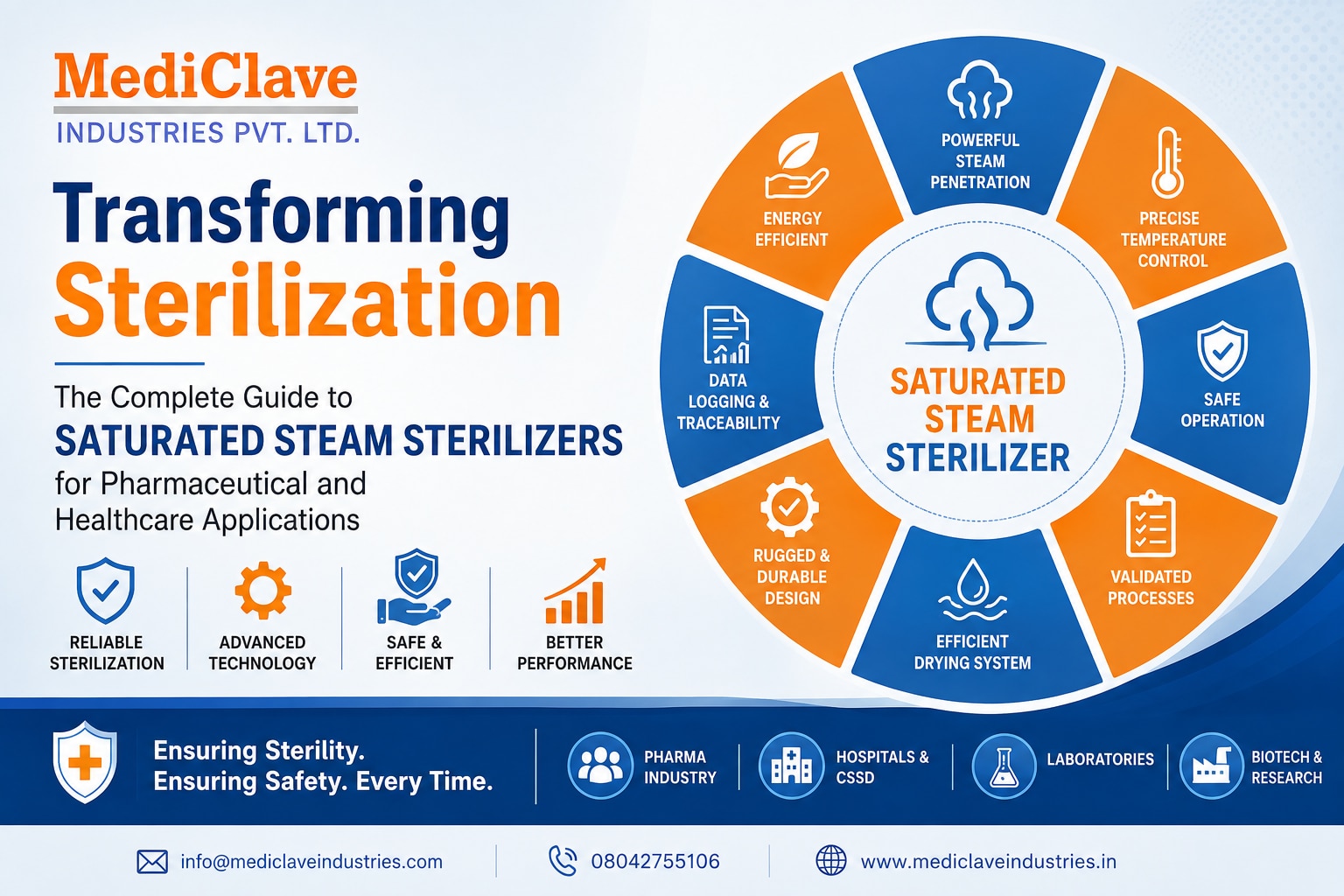
Transforming Sterilization: The Complete Guide to Saturated Steam Sterilizers for
Pharmaceutical and Healthcare Applications
Sterilization is one of the most important processes in pharmaceutical manufacturing, hospitals, laboratories, biotechnology facilities, and other healthcare environments. When equipment, instruments, containers, or production components are used in a sterile process, even a small amount of microbial contamination can affect product quality, patient safety, and the reliability of the entire operation. This is why selecting a dependable sterilization system is not simply an equipment purchase—it is an important part of building a safe, controlled, and efficient facility.
Among the different sterilization technologies available today, the Saturated Steam Sterilizer remains one of the most trusted and widely used solutions. It uses saturated steam under controlled temperature and pressure conditions to transfer heat efficiently to the load and destroy microorganisms. Because steam provides excellent heat transfer, the technology can deliver effective and repeatable sterilization when the equipment, loading pattern, cycle parameters, and process are properly validated.
Modern pharmaceutical and healthcare facilities need more than a basic sterilization chamber. They require equipment designed around process control, safety, automation, documentation, hygiene, maintenance, and validation. This is where a well-engineered saturated steam sterilization system can make a significant difference.
Mediclave Industries provides sterilization solutions for pharmaceutical, healthcare, hospital, biotechnology, and life-science applications, including its Saturated Steam Sterilizer (Autoclave). The system is designed for applications where reliable steam-based sterilization is required and can form an important part of a modern sterile processing environment.
What Is a Saturated Steam Sterilizer?
A Saturated Steam Sterilizer is a sterilization system that uses saturated steam under controlled pressure and temperature to destroy microorganisms. Saturated steam contains the maximum amount of water vapour possible at a specific temperature and pressure. When this steam comes into contact with a cooler load surface, it condenses and releases a large amount of latent heat.
This heat transfer is one of the major reasons steam sterilization is so effective.
The process can destroy a wide range of microorganisms, including bacteria, fungi, viruses, and bacterial spores, provided that the appropriate validated conditions are achieved throughout the load.
Unlike dry heat sterilization, which depends on hot air, saturated steam sterilization uses moist heat. The presence of moisture allows heat to transfer efficiently, which generally makes steam sterilization faster and highly effective for compatible materials.
A modern saturated steam sterilizer can be used for suitable pharmaceutical components, production accessories, stainless steel equipment, containers, garments, laboratory items, and healthcare instruments. The exact application depends on the equipment configuration and the validated sterilization cycle.
Why Saturated Steam Sterilization Is So Important
In sterile manufacturing and healthcare, the objective of sterilization is not simply to make an item appear clean. Cleaning removes visible dirt, residues, and other contaminants, while sterilization is a controlled process intended to eliminate viable microorganisms to the required level.
A properly designed saturated steam sterilization process can help facilities:
Reduce microbial contamination
Protect product and patient safety
Support consistent batch processing
Improve process reliability
Support GMP-oriented manufacturing
Reduce the risk of contamination-related failures
Create repeatable sterilization cycles
Improve operational confidence
For pharmaceutical companies, sterilization may be required for production equipment, components, containers, garments, and other items that come into contact with sterile products. In hospitals, steam sterilization is widely associated with processing suitable surgical instruments and reusable medical items.
The key is to understand that the sterilizer is only one part of the overall process. Cleaning, preparation, packaging, loading, sterilization, unloading, storage, and documentation must all work together.
How Does a Saturated Steam Sterilizer Work?
The operating principle of a saturated steam sterilizer is relatively simple, but achieving reliable sterilization requires careful control.
The process generally begins with loading the material into the sterilization chamber. The load must be arranged properly so that steam can contact the required surfaces. Poor loading can create cold spots or prevent steam from reaching difficult areas.
The next stage involves removing unwanted air from the chamber. Air is a poor substitute for steam during sterilization, and trapped air can interfere with effective steam contact and heat transfer. Depending on the sterilizer design, air removal can be achieved through steam displacement, vacuum-assisted systems, or other suitable methods.
Once the chamber conditions are ready, saturated steam is introduced. Steam surrounds the load and begins transferring heat to the surfaces.
As steam condenses on cooler surfaces, it releases latent heat. This raises the temperature of the load and supports microbial destruction.
The load is then held at the required sterilization conditions for the validated exposure period. Common steam sterilization cycles may involve temperatures such as 121°C or 134°C, but the actual temperature, holding time, pressure, and cycle configuration must be determined according to the application and validation requirements rather than assumed universally.
After the sterilization phase, the system may enter drying and cooling stages. Proper drying can be particularly important for loads that need to remain dry before storage or further processing.
Finally, the sterilized material is unloaded according to the facility's established procedures.
What Can Be Sterilized Using Saturated Steam?
One of the biggest advantages of saturated steam sterilization is its versatility. However, not every material is suitable for steam, so the load should always be evaluated before processing.
Suitable applications may include:
Stainless steel components
Surgical instruments
Metal instruments
Glassware
Suitable laboratory equipment
Pharmaceutical production accessories
Garments
Containers
Certain rubber components
Compatible utensils and tools
Other heat- and moisture-resistant materials
The material should be capable of tolerating the temperature, pressure, moisture, and other conditions associated with the selected cycle.
For materials that cannot tolerate moisture or conventional steam temperatures, another sterilization technology may be more appropriate.
For example, a Dry Heat Sterilizer uses controlled hot air rather than steam and can be useful for suitable moisture-sensitive, heat-resistant materials such as certain glassware, metal components, powders, oils, and pharmaceutical containers. This difference highlights why sterilization technology should always be selected according to the product and process rather than using one method for every application.
Saturated Steam Sterilizer vs. Dry Heat Sterilizer
Both systems are designed to achieve sterilization, but they work differently.
A Saturated Steam Sterilizer uses moist heat. Steam condenses on the load and transfers heat rapidly. This makes it highly effective for many heat- and moisture-resistant materials.
A Dry Heat Sterilizer uses hot air without introducing moisture. It is therefore more appropriate when moisture could damage the material or affect the product.
In simple terms:
Saturated Steam Sterilizer: moist heat, excellent heat transfer, suitable for compatible heat- and moisture-resistant loads.
Dry Heat Sterilizer: dry hot air, higher temperatures, suitable for certain heat-resistant and moisture-sensitive materials.
The choice should be based on the material, product characteristics, validated cycle, regulatory requirements, and overall process design.
Important Features of a Modern Saturated Steam Sterilizer
A modern sterilizer should provide more than temperature and pressure control. Reliable equipment needs to support safe operation and consistent process performance.
Important features may include a robust stainless-steel chamber, controlled steam distribution, accurate temperature and pressure monitoring, programmable cycles, PLC-based automation, HMI operation, safety interlocks, alarms, and appropriate documentation capabilities.
Depending on the application, customers may also require:
Automatic cycle control
Multiple sterilization programs
Temperature sensors
Pressure transmitters
Data recording
Batch documentation
Safety door locking
Emergency protection
Validation ports
Vacuum systems
Drying systems
Clean-steam compatibility
Customized chamber capacity
Single-door or double-door configuration
The exact specification should be finalized according to the facility's process requirements.
For regulated pharmaceutical operations, documentation and validation support are particularly important. The sterilizer should be considered as part of a complete validated process rather than as an isolated machine.
Role of Steam Quality in Sterilization
Steam quality has a direct influence on steam sterilization performance.
If the steam contains excessive moisture, non-condensable gases, contaminants, or other undesirable characteristics, the process may not perform as intended. For pharmaceutical applications, facilities may therefore require high-quality clean or pure steam depending on the process.
This is why the steam supply system should be considered when planning a sterilizer installation.
A facility that requires dedicated pharmaceutical steam generation can also evaluate a Pure Steam Generator as part of its broader utility infrastructure.
A properly designed steam system helps provide the required steam quality and supports reliable sterilization performance.
Importance of Air Removal
Air removal is one of the most important aspects of steam sterilization.
Steam needs to contact the surfaces being sterilized. If pockets of air remain trapped inside the chamber or load, the steam may not reach those areas effectively.
This can create differences in temperature and reduce the reliability of the process.
For this reason, the sterilizer's air-removal method, loading pattern, chamber design, and cycle development all need careful consideration.
Vacuum-assisted sterilizers can provide controlled air removal before steam exposure. However, the correct system depends on the type of load and the intended application.
Why Loading Practices Matter
Even an advanced sterilizer cannot compensate for incorrect loading.
The load should be arranged according to the equipment manufacturer's instructions and the validated process. Materials should not be packed so tightly that steam cannot circulate effectively.
Containers, instruments, trays, garments, and other items should be positioned to support steam penetration and heat transfer.
Overloading can create problems such as:
Poor steam penetration
Uneven temperature distribution
Longer heating times
Wet loads
Inconsistent sterilization
Reduced process repeatability
A properly designed CSSD or pharmaceutical sterilization workflow therefore considers the sterilizer, loading accessories, racks, trolleys, packaging, and operating procedures together.
For hospital environments, Mediclave also offers high-pressure steam sterilization equipment such as the Horizontal Rectangular High-Pressure Steam Sterilizer, designed for larger and more demanding heat- and moisture-resistant loads.
Applications in the Pharmaceutical Industry
Pharmaceutical manufacturing requires strict control of contamination because sterile products can be highly sensitive to microbial contamination.
Saturated steam sterilizers can be used for suitable pharmaceutical applications such as:
Production equipment sterilization
Stainless steel components
Manufacturing accessories
Containers
Garments
Utensils
Laboratory equipment
Compatible rubber components
Other heat- and moisture-resistant materials
The equipment can become an important part of a pharmaceutical facility's contamination-control strategy.
For example, rubber stoppers used for injectable products may require specialized processing. In such cases, a dedicated Rubber Bung Processor Cum Steam Sterilizer can integrate washing, rinsing, siliconization, steam sterilization, drying, and cooling into a controlled process.
This demonstrates an important principle: saturated steam is a powerful sterilization medium, but the equipment configuration should be selected according to the specific product and process.
Applications in Hospitals and CSSD Departments
In hospitals, steam sterilization is commonly used for compatible reusable medical instruments and equipment.
A Central Sterile Supply Department may process surgical instruments, trays, textiles, dressing materials, and other reusable items. The sterilization equipment needs to fit into a controlled workflow that begins with receiving contaminated items and ends with the distribution of sterile supplies.
For larger hospital operations, equipment capacity becomes particularly important. The hospital should consider:
Number of operating rooms
Number of daily surgeries
Instrument volume
Number of sterilization cycles
Peak workload
Future expansion
Available floor space
Loading and unloading arrangements
Utility requirements
Maintenance requirements
Choosing the right chamber size can help prevent the sterilizer from becoming a bottleneck in the CSSD.
Saturated Steam Sterilization for Different Load Types
Different loads behave differently during sterilization.
Metal instruments generally transfer heat efficiently. Textiles can require careful loading to allow proper steam penetration. Containers and hollow instruments may require specific cycle development. Rubber components may have different temperature and pressure limitations.
This means that a single cycle should not automatically be applied to every type of load.
Facilities should develop and validate suitable cycles based on:
Load type
Load quantity
Packaging
Container configuration
Material characteristics
Temperature requirements
Exposure time
Steam quality
Drying requirements
Proper cycle development improves confidence that the entire load—not just the chamber air—is receiving the required sterilization conditions.
Validation and Process Monitoring
Sterilization validation is essential when consistent and documented sterilization performance is required.
Validation activities may include installation qualification, operational qualification, performance qualification, temperature mapping, heat penetration studies, calibration, and biological or other appropriate process challenge testing.
The precise validation program depends on the application, facility procedures, regulatory expectations, and equipment configuration.
Monitoring critical parameters such as temperature, pressure, time, and other process variables provides evidence that the cycle is operating within the defined limits.
Modern PLC and HMI systems can help operators manage programmed cycles and monitor process conditions more efficiently.
The goal is not simply to operate the sterilizer. The goal is to demonstrate that the sterilization process is reproducible and appropriate for the intended load.
Maintenance of a Saturated Steam Sterilizer
Regular maintenance helps protect equipment reliability and process consistency.
A maintenance program should address areas such as chamber condition, door seals, valves, sensors, steam lines, filters, pumps, vacuum systems, safety devices, control systems, and other critical components.
Operators should also follow the manufacturer's recommended inspection and maintenance schedule.
Preventive maintenance can help identify problems before they become major failures.
It is equally important to maintain accurate calibration of temperature and pressure instruments. If a sensor provides incorrect information, the displayed cycle parameters may not accurately represent actual process conditions.
Training operators is another important part of maintenance and reliability. Personnel should understand correct loading, cycle selection, safety procedures, unloading, cleaning, and reporting requirements.
Saturated Steam Sterilizer vs. Other Sterilization Technologies
Modern facilities may use several sterilization technologies because different materials require different approaches.
For heat- and moisture-resistant materials, saturated steam is often an excellent option.
For heat-sensitive and moisture-sensitive medical devices, an ETO Sterilizer can provide low-temperature sterilization using ethylene oxide. It is designed for applications involving materials such as certain plastics, rubber components, electronics, and complex medical devices that cannot tolerate conventional steam sterilization.
For sealed pharmaceutical liquid products, other specialized systems may be more appropriate. A Super Heated Water Shower Sterilizer uses controlled heated water and is designed for applications such as IV fluids, vials, ampoules, infusion bags, and injectable products.
Similarly, a Steam + Air Mixture Sterilizer can be considered for sealed pharmaceutical products where pressure balancing is important. It combines steam with filtered air to help control pressure while providing effective heat transfer.
Therefore, the best sterilization strategy may involve multiple technologies rather than relying on one system for every application.
How to Choose the Right Saturated Steam Sterilizer
Before purchasing a saturated steam sterilizer, buyers should evaluate the complete process rather than focusing only on chamber capacity or equipment price.
Consider the following questions:
What will you sterilize? Identify the materials, products, instruments, and components that will be processed.
How much will you sterilize? Estimate the normal and peak batch sizes.
What cycle is required? Determine the validated temperature, exposure time, pressure, air-removal, and drying requirements.
What level of automation is needed? Consider PLC control, HMI, data recording, alarms, recipes, and reporting.
What utilities are available? Review steam, water, electricity, compressed air, drainage, and other site requirements.
What validation is required? Pharmaceutical facilities may require extensive qualification and documentation.
What are the future requirements? Select equipment that can support expected production or hospital growth.
Who will provide technical support? Consider installation, commissioning, training, spare parts, preventive maintenance, and after-sales service.
A reliable manufacturer should be able to understand the application and recommend an appropriate configuration rather than offering a generic machine.
Why Choose Mediclave Industries for Sterilization Solutions?
Mediclave Industries Pvt. Ltd. provides sterilization and pharmaceutical process equipment for healthcare, pharmaceutical, laboratory, and life-science applications.
Its portfolio covers different sterilization requirements, allowing customers to select technology according to their material and process.
The company's solutions include Saturated Steam Sterilizers, Dry Heat Sterilizers, ETO Sterilizers, Rubber Bung Processor Cum Steam Sterilizers, Super Heated Water Shower Sterilizers, and Steam + Air Mixture Sterilizers.
This broad range is valuable because modern facilities often need different sterilization approaches for different materials and products.
The focus should always remain on reliable engineering, hygienic construction, process control, safety, validation support, and long-term operational performance.
Final Thoughts
A Saturated Steam Sterilizer continues to be one of the most dependable sterilization technologies for compatible pharmaceutical, healthcare, hospital, laboratory, and biotechnology applications.
Its strength comes from the excellent heat-transfer characteristics of saturated steam. When air removal, steam quality, temperature, pressure, exposure time, loading, and drying are properly controlled, steam sterilization can provide highly repeatable results.
However, choosing a sterilizer should never be based only on capacity or purchase price. The equipment must match the intended load, facility workflow, process requirements, utilities, automation needs, validation expectations, and future production demands.
For conventional heat- and moisture-resistant loads, a saturated steam system can provide an efficient and proven solution. For other applications, facilities may need Dry Heat, ETO, Super Heated Water Shower, or Steam + Air Mixture technology.
The right solution is therefore the one that matches the process.
Mediclave Industries combines a broad sterilization portfolio with pharmaceutical and healthcare equipment expertise to help customers select suitable solutions for their individual requirements. Whether you are establishing a new pharmaceutical plant, expanding a sterile manufacturing facility, upgrading a hospital CSSD, or replacing an existing sterilizer, understanding your process requirements is the first step toward making a confident equipment decision.
For more information about Saturated Steam Sterilizers and other sterilization solutions, contact Mediclave Industries Pvt. Ltd.
Mediclave Industries Pvt. Ltd.
Email: info@mediclaveindustries.com
Phone: 08042755106
Website: https://www.mediclaveindustries.in/
