

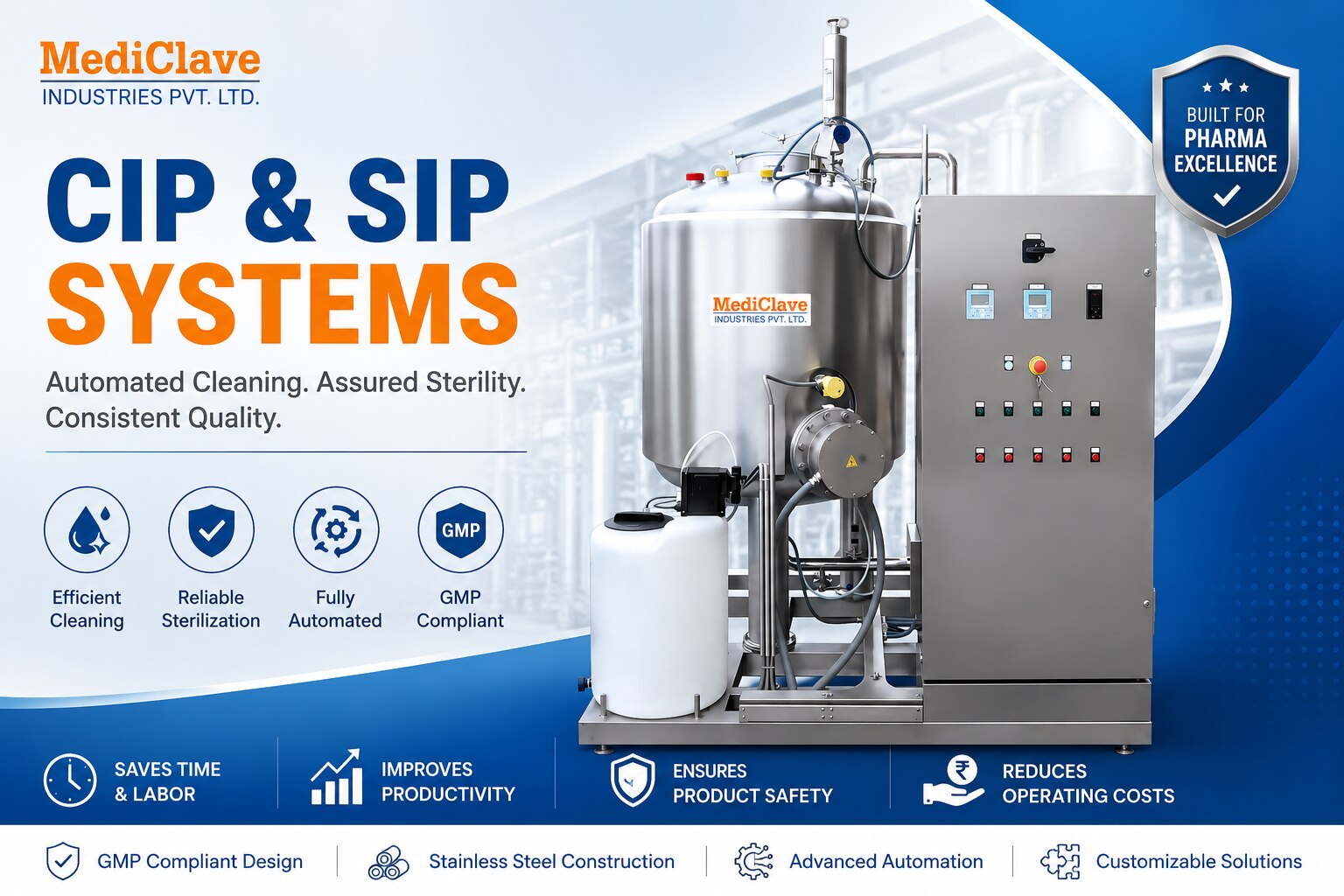
What Are CIP & SIP Systems and Why Are They Essential for Modern Pharmaceutical Manufacturing?
In the pharmaceutical industry, cleanliness is much more than just keeping equipment looking neat. Every product manufactured must meet strict quality and safety standards to ensure that patients receive medicines that are free from contamination. Even the smallest amount of residue or bacteria left inside a manufacturing system can affect product quality, reduce production efficiency, and create serious compliance issues.
This is why pharmaceutical manufacturers around the world rely on CIP (Clean-in-Place) and SIP (Sterilize-in-Place) Systems. These advanced cleaning and sterilization solutions help manufacturers maintain hygienic production environments without dismantling their equipment. They save time, reduce manual labor, improve safety, and ensure consistent cleaning results.
Whether you manufacture injectable medicines, oral liquids, vaccines, biotechnology products, or other pharmaceutical formulations, understanding CIP & SIP Systems is essential for maintaining high production standards.
In this blog, we'll explain what CIP & SIP Systems are, how they work, their advantages, applications, and why they have become an essential part of modern pharmaceutical manufacturing.
Understanding CIP & SIP Systems
CIP stands for Clean-in-Place, while SIP stands for Sterilize-in-Place.
Although these processes are often used together, they serve different purposes.
CIP (Clean-in-Place) is a fully automated cleaning process that removes product residues, dirt, oils, proteins, chemicals, and other contaminants from the internal surfaces of production equipment.
SIP (Sterilize-in-Place) is the sterilization process that follows cleaning. It uses high-temperature pure steam to destroy microorganisms, bacteria, viruses, fungi, and spores that may still be present after cleaning.
Together, these systems ensure that manufacturing equipment is not only clean but also sterile before the next production batch begins.
Why Cleaning Matters in Pharmaceutical Manufacturing
Pharmaceutical products are highly sensitive. Even microscopic contamination can lead to:
Product rejection
Batch failure
Cross contamination
Reduced product quality
Regulatory non-compliance
Increased manufacturing costs
Production downtime
Manual cleaning methods are often inconsistent because results depend on human effort. Modern pharmaceutical manufacturing requires repeatable, validated, and documented cleaning processes.
This is exactly where CIP & SIP Systems provide significant value.
How Does a CIP System Work?
A CIP System performs automatic cleaning through a sequence of programmed steps.
A typical cleaning cycle includes:
1. Pre-Rinse
The equipment is flushed with water to remove loose particles and remaining product.
2. Detergent Washing
Special cleaning chemicals circulate through tanks, pipelines, valves, filters, heat exchangers, and other process equipment.
These chemicals dissolve:
Product residues
Oils
Sugars
Proteins
Organic deposits
Chemical buildup
3. Intermediate Rinse
The cleaning chemicals are completely removed using purified water.
4. Final Rinse
A final rinse ensures no detergent remains inside the equipment.
Depending on production requirements, this stage may use Purified Water (PW) or Water for Injection (WFI).
The complete process is automated and controlled through programmable logic systems, ensuring every cleaning cycle follows the same validated procedure.
How Does an SIP System Work?
Once the cleaning process is complete, sterilization begins.
During SIP, high-temperature pure steam flows through the equipment.
The steam reaches every internal surface including:
Storage vessels
Pipelines
Mixing tanks
Transfer lines
Filling systems
Process equipment
The high temperature destroys harmful microorganisms that could contaminate future batches.
The sterilization cycle is monitored continuously for:
Temperature
Pressure
Holding time
Steam quality
This ensures complete sterilization while maintaining regulatory compliance.
Main Components of a CIP & SIP System
A pharmaceutical-grade CIP & SIP System typically consists of several integrated components.
These include:
Cleaning solution tanks
Water storage tanks
Chemical dosing systems
Sanitary pumps
Stainless steel pipelines
Automated valves
Heat exchangers
Steam generators
Instrumentation
PLC-based automation
Human Machine Interface (HMI)
Flow meters
Temperature sensors
Pressure sensors
Conductivity sensors
Together, these components create a fully automated cleaning and sterilization process.
Industries That Use CIP & SIP Systems
Although widely known in pharmaceuticals, CIP & SIP Systems are also used across several hygienic industries.
These include:
Pharmaceutical manufacturing
Biotechnology
Vaccine production
Injectable manufacturing
Food processing
Dairy industry
Beverage manufacturing
Cosmetics production
Nutraceutical manufacturing
Healthcare product manufacturing
Any industry that requires contamination-free production can benefit from these systems.
Major Advantages of CIP & SIP Systems
Improved Product Quality
Clean and sterile equipment significantly reduces the risk of contamination, resulting in higher product quality and consistency.
Better Regulatory Compliance
Modern pharmaceutical companies must comply with GMP, WHO, US FDA, EU GMP, and other international quality standards.
Automated CIP & SIP Systems help generate repeatable cleaning records that simplify validation and inspections.
Reduced Human Error
Manual cleaning depends on operator skills.
Automated systems perform the same validated cleaning cycle every time, reducing mistakes.
Faster Production
Since equipment does not need to be dismantled, cleaning time is reduced considerably.
Production resumes much faster between batches.
Lower Operating Costs
Although the initial investment is higher, automated cleaning reduces:
Labor costs
Water usage
Chemical consumption
Production downtime
Maintenance expenses
Over time, these savings provide an excellent return on investment.
Improved Operator Safety
Workers have minimal exposure to hot water, chemicals, and cleaning agents.
Automation creates a much safer working environment.
Where Are CIP & SIP Systems Used?
These systems are commonly connected with:
Mixing vessels
Manufacturing tanks
Holding tanks
Storage vessels
Transfer pipelines
Filling lines
Filtration systems
Bioreactors
Reactors
Fermenters
They ensure every internal surface is properly cleaned and sterilized before production starts again.
Integration with Other Pharmaceutical Equipment
One of the biggest advantages of CIP & SIP Systems is their ability to integrate with various pharmaceutical manufacturing equipment.
For example, they work efficiently alongside Injectable Manufacturing Plants, ensuring sterile processing environments for critical pharmaceutical products. Learn more here:
https://www.mediclaveindustries.in/injectable-liquid-manufacturing-plant.html
Similarly, manufacturers producing purified water can integrate CIP & SIP Systems with Multi Column Distillation Plants to maintain contamination-free production and ensure reliable steam and water quality.
https://www.mediclaveindustries.in/multi-column-distillation-plant.html
Facilities using Pure Steam Generators also benefit from seamless integration, as high-quality pure steam plays a vital role in the SIP process.
https://www.mediclaveindustries.in/pure-steam-generator.html
In addition, CIP & SIP Systems are often installed with Liquid Syrup Manufacturing Plants, helping manufacturers maintain hygienic production while reducing cleaning downtime between batches.
https://www.mediclaveindustries.in/liquid-syrup-manufacturing-plant.html
By integrating these systems, pharmaceutical manufacturers can achieve a highly efficient, automated, and GMP-compliant production environment.
Automation Makes Cleaning Smarter
Modern CIP & SIP Systems include advanced automation features such as:
Automatic recipe selection
Multiple cleaning programs
Data logging
Batch reporting
Password protection
Alarm systems
Remote monitoring
PLC control
SCADA integration
Automatic chemical dosing
These features help manufacturers maintain complete process control while reducing operator intervention.
Validation and Documentation
Validation is a critical requirement in pharmaceutical manufacturing.
Every cleaning cycle should demonstrate that:
Cleaning was performed correctly.
Required temperatures were achieved.
Correct chemical concentrations were maintained.
Sterilization time met specifications.
Equipment is ready for production.
Automated systems generate electronic records that simplify audits and regulatory inspections.
Environmental Benefits
Modern pharmaceutical companies are increasingly focused on sustainability.
CIP & SIP Systems support environmentally responsible manufacturing by reducing:
Water wastage
Chemical consumption
Energy usage
Manual cleaning materials
Product loss
Many advanced systems also recover rinse water for reuse where appropriate, helping facilities lower operating costs while supporting environmental goals.
Choosing the Right CIP & SIP System
Every pharmaceutical facility has different production requirements.
Before selecting a system, manufacturers should consider:
Production capacity
Number of process lines
Type of pharmaceutical products
Cleaning frequency
Automation requirements
Utility availability
Future expansion plans
Regulatory requirements
Validation needs
Working with an experienced equipment manufacturer helps ensure the system is designed to match both current operations and future growth.
Why Mediclave Industries Is a Trusted Partner
Mediclave Industries specializes in designing and manufacturing high-quality pharmaceutical process equipment that meets the demanding requirements of modern production facilities.
Its CIP & SIP Systems are engineered to deliver efficient cleaning, reliable sterilization, and seamless integration with a wide range of pharmaceutical equipment. Manufactured using premium stainless steel and advanced automation, these systems are built for long service life, easy operation, and compliance with international GMP standards.
Beyond supplying equipment, Mediclave Industries works closely with customers to understand their manufacturing processes and provide solutions tailored to specific production needs. From design and engineering to installation and support, the company focuses on helping pharmaceutical manufacturers achieve consistent quality, improved productivity, and regulatory compliance.
Final Thoughts
As pharmaceutical manufacturing continues to evolve, maintaining hygienic production processes has become more important than ever. CIP & SIP Systems are no longer optional for facilities aiming to produce safe, high-quality medicines efficiently. They provide automated cleaning and sterilization that reduces contamination risks, minimizes downtime, improves worker safety, and supports compliance with global regulatory standards.
Whether you operate a new pharmaceutical plant or are upgrading an existing facility, investing in a reliable CIP & SIP System is a smart decision that delivers long-term value. When combined with advanced equipment such as Injectable Manufacturing Plants, Multi Column Distillation Plants, Pure Steam Generators, and Liquid Syrup Manufacturing Plants, these systems help create an integrated manufacturing environment where efficiency, product quality, and patient safety remain the highest priorities.
Choosing the right technology today can strengthen your production capabilities for years to come, making CIP & SIP Systems one of the most important investments for any modern pharmaceutical manufacturer.
