
Manufacturing Plant | Modern Pharmaceutical Production | @LOCATION
What Is an Ointment Manufacturing Plant and Why Is It Essential for Modern Pharmaceutical Production?
The pharmaceutical industry depends on precision, hygiene, and consistency to manufacture safe and effective products. Among the many types of pharmaceutical processing equipment used today, the Ointment Manufacturing Plant plays a vital role in producing creams, ointments, gels, lotions, and other semi-solid formulations that millions of people use every day. Whether it is a medicinal cream for skin infections, a cosmetic moisturizer, an antiseptic gel, or a pain relief ointment, every high-quality product starts with a well-designed manufacturing process.
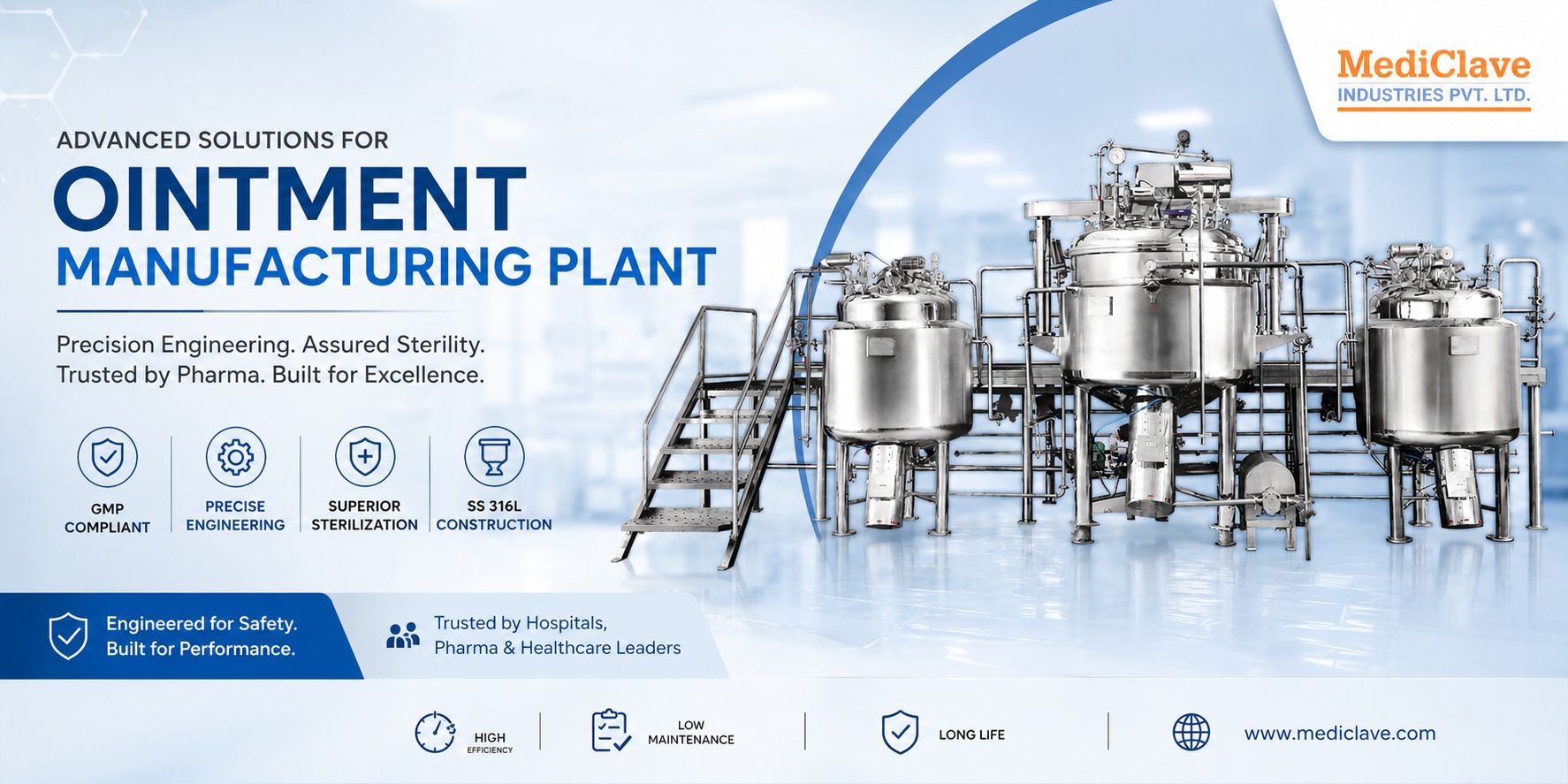
An ointment manufacturing plant is much more than a simple mixing machine. It is a complete processing system designed to blend, heat, homogenize, emulsify, and transfer pharmaceutical products under hygienic and controlled conditions. Modern plants are built to comply with GMP standards while ensuring product quality, batch consistency, and production efficiency.
As pharmaceutical companies continue to expand their manufacturing capabilities, investing in reliable processing equipment has become more important than ever. Choosing the right manufacturing plant helps companies improve productivity, reduce production losses, maintain regulatory compliance, and deliver products that meet customer expectations.
At Mediclave Industries, we design and manufacture high-quality pharmaceutical processing equipment that supports efficient, hygienic, and reliable production for pharmaceutical manufacturers across India and international markets.
Understanding an Ointment Manufacturing Plant
An Ointment Manufacturing Plant is a complete processing system used to manufacture semi-solid pharmaceutical and cosmetic products. These products include:
- Medicinal ointments
- Skin creams
- Cosmetic creams
- Moisturizers
- Antiseptic gels
- Hair gels
- Toothpaste
- Lotions
- Petroleum jelly products
- Herbal creams
- Ayurvedic ointments
- Pain relief gels
The plant combines multiple processing operations into one integrated system, ensuring every ingredient is mixed uniformly while maintaining product quality throughout the manufacturing cycle.
Unlike manual mixing methods, modern pharmaceutical plants use automated controls to achieve precise temperature control, controlled mixing speed, vacuum processing, homogenization, and safe product transfer.
Why Pharmaceutical Companies Need an Advanced Ointment Manufacturing Plant
Manufacturing pharmaceutical creams and ointments requires much greater precision than ordinary industrial mixing. Even a small variation in temperature or mixing speed can affect the texture, stability, appearance, and effectiveness of the final product.
A modern plant helps manufacturers achieve:
- Uniform product consistency
- Faster production cycles
- Better ingredient dispersion
- Reduced contamination risks
- Improved production efficiency
- Lower labor requirements
- Minimal product wastage
- Easier cleaning and maintenance
- GMP-compliant manufacturing
- Higher customer satisfaction
These advantages directly improve manufacturing productivity while maintaining the highest quality standards.
Main Components of an Ointment Manufacturing Plant
A complete pharmaceutical ointment manufacturing system generally includes several interconnected units working together.
Manufacturing Vessel
The manufacturing vessel is the heart of the plant. It is where ingredients are mixed under controlled temperature and vacuum conditions.
The vessel is generally manufactured from high-grade stainless steel and designed for pharmaceutical hygiene.
Oil Phase Vessel
Oil-based ingredients are prepared separately before being transferred into the main vessel.
Maintaining proper temperature in the oil phase helps improve emulsion quality.
Water Phase Vessel
Water-soluble ingredients are processed independently before combining them with the oil phase.
Separate preparation ensures better control over ingredient dissolution.
Vacuum System
Vacuum processing removes trapped air from the product, resulting in smoother creams and ointments while improving product stability.
Homogenizer
The homogenizer creates extremely fine particle dispersion, producing creams with excellent texture and consistency.
High-speed homogenization is particularly important for cosmetic and pharmaceutical creams.
Transfer System
After manufacturing, the finished product is transferred hygienically to storage tanks or filling machines.
This reduces contamination while minimizing product loss.
How an Ointment Manufacturing Plant Works
The manufacturing process follows a carefully controlled sequence.
First, the required ingredients are accurately weighed according to the approved formulation.
The oil phase ingredients are heated in one vessel while water-based ingredients are prepared separately.
Once both phases reach the required temperature, they are transferred into the main manufacturing vessel.
The mixing system blends the ingredients while the homogenizer creates a smooth and uniform emulsion.
Vacuum is applied to eliminate air bubbles and improve product quality.
After cooling to the desired temperature, the finished ointment is transferred to storage or directly to filling equipment.
Every stage is monitored carefully to maintain product quality and batch consistency.
Products That Can Be Manufactured
A versatile ointment manufacturing plant can produce numerous pharmaceutical and cosmetic products.
Some common applications include:
- Antibiotic ointments
- Burn creams
- Anti-fungal creams
- Anti-inflammatory gels
- Pain relief ointments
- Moisturizing creams
- Cosmetic creams
- Sunscreen creams
- Petroleum jelly
- Baby creams
- Herbal ointments
- Ayurvedic formulations
- Face creams
- Beauty creams
- Hand creams
- Foot creams
- Hair gels
- Medical gels
- Toothpaste
- Cosmetic lotions
Its flexibility makes it a valuable investment for manufacturers serving multiple product categories.
Features of a High-Quality Ointment Manufacturing Plant
When selecting pharmaceutical processing equipment, manufacturers should look for advanced features that improve productivity and ensure long-term reliability.
Important features include:
- Stainless steel SS304/SS316 construction
- GMP-compliant design
- Vacuum processing system
- High-speed homogenizer
- Anchor agitator
- Variable speed mixing
- Steam or electrical heating
- Jacketed vessel
- Temperature control system
- PLC-based automation
- User-friendly control panel
- CIP compatibility
- Easy cleaning
- Low maintenance
- Energy-efficient operation
- Hygienic piping
- Product recirculation system
- Safety interlocks
- Durable construction
These features ensure dependable operation while reducing downtime and maintenance costs.
Importance of GMP Compliance
The pharmaceutical industry operates under strict manufacturing regulations.
A GMP-compliant ointment manufacturing plant helps companies maintain:
- Hygienic processing
- Batch traceability
- Process consistency
- Equipment validation
- Product safety
- Easy cleaning
- Cross-contamination prevention
- Regulatory compliance
This is essential for companies manufacturing pharmaceutical products for domestic and international markets.
Benefits of Automation
Modern pharmaceutical manufacturing is increasingly automated.
Automation offers several advantages:
- Accurate process control
- Reduced operator error
- Faster production
- Improved repeatability
- Lower operating costs
- Better documentation
- Increased productivity
- Reduced product rejection
- Consistent quality
Automated systems also simplify production monitoring and quality assurance.
Choosing the Right Capacity
Every pharmaceutical company has unique production requirements.
Manufacturing plants are available in various capacities ranging from small laboratory systems to large industrial production units.
Factors to consider include:
- Daily production volume
- Future expansion plans
- Product range
- Factory space
- Utility availability
- Budget
- Automation level
- Regulatory requirements
Selecting the appropriate capacity ensures maximum return on investment.
Why Material Quality Matters
Since pharmaceutical products come into direct contact with processing equipment, material quality cannot be compromised.
High-quality stainless steel offers:
- Corrosion resistance
- Long equipment life
- Smooth internal surfaces
- Easy cleaning
- Better hygiene
- Chemical resistance
- Compliance with pharmaceutical standards
This significantly reduces maintenance while improving manufacturing reliability.
Integration with Other Pharmaceutical Equipment
An ointment manufacturing plant performs even better when integrated with other pharmaceutical systems.
For purified steam used in sterilization processes, manufacturers often install a Pure Steam Generator alongside processing equipment.
Internal Link:
https://www.mediclaveindustries.in/pure-steam-generator
Water quality is equally important for pharmaceutical manufacturing. A Multi Column Distillation Plant helps produce high-purity water required for pharmaceutical applications.
Internal Link:
https://www.mediclaveindustries.in/multi-column-distillation-plant
Cleaning production equipment is another critical requirement. A CIP & SIP System enables automated cleaning and sterilization without dismantling equipment, improving hygiene and reducing downtime.
Internal Link:
https://www.mediclaveindustries.in/cip-sip-system
Many pharmaceutical companies manufacturing liquid medicines also complement their facilities with a Liquid Syrup Manufacturing Process Plant, allowing them to expand production capabilities while maintaining consistent quality.
Internal Link:
https://www.mediclaveindustries.in/liquid-syrup-manufacturing-process-plant
Similarly, manufacturers producing injectable medicines often integrate an Injectable Liquid Manufacturing Vessel with Magnetic Stirrer to support sterile pharmaceutical production.
Internal Link:
https://www.mediclaveindustries.in/injectable-liquid-manufacturing-vessel-with-magnetic-stirrer
These integrated solutions create a complete pharmaceutical manufacturing facility capable of handling multiple dosage forms efficiently.
Industries That Use Ointment Manufacturing Plants
These systems are widely used across various industries, including:
- Pharmaceutical manufacturing
- Cosmetic manufacturing
- Ayurvedic medicine production
- Herbal product manufacturing
- Veterinary medicine production
- Personal care product manufacturing
- Biotechnology companies
- Contract manufacturing organizations
- Research laboratories
Their flexibility makes them suitable for both small and large production facilities.
Factors to Consider Before Purchasing
Before investing in an ointment manufacturing plant, buyers should evaluate several important aspects.
Consider:
- Manufacturing experience
- Equipment quality
- GMP compliance
- Customization options
- Automation level
- Installation support
- Validation assistance
- After-sales service
- Spare parts availability
- Technical support
- Production capacity
- Future scalability
- Energy efficiency
Working with an experienced manufacturer ensures smooth installation and reliable long-term performance.
Maintenance Tips
Regular maintenance helps maximize equipment life and maintain consistent production quality.
Good maintenance practices include:
- Routine cleaning after every batch
- Inspection of seals and gaskets
- Calibration of instruments
- Lubrication of moving parts
- Regular inspection of pipelines
- Preventive maintenance schedules
- Verification of vacuum performance
- Electrical system inspection
Preventive maintenance reduces unexpected downtime while improving production efficiency.
Why Choose Mediclave Industries?
Mediclave Industries has established itself as a trusted manufacturer of pharmaceutical process equipment by focusing on quality, innovation, and customer satisfaction.
Every machine is engineered with precision to meet modern pharmaceutical manufacturing requirements. From design and fabrication to installation and after-sales support, the company provides complete solutions tailored to customer needs.
The company's equipment is manufactured using premium-grade stainless steel, advanced engineering practices, and stringent quality control procedures to ensure reliable performance and long service life.
Whether a customer requires a compact system for limited production or a fully automated high-capacity manufacturing plant, Mediclave Industries offers customized solutions that align with GMP standards and industry expectations.
Future of Ointment Manufacturing Technology
Pharmaceutical manufacturing continues to evolve with advances in automation, digital monitoring, and process optimization.
Future ointment manufacturing plants are expected to include:
- Smart PLC automation
- IoT-enabled monitoring
- Remote diagnostics
- Advanced energy management
- Real-time batch monitoring
- Digital production records
- Predictive maintenance
- Enhanced process validation
- Improved cleaning systems
- Greater production flexibility
These innovations will help manufacturers achieve even higher levels of efficiency, quality, and regulatory compliance.
Conclusion
An Ointment Manufacturing Plant is one of the most important investments for pharmaceutical, cosmetic, herbal, and personal care manufacturers seeking consistent product quality and efficient production. By combining advanced mixing, homogenization, vacuum processing, and automated controls, these systems ensure every batch meets the highest standards of safety, performance, and reliability.
As market demand for creams, gels, lotions, and ointments continues to grow, manufacturers need equipment that not only increases production capacity but also supports GMP compliance, minimizes waste, and delivers long-term value. Choosing a trusted partner like Mediclave Industries ensures access to robust engineering, customized solutions, dependable after-sales support, and modern pharmaceutical technology.
Whether you are establishing a new production facility or upgrading an existing manufacturing line, investing in a high-quality ointment manufacturing plant is a strategic decision that enhances operational efficiency, strengthens product quality, and prepares your business for future growth in the competitive pharmaceutical industry.
