

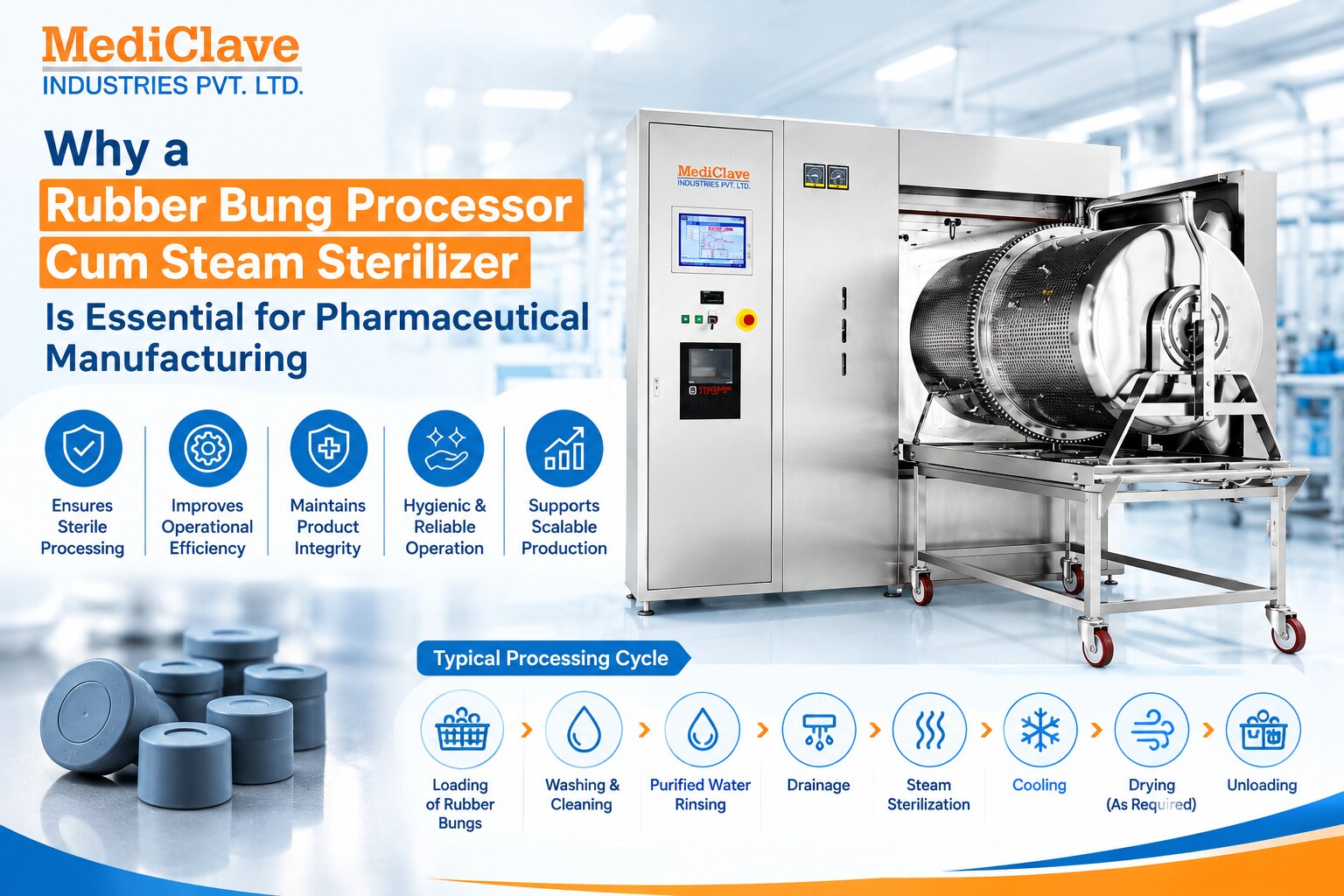
Why a Rubber Bung Processor Cum Steam Sterilizer Is Essential for
Pharmaceutical Manufacturing
In pharmaceutical manufacturing, rubber bungs and elastomeric closures play an important role in maintaining the integrity of injectable and sterile products. Because these components come into contact with sterile products and container-closure systems, their cleaning, processing, and sterilization must be carefully controlled.
A Rubber Bung Processor Cum Steam Sterilizer is specially designed to process, wash, and sterilize rubber bungs using controlled steam and suitable processing cycles. By combining bung processing and steam sterilization in a single system, pharmaceutical manufacturers can improve operational efficiency, maintain hygienic processing conditions, and support consistent sterilization practices.
For pharmaceutical companies involved in injectable manufacturing, parenteral production, and sterile filling operations, selecting an appropriately designed Rubber Bung Processor Cum Steam Sterilizer can be an important part of an effective sterilization and component-preparation process.
What Is a Rubber Bung Processor Cum Steam Sterilizer?
A Rubber Bung Processor Cum Steam Sterilizer is pharmaceutical processing equipment designed for the washing/processing and steam sterilization of rubber bungs or elastomeric closures used in pharmaceutical packaging.
The equipment combines processing functions with a steam sterilization cycle. Depending on the equipment configuration and validated process, it can support stages such as:
- Loading of rubber bungs
- Washing or rinsing
- Processing and cleaning
- Purified-water rinsing
- Drainage
- Steam sterilization
- Controlled cooling
- Drying, where applicable
- Unloading of processed bungs
The exact cycle parameters, washing sequence, temperature, pressure, and drying requirements should be established according to the product, equipment design, and validated manufacturing procedure.
Why Are Rubber Bungs Important in Pharmaceutical Manufacturing?
Rubber bungs, also called rubber closures or elastomeric closures, are commonly used with pharmaceutical containers such as vials and bottles.
They help provide a suitable container-closure system and can play an important role in protecting sterile pharmaceutical products from external contamination.
However, before use, the closures need to undergo appropriate preparation and sterilization procedures. Any residual particles, contaminants, or unsuitable processing conditions can affect the quality of the finished pharmaceutical product.
This makes controlled bung processing an important part of sterile pharmaceutical manufacturing.
Why Use a Dedicated Rubber Bung Processor Cum Steam Sterilizer?
1. Controlled Bung Processing
A dedicated system provides controlled conditions for processing rubber bungs before they are introduced into sterile manufacturing operations.
Instead of relying heavily on manual handling, the process can be carried out within a purpose-designed pharmaceutical system.
2. Steam Sterilization
Steam is widely used as a sterilization medium for suitable heat- and moisture-resistant pharmaceutical components.
The sterilization cycle is designed according to the characteristics of the rubber bungs and the validated process requirements.
3. Improved Hygiene
Pharmaceutical equipment is designed with hygienic processing requirements in mind. Suitable construction, internal surfaces, connections, and drainage arrangements can help facilitate cleaning and reduce the possibility of contamination.
4. Reduced Manual Handling
Combining processing and sterilization operations can reduce unnecessary movement of rubber bungs between different processing stages.
Lower manual intervention can also help improve process consistency when the system is properly operated and validated.
5. Consistent Processing
A controlled process allows important parameters such as temperature, pressure, time, and other cycle conditions to be monitored according to the equipment design and validated process.
This supports repeatable processing from batch to batch.
How Does a Rubber Bung Processor Cum Steam Sterilizer Work?
The exact process varies according to equipment design, rubber bung specifications, and the manufacturer's validated cycle. A typical workflow may involve the following stages.
Step 1: Loading of Rubber Bungs
The required quantity of rubber bungs is loaded into the processing chamber or suitable loading arrangement.
The loading configuration should allow appropriate exposure to the processing and sterilization conditions.
Step 2: Washing and Cleaning
The rubber bungs may undergo a controlled washing cycle to remove manufacturing residues, particulate matter, and other contaminants.
The washing sequence can include appropriate water circulation, rinsing, and drainage stages according to the validated process.
Step 3: Purified Water Rinsing
Where required, the bungs are rinsed using suitable pharmaceutical-grade water.
The objective is to achieve the required cleanliness before sterilization.
Step 4: Drainage
After washing and rinsing, the system removes residual water through the designed drainage arrangement.
Effective drainage is important for maintaining controlled processing conditions.
Step 5: Steam Sterilization
The sterilization phase introduces saturated steam into the chamber under controlled conditions.
The required temperature, pressure, exposure time, and other cycle parameters are established as part of the validated sterilization process.
Step 6: Cooling
After the sterilization phase, the equipment proceeds through a controlled cooling stage as required by the process.
Cooling conditions should be designed to protect the processed components and maintain the required sterile-processing conditions.
Step 7: Drying
Depending on the process and equipment configuration, a drying stage may be incorporated.
Drying requirements depend on the type of rubber closure and the intended downstream application.
Step 8: Unloading
After completion of the validated cycle, the processed rubber bungs can be unloaded using the appropriate handling procedure and transferred to the next stage of sterile manufacturing.
Major Features of a Rubber Bung Processor Cum Steam Sterilizer
A modern pharmaceutical bung processor may incorporate features such as:
- Stainless-steel pharmaceutical-grade construction
- Steam sterilization system
- Controlled washing cycle
- Purified-water rinsing
- Temperature monitoring
- Pressure monitoring
- Programmable process control
- Suitable filtration arrangements
- Hygienic product-contact surfaces
- Efficient drainage system
- Safety interlocks
- Process monitoring instruments
- Controlled cooling arrangement
- Drying facility, where required
- Easy cleaning and maintenance
- Customized chamber capacity
The final configuration should be selected according to the pharmaceutical manufacturing process and applicable requirements.
Importance of Stainless-Steel Construction
Material selection is an important consideration when purchasing pharmaceutical processing equipment.
Suitable stainless-steel construction can provide:
- Corrosion resistance
- Durability
- Smooth hygienic surfaces
- Easier cleaning
- Resistance to repeated processing cycles
- Compatibility with pharmaceutical manufacturing environments
The exact material grade and surface finish should be specified according to the application, formulation, cleaning method, and applicable engineering requirements.
Applications of Rubber Bung Processor Cum Steam Sterilizer
Rubber bung processing and sterilization systems can be used in pharmaceutical manufacturing facilities involved in:
- Injectable manufacturing
- Sterile pharmaceutical production
- Vial filling operations
- Parenteral manufacturing
- Vaccine-related manufacturing processes
- Biopharmaceutical production
- Sterile filling facilities
- Pharmaceutical packaging component preparation
The suitability of the equipment depends on the specific rubber closure, process, and validated sterilization requirements.
Rubber Bung Processing for Injectable Manufacturing
Injectable products require particularly controlled manufacturing environments because they are administered through routes that require stringent quality controls.
Rubber closures used with injectable vials therefore need suitable preparation before being used in the filling process.
A Rubber Bung Processor Cum Steam Sterilizer provides a dedicated system for processing these components under controlled conditions.
When integrated appropriately with the overall sterile manufacturing workflow, the equipment can help manufacturers establish a more organized component-preparation process.
Benefits for Pharmaceutical Manufacturers
Investing in suitable rubber bung processing equipment can provide several operational advantages.
Better Process Control
Controlled processing parameters allow manufacturers to monitor the cycle according to established procedures.
Improved Operational Efficiency
Combining processing and sterilization functions can simplify the component-preparation workflow.
Reduced Cross-Contamination Risk
A purpose-designed system can help minimize unnecessary handling and movement of components.
Repeatable Sterilization Cycles
Programmable cycles can support consistent operation when properly validated and maintained.
Easy Cleaning
Hygienically designed equipment can facilitate routine cleaning and maintenance.
Integration With Sterile Manufacturing
The equipment can be incorporated into a broader pharmaceutical production and sterile filling workflow according to facility requirements.
How to Select the Right Rubber Bung Processor Cum Steam Sterilizer?
Before purchasing a system, pharmaceutical manufacturers should evaluate several technical parameters.
1. Processing Capacity
Determine the quantity of rubber bungs that must be processed per batch and the expected production frequency.
2. Rubber Bung Type
Different elastomeric closures may have different processing requirements. The equipment should be selected according to the actual closure specifications.
3. Washing Requirements
Consider the required washing sequence, water quality, circulation arrangement, rinsing requirements, and drainage.
4. Sterilization Requirements
The sterilization system should be capable of supporting the required validated steam sterilization cycle.
5. Automation Level
Depending on production requirements, manufacturers can consider manual, semi-automatic, or automatic process control.
6. Instrumentation
Important parameters such as temperature and pressure should be appropriately monitored and controlled.
7. Cleaning and Maintenance
The equipment should provide suitable accessibility for cleaning, inspection, servicing, and preventive maintenance.
8. Facility Integration
Utilities, floor space, steam supply, water supply, drainage, electrical requirements, and process flow should be considered before installation.
Why Automation Matters in Bung Processing
Automation can help pharmaceutical manufacturers improve process repeatability and reduce unnecessary operator intervention.
Depending on the system, automated controls may monitor:
- Temperature
- Pressure
- Cycle time
- Washing stages
- Rinsing stages
- Steam exposure
- Cooling stages
- Alarms and safety conditions
A PLC-based control system with an appropriate HMI can provide operators with a centralized interface for monitoring and controlling the process.
The appropriate automation level depends on the facility's production volume, process requirements, and operational strategy.
Maintenance of Rubber Bung Processing Equipment
Regular maintenance is essential for reliable equipment performance.
Manufacturers should establish appropriate procedures for:
- Routine inspection
- Chamber cleaning
- Gasket inspection
- Valve inspection
- Instrument calibration
- Pump inspection
- Steam-line inspection
- Drain-line inspection
- Filter replacement
- Safety-system checks
- Preventive maintenance
Maintenance intervals should follow the equipment manufacturer's recommendations and the pharmaceutical facility's quality and maintenance procedures.
Why Choose a Reliable Pharmaceutical Equipment Manufacturer?
A Rubber Bung Processor Cum Steam Sterilizer is a specialized pharmaceutical system, so equipment selection should go beyond price comparison.
A reliable manufacturer should be able to provide appropriate technical support for:
- Equipment design
- Capacity selection
- Material of construction
- Process configuration
- Automation
- Documentation
- Installation
- Testing
- Commissioning
- After-sales support
The equipment should be designed around the actual manufacturing process rather than using a one-size-fits-all configuration.
Conclusion
A Rubber Bung Processor Cum Steam Sterilizer is an important piece of equipment for pharmaceutical facilities that require controlled processing and sterilization of rubber closures used in sterile manufacturing.
By combining bung processing with steam sterilization, the system can help improve process organization, reduce manual handling, support hygienic processing, and provide controlled sterilization cycles.
For pharmaceutical manufacturers involved in injectable, parenteral, vial filling, and sterile production applications, selecting a properly engineered and validated rubber bung processing system can contribute to a more efficient and controlled manufacturing workflow.
For pharmaceutical process and sterilization equipment solutions, explore Mediclave Industries Pvt. Ltd..
Frequently Asked Questions
1. What is a Rubber Bung Processor Cum Steam Sterilizer?
It is pharmaceutical equipment designed to process, clean, and steam-sterilize rubber bungs or elastomeric closures used in pharmaceutical manufacturing.
2. Where are rubber bung sterilizers used?
They are primarily used in pharmaceutical and sterile manufacturing facilities where rubber closures are required for vials and other suitable pharmaceutical containers.
3. Can the equipment wash rubber bungs?
Yes, depending on the configuration, the system can incorporate controlled washing and rinsing stages before sterilization.
4. How are rubber bungs sterilized?
Suitable rubber bungs can be sterilized using a controlled steam sterilization cycle, with cycle parameters established and validated for the specific application.
5. Can the rubber bung processor be customized?
Yes. Capacity, processing configuration, automation, instrumentation, and other features can be customized according to the manufacturer's process requirements.
6. What material is used for the equipment?
Pharmaceutical processing equipment is commonly constructed using suitable stainless-steel materials, with the exact grade and finish selected according to the application.
7. Can the system be automated?
Yes. Depending on the required configuration, the system can be supplied with manual, semi-automatic, or automatic controls.
8. What industries use rubber bung processing equipment?
The primary application is pharmaceutical manufacturing, particularly injectable, parenteral, sterile filling, and related applications.
9. Why is controlled processing of rubber bungs important?
Controlled processing helps manufacturers establish consistent cleaning and sterilization conditions before the closures are used in pharmaceutical production.
10. What should I consider before buying a rubber bung sterilizer?
Consider processing capacity, bung type, washing requirements, sterilization cycle, automation, instrumentation, utilities, cleaning requirements, facility layout, and technical support.
11. Is steam sterilization suitable for every rubber bung?
Not necessarily. Suitability depends on the elastomer material and its compatibility with the intended sterilization conditions. The process should be established and validated for the specific closure.
12. Can the system be integrated into a sterile manufacturing line?
Yes. The equipment can be incorporated into an overall sterile manufacturing workflow when appropriately designed for the facility's process flow and requirements.
Get the Right Rubber Bung Processing Solution
If you are planning a Rubber Bung Processor Cum Steam Sterilizer for your pharmaceutical manufacturing facility, discuss your required batch capacity, rubber bung specifications, washing process, sterilization cycle, automation level, and utility requirements with the equipment manufacturer.
Mediclave Industries Pvt. Ltd. provides pharmaceutical process and sterilization equipment solutions for manufacturing applications.
Website: https://www.mediclaveindustries.in/
