

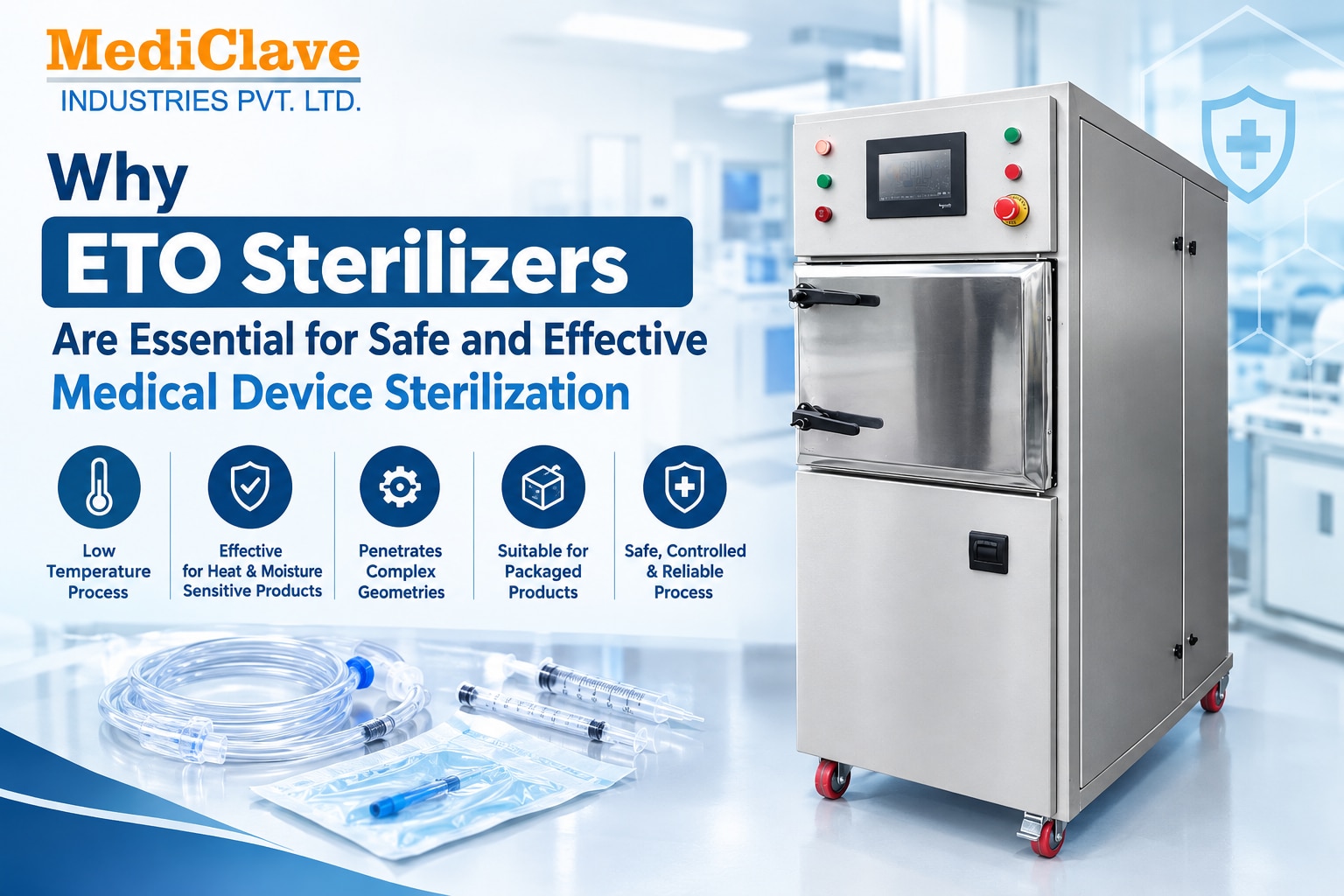
Sterilization is one of the most important processes in hospitals, healthcare facilities, laboratories, and medical device manufacturing. Medical instruments and devices must be properly sterilized before they are used to prevent contamination and reduce the risk of healthcare-associated infections. While steam sterilization is widely used for heat-resistant instruments, many modern medical devices cannot tolerate high temperatures or moisture. This is where an ETO Sterilizer becomes an important sterilization solution.
Ethylene Oxide (ETO) sterilization is a low-temperature sterilization method designed for heat- and moisture-sensitive medical equipment. It can penetrate complex device geometries, packaging materials, narrow passages, and other areas that may be difficult to sterilize using conventional steam.
For hospitals, pharmaceutical manufacturers, medical device companies, and healthcare facilities handling temperature-sensitive products, an appropriately designed ETO sterilization system can provide an effective and controlled sterilization process.
What Is an ETO Sterilizer?
An ETO Sterilizer, also called an Ethylene Oxide Sterilizer, is a specialized sterilization system that uses ethylene oxide gas under controlled conditions to eliminate microorganisms from medical equipment and other compatible products.
The ETO process generally involves several controlled stages, including:
- Preconditioning or humidification
- Loading of products
- Evacuation or air removal
- Humidification
- ETO gas introduction
- Exposure
- Gas evacuation
- Air washes
- Aeration
The exact cycle parameters depend on the sterilizer design, load characteristics, packaging materials, product configuration, and validated process requirements.
Why Is ETO Sterilization Important?
Many medical products contain plastics, polymers, electronics, adhesives, tubing, and other components that may be damaged by high-temperature steam sterilization.
ETO sterilization provides a low-temperature alternative for compatible products.
It is particularly useful when the product:
- Cannot withstand high temperatures
- Is sensitive to moisture
- Contains complex internal pathways
- Has narrow lumens or difficult-to-reach areas
- Is packaged before sterilization
- Contains materials that may deform under steam sterilization
Because ETO gas can penetrate porous packaging and complex product configurations, it can be suitable for sterilizing certain medical devices that cannot be processed using conventional high-temperature methods.
How Does an ETO Sterilizer Work?
The ETO sterilization process requires carefully controlled temperature, humidity, gas concentration, exposure time, pressure, and aeration conditions.
1. Preconditioning
The products are brought to appropriate environmental conditions before the sterilization cycle. Humidity can be particularly important because adequate moisture supports the effectiveness of the ETO process.
2. Loading
Products are placed inside the sterilization chamber according to the validated loading configuration. Proper loading is important because excessive or improper loading can affect gas distribution and sterilization performance.
3. Evacuation
Air may be removed from the chamber to establish the required process conditions and facilitate gas penetration.
4. Humidification
Controlled humidity is introduced according to the validated cycle requirements.
5. ETO Gas Introduction
Ethylene oxide gas is introduced into the chamber at the specified concentration and process conditions.
6. Exposure
The products remain exposed to ETO for a predetermined period. During this stage, the gas penetrates the product and packaging and acts against microorganisms.
7. Gas Removal
After the exposure stage, the chamber undergoes controlled gas removal and air-wash cycles to reduce residual ETO levels.
8. Aeration
Aeration allows residual ethylene oxide and its by-products to dissipate from the sterilized products. Aeration requirements depend on the product, materials, packaging, and validated process.
Key Advantages of ETO Sterilizers
ETO sterilization offers several important advantages for compatible applications.
| Feature | Benefit |
|---|---|
| Low-temperature process | Suitable for many heat-sensitive products |
| Gas penetration | Can reach complex product geometries |
| Moisture compatibility | Useful for products unsuitable for steam |
| Packaging penetration | Can sterilize compatible packaged products |
| Complex device compatibility | Suitable for selected intricate medical devices |
| Controlled process | Cycle parameters can be monitored and documented |
| Wide application range | Used for various compatible medical products |
Applications of ETO Sterilizers
ETO sterilization can be used for a variety of compatible medical and healthcare products.
Common applications may include:
- Plastic medical devices
- Catheters
- Tubing
- Syringes and components
- Surgical accessories
- Respiratory equipment
- Medical device assemblies
- Disposable medical products
- Certain electronic medical components
- Heat-sensitive laboratory products
- Complex instruments and devices
- Other temperature-sensitive healthcare products
The suitability of ETO should always be determined based on the product material, design, packaging, residual requirements, and validated sterilization process.
ETO Sterilizer vs. Steam Sterilizer
ETO and steam sterilization serve different purposes.
| Parameter | ETO Sterilizer | Steam Sterilizer |
|---|---|---|
| Sterilization method | Ethylene oxide gas | Saturated steam |
| Typical temperature | Low temperature | High temperature |
| Moisture | Controlled humidity required | Steam-based process |
| Heat-sensitive products | Suitable for compatible products | Generally unsuitable |
| Complex devices | Can be suitable | Depends on device design |
| Cycle considerations | Exposure + aeration | Heating, exposure, drying |
| Common application | Heat/moisture-sensitive devices | Heat-resistant instruments |
The correct sterilization method should be selected based on the characteristics of the product and its validated sterilization requirements rather than simply choosing one technology for all applications.
Important ETO Sterilizer Features
A modern ETO sterilization system should be designed with process control, operator safety, monitoring, and reliable chamber performance in mind.
Important features can include:
Stainless Steel Chamber
A robust stainless-steel chamber provides durability and facilitates cleaning and maintenance.
Controlled Temperature and Humidity
Precise control of process parameters helps maintain consistent sterilization conditions.
Vacuum System
A suitable vacuum system assists in establishing the required chamber conditions and supporting gas penetration.
ETO Gas Control
Controlled introduction and management of ETO gas are essential for a properly validated cycle.
PLC-Based Automation
PLC-based control systems can automate cycle sequences and monitor important process parameters.
Safety Interlocks
Safety interlocks help prevent inappropriate operation and provide additional protection during the cycle.
Aeration System
Aeration is an important part of ETO processing because products need to be managed appropriately after exposure to the gas.
Data Monitoring and Recording
Process data recording can support batch documentation, traceability, quality control, and validation activities.
Why Safety Is Critical in ETO Sterilization
Ethylene oxide is a hazardous and highly reactive gas. Therefore, ETO sterilization requires appropriate engineering controls, monitoring, ventilation, gas handling, leak detection, operator protection, and validated operating procedures.
A sterilization facility should consider:
- Gas containment
- Chamber integrity
- Leak detection
- Controlled gas handling
- Ventilation
- Exhaust systems
- Operator safety
- Emergency procedures
- Residual ETO management
- Proper aeration
- Preventive maintenance
- Process validation
ETO sterilization should only be performed using appropriately designed equipment and according to applicable safety requirements and validated procedures.
Why Choose a Quality ETO Sterilizer?
Selecting the right ETO sterilizer is important for achieving reliable and repeatable sterilization results.
Before purchasing an ETO sterilization system, organizations should evaluate:
Chamber capacity: Choose a chamber size appropriate for the expected batch volume.
Automation level: Consider manual, semi-automatic, or automatic control according to operational requirements.
Process monitoring: The system should provide appropriate monitoring of critical process parameters.
Safety systems: Gas handling, leak detection, interlocks, ventilation, and emergency controls should be carefully evaluated.
Material compatibility: Chamber and piping materials should be appropriate for the intended process.
After-sales support: Installation, training, preventive maintenance, validation assistance, and technical support are important for long-term operation.
ETO Sterilizer for Hospitals and Medical Device Manufacturers
Hospitals may use ETO sterilization for compatible heat-sensitive medical devices that cannot be processed through conventional steam sterilization.
Medical device manufacturers may also use ETO technology where their products require low-temperature sterilization. However, every product and sterilization process must be appropriately validated to demonstrate the required level of sterilization and product safety.
The selection of an ETO sterilizer should therefore consider the entire process—not just the chamber size or gas delivery system.
Process Validation and Quality Control
Sterilization is not simply a matter of running a machine. A reliable sterilization process requires appropriate development, validation, monitoring, documentation, and routine control.
Important considerations include:
- Installation qualification
- Operational qualification
- Performance qualification
- Cycle development
- Biological indicators
- Chemical indicators
- Physical parameter monitoring
- Product compatibility
- Packaging compatibility
- Residual ETO evaluation
- Batch documentation
- Routine process monitoring
These activities help establish confidence that the sterilization process consistently achieves its intended purpose.
How to Select the Right ETO Sterilizer
When selecting an ETO sterilization system, ask the following questions:
- What type of products will be sterilized?
- What is the required batch capacity?
- Are the products heat- or moisture-sensitive?
- What packaging configuration will be used?
- What cycle parameters are required?
- What level of automation is preferred?
- What safety systems are included?
- How will ETO gas be monitored and controlled?
- What aeration system is provided?
- What validation and technical support are available?
A detailed evaluation based on these factors can help organizations choose a system that fits their application and operational requirements.
Why ETO Sterilizers Remain Important in Modern Healthcare
Modern healthcare and medical-device manufacturing increasingly depend on products made from temperature-sensitive polymers, complex assemblies, electronics, tubing, and other specialized materials.
Steam sterilization remains highly effective for many heat-resistant instruments, but it cannot be applied universally. ETO technology fills an important role by providing a low-temperature sterilization option for compatible products.
When properly designed, validated, operated, and monitored, an ETO sterilization system can support the safe processing of a wide range of heat-sensitive medical products.
Frequently Asked Questions About ETO Sterilizers
1. What is an ETO Sterilizer?
An ETO Sterilizer is a low-temperature sterilization system that uses ethylene oxide gas to sterilize compatible medical and healthcare products.
2. What does ETO stand for?
ETO stands for Ethylene Oxide.
3. Why is ETO sterilization used?
ETO sterilization is used primarily for compatible products that cannot tolerate the temperature or moisture associated with conventional steam sterilization.
4. Can ETO sterilize plastic medical devices?
Yes, many plastic medical devices can be compatible with ETO sterilization, subject to material compatibility and process validation.
5. Is aeration required after ETO sterilization?
Yes. Aeration is an important part of ETO processing because residual ETO must be reduced to acceptable levels before products are released for their intended use.
6. Is ETO sterilization a high-temperature process?
No. ETO is generally considered a low-temperature sterilization method, making it useful for many heat-sensitive products.
7. Is ETO sterilization safe?
ETO can be used safely when the sterilizer, facility, gas-handling systems, monitoring, ventilation, operating procedures, and validation controls are appropriately designed and maintained.
8. How do I choose an ETO Sterilizer?
Consider chamber capacity, product characteristics, cycle requirements, automation, safety systems, monitoring, aeration, validation requirements, and after-sales technical support.
Conclusion
An ETO Sterilizer is an important low-temperature sterilization solution for compatible medical devices and products that cannot withstand conventional high-temperature steam sterilization. Its ability to process complex and heat-sensitive products makes it valuable in hospitals, healthcare facilities, laboratories, and medical device manufacturing.
However, effective ETO sterilization depends on more than simply exposing a product to ethylene oxide. Proper equipment design, humidity control, gas management, exposure conditions, aeration, safety systems, process validation, and routine monitoring are all essential.
If you are looking for a reliable ETO Sterilizer manufacturer and supplier, explore the sterilization solutions offered by Mediclave Industries Pvt. Ltd. for your specific application and capacity requirements.
Learn more: Mediclave Industries Pvt. Ltd.
Contact Mediclave Industries Pvt. Ltd. for ETO sterilizer specifications, technical information, customization requirements, and project discussions.
