

In the pharmaceutical industry, high-purity water is an essential part of manufacturing, cleaning, formulation, and sterilization processes. Water used in pharmaceutical applications must meet strict quality requirements, and the method used to produce and purify that water plays an important role in maintaining product quality and process reliability.
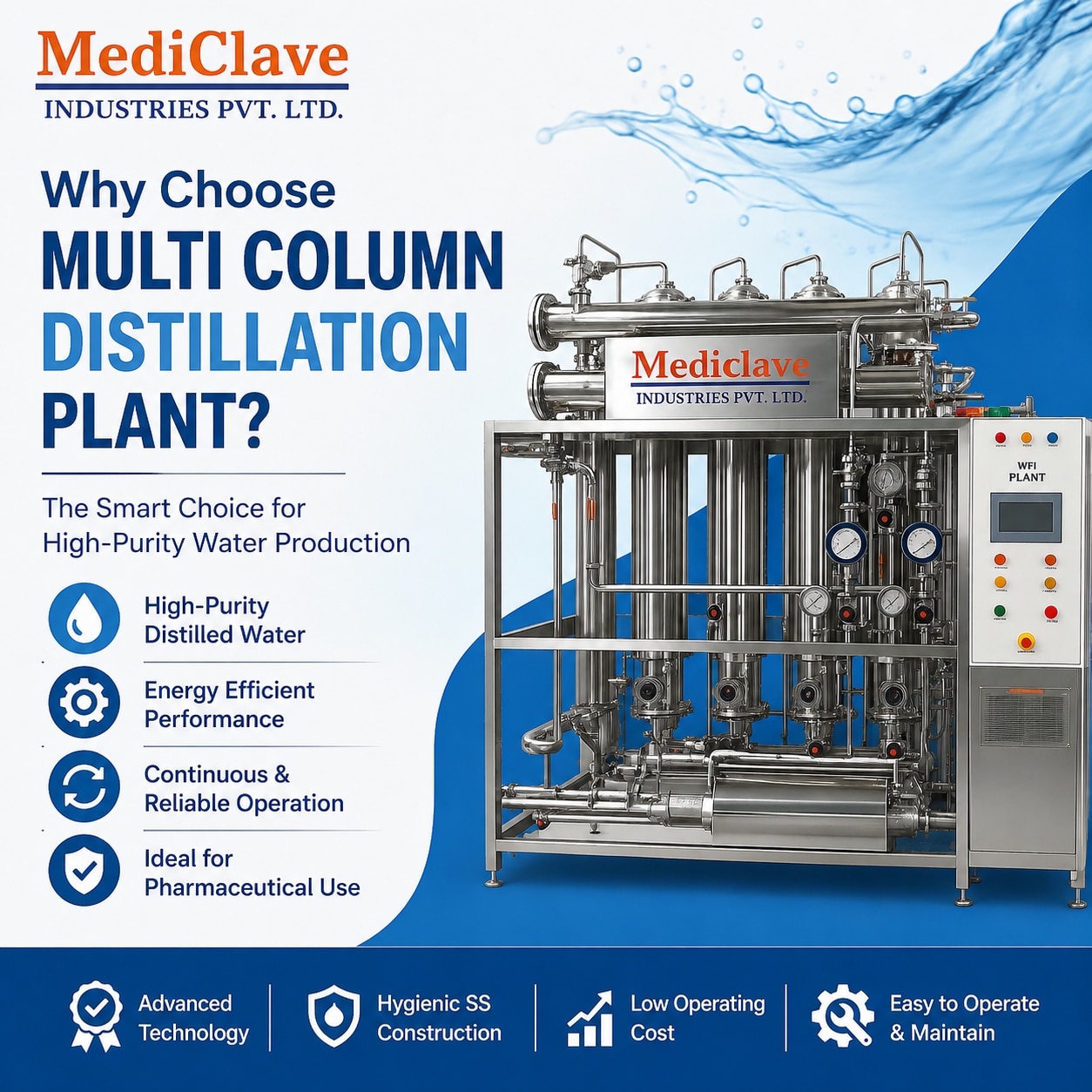
A Multi Column Distillation Plant is an advanced pharmaceutical water purification system designed to produce high-quality distilled water through multiple stages of evaporation and condensation. It is widely used in pharmaceutical manufacturing facilities where consistent water quality, efficient operation, and reliable performance are important.
But why is a Multi Column Distillation Plant preferred for pharmaceutical applications? The answer lies in its multi-stage purification process, energy-efficient operation, continuous production capability, and ability to provide high-purity distilled water suitable for demanding pharmaceutical processes.
In this blog, we will understand what a Multi Column Distillation Plant is, how it works, its major benefits, applications, important components, and factors to consider when selecting a system.
What Is a Multi Column Distillation Plant?
A Multi Column Distillation Plant is a pharmaceutical water purification system that uses a series of interconnected distillation columns to remove impurities from purified water.
The plant works on the principle of evaporation and condensation. Water is heated until it changes into vapor. Non-volatile impurities remain behind, while the generated vapor is transferred to another column for further purification. This process is repeated through multiple columns.
Each column performs a specific stage of the distillation process. As water passes through the columns, impurities such as dissolved solids, salts, microorganisms, pyrogens, and other contaminants are progressively reduced.
The final distilled water can be collected and transferred to a suitable WFI storage and distribution system, depending on the application and applicable quality requirements.
For pharmaceutical manufacturers looking for reliable water-generation solutions, Mediclave Industries offers pharmaceutical process and water-system solutions.
Why Use a Multi Column Distillation Plant?
The main reason to use a Multi Column Distillation Plant is to achieve efficient and reliable production of high-purity water while making better use of steam and energy.
Unlike a single-stage distillation process, a multi-column system reuses heat energy from one stage in subsequent stages. This improves the overall thermal efficiency of the plant.
1. High-Purity Water Production
One of the most important advantages of multi-column distillation is its ability to produce high-purity distilled water.
The repeated evaporation and condensation stages help separate water from many unwanted contaminants. This makes the technology particularly useful for pharmaceutical manufacturing environments where water quality is critical.
2. Multiple Stages of Purification
The use of several columns provides multiple purification stages.
The first column generally generates steam from the incoming water. The vapor produced is then used as the heating medium for the next column. This process continues through subsequent columns.
Each additional stage provides further purification while also improving energy utilization.
3. Better Energy Efficiency
Energy consumption is an important consideration in pharmaceutical manufacturing.
A Multi Column Distillation Plant is designed so that heat energy can be reused between columns. Instead of requiring fresh heating energy independently for every stage, vapor generated in one column can provide heating energy to the next.
This heat recovery approach can help reduce overall steam consumption.
4. Continuous Operation
Pharmaceutical manufacturing facilities often require a dependable supply of purified water.
Multi-column systems can be designed for continuous operation, allowing water production to continue according to the required process demand.
This is particularly useful for large pharmaceutical plants where water requirements can be substantial.
5. Suitable for Pharmaceutical Applications
Distillation is a widely established method for producing high-quality pharmaceutical water.
Depending on the complete system design, feed-water quality, operating conditions, monitoring system, and applicable standards, multi-column distillation technology can be integrated into pharmaceutical water-generation systems.
How Does a Multi Column Distillation Plant Work?
Understanding the working principle makes it easier to appreciate why this technology is so effective.
A typical process involves the following stages:
Step 1: Feed Water Entry
Pre-treated or purified feed water enters the distillation system.
The quality of incoming water is important because proper pre-treatment helps protect the distillation equipment and improves overall plant performance.
Step 2: Heating
The feed water is heated using an appropriate steam or heating source.
As the temperature increases, the water begins to evaporate.
Step 3: Vapor Generation
The generated vapor moves toward the next distillation column.
Non-volatile contaminants generally remain with the liquid phase rather than traveling with the distilled vapor.
Step 4: Secondary Distillation
The vapor enters the next column and transfers its heat to the feed water present in that column.
The vapor condenses, while the heat causes additional water to evaporate.
Step 5: Repeated Distillation
The same principle is repeated across multiple columns.
This creates several stages of evaporation and condensation.
Step 6: Final Condensation
At the final stage, the purified vapor is condensed to produce distilled water.
Step 7: Collection and Distribution
The distilled water is collected in a suitable storage tank or transferred to the required downstream system.
For applications requiring high-quality pharmaceutical water, the system can be integrated with appropriate WFI storage and distribution arrangements.
Major Components of a Multi Column Distillation Plant
The exact configuration depends on capacity and project requirements, but a typical system may include:
- Distillation columns
- Pre-heater
- Condenser
- Feed-water system
- Steam inlet system
- Product water outlet
- Drain system
- Pressure control system
- Temperature sensors
- Pressure gauges/transmitters
- Level monitoring
- Control panel
- Piping and valves
- Safety devices
- Sampling points
- Instrumentation and automation system
The equipment is generally constructed with materials and surface finishes selected according to pharmaceutical process requirements.
Key Benefits of a Multi Column Distillation Plant
A well-designed system can offer several operational benefits.
High Purification Performance
Multiple distillation stages provide repeated separation of water from contaminants.
Improved Steam Utilization
Heat from the previous column can be reused in the next stage, improving thermal efficiency.
Consistent Water Production
The system can be designed for continuous and stable operation.
Reduced Operating Cost
Better energy utilization can contribute to lower operating costs compared with less efficient distillation arrangements.
Hygienic Construction
Pharmaceutical water systems are commonly designed with hygienic piping, suitable materials, and appropriate drainability to minimize contamination risks.
Automation
Modern plants can incorporate automated monitoring and control of parameters such as:
- Temperature
- Pressure
- Flow
- Water level
- Conductivity
- System status
Scalability
Multi-column systems can be engineered for different production capacities depending on the requirements of the pharmaceutical facility.
Where Is a Multi Column Distillation Plant Used?
Multi Column Distillation Plants are primarily associated with pharmaceutical and high-purity water applications.
Common applications include:
Pharmaceutical Manufacturing
Distilled water can be required for various manufacturing and process activities.
Injectable Product Manufacturing
Water quality is particularly important in facilities involved in manufacturing sterile or injectable products. The water system must be designed and operated according to the applicable pharmaceutical requirements.
API Manufacturing
High-purity water may be required at different stages of active pharmaceutical ingredient production and associated cleaning operations.
Sterile Manufacturing
Sterile manufacturing environments require carefully controlled utilities, including pharmaceutical water systems.
Cleaning and Equipment Washing
High-quality water can be used for cleaning process equipment, vessels, pipelines, and other components depending on the validated cleaning process.
Research and Development
Pharmaceutical R&D facilities may also require high-purity water for laboratory and development activities.
Multi Column Distillation Plant vs. Single Column Distillation
Both technologies use distillation, but their configurations and energy utilization can differ.
| Feature | Multi Column Distillation | Single Column Distillation |
|---|---|---|
| Number of stages | Multiple | Single/main stage |
| Heat recovery | High potential | Comparatively limited |
| Steam utilization | Efficient | Generally higher per unit output |
| Production capacity | Suitable for larger requirements | Suitable for smaller requirements |
| Continuous production | Yes, depending on design | Yes, depending on design |
| Pharmaceutical applications | Widely suitable | Suitable for selected applications |
| System complexity | Higher | Lower |
| Initial investment | Generally higher | Generally lower |
The correct choice depends on production capacity, water-quality requirements, utility availability, operating cost, and project specifications.
Why Is Energy Efficiency Important?
Pharmaceutical manufacturing facilities operate large numbers of utility systems, and steam can represent a significant operating expense.
A multi-column system uses the principle of heat reuse.
For example, vapor generated in one column can be used as the heating medium for the following column. This means the same thermal energy can contribute to multiple stages of purification.
As a result, a properly engineered multi-column arrangement can provide a favorable balance between:
Water quality + production capacity + steam consumption + operating cost
This is one of the major reasons pharmaceutical manufacturers consider multi-column distillation technology for larger water-generation requirements.
How to Choose the Right Multi Column Distillation Plant?
Before purchasing a system, pharmaceutical manufacturers should carefully evaluate several factors.
1. Required Production Capacity
Determine how much distilled water is required per hour.
Capacity should be selected based on current consumption as well as expected future requirements.
2. Feed Water Quality
The incoming water quality directly affects plant performance.
The complete pre-treatment system should be considered along with the distillation plant.
3. Steam Availability
Check the available steam pressure, quality, and capacity before finalizing the equipment.
4. Material of Construction
Pharmaceutical water systems commonly require suitable stainless-steel construction and hygienic fabrication.
5. Automation Level
Depending on the facility, the system may be supplied with manual, semi-automatic, or automated controls.
6. Instrumentation
Important parameters should be monitored using suitable instruments and sensors.
7. Cleaning and Maintenance
The plant should be designed for easy inspection, cleaning, maintenance, and servicing.
8. Compliance Requirements
The system should be designed around the applicable pharmaceutical standards, user requirements, validation strategy, and regulatory expectations.
Maintenance of a Multi Column Distillation Plant
Regular maintenance is essential for reliable performance.
A typical maintenance program may include:
- Checking steam pressure
- Inspecting valves and pipelines
- Checking temperature sensors
- Checking pressure instruments
- Inspecting condenser performance
- Monitoring water quality
- Checking pumps
- Inspecting seals and gaskets
- Cleaning appropriate components
- Checking control-panel functions
- Inspecting safety devices
- Maintaining system documentation
Preventive maintenance can help identify problems before they affect production.
Role of Automation in Modern Distillation Plants
Automation has become increasingly important in pharmaceutical utility systems.
An automated Multi Column Distillation Plant can continuously monitor critical operating parameters and provide alarms when a parameter moves outside the configured operating range.
A control system may monitor:
- Temperature
- Pressure
- Flow
- Level
- Conductivity
- Product-water conditions
- Equipment status
Automation can improve operational consistency while reducing the need for continuous manual intervention.
Why Choose Mediclave Industries for Pharmaceutical Water Systems?
Selecting the right manufacturer is just as important as selecting the right technology.
Mediclave Industries provides pharmaceutical process and water-system equipment designed for industrial applications. The company offers solutions across pharmaceutical sterilization, process equipment, and water-system requirements.
Its pharmaceutical water-system range includes solutions such as:
- Multi Column Distillation Plant
- Pure Steam Generator
- WFI Storage & Distribution System
- CIP & SIP Systems
You can explore the company's pharmaceutical equipment range through the Mediclave Industries website.
Conclusion
So, why is a Multi Column Distillation Plant important?
The answer is its ability to combine multi-stage purification, efficient heat utilization, continuous production, and reliable high-purity water generation in one system.
For pharmaceutical manufacturers, water is not simply a utility—it can be an important process requirement. Therefore, selecting a properly designed water-generation system is essential for maintaining consistent production and quality.
A Multi Column Distillation Plant can be an excellent solution for pharmaceutical facilities that require dependable distilled-water production with efficient steam utilization.
Before selecting a plant, manufacturers should evaluate capacity, feed-water quality, steam availability, material of construction, automation, instrumentation, maintenance requirements, and applicable regulatory expectations.
Frequently Asked Questions
1. What is a Multi Column Distillation Plant?
A Multi Column Distillation Plant is a water purification system that uses multiple distillation columns to produce high-purity distilled water through repeated evaporation and condensation.
2. Why is a multi-column system used in pharmaceuticals?
It is used because multiple distillation stages can provide high purification performance while improving heat and steam utilization.
3. What is the working principle of a Multi Column Distillation Plant?
The system works through repeated evaporation and condensation. Vapor from one column can provide heating energy to the next column.
4. Is a Multi Column Distillation Plant suitable for pharmaceutical water production?
Yes, multi-column distillation technology is widely used for pharmaceutical water-generation applications when the complete system is appropriately designed, operated, monitored, and validated.
5. What factors affect the capacity of a distillation plant?
Capacity depends on factors such as feed-water conditions, steam availability, column configuration, operating parameters, and required product-water output.
6. Does a Multi Column Distillation Plant save energy?
Its multi-stage design allows heat to be reused between columns, which can improve steam utilization compared with less efficient distillation arrangements.
7. What material is commonly used for pharmaceutical distillation equipment?
Pharmaceutical systems commonly use suitable grades of stainless steel selected according to the application and hygienic requirements.
8. What is the difference between a Multi Column Distillation Plant and a single-column system?
A multi-column plant uses several distillation stages and can provide better heat utilization, while a single-column system has a simpler configuration.
9. Can the plant be automated?
Yes. Depending on project requirements, automation can be incorporated for monitoring and controlling temperature, pressure, flow, level, and other operating parameters.
10. How do I select the right Multi Column Distillation Plant?
Consider required capacity, feed-water quality, steam availability, water-quality requirements, automation, construction materials, maintenance, and applicable pharmaceutical standards.
Get in Touch
Looking for a Multi Column Distillation Plant for your pharmaceutical manufacturing facility?
Visit Mediclave Industries to explore pharmaceutical water systems and process equipment solutions.
