
Why Super Heated Water Shower Sterilizer Is Becoming Essential for Modern Pharmaceutical Manufacturing
Sterilization is one of the most important steps in pharmaceutical manufacturing. A product may have the right formulation, correct ingredients, attractive packaging, and excellent quality control, but if the final sterilization process is not properly designed, the entire batch can be at risk.
This is especially important for injectable medicines, IV fluids, ophthalmic products, vaccines, biological formulations, and other pharmaceutical products packed inside bottles, vials, syringes, ampoules, or flexible containers. These products need reliable microbial control, but they can also be sensitive to excessive heat, pressure, moisture, and mechanical stress.
This is where a Super Heated Water Shower Sterilizer becomes an important solution.
Unlike conventional sterilization systems that expose products directly to saturated steam, a Super Heated Water Shower Sterilizer uses heated purified water that is continuously circulated and sprayed over the products inside a controlled chamber. At the same time, pressure can be carefully managed to protect containers from deformation, leakage, breakage, or seal damage.
The result is a controlled terminal sterilization process that combines excellent heat transfer, temperature uniformity, pressure control, and product protection.
For pharmaceutical manufacturers looking to improve sterilization reliability while maintaining product and packaging integrity, this technology offers a practical and advanced approach.
What Is a Super Heated Water Shower Sterilizer?
A Super Heated Water Shower Sterilizer is an advanced pharmaceutical terminal sterilization system designed to sterilize sealed pharmaceutical products using recirculated heated water.
The basic concept is straightforward. Purified water is heated through a controlled heating system or heat exchanger and then circulated through the sterilization chamber. Specially designed spray nozzles distribute the hot water uniformly over the entire product load.
Because water is an excellent medium for transferring heat, the system can provide highly uniform temperature distribution throughout the chamber.
At the same time, compressed air or counter-pressure can be introduced into the chamber. This is particularly useful when sterilizing products in flexible or semi-flexible containers because the pressure inside and outside the container can be controlled during heating and cooling.
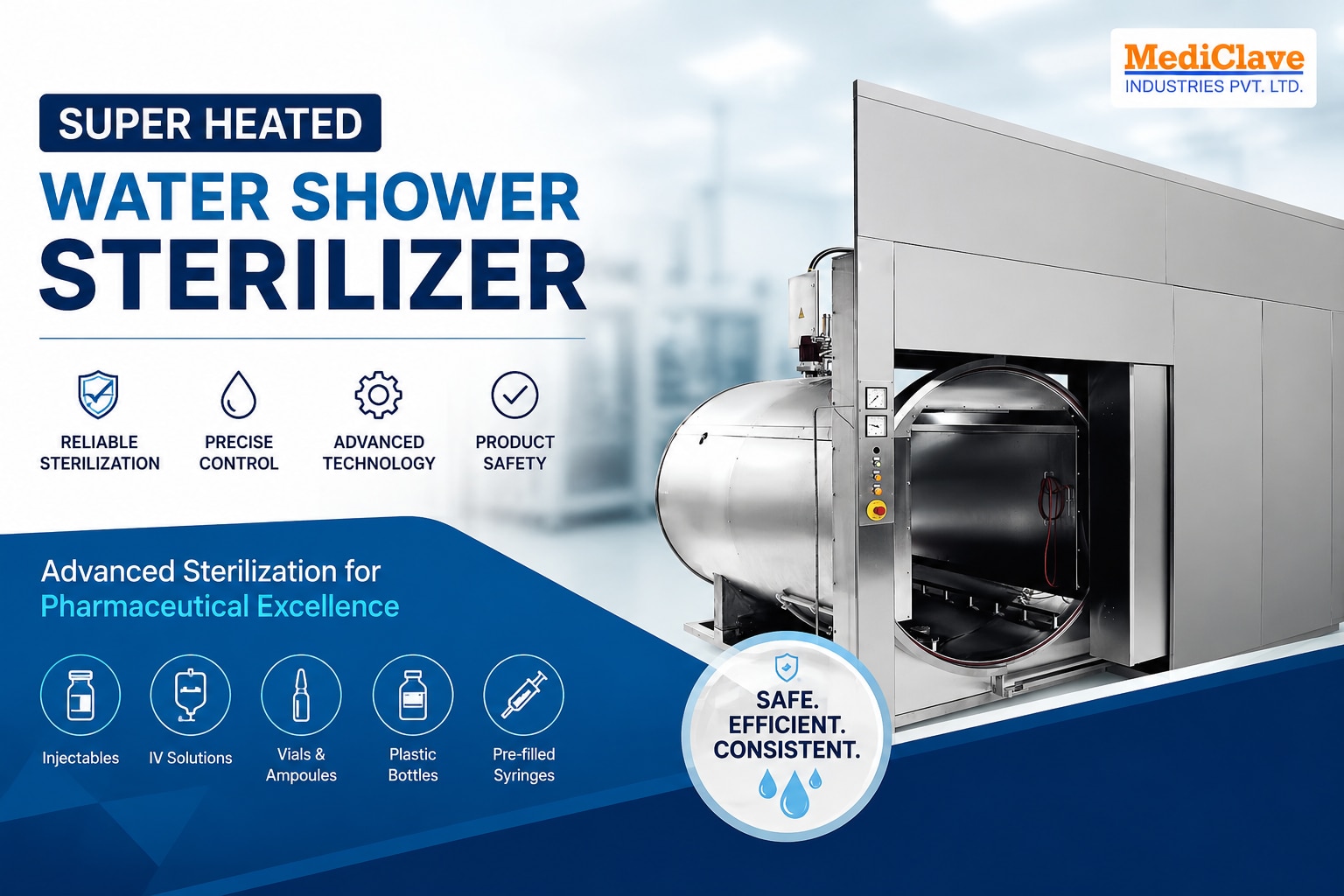
According to Mediclave Industries' technical information, this technology is particularly suitable for products such as glass vials, plastic bottles, IV fluids, ampoules, pre-filled syringes, injectable pharmaceuticals, biotechnology products, and other liquid formulations.
This makes the technology especially valuable in modern pharmaceutical facilities where product protection is just as important as microbial destruction.
Why Is Terminal Sterilization So Important?
Terminal sterilization takes place after a pharmaceutical product has been filled and sealed in its final container. The objective is to achieve the required level of sterility assurance without compromising the product.
For example, imagine an injectable solution filled into a plastic bottle. The product may require thermal sterilization, but excessive pressure could deform the bottle. Similarly, rapid temperature changes could create thermal stress in glass containers.
Therefore, the sterilization system must do more than simply generate heat.
It must provide:
Controlled temperature
Uniform heat distribution
Appropriate exposure time
Controlled chamber pressure
Reliable water circulation
Protection of product containers
Repeatable sterilization cycles
Accurate process monitoring
Validation support
A Super Heated Water Shower Sterilizer is designed around these requirements.
How Does a Super Heated Water Shower Sterilizer Work?
The working principle can be understood through several important stages.
1. Loading the Products
The sealed pharmaceutical products are loaded into baskets, trays, or suitable loading arrangements inside the sterilization chamber.
Proper loading is important because the circulation of heated water must reach the complete load uniformly.
Products may include:
Injectable bottles
IV bottles
IV bags
Plastic containers
Glass vials
Ampoules
Prefilled syringes
Ophthalmic containers
Biological products
The exact loading configuration depends on the product, container type, batch size, and validated sterilization cycle.
2. Chamber Preparation
Once the chamber is loaded and closed, the system prepares the sterilization environment.
Sensors and control systems monitor important process parameters. The chamber is then prepared for the heating and circulation cycle.
3. Water Heating
Purified water is heated through a heat exchanger or controlled heating arrangement.
The water temperature is raised according to the validated process recipe.
The goal is not simply to make the water hot. The objective is to achieve the required thermal profile accurately and consistently.
4. Water Circulation and Showering
The heated water is circulated using a high-capacity pump and distributed through specially designed spray nozzles.
The water continuously flows over the products, transferring heat to the containers and their contents.
Because the water is continuously recirculated, the system can maintain a highly uniform thermal environment.
This is one of the major advantages of water shower technology.
5. Pressure Control
Pressure control is another important part of the process.
During heating, the pressure inside sealed containers can change. If the external chamber pressure is not properly controlled, flexible containers may deform or seals may be affected.
The Super Heated Water Shower Sterilizer can use controlled counter-pressure to help maintain container integrity during the sterilization cycle.
This makes the technology particularly useful for plastic bottles, flexible bags, and other sensitive packaging formats.
6. Sterilization Holding Phase
Once the required temperature is achieved, the system maintains the validated sterilization conditions for the required holding period.
Temperature sensors continuously monitor the process.
The sterilization cycle is designed according to the product, container, load configuration, and validated process requirements.
7. Cooling Phase
After sterilization, the products must be cooled in a controlled manner.
Rapid or uncontrolled cooling can create thermal stress, especially in glass containers and certain packaging materials.
Controlled cooling helps protect:
Container shape
Seals
Product quality
Packaging integrity
Batch yield
8. Unloading
After completion of the validated cycle, the products are removed from the sterilizer and transferred to the next stage of production under the required controlled conditions.
What Makes Water Shower Sterilization Different From Conventional Steam Sterilization?
Steam sterilization is one of the most widely accepted sterilization technologies and remains highly suitable for many applications. A Saturated Steam Sterilizer uses saturated steam under controlled temperature and pressure to achieve effective microbial destruction.
However, not every product or container is ideally suited to direct steam exposure.
A Super Heated Water Shower Sterilizer offers a different approach.
Instead of allowing steam to directly contact the product, heated water is circulated and sprayed over the load. This provides excellent heat transfer while allowing pressure to be controlled independently.
The difference becomes especially important when processing:
Plastic bottles
Flexible IV bags
Polypropylene containers
Prefilled syringes
Sealed liquid pharmaceutical products
Sensitive biological products
Therefore, the decision between steam and water shower sterilization should be based on the product, container, validated process requirements, and manufacturing objectives rather than simply choosing the most familiar technology.
Major Advantages of a Super Heated Water Shower Sterilizer
1. Excellent Temperature Uniformity
Temperature uniformity is critical for reliable sterilization.
Uneven heating can result in cold spots where the required sterilization conditions may not be achieved.
The continuous circulation and spraying of heated water help distribute thermal energy throughout the chamber, supporting consistent exposure across the load.
2. Better Protection of Pharmaceutical Containers
One of the biggest advantages is controlled pressure.
Flexible containers and plastic bottles can be sensitive to pressure differences during heating and cooling. Counter-pressure control helps reduce the risk of deformation, leakage, and seal-related problems.
This can contribute to improved product yield and reduced batch rejection.
3. Excellent Heat Transfer
Water transfers heat more efficiently than air.
Continuous water circulation allows thermal energy to reach the product surfaces efficiently and supports uniform heating.
This makes water shower sterilization particularly useful for liquid pharmaceutical products.
4. Reduced Thermal Shock
Controlled heating and cooling help reduce sudden temperature changes.
This is particularly important when working with glass containers or products where thermal stress could affect packaging integrity.
5. Suitable for Sensitive Products
Modern pharmaceutical manufacturing increasingly uses different packaging materials and product formats.
A water shower sterilizer can accommodate many products that may be challenging to process using conventional steam exposure.
6. Repeatable Sterilization Cycles
Modern systems can incorporate PLC-based controls, sensors, alarms, recipe management, temperature monitoring, pressure monitoring, and batch documentation.
Repeatability is extremely important in pharmaceutical manufacturing because each batch must be processed according to an established and validated procedure.
7. Support for Validation
Sterilization equipment used in pharmaceutical manufacturing must be capable of demonstrating consistent performance.
Validation activities may include temperature mapping, heat penetration studies, calibration, cycle development, and IQ/OQ/PQ documentation depending on the facility and regulatory requirements.
The ability to monitor critical process parameters makes modern automated systems well suited for validated pharmaceutical production.
What Products Can Be Sterilized Using This Technology?
A major reason manufacturers consider Super Heated Water Shower Sterilizers is their flexibility.
Typical applications include:
Injectable pharmaceutical products
IV fluids
Infusion bottles
Plastic bottles
Glass bottles
Vials
Ampoules
Prefilled syringes
Ophthalmic products
Biological formulations
Vaccine-related products
Nutritional solutions
Certain biotechnology products
The exact suitability should always be established through product-specific studies and validation.
For manufacturers involved in injectable production, sterilization is only one part of the overall manufacturing process. Equipment such as an Injectable Liquid Manufacturing Vessel With Magnetic Stirrer can support controlled preparation and mixing of sterile liquid formulations. Mediclave's injectable manufacturing vessel technology uses magnetic stirring to reduce contamination and leakage risks associated with conventional shaft-driven mixing arrangements.
Why Water Quality Matters
The performance of a water shower sterilization system depends heavily on the quality of the water used in the process.
Pharmaceutical manufacturing requires carefully controlled water quality because water can come into direct or indirect contact with critical equipment and products.
For facilities requiring high-purity pharmaceutical water, a Multi-Column Distillation Plant can be an important part of the overall utility infrastructure.
Multi-column distillation systems use multiple stages of evaporation and condensation to produce high-purity water suitable for demanding pharmaceutical applications.
A properly planned pharmaceutical facility therefore looks at sterilization equipment and water-generation systems as interconnected parts of the overall contamination-control strategy.
The Role of Pure Steam in Pharmaceutical Facilities
Although a Super Heated Water Shower Sterilizer primarily uses heated water for the sterilization process, steam remains an essential utility throughout many pharmaceutical manufacturing plants.
For example, steam may be required for heating, sterilization of process equipment, SIP applications, and other pharmaceutical operations.
A Pure Steam Generator is designed to generate high-purity steam from pharmaceutical-grade water such as Purified Water or WFI. Pure steam is widely used for SIP, equipment sterilization, pipelines, tanks, and other critical pharmaceutical applications.
Having an appropriate pharmaceutical water and steam infrastructure helps create a more reliable and integrated manufacturing environment.
CIP and SIP: Supporting Hygienic Manufacturing
Sterilization equipment does not operate in isolation. Pharmaceutical facilities must also control contamination in tanks, pipelines, vessels, and process equipment.
This is where CIP & SIP Systems become valuable.
CIP, or Clean-In-Place, allows process equipment to be cleaned without dismantling it. SIP, or Sterilize-In-Place, uses controlled sterilization conditions to reduce microbial contamination within process equipment.
A modern CIP & SIP System can help reduce manual intervention, improve cleaning consistency, reduce downtime, and support hygienic pharmaceutical production.
Together, CIP, SIP, pharmaceutical water systems, process vessels, and terminal sterilization equipment can form an integrated contamination-control strategy.
Super Heated Water Shower Sterilizer vs Dry Heat Sterilizer
Different sterilization methods are suitable for different materials.
A Dry Heat Sterilizer uses controlled hot air rather than water or steam. It is particularly suitable for heat-resistant and moisture-sensitive materials such as glassware, metal components, certain pharmaceutical containers, powders, and oils.
By comparison, a Super Heated Water Shower Sterilizer is especially attractive for sealed liquid pharmaceutical products and containers where uniform heat transfer and pressure control are important.
In simple terms:
Choose the sterilization method based on the product—not simply the equipment.
Factors such as product formulation, container material, moisture sensitivity, temperature sensitivity, packaging design, required sterilization assurance, and validated process parameters should all be evaluated.
Important Features to Consider Before Buying
Selecting the right Super Heated Water Shower Sterilizer requires more than comparing prices.
Here are some important factors to evaluate.
Chamber Capacity
The chamber should accommodate the required batch size without unnecessarily increasing equipment size.
Water Circulation System
Efficient pumps and properly designed distribution nozzles are essential for uniform water circulation.
Temperature Control
Precise sensors and reliable control systems are necessary to maintain the validated temperature profile.
Pressure Control
For flexible and polymeric containers, controlled counter-pressure can be particularly important.
PLC and HMI Automation
A modern control system can simplify operation, recipe management, alarms, monitoring, and batch documentation.
Data Recording
Batch records and process data help manufacturers demonstrate that the cycle was performed according to approved parameters.
Material of Construction
Pharmaceutical-grade stainless steel construction provides hygiene, durability, and corrosion resistance.
Safety Features
The equipment should include appropriate door interlocks, alarms, emergency functions, pressure protection, and other safety systems.
Validation Support
The manufacturer should be capable of supporting documentation and qualification requirements appropriate to the project.
Why Automation Matters
Manual sterilization control can increase the possibility of operator error.
Modern pharmaceutical facilities increasingly depend on automation because it provides better process consistency and documentation.
A PLC-HMI-based Super Heated Water Shower Sterilizer can allow operators to:
Select validated recipes
Monitor temperature
Monitor pressure
Monitor water circulation
Control heating
Control cooling
Review alarms
Record batch information
Maintain process history
Automation does not replace validation or trained operators, but it can make the process more controlled, repeatable, and easier to monitor.
Maintenance and Operational Considerations
Even advanced sterilization equipment requires regular maintenance.
Manufacturers should establish preventive maintenance procedures covering:
Pump inspection
Spray nozzle inspection
Temperature sensor calibration
Pressure sensor calibration
Door gasket inspection
Valve inspection
Heat exchanger inspection
PLC and HMI checks
Safety interlock testing
Water quality monitoring
Chamber cleaning
Calibration documentation
Regular maintenance helps prevent unexpected downtime and supports consistent equipment performance.
It is also important to maintain complete records of calibration, preventive maintenance, repairs, deviations, and validation activities.
Why Choose Mediclave Industries?
Choosing a sterilizer is an important investment for any pharmaceutical manufacturing facility. The equipment manufacturer should therefore be evaluated not only on the machine itself but also on engineering support, customization, documentation, installation, validation assistance, and after-sales service.
Mediclave Industries Pvt. Ltd. provides pharmaceutical sterilization, process equipment, and water-system solutions designed for modern manufacturing requirements.
Its portfolio includes:
Super Heated Water Shower Sterilizers
Saturated Steam Sterilizers
Dry Heat Sterilizers
Pure Steam Generators
Multi-Column Distillation Plants
CIP & SIP Systems
Injectable Liquid Manufacturing Vessels
Pharmaceutical process equipment
This broader product range can be useful for pharmaceutical companies planning an integrated manufacturing facility rather than purchasing individual machines from multiple suppliers.
Final Thoughts
The future of pharmaceutical sterilization is not simply about achieving high temperatures. It is about achieving controlled, uniform, repeatable, validated sterilization while protecting the product and its packaging.
This is why the Super Heated Water Shower Sterilizer has become an important technology for modern pharmaceutical manufacturing.
Its combination of heated water circulation, excellent heat transfer, temperature uniformity, controlled pressure, and packaging protection makes it particularly valuable for terminal sterilization of injectable products, IV fluids, vials, bottles, syringes, and other sensitive pharmaceutical formulations.
At the same time, the best sterilization solution depends on the individual application. Some products may be better suited to saturated steam, while others may require dry heat. Pharmaceutical water systems, pure steam generation, CIP/SIP, and process equipment must also be considered when designing a complete manufacturing facility.
For companies planning a new pharmaceutical plant or upgrading an existing sterilization system, the right approach is to evaluate the product, packaging, batch size, process requirements, validation strategy, utilities, and future production needs together.
With the right equipment and engineering approach, sterilization can become more than a compliance requirement—it can become a powerful part of a pharmaceutical manufacturer's overall strategy for product quality, process reliability, patient safety, and long-term manufacturing efficiency.
Frequently Asked Questions
1. What is a Super Heated Water Shower Sterilizer?
A Super Heated Water Shower Sterilizer is a terminal sterilization system that uses recirculated heated water sprayed uniformly over products inside a controlled chamber. It is designed to provide reliable heat treatment while helping protect pharmaceutical containers.
2. What products are suitable for water shower sterilization?
It is commonly considered for injectable products, IV fluids, vials, bottles, ampoules, prefilled syringes, ophthalmic products, biological formulations, and other sealed pharmaceutical products. Final suitability should be established through product-specific validation.
3. How does a water shower sterilizer protect plastic containers?
The system can use controlled counter-pressure to help balance pressure changes during heating and cooling. This can reduce the risk of container deformation, seal damage, and leakage.
4. What is the difference between a water shower sterilizer and a steam sterilizer?
A conventional saturated steam sterilizer uses saturated steam as the sterilizing medium. A water shower sterilizer circulates heated water over the products while allowing chamber pressure to be controlled. The appropriate technology depends on the product and packaging requirements.
5. Is a Super Heated Water Shower Sterilizer suitable for injectable products?
Yes, it is particularly useful for terminal sterilization applications involving sealed injectable products and liquid pharmaceutical formulations, provided the specific product and process are appropriately validated.
6. Why is temperature uniformity important?
Uniform temperature helps ensure that different parts of the load receive the required thermal exposure. This supports repeatable sterilization performance and reduces the risk of cold spots.
7. What is counter-pressure in a water shower sterilizer?
Counter-pressure is controlled chamber pressure used to help protect sealed containers from excessive pressure differences during heating and cooling.
8. Can Mediclave customize pharmaceutical sterilization equipment?
Pharmaceutical sterilization systems can be engineered according to application-specific requirements such as chamber capacity, load configuration, automation, process parameters, utilities, and validation requirements. A detailed technical discussion is recommended before finalizing the equipment.
9. What other equipment may be required with a water shower sterilizer?
Depending on the facility, pharmaceutical water systems, pure steam generation, CIP/SIP systems, process vessels, storage and distribution systems, and other sterilization equipment may be required as part of the overall manufacturing setup.
10. Where can I get more information about a Super Heated Water Shower Sterilizer?
For technical specifications, capacity selection, customization, project requirements, and commercial details, contact Mediclave Industries Pvt. Ltd. and discuss your application with the technical team.
Mediclave Industries Pvt. Ltd.
Email: info@mediclaveindustries.com
Phone: 08042755106
Website: https://www.mediclaveindustries.in/
