

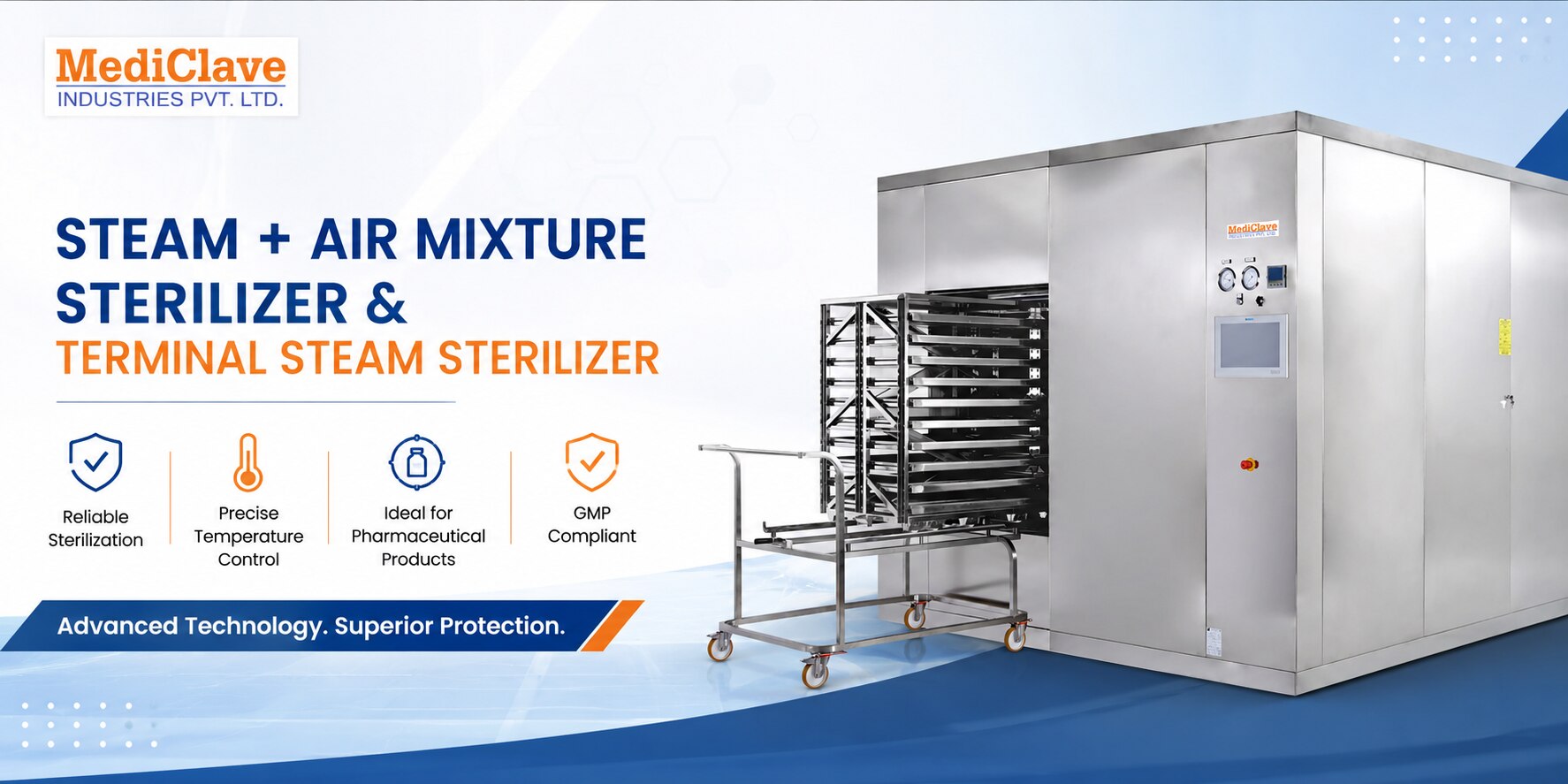
Why Terminal Steam Sterilizers Are Essential for Safe Pharmaceutical Manufacturing
In pharmaceutical manufacturing, sterilization is one of the most important steps in protecting product quality, patient safety, and regulatory compliance. When a medicine is filled into its final container, the product must remain protected from microorganisms and contamination until it reaches the end user. This is where Terminal Steam Sterilizer technology becomes highly valuable.
A Terminal Steam Sterilizer is designed to sterilize pharmaceutical products after they have been filled and sealed in their final containers. Unlike processes where sterilization takes place before filling, terminal sterilization treats the finished, closed product. This provides an important additional level of protection because the product remains inside its final package during the sterilization cycle.
For pharmaceutical companies manufacturing injectable medicines, IV fluids, parenteral solutions, sterile water products, and other suitable heat-stable formulations, selecting the right sterilization equipment can make a significant difference in product safety and process reliability.
At Mediclave Industries Pvt. Ltd., pharmaceutical manufacturers can explore a range of sterilization and process equipment designed to support modern manufacturing environments. The company's Terminal Steam Sterilizer solutions are developed around controlled temperature, pressure, steam distribution, automation, and hygienic design requirements.
What Is a Terminal Steam Sterilizer?
A Terminal Steam Sterilizer is a pharmaceutical sterilization system used for the final sterilization of products after filling and sealing. The sealed products are loaded into the sterilizer chamber, where controlled saturated steam and carefully managed temperature and pressure conditions are used to destroy microorganisms.
The basic objective is simple: achieve effective microbial inactivation while maintaining the quality and integrity of the pharmaceutical product and its container.
Terminal sterilization is commonly associated with products such as:
Injectable pharmaceutical products
Parenteral solutions
Large Volume Parenterals (LVP)
IV fluids
Sterile water products
Pharmaceutical solutions
Sealed bottles
Vials and suitable containers
Ampoules and other compatible sealed packaging
The exact sterilization cycle depends on the product formulation, container type, load configuration, thermal characteristics, and validated process requirements.
Why Is Terminal Sterilization Important?
Sterility is not simply about heating a product. Pharmaceutical sterilization must be carefully controlled so that microorganisms are effectively destroyed without compromising the product.
One of the major advantages of terminal sterilization is that the product is sterilized after final filling and sealing. Once the container has been sealed, the risk of contamination from subsequent handling can be reduced.
This makes terminal sterilization particularly valuable for pharmaceutical manufacturers because it can provide a robust final barrier against microbial contamination.
A properly designed and validated sterilization process can help manufacturers achieve:
Reliable microbial reduction
Improved sterility assurance
Consistent batch processing
Better product protection
Reduced contamination opportunities
Controlled temperature and pressure
Repeatable sterilization cycles
Support for GMP-oriented manufacturing
However, terminal sterilization should always be selected according to the characteristics of the pharmaceutical product. Some formulations may not tolerate the required heat exposure and may require alternative sterile manufacturing approaches.
How Does a Terminal Steam Sterilizer Work?
The operating principle of a Terminal Steam Sterilizer is based on controlled heat transfer through steam.
First, the filled and sealed products are arranged inside the sterilization chamber according to the validated loading pattern. The chamber is then prepared for the sterilization cycle.
Steam is introduced under controlled conditions. As the chamber reaches the required temperature, heat is transferred to the product containers. The sterilization phase is maintained for a predetermined period based on the validated cycle.
A typical process can include several stages:
Loading: Sealed products are carefully placed inside the chamber.
Air removal: Air is removed or managed so that the sterilizing medium can reach the load effectively.
Heating: Steam is introduced and the chamber temperature gradually reaches the required set point.
Sterilization: The required temperature and pressure are maintained for the validated holding period.
Cooling: The load is cooled under controlled conditions to protect the product and packaging.
Cycle completion: Process data is reviewed and the sterilized batch is unloaded according to the facility's procedures.
Every pharmaceutical product behaves differently during heating and cooling. Therefore, sterilization cycles should be developed and validated for the specific product and packaging combination rather than relying on a generic cycle.
Terminal Steam Sterilizer vs. Conventional Steam Sterilization
The terms steam sterilization and terminal steam sterilization are sometimes used interchangeably, but their application can be different.
A conventional steam sterilizer or autoclave may be used for sterilizing equipment, components, utensils, garments, laboratory materials, and other suitable loads.
A terminal steam sterilizer, on the other hand, is specifically associated with the final sterilization of filled and sealed pharmaceutical products.
For facilities requiring a broader range of pharmaceutical sterilization applications, Mediclave also offers a Saturated Steam Sterilizer (Autoclave) designed for steam-based sterilization applications.
The right equipment therefore depends on what the facility needs to sterilize, the packaging format, production capacity, process requirements, and validation strategy.
Why Pressure Control Matters
Pressure management is particularly important when sterilizing sealed pharmaceutical containers.
During heating, the pressure inside a sealed container can change as the product and its headspace respond to temperature. If the pressure conditions outside the container are not appropriately controlled, certain packaging formats may experience stress or deformation.
This is one reason advanced pharmaceutical sterilization systems may use controlled steam-air mixtures for applications involving flexible or pressure-sensitive containers.
Mediclave's Steam + Air Mixture Sterilizer & Terminal Steam Sterilizer combines controlled steam and filtered air technology for applications where pressure balance and product-container protection are important.
This type of system can be particularly useful for products packaged in flexible bags, plastic containers, IV containers, and other suitable packaging formats.
Terminal Steam Sterilization for IV Fluids and Parenteral Products
IV fluids and parenteral products require strict control because they are administered directly into the body.
The sterilization process must therefore consider not only microbial destruction but also product quality, container integrity, temperature exposure, and repeatability.
Terminal steam sterilization can be used for suitable heat-stable products after filling and sealing. The process helps create a final sterilization barrier before the finished product leaves the manufacturing facility.
For facilities producing sensitive IV products, a steam-air mixture approach can provide an additional advantage by helping maintain controlled pressure around the containers during heating and cooling.
This can help reduce the possibility of problems such as:
Container deformation
Leakage
Seal damage
Bag swelling
Packaging stress
Product loss
The actual suitability of a sterilization cycle must always be established through appropriate process development and validation.
The Importance of Temperature and Time Control
Effective sterilization requires more than simply reaching a high temperature.
The relationship between temperature, exposure time, steam quality, load configuration, and product characteristics determines the effectiveness of the sterilization cycle.
A modern Terminal Steam Sterilizer therefore needs accurate monitoring and control systems.
PLC and HMI-based controls can help operators monitor important parameters such as:
Chamber temperature
Chamber pressure
Sterilization time
Heating phase
Cooling phase
Cycle status
Alarms and safety conditions
Automated control can also improve repeatability between batches. Instead of relying heavily on manual intervention, the equipment can execute programmed process steps according to established operating procedures.
For pharmaceutical manufacturing, this repeatability is particularly important because consistent processing contributes to reliable product quality.
Hygienic Construction and SS316L
Equipment construction is another important consideration when selecting pharmaceutical sterilization machinery.
Pharmaceutical equipment must be designed with hygiene, cleanability, durability, and contamination control in mind. Stainless steel is widely used because of its corrosion resistance and suitability for hygienic applications.
For pharmaceutical contact areas, SS316L is commonly selected where appropriate because it offers excellent corrosion resistance and is well suited to demanding pharmaceutical environments.
A well-designed sterilizer should also minimize areas where residues, water, or contaminants can accumulate.
Smooth surfaces, hygienic chamber construction, appropriate drainage, and suitable piping design can make cleaning and maintenance easier.
The Role of Pure Steam in Pharmaceutical Sterilization
The quality of steam used in pharmaceutical applications can have a direct impact on the sterilization process.
Industrial steam may not always be suitable for applications where pharmaceutical-grade steam quality is required. For this reason, pharmaceutical manufacturing facilities often incorporate dedicated pure steam generation systems.
Mediclave's Pure Steam Generator is designed to generate high-purity steam for pharmaceutical applications, including equipment sterilization and Steam-In-Place operations.
Pure steam can be used for applications such as:
Pharmaceutical sterilizers
Manufacturing vessels
Process pipelines
Storage tanks
SIP systems
Sterile equipment
Other hygienic process applications
Integrating an appropriate pure steam source with a pharmaceutical sterilizer can help create a more controlled sterilization infrastructure.
Connecting Terminal Sterilization With CIP and SIP
Sterilization does not operate in isolation inside a modern pharmaceutical plant.
Before equipment can be sterilized, it generally needs to be properly cleaned. Residues, product deposits, and other contaminants should be removed before the sterilization stage.
This is where Cleaning-in-Place (CIP) and Sterilization-in-Place (SIP) systems become important.
Mediclave's CIP & SIP System can support automated cleaning and sterilization of suitable pharmaceutical process equipment and systems.
CIP helps clean equipment without extensive dismantling, while SIP uses sterilizing media such as pure steam to sterilize suitable equipment and process pathways.
When properly integrated, CIP, SIP, pure steam generation, and terminal sterilization can create a more efficient pharmaceutical manufacturing environment.
The Importance of Pharmaceutical-Grade Water
Water is another essential part of sterile pharmaceutical manufacturing.
Water may be required for formulation, cleaning, equipment operation, and other pharmaceutical processes. When high-purity water is required, facilities may use dedicated pharmaceutical water systems.
A Multi Column Distillation Plant can be used to produce high-purity Water for Injection (WFI) for suitable pharmaceutical applications.
WFI can play an important role in injectable manufacturing and other processes where high-quality water is required.
The generated water can also be stored and distributed through a dedicated WFI Storage & Distribution System to help maintain water quality throughout the facility.
This demonstrates why a Terminal Steam Sterilizer should not be viewed as an isolated piece of machinery. It can form part of a larger pharmaceutical utility and process ecosystem.
What Should You Consider Before Buying a Terminal Steam Sterilizer?
Selecting a sterilizer is an important investment, so pharmaceutical manufacturers should evaluate several factors before purchasing equipment.
1. Product Type
First identify what products will be sterilized. Injectable solutions, IV fluids, vials, bottles, and flexible containers can have different requirements.
2. Container Type
The material and design of the final container can affect heating, cooling, pressure balance, and sterilization-cycle development.
3. Batch Capacity
Determine the expected batch size and production frequency. The chamber should provide sufficient capacity without unnecessarily increasing equipment size.
4. Automation
PLC and HMI controls can simplify operation and provide better monitoring of process parameters.
5. Steam Quality
Evaluate whether the facility requires pharmaceutical-grade pure steam and how the sterilizer will connect to the steam-generation system.
6. Pressure Management
For sealed or flexible containers, pressure management can be a major consideration.
7. Validation Requirements
The system should support the facility's process validation strategy and applicable documentation requirements.
8. Hygienic Design
Consider chamber construction, surface finish, drainage, piping, cleanability, and maintenance access.
9. Safety Features
Door interlocks, pressure protection, alarms, controlled cycle operation, and other safety features are important for reliable operation.
10. Service and Support
A sterilizer is a long-term investment. Manufacturer support, installation assistance, spare parts, maintenance, and technical guidance should therefore be considered alongside the initial purchase price.
Why Choose Mediclave Industries for Pharmaceutical Sterilization Equipment?
Choosing the right manufacturer can be just as important as selecting the right sterilization technology.
Mediclave Industries Pvt. Ltd. provides pharmaceutical process, sterilization, and water-system equipment for manufacturing environments where hygiene, process control, and reliable operation are important.
Its product range includes Terminal Steam Sterilizers, Steam + Air Mixture Sterilizers, Saturated Steam Sterilizers, Pure Steam Generators, CIP & SIP Systems, Multi Column Distillation Plants, WFI Storage & Distribution Systems, and other pharmaceutical process equipment.
The benefit of working with an equipment manufacturer offering multiple complementary systems is that different parts of a pharmaceutical facility can be considered as a connected process rather than as independent machines.
For example, a pharmaceutical manufacturer may require high-purity water from a distillation system, pure steam for sterilization, CIP and SIP for process equipment hygiene, and a Terminal Steam Sterilizer for final product sterilization.
An integrated engineering approach can make equipment selection, installation, utility planning, and long-term operation easier.
Where Are Terminal Steam Sterilizers Used?
Terminal Steam Sterilizers can be valuable in several pharmaceutical manufacturing environments where suitable products require final sterilization.
Common applications include:
Pharmaceutical manufacturing plants
Injectable manufacturing facilities
IV fluid production facilities
Parenteral manufacturing units
Sterile pharmaceutical production
Biotechnology facilities
Healthcare product manufacturing
Research and development facilities
Contract manufacturing organizations
The exact application depends on product formulation, packaging, thermal stability, and validated sterilization requirements.
The Future of Pharmaceutical Terminal Sterilization
Pharmaceutical manufacturing is moving toward greater automation, improved data management, stronger process control, and more efficient use of utilities.
Modern sterilizers are increasingly expected to provide accurate sensors, automated cycles, electronic data handling, improved alarm systems, and reliable process monitoring.
Future developments are likely to focus on greater connectivity, energy efficiency, predictive maintenance, remote monitoring, and smarter process optimization.
However, the fundamental objective will remain the same: provide reliable sterilization while protecting product quality and maintaining patient safety.
Conclusion
A Terminal Steam Sterilizer is an important piece of equipment for pharmaceutical manufacturers producing suitable heat-stable products that require sterilization after filling and sealing. By combining controlled steam, temperature, pressure, and exposure time, the system can provide a reliable final sterilization step before the product reaches the market.
For manufacturers of injectables, IV fluids, parenteral products, and other suitable pharmaceutical formulations, the choice of sterilization technology should be based on product characteristics, container design, batch capacity, steam quality, pressure requirements, automation, validation, and long-term service support.
A successful pharmaceutical sterilization setup is also connected to the quality of supporting utilities. Pure Steam Generators, CIP & SIP Systems, Multi Column Distillation Plants, and WFI Storage & Distribution Systems can all contribute to a complete and hygienic manufacturing infrastructure.
Mediclave Industries Pvt. Ltd. offers a range of pharmaceutical sterilization, process, and water-system solutions designed to support modern manufacturing requirements. If you are planning a new pharmaceutical production facility, expanding capacity, or upgrading an existing sterilization process, the right equipment selection can help improve reliability, process consistency, and long-term operational efficiency.
For more information about Terminal Steam Sterilizers and pharmaceutical process equipment, contact Mediclave Industries Pvt. Ltd.
Email: info@mediclaveindustries.com
Phone: 08042755106
Website: https://www.mediclaveindustries.in/
10 Frequently Asked Questions About Terminal Steam Sterilizers
1. What is a Terminal Steam Sterilizer?
A Terminal Steam Sterilizer is pharmaceutical sterilization equipment used to sterilize products after they have been filled and sealed in their final containers. It uses controlled steam, temperature, pressure, and exposure time to achieve validated microbial inactivation.
2. How does a Terminal Steam Sterilizer work?
The sealed pharmaceutical products are loaded into the sterilization chamber. The system controls air removal, steam introduction, heating, sterilization, cooling, and other cycle stages. The exact cycle parameters are established through product-specific process development and validation.
3. Which pharmaceutical products can be sterilized using a Terminal Steam Sterilizer?
Suitable heat-stable products may include IV fluids, injectable solutions, parenteral products, infusion solutions, sterile water products, and other pharmaceutical preparations in compatible sealed containers. Heat-sensitive products may require alternative sterilization or aseptic processing.
4. What is the difference between terminal sterilization and aseptic processing?
In terminal sterilization, the product is sterilized after it has been filled and sealed in its final container. In aseptic processing, sterile components are assembled under controlled conditions. When a product can tolerate terminal sterilization, it can provide a measurable and validated final sterilization step.
5. Can Terminal Steam Sterilizers be used for IV bags?
Yes, suitable IV bags and other packaged pharmaceutical products can be terminally sterilized. For pressure-sensitive flexible containers, a steam + air mixture sterilization process may be appropriate because controlled air pressure can help manage pressure differences during heating and cooling.
6. Why is pressure control important during terminal steam sterilization?
When sealed containers are heated, pressure inside the container can change. Appropriate chamber pressure control helps protect containers from excessive pressure differences that could cause deformation, leakage, or packaging damage. The required pressure profile depends on the product and container design.
7. What is the role of F₀ in terminal steam sterilization?
F₀ represents the accumulated sterilizing effect of a moist-heat sterilization cycle, expressed as equivalent exposure time at a reference temperature. It is an important parameter used during cycle development and validation to demonstrate that the required microbial lethality has been achieved.
8. Does a Terminal Steam Sterilizer require pure steam?
Pharmaceutical sterilization applications may require appropriately qualified steam, depending on the process and applicable requirements. Pharmaceutical facilities may use a dedicated Pure Steam Generator to provide high-purity steam for suitable sterilization and SIP applications.
9. What factors should be considered when selecting a Terminal Steam Sterilizer?
Important factors include product type, formulation, container material, batch capacity, chamber size, temperature and pressure control, steam quality, automation, cooling requirements, loading arrangement, safety features, data recording, validation requirements, and after-sales technical support.
10. Why should pharmaceutical manufacturers choose a specialized Terminal Steam Sterilizer manufacturer?
A specialized manufacturer can help match the sterilizer design and process controls to the product, container, capacity, and pharmaceutical manufacturing requirements. Mediclave Industries offers Terminal Steam Sterilizers and Steam + Air Mixture Sterilizers along with complementary pharmaceutical equipment such as Pure Steam Generators, CIP & SIP Systems, and pharmaceutical water systems. This can help manufacturers plan a more integrated process infrastructure.
