
Injectable Liquid Manufacturing Vessel: Complete Guide for Sterile Pharmaceutical Manufacturing
Introduction
The pharmaceutical industry operates under strict quality and sterility requirements, especially when manufacturing injectable medicines. Injectable formulations directly enter the human body, making contamination control, product consistency, and GMP compliance critical.
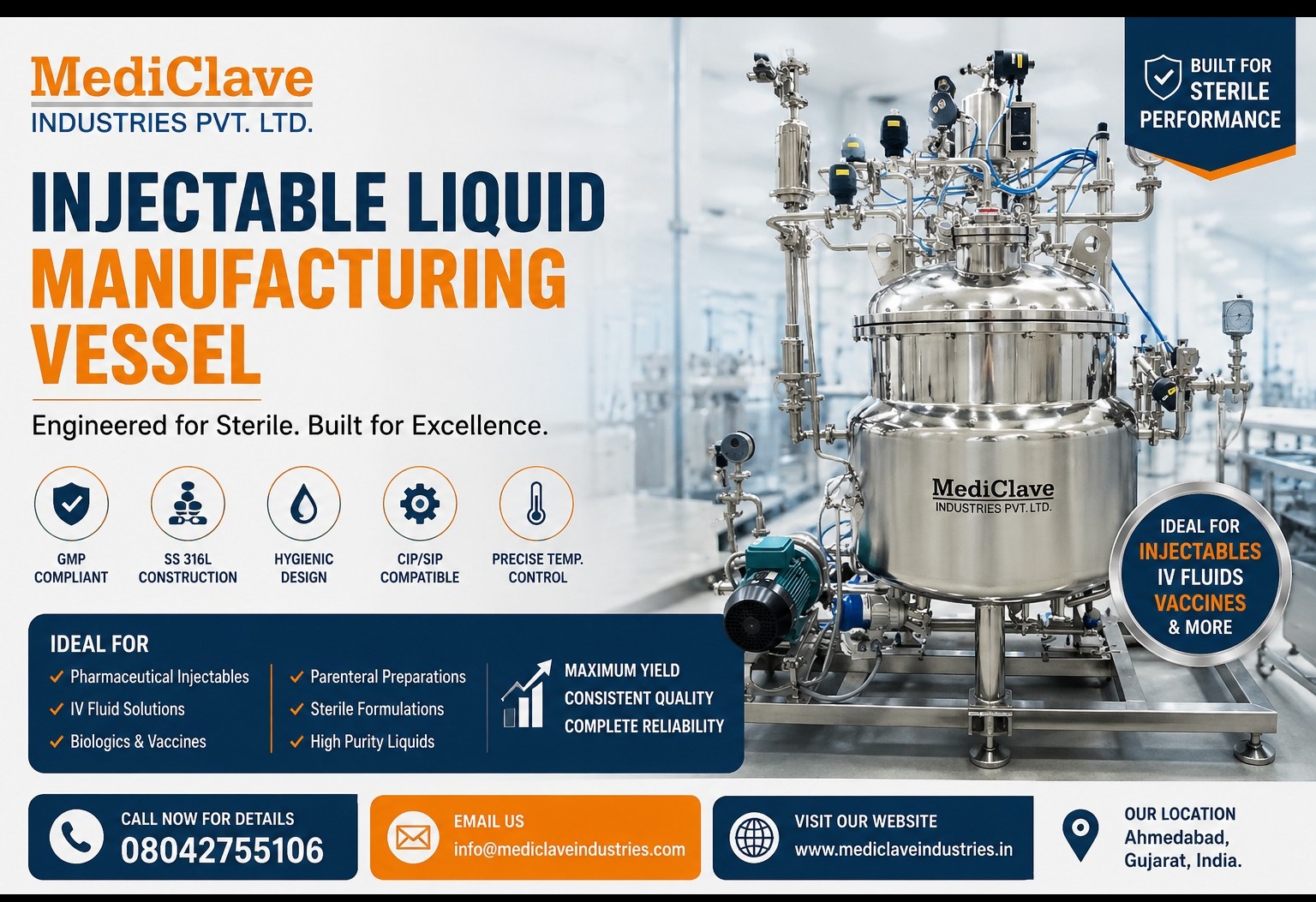
An Injectable Liquid Manufacturing Vessel is one of the most important pieces of equipment used in sterile pharmaceutical production facilities. These vessels are specifically designed for the preparation, mixing, storage, and transfer of injectable liquid formulations while maintaining the highest standards of hygiene and product safety.
Modern pharmaceutical manufacturers depend on high-quality Injectable Liquid Manufacturing Vessels to ensure batch consistency, regulatory compliance, and contamination-free production.
What is an Injectable Liquid Manufacturing Vessel?
An Injectable Liquid Manufacturing Vessel is a pharmaceutical-grade stainless steel vessel designed for preparing sterile injectable formulations under controlled manufacturing conditions.
These vessels are widely used for:
- Injectable medicines
- IV fluids
- Vaccines
- Sterile pharmaceutical solutions
- Biopharmaceutical products
- Parenteral preparations
The vessel provides a controlled environment where ingredients are accurately mixed and processed before filling and packaging operations.
Importance of Injectable Liquid Manufacturing Vessels
Injectable products require much stricter manufacturing standards compared to oral medicines.
Even minor contamination can affect:
- Product safety
- Patient health
- Regulatory approval
- Brand reputation
A properly designed Injectable Liquid Manufacturing Vessel helps pharmaceutical manufacturers achieve:
- Sterile processing
- Product consistency
- GMP compliance
- Reduced contamination risks
- Better production efficiency
Key Components of an Injectable Liquid Manufacturing Vessel
SS316L Product Contact Parts
SS316L stainless steel is the preferred material because of its:
- Corrosion resistance
- Easy cleaning
- Long service life
- Pharmaceutical compatibility
Agitation System
The agitation system ensures:
- Uniform mixing
- Homogeneous formulation
- Batch consistency
- Reduced processing time
Jacketed Construction
The jacket allows:
- Controlled heating
- Controlled cooling
- Temperature-sensitive processing
- Improved product stability
CIP System
Clean-In-Place technology enables:
- Automated cleaning
- Reduced downtime
- Improved hygiene
- GMP compliance
SIP Capability
Sterilize-In-Place systems provide:
- Sterile processing
- Reduced contamination
- Improved product quality
Working Principle of Injectable Liquid Manufacturing Vessel
Step 1: Water Charging
WFI (Water for Injection) is introduced into the vessel.
Step 2: Ingredient Addition
Active ingredients and excipients are added according to the formulation.
Step 3: Controlled Mixing
Agitators create a homogeneous mixture.
Step 4: Temperature Control
Heating or cooling is performed when required.
Step 5: Filtration
The solution passes through pharmaceutical-grade filtration systems.
Step 6: Sterile Transfer
The finished solution is transferred to filling machines under sterile conditions.
Applications of Injectable Liquid Manufacturing Vessels
Pharmaceutical Industry
Used for:
- Injectable drugs
- Antibiotic injections
- Pain management injections
- Specialty medicines
Vaccine Manufacturing
Supports production of:
- Human vaccines
- Veterinary vaccines
- Biological formulations
Biotechnology Industry
Used for:
- Biological products
- Research formulations
- Advanced therapies
Healthcare Manufacturing
Suitable for:
- Sterile liquids
- Healthcare formulations
- Specialized pharmaceutical products
Advantages of Injectable Liquid Manufacturing Vessels
Superior Product Quality
Ensures batch-to-batch consistency.
Sterile Processing Environment
Minimizes contamination risks.
GMP Compliance
Supports regulatory requirements.
Increased Productivity
Improves manufacturing efficiency.
Easy Cleaning and Maintenance
Reduces production downtime.
Long Equipment Life
Provides excellent return on investment.
Why SS316L is Essential for Injectable Manufacturing
SS316L offers several benefits:
- High corrosion resistance
- Smooth surface finish
- Easy sterilization
- Reduced contamination risk
- Long operational life
For pharmaceutical injectable manufacturing, SS316L remains the industry standard.
GMP Requirements for Injectable Manufacturing Equipment
Pharmaceutical regulatory agencies require:
- Hygienic design
- Documentation
- Validation support
- Surface finish standards
- Material traceability
- Cleaning validation
An advanced Injectable Liquid Manufacturing Vessel is designed to meet these requirements.
Challenges in Injectable Production
Contamination Control
Solution:
Closed sterile processing systems.
Batch Consistency
Solution:
Advanced agitation technology.
Regulatory Compliance
Solution:
GMP-compliant equipment design.
Production Efficiency
Solution:
Automation and process control systems.
Future Trends in Injectable Manufacturing
The pharmaceutical industry is moving toward:
- Automated production systems
- Smart process monitoring
- Digital batch recording
- Industry 4.0 integration
- Advanced sterile manufacturing
Modern Injectable Liquid Manufacturing Vessels are designed to support these future manufacturing requirements.
Why Choose Mediclave Industries?
Mediclave Industries manufactures high-quality pharmaceutical processing equipment designed for modern sterile manufacturing facilities.
Our Injectable Liquid Manufacturing Vessels feature:
- SS316L construction
- GMP-compliant design
- Advanced agitation systems
- CIP/SIP compatibility
- Customized capacities
- Superior engineering quality
- Long operational life
- Reliable technical support
We serve pharmaceutical companies, biotech industries, vaccine manufacturers, and healthcare organizations across India.
Frequently Asked Questions
What is an Injectable Liquid Manufacturing Vessel?
It is a pharmaceutical vessel used for preparing sterile injectable formulations under GMP-controlled conditions.
Why is SS316L used in injectable manufacturing?
SS316L provides corrosion resistance, hygiene, and pharmaceutical-grade product safety.
Which industries use Injectable Liquid Manufacturing Vessels?
Pharmaceutical, biotechnology, vaccine manufacturing, and healthcare industries.
Is the vessel GMP compliant?
Modern pharmaceutical vessels are designed according to GMP requirements and international industry standards.
Can the vessel be customized?
Yes, capacities, automation levels, and design configurations can be customized based on production requirements.
Conclusion
An Injectable Liquid Manufacturing Vessel plays a critical role in sterile pharmaceutical production. From ensuring contamination-free processing to supporting GMP compliance and product consistency, these vessels are essential for modern injectable manufacturing facilities.
Pharmaceutical companies investing in advanced Injectable Liquid Manufacturing Vessels can significantly improve quality, efficiency, and regulatory compliance while supporting long-term business growth.
If you're interested in pharmaceutical equipment, you may also read:
👉 https://www.mediclaveindustries.in/products/ointment-cream-tooth-paste-gel-manufacturing-plant/18
👉https://www.mediclaveindustries.in/products/liquid-syrup-manufacturing-process-plant/17
@Ahmedabad @Mumbai @Delhi @NewDelhi @Bangalore @Hyderabad @Chennai @Pune @Surat @Vadodara @Rajkot @Gandhinagar @Kolkata @Jaipur @Udaipur @Jodhpur @Indore @Bhopal @Nagpur @Nashik @Aurangabad @Lucknow @Kanpur @Patna @Ranchi @Bhubaneswar @Raipur @Chandigarh @Ludhiana @Amritsar @Jammu @Srinagar @Dehradun @Noida @Gurgaon @Faridabad @Sonipat @Panipat @Visnagar @Mehsana @Anand @Bhavnagar @Jamnagar @Morbi @Vapi @Silvassa @Goa @Kochi @Trivandrum @Coimbatore @Madurai @Vijayawada @Visakhapatnam @Mysore @Hubli @Belgaum @Tirupati @Salem @Tiruppur @Bikaner @Ajmer @Alwar @Haridwar @Shimla @Manali @Agra @Varanasi @Prayagraj @Guwahati @Shillong @Imphal @Aizawl @Itanagar @Gangtok @Dibrugarh @Siliguri @Jabalpur @Gwalior @Kolhapur @Solapur @Thane @NaviMumbai @Kalyan @Palghar @Rewari @Hisar @Rohtak @Karnal @Bhilai @Durg @Cuttack @Jamshedpur @Hosur @Kakinada @Warangal @Nellore @Kota @Sikar @Bharuch @Junagadh @Porbandar @Kutch @Dwarka @Amravati @Akola @Yavatmal @Satara @Sangli @Ratnagiri @Ahmednagar @Latur @Nanded @Beed @Jalgaon @Dhule @Parbhani @Osmanabad @Wardha @Chandrapur @Gondia @Bhandara @Malegaon @Ujjain @Ratlam @Dewas @Sagar @Satna @Rewa @Chhindwara @Sehore @Vidisha @Betul @Bilaspur @Korba @Ambikapur @Jagdalpur @Rourkela @Sambalpur @Balasore @Puri @Berhampur @Muzaffarpur @Gaya @Darbhanga @Bhagalpur @Purnia @Hajipur @Begusarai @Dhanbad @Bokaro @Hazaribagh @Giridih @Asansol @Durgapur @Howrah @Kharagpur @Malda @Murshidabad @Darjeeling @Aligarh @Meerut @Ghaziabad @Moradabad @Bareilly @Saharanpur @Mathura @Firozabad @Jhansi @Gorakhpur @Faizabad @Ayodhya @Sitapur @Unnao @Barabanki @Raebareli @Etawah @Muzaffarnagar @Bulandshahr @Rampur @Basti @Bahraich @Shahjahanpur @Haldwani @Rudrapur @Nainital @Rishikesh @Pathankot @Patiala @Mohali @Bathinda @Jalandhar @Hoshiarpur @Ambala @Yamunanagar @Kurukshetra @Sirsa @Bhiwani @Jhajjar @Panchkula @Dharamshala @Mandi @Kullu @Leh @Anantnag @Baramulla @Pulwama @Udhampur @Samba @Kathua @Guntur @Rajahmundry @Eluru @Kadapa @Anantapur @Karimnagar @Nizamabad @Khammam @Mahbubnagar @Secunderabad @Kurnool @Ballari @Davanagere @Shimoga @Mangalore @Udupi @Bijapur @Tumkur @Chikmagalur @Karwar @Erode @Vellore @Thoothukudi @Kanchipuram @Namakkal @Dindigul @Karur @Cuddalore @Pondicherry @Palakkad @Thrissur @Kannur @Alappuzha @Kollam @Kottayam @Pathanamthitta @Bhilwara @Chittorgarh @Pali @Barmer @SriGanganagar @Hanumangarh @Tonk @Bundi @Neemuch @Godhra @Patan @Surendranagar @Botad @Amreli @Valsad @Navsari @Dahod @Nadiad @Kalol @Mundra @Veraval @Somnath @Diu @Daman Baddi