

SEO
Title: Autoclave Machine Manufacturer in India | Hospital & Pharma
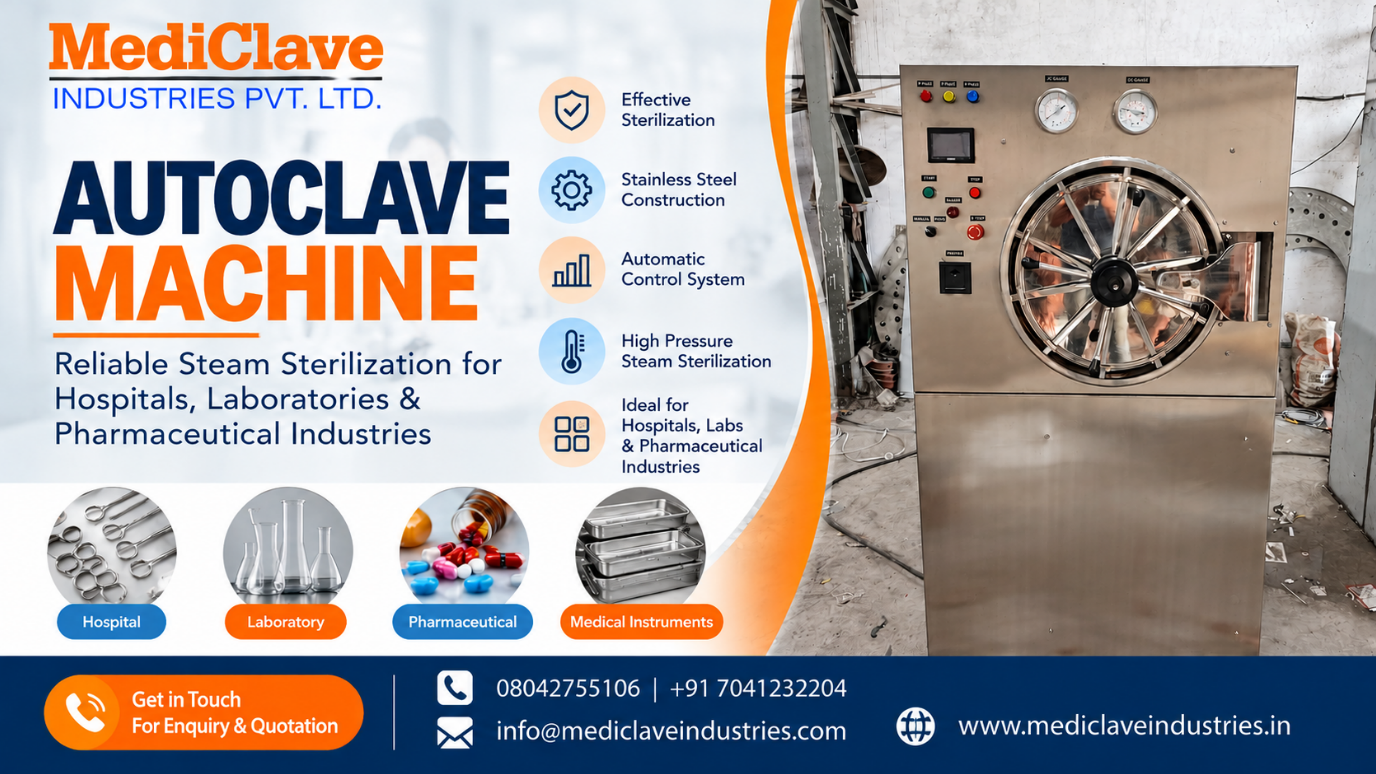
Autoclave – Mediclave Industries
Meta
Description: Explore Autoclave Machines for hospitals, pharmaceutical
industries, laboratories, and healthcare facilities. Learn about types, working
principles, applications, and benefits of steam sterilizers from Mediclave
Industries Private Limited.
Focus
Keyword: Autoclave Machine
Secondary
Keywords: Autoclave Machine Manufacturer, Autoclave Sterilizer, Steam Autoclave
Machine, Hospital Autoclave, Pharmaceutical Autoclave, Industrial Autoclave,
Autoclave Machine Manufacturer in India
Introduction
Sterilization
is one of the most important processes in healthcare, pharmaceutical
manufacturing, laboratories, and medical device industries. Maintaining sterile
instruments, equipment, and materials helps prevent contamination, supports
product quality, and promotes patient safety.
Among the
different sterilization technologies available, the Autoclave Machine is one of
the most widely used and trusted solutions for steam sterilization.
An autoclave
machine uses saturated steam under pressure to inactivate microorganisms,
including bacteria, viruses, fungi, and bacterial spores. It is commonly used
for sterilizing surgical instruments, laboratory glassware, pharmaceutical
manufacturing accessories, and other heat- and moisture-resistant materials.
At
Mediclave Industries Private Limited, we understand the importance of reliable
sterilization equipment for modern healthcare and industrial facilities. Our
sterilization equipment solutions are intended to support effective processing,
operational safety, and consistent performance.
As an Autoclave Machine
Manufacturer in India, Mediclave Industries offers sterilization
equipment solutions for hospitals, pharmaceutical companies, laboratories, and
other industries.
What Is an Autoclave Machine?
An
Autoclave Machine is a pressure-rated sterilization system that uses saturated
steam at controlled temperatures and pressures to sterilize suitable materials
and equipment.
The
primary purpose of an autoclave is to eliminate viable microorganisms through a
validated moist-heat sterilization process.
Unlike
ordinary cleaning or disinfection, sterilization is designed to achieve a
defined level of microbial inactivation, including resistant bacterial spores.
Autoclaves
are commonly used for:
- Surgical
instruments and medical equipment
- Laboratory
glassware and stainless steel accessories
- Pharmaceutical
production tools
- Microbiology
culture media
- Healthcare
instruments
- Medical
device manufacturing components
- Selected
laboratory waste
- Heat-resistant
industrial components
The
effectiveness of sterilization depends on proper steam penetration, air
removal, exposure temperature, holding time, and validated loading
arrangements.
How Does an Autoclave Machine Work?
An
autoclave works on the principle of moist-heat sterilization using saturated
steam under pressure.
Pressure
allows steam to reach temperatures above the normal boiling point of water. The
sterilizing action comes primarily from the transfer of heat when steam
condenses on the load.
The
process generally includes the following stages.
1. Loading the Autoclave
Materials
are arranged inside the sterilization chamber using appropriate trays, baskets,
or racks.
Proper
loading is important to ensure effective steam circulation and contact with all
required surfaces.
2. Air Removal
Air must
be removed from the chamber to allow effective steam penetration.
Depending
on the autoclave design, this may be achieved through gravity displacement,
vacuum-assisted air removal, or other validated methods.
3. Steam Generation and Heating
Saturated
steam is introduced into the sterilization chamber through an internal or
external steam generation system.
The chamber
temperature and pressure increase until the required process conditions are
achieved.
4. Sterilization Holding Time
Once the
validated sterilization conditions are reached, the exposure period begins.
Common
steam sterilization temperatures include 121°C and 134°C. The actual holding
time depends on the load type, packaging, equipment design, and validated
sterilization cycle.
5. Exhaust and Depressurization
After the
sterilization exposure is complete, steam is discharged through a controlled
process.
The
chamber pressure is reduced according to the selected cycle.
6. Drying and Unloading
Certain
autoclaves include vacuum-assisted drying systems to help remove moisture from
processed loads.
After the
cycle is complete and safe unloading conditions are achieved, materials can be
removed and handled according to the facility's procedures.
Types of Autoclave Machines
Different
industries require different autoclave designs depending on their applications,
chamber capacities, and sterilization requirements.
1. Horizontal Rectangular Autoclave
A
Horizontal Rectangular Autoclave is commonly used in hospitals, central sterile
supply departments (CSSD), pharmaceutical facilities, and medical device
manufacturing units.
Its
rectangular chamber provides practical loading arrangements for trays,
instrument baskets, and larger sterilization loads.
Common
applications: Hospital surgical instruments, pharmaceutical equipment
accessories, and medical device sterilization.
2. Horizontal Cylindrical Autoclave
A
Horizontal Cylindrical Autoclave features a cylindrical pressure chamber
designed for steam sterilization applications.
These
machines are used in hospitals, laboratories, and industrial facilities where
horizontal loading and suitable chamber capacities are required.
Common
applications: Medical instruments, laboratory materials, and industrial
sterilization loads.
3. Vertical Autoclave
A
Vertical Autoclave is a compact, top-loading sterilization machine suitable for
laboratories, research institutions, medical colleges, and selected healthcare
applications.
Vertical
autoclaves are available in different configurations, including double-wall and
triple-wall models.
Common
applications: Laboratory glassware, culture media, and compatible stainless
steel instruments.
4. High-Pressure Steam Sterilizer
A
High-Pressure Steam Sterilizer uses saturated steam under controlled pressure
to achieve the required sterilization temperature.
Depending
on the design, these systems may offer automatic process control, digital
monitoring, and cycle recording.
Common
applications: Hospitals, pharmaceutical production facilities, and
laboratories.
Explore
the sterilization equipment range on the Mediclave Industries
website.
Key Features of an Autoclave Machine
Stainless Steel Construction
Industrial
and medical autoclaves commonly use stainless steel chambers and components for
durability, corrosion resistance, and ease of cleaning.
Automatic Control Systems
Modern
autoclave machines may include PLC-based controllers, HMI displays, and
programmable sterilization cycles.
These
systems help operators monitor and manage the sterilization process.
Temperature and Pressure Monitoring
Accurate
sensors and instruments help monitor sterilization conditions throughout the
operating cycle.
Safety Interlocks
Safety
arrangements may include door interlocks, pressure relief devices, emergency
alarms, and protection against unsafe operating conditions.
Multiple Chamber Capacities
Autoclave
machines are available in different sizes to accommodate various sterilization
loads and production requirements.
Cycle Documentation
Depending
on the model, autoclaves may offer data recording, printing, and digital cycle
documentation for quality assurance purposes.
Applications of Autoclave Machines
Hospitals and CSSD Departments
Hospitals
use autoclave machines to sterilize reusable surgical instruments, medical
trays, dressing materials, and other compatible equipment.
Central
Sterile Supply Departments rely on appropriately validated sterilization
systems to support infection prevention and efficient instrument processing.
Pharmaceutical Manufacturing Industries
Pharmaceutical
facilities use autoclaves for sterilizing production accessories, containers,
components, and other suitable materials.
Depending
on the process, specialized autoclaves may also be used for terminal
sterilization of compatible pharmaceutical products.
Laboratories and Research Institutes
Laboratories
use autoclaves for glassware, microbiological culture media, laboratory tools,
and certain waste-processing applications.
Biotechnology Industries
Biotechnology
facilities require controlled sterilization processes for laboratory
accessories, processing components, and suitable research materials.
Medical Device Manufacturing
Autoclaves
can be used to sterilize medical devices and components that are compatible
with moist heat and validated steam sterilization cycles.
Benefits of Using an Autoclave Machine
Effective
Microbial Inactivation: Saturated steam provides reliable microbial
inactivation when appropriate sterilization conditions are achieved.
Consistent
Performance: Automatic monitoring and validated operating cycles support
repeatable sterilization processes.
No Chemical
Sterilant Residues: Steam sterilization avoids the chemical sterilant residues
associated with certain gas sterilization methods.
Efficient
Processing: Suitable autoclave designs can accommodate multiple instruments and
materials within a single sterilization load.
Durable
Construction: Stainless steel pressure chambers provide corrosion resistance
and mechanical durability.
Versatile
Applications: Autoclaves are suitable for many healthcare, pharmaceutical,
laboratory, and industrial applications.
Autoclave Machine vs. ETO Sterilizer
|
Parameter |
Autoclave Machine |
ETO Sterilizer |
|
Sterilization method |
Saturated steam |
Ethylene oxide gas |
|
Temperature |
Generally high |
Generally low |
|
Heat-sensitive products |
Often unsuitable |
Suitable for many compatible products |
|
Chemical residues |
No ETO residues |
Requires residual control |
|
Processing time |
Generally shorter |
Often longer due to aeration |
|
Applications |
Surgical instruments, laboratory materials |
Selected heat-sensitive medical devices |
Both
sterilization technologies have important applications. The correct method
depends on the product's material compatibility, packaging, and validated
sterilization requirements.
How to Choose the Right Autoclave Machine
Before
purchasing an autoclave machine, businesses should evaluate their specific
sterilization requirements.
Chamber
Capacity: Select a chamber size based on daily processing volume, load
dimensions, and future requirements.
Application:
Determine whether the equipment will be used in a hospital, pharmaceutical
facility, laboratory, or industrial environment.
Construction
Material: Choose appropriate stainless steel materials according to the
application and operating conditions.
Automation
Level: Consider manual, semi-automatic, or fully automatic operation.
Safety
Systems: Check pressure relief arrangements, door interlocks, alarms, and other
relevant protection features.
Validation
Requirements: Confirm whether the equipment can support the necessary
qualification, process validation, and documentation.
Technical
Support: Consider installation requirements, maintenance services, spare parts,
and operator training.
Why Choose Mediclave Industries Private Limited?
Mediclave
Industries Private Limited is a manufacturer of sterilization equipment and
pharmaceutical process machinery based in Ahmedabad, Gujarat, India.
Our
sterilization product portfolio includes horizontal rectangular autoclaves,
horizontal cylindrical steam sterilizers, vertical autoclaves, and other
sterilization systems.
We focus
on helping hospitals, pharmaceutical companies, laboratories, and healthcare
facilities select equipment according to their operating requirements.
Our
equipment range includes options for different chamber capacities, automation
requirements, and sterilization applications.
Explore
our Autoclave and
Sterilization Equipment Product Range.
For
detailed information about horizontal autoclaves, read our Horizontal Autoclave
Manufacturer in India product guide.
Frequently Asked Questions About Autoclave Machines
1. What
is an Autoclave Machine used for?
An
autoclave machine is used to sterilize compatible surgical instruments,
laboratory glassware, pharmaceutical accessories, and other heat- and
moisture-resistant materials.
2. What
is the working principle of an Autoclave Machine?
An
autoclave uses saturated steam under pressure to transfer heat to the load and
inactivate microorganisms, including bacterial spores.
3. What
temperature is used in an Autoclave Machine?
Common
steam sterilization temperatures include 121°C and 134°C. The required temperature
and exposure time depend on the load and validated process.
4. Which
Autoclave Machine is best for hospitals?
Horizontal
autoclaves are commonly selected for larger hospital CSSD departments, while
vertical autoclaves may be suitable for smaller facilities and selected
applications.
5. What
is the difference between a Vertical and Horizontal Autoclave?
A
vertical autoclave uses a top-loading chamber, while a horizontal autoclave
uses a front-loading arrangement. Horizontal models are often more convenient
for larger or heavier sterilization loads.
6. Where
can I find an Autoclave Machine Manufacturer in India?
Mediclave
Industries Private Limited, based in Ahmedabad, Gujarat, manufactures autoclave
machines and steam sterilization equipment for hospitals, laboratories, and
pharmaceutical industries.
Conclusion
An
Autoclave Machine is an essential sterilization solution for hospitals,
pharmaceutical industries, laboratories, and medical device manufacturing
facilities.
With
controlled saturated-steam sterilization, suitable chamber construction, safety
systems, and modern automation options, autoclaves help organizations maintain
consistent and reliable sterilization processes.
Selecting
the right equipment is important for achieving effective sterilization,
improving operational efficiency, and meeting industry-specific processing
requirements.
If you
are looking for an Autoclave Machine Manufacturer in India, Mediclave
Industries Private Limited offers steam sterilization equipment solutions for a
wide range of healthcare and industrial applications.
Contact Mediclave Industries Private Limited
Looking
for a reliable Autoclave Machine for your hospital, pharmaceutical plant, or
laboratory?
Contact
our team for product details, technical specifications, and quotations.
MEDICLAVE
INDUSTRIES PRIVATE LIMITED
Ahmedabad,
Gujarat, India
08042755106
| +91 7041232204
info@mediclaveindustries.com


