

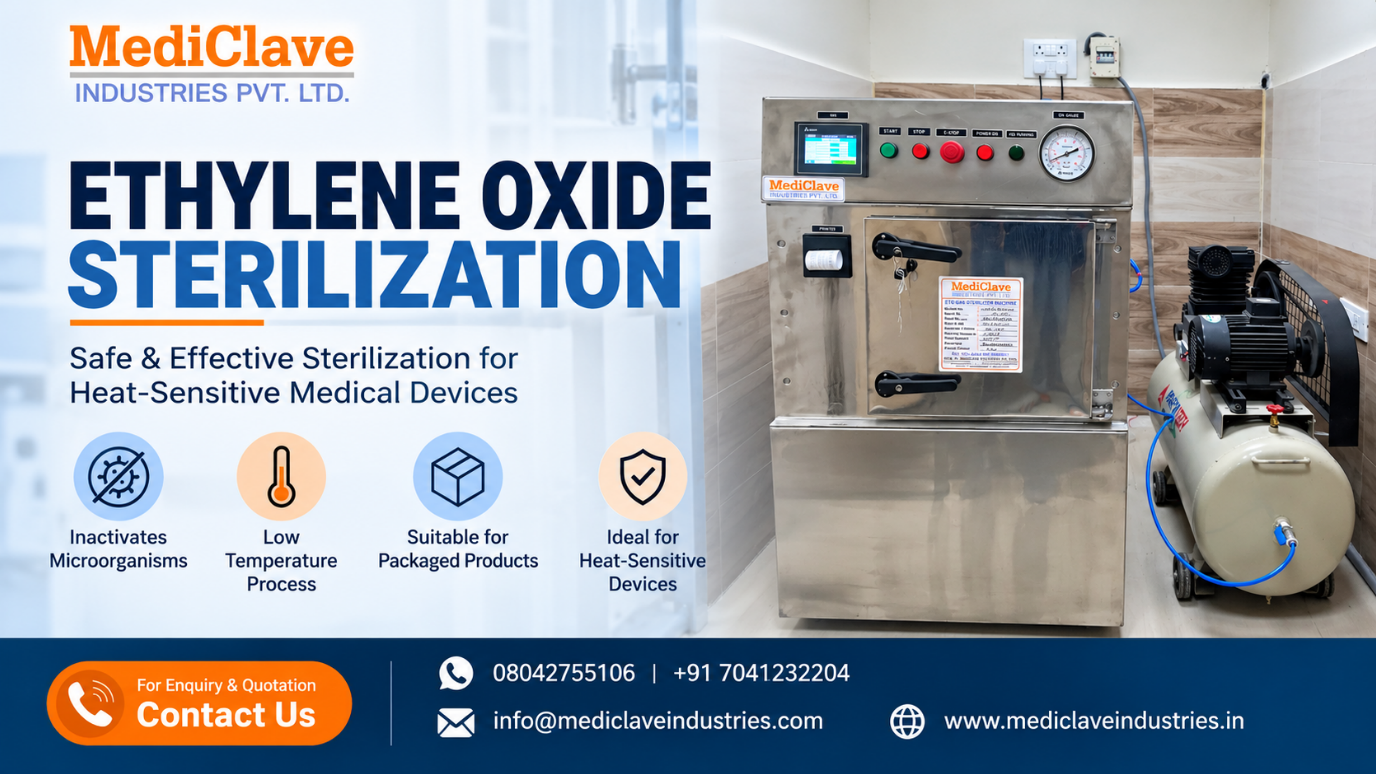
Introduction
Sterilization
plays a vital role in maintaining safety, hygiene, and quality across
healthcare facilities, pharmaceutical industries, and medical device
manufacturing units. As medical technology continues to advance, the demand for
reliable sterilization methods for delicate and heat-sensitive products is
increasing.
One
widely established method is Ethylene Oxide Sterilization (ETO Sterilization),
a low-temperature sterilization process used for medical devices and other
compatible products that cannot withstand conventional high-temperature steam
sterilization.
Unlike
steam sterilization, which relies on elevated temperatures and moisture,
ethylene oxide sterilization uses a chemical gas to inactivate microorganisms,
including bacterial spores, under carefully controlled conditions.
At Mediclave Industries
Private Limited, we understand the importance of reliable
sterilization equipment for healthcare and industrial applications. Our focus
is on providing sterilization equipment solutions designed around operational
requirements, process control, and safety.
What Is Ethylene Oxide Sterilization?
Ethylene
Oxide Sterilization is a chemical sterilization method that uses ethylene oxide
gas to inactivate microorganisms on compatible medical devices and products.
Ethylene
oxide is particularly useful because it can penetrate many types of packaging
materials and reach areas that may be difficult to sterilize using other
methods.
The
process is commonly selected for medical devices that contain heat-sensitive
plastics, electronic components, complex internal channels, or materials that
may be damaged by excessive heat or moisture.
ETO
sterilization requires precise control of several process parameters,
including:
- Gas
concentration
- Temperature
- Relative
humidity
- Exposure
time
- Chamber
pressure and gas distribution
- Aeration
and residual gas removal
The
successful sterilization of a product depends on the validated combination of
these parameters, the product design, its packaging, and the sterilization load
configuration.
How Does Ethylene Oxide Sterilization Work?
Ethylene
oxide sterilization works by chemically modifying essential components of
microorganisms, including proteins and nucleic acids, preventing them from
functioning and reproducing.
The
sterilization process typically involves several carefully controlled stages.
1. Preconditioning
Before
sterilization, products may undergo preconditioning to establish suitable
temperature and humidity conditions.
This
stage helps prepare the sterilization load for effective gas penetration and microbial
inactivation.
2. Humidification and Conditioning
Moisture
plays an important role in the effectiveness of ethylene oxide sterilization.
The
sterilization chamber is conditioned according to validated process
requirements to support consistent sterilization performance.
3. Ethylene Oxide Gas Exposure
Once the
required chamber conditions are established, ethylene oxide gas is introduced
through a controlled system.
The gas
penetrates compatible packaging materials and reaches exposed product surfaces,
including certain internal spaces.
Gas
concentration, temperature, humidity, and exposure duration must be maintained
within validated limits.
4. Gas Evacuation and Air Washing
After the
required exposure period, the ethylene oxide gas is removed from the chamber
using controlled evacuation and flushing stages.
Appropriate
gas handling and emission-control systems are essential because ethylene oxide
is hazardous and flammable.
5. Aeration
Aeration
is one of the most important stages of the ETO sterilization process.
Sterilized
products may retain ethylene oxide and related chemical residues. A validated
aeration process is therefore required to reduce residual levels to acceptable
limits before the products are released for their intended use.
Key Benefits of Ethylene Oxide Sterilization
Low-Temperature Sterilization
ETO
sterilization is suitable for many heat-sensitive medical devices that cannot
tolerate conventional steam sterilization temperatures.
Effective Gas Penetration
Ethylene
oxide gas can penetrate compatible packaging materials and certain complex
device geometries, making it useful for appropriately validated products with
intricate designs.
Compatibility With Various Materials
ETO
sterilization can be suitable for many plastics, polymers, rubber components,
and other materials used in medical device manufacturing.
However,
compatibility must be evaluated for each specific product.
Sterilization of Packaged Products
ETO
sterilization can be performed on products enclosed in compatible sterile barrier
packaging, helping manufacturers maintain product sterility after processing
when packaging integrity is preserved.
Wide Range of Applications
Ethylene
oxide sterilization is used in medical device manufacturing, healthcare-related
processing, and selected industrial applications where other sterilization
methods may not be suitable.
Applications of Ethylene Oxide Sterilization
Medical
Device Manufacturing
ETO
sterilization is widely used for compatible medical devices, including
disposable medical products, tubing sets, catheters, and certain surgical
accessories.
Hospital
and Healthcare Facilities
Appropriately
designed ETO sterilization systems may be used for certain reusable,
heat-sensitive medical devices when the device manufacturer's instructions
permit this method.
Pharmaceutical
and Healthcare Packaging
ETO
sterilization may be suitable for selected packaging components and healthcare
products, subject to material compatibility, product requirements, and process
validation.
Diagnostic
and Laboratory Equipment
Certain
diagnostic accessories, laboratory consumables, and specialized components may
be processed using validated ethylene oxide sterilization cycles.
Plastic
and Polymer Medical Components
Many
polymer-based medical devices require low-temperature sterilization to reduce
the risk of heat-related deformation or damage.
Ethylene Oxide Sterilization vs. Steam
Sterilization
Both
ethylene oxide sterilization and steam sterilization are established methods,
but they serve different purposes.
|
Parameter |
Ethylene Oxide Sterilization |
Steam Sterilization |
|
Sterilizing agent |
Ethylene oxide gas |
Saturated steam |
|
Operating temperature |
Generally low temperature |
High temperature |
|
Heat-sensitive devices |
Suitable for many compatible devices |
Often unsuitable |
|
Cycle duration |
Longer, including aeration |
Generally shorter |
|
Chemical residues |
Requires residual control and aeration |
No ETO chemical residues |
|
Common applications |
Heat-sensitive medical devices |
Heat- and moisture-resistant instruments |
The appropriate
sterilization method depends on product characteristics, compatibility,
regulatory requirements, and validated processing conditions.
Important Features of an Industrial ETO Sterilizer
When
selecting an Ethylene Oxide Sterilizer, manufacturers and healthcare
organizations should consider the equipment's technical capabilities, safety
provisions, and operational requirements.
Important
features may include:
- Automatic
process control through PLC and HMI systems
- Accurate
temperature and humidity monitoring
- Controlled
gas introduction and evacuation
- Chamber
pressure monitoring
- Process
recording and cycle documentation
- Safety
interlocks and alarm systems
- Appropriate
gas handling and emission treatment
- Integration
with validated aeration arrangements
- Equipment
design suitable for installation and maintenance requirements
The
actual configuration and specifications should be selected according to the
intended application and equipment model.
Safety and Quality Standards in Ethylene Oxide
Sterilization
Safety
and process validation are essential when operating an ETO sterilization
system.
Ethylene
oxide is a toxic, flammable chemical, and prolonged exposure can pose serious
health risks. Therefore, ETO sterilization facilities must incorporate suitable
engineering controls, trained operators, exposure monitoring, and
emission-management systems.
These
standards support manufacturers in establishing safe, reproducible
sterilization processes.
Why Choose Mediclave Industries for ETO
Sterilization Equipment?
Choosing
the right sterilization equipment supplier is an important decision for
healthcare facilities, pharmaceutical companies, and medical device
manufacturers.
Mediclave
Industries Private Limited offers sterilization equipment solutions for
healthcare and industrial applications, including ETO sterilizers.
Our
approach focuses on understanding the customer's application, sterilization
load requirements, equipment configuration, and operational expectations.
Whether
your requirement involves medical device manufacturing or healthcare
sterilization, selecting the appropriate ETO sterilizer can help establish a
controlled and repeatable sterilization process.
Explore
our ETO Sterilizer product
information to learn more about available solutions.
You can
also visit our official website to
explore our broader range of hospital sterilization and pharmaceutical
equipment.
Frequently Asked Questions About Ethylene Oxide
Sterilization
1. What
is Ethylene Oxide Sterilization used for?
Ethylene
oxide sterilization is primarily used for compatible heat-sensitive medical
devices, disposable medical products, catheters, tubing sets, and certain
complex medical instruments.
2. Is
Ethylene Oxide Sterilization better than steam sterilization?
Neither
method is universally better. ETO sterilization is valuable for compatible
heat-sensitive products, while steam sterilization is generally preferred for
instruments that can tolerate high temperatures and moisture.
3. How
long does Ethylene Oxide Sterilization take?
The
duration depends on the validated sterilization cycle, equipment configuration,
product materials, and aeration requirements. Complete processing can take many
hours and may extend beyond a day.
4. Is
Ethylene Oxide Sterilization safe?
ETO
sterilization can be used safely when properly validated and operated with
appropriate exposure controls, gas handling, aeration, and residual testing.
Ethylene oxide itself is hazardous and requires strict safety precautions.
5. Where
can I find an ETO Sterilizer Manufacturer in India?
Mediclave
Industries Private Limited, based in Ahmedabad, Gujarat, provides ETO
sterilization equipment solutions for healthcare and industrial applications.
Conclusion
Ethylene
Oxide Sterilization remains an important method for sterilizing medical devices
and healthcare products that cannot tolerate conventional high-temperature
sterilization.
Its
ability to penetrate compatible packaging materials and process complex medical
devices makes it valuable for medical device manufacturers and healthcare
facilities.
However, successful
ETO sterilization requires much more than gas exposure. Proper equipment
selection, validated process parameters, safety systems, aeration, and routine
monitoring are all essential.
For
businesses seeking an Ethylene Oxide Sterilizer Manufacturer in India,
Mediclave Industries Private Limited offers ETO sterilization equipment
solutions designed to meet different operational requirements.
Contact Mediclave Industries Private Limited
Looking
for an Ethylene Oxide Sterilizer for your hospital, pharmaceutical facility, or
medical device manufacturing unit?
Contact our team to discuss your
equipment requirements and request a quotation.
MEDICLAVE
INDUSTRIES PRIVATE LIMITED
08042755106
| +91 7041232204
info@mediclaveindustries.com
Ahmedabad,
Gujarat, India


