
Introduction
The pharmaceutical industry demands high standards of quality, precision, and hygiene in the production of topical formulations. Among the most widely manufactured pharmaceutical dosage forms are ointments, creams, gels, and medicated pastes, all of which require specialized manufacturing equipment to ensure consistent quality and regulatory compliance.
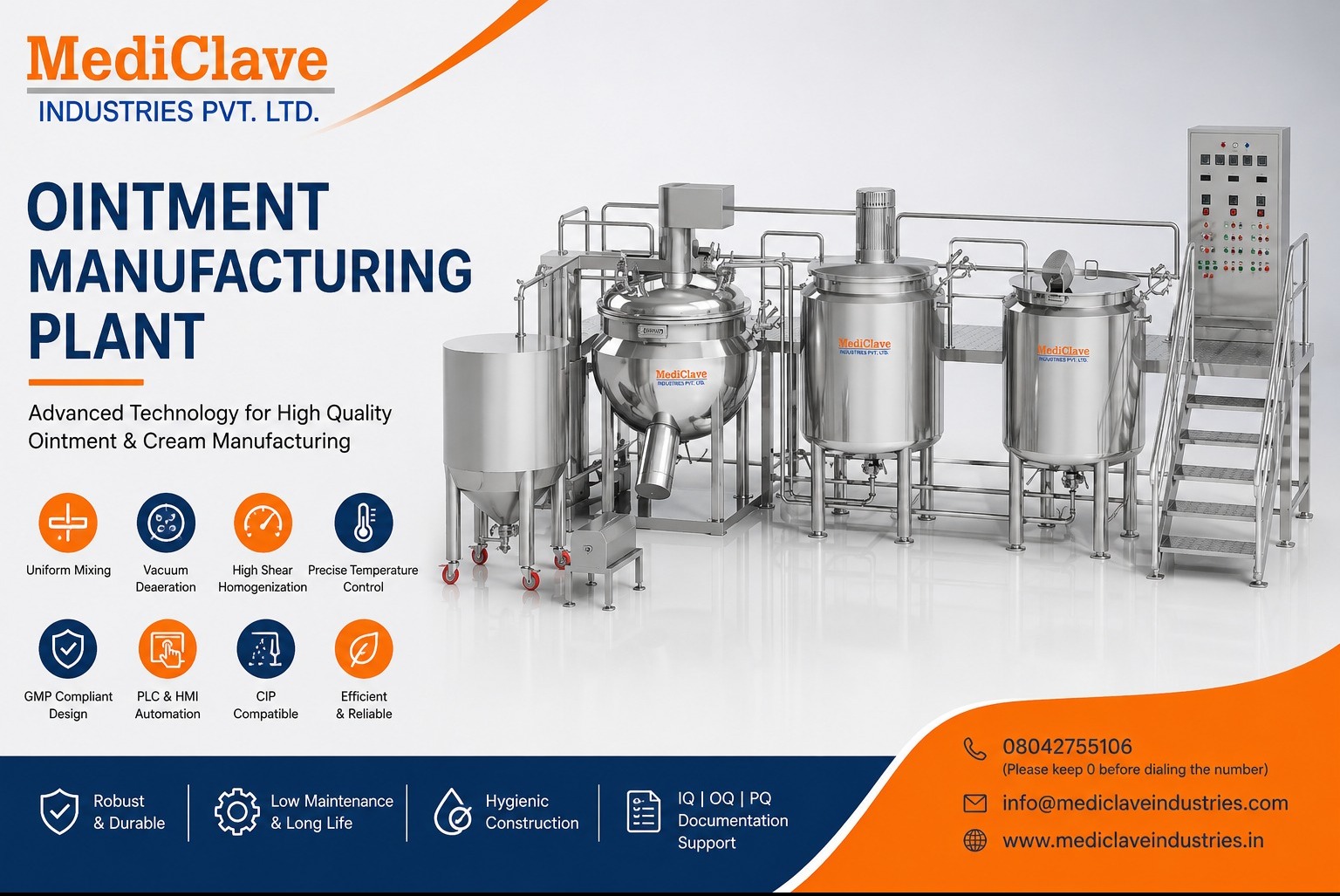
An Ointment Manufacturing Plant is a complete processing system designed for the hygienic manufacturing of semi-solid pharmaceutical formulations. It integrates advanced technologies such as vacuum emulsification, homogenization, controlled heating and cooling, mixing, and automated product transfer to produce uniform and stable formulations.
Modern ointment manufacturing plants are extensively used in pharmaceutical companies, cosmetic manufacturers, personal care industries, herbal product manufacturers, veterinary medicine production, and nutraceutical facilities. These plants are engineered to comply with WHO-GMP, cGMP, US FDA, EU GMP, and other international pharmaceutical manufacturing standards.
Whether producing antibiotic ointments, antiseptic creams, moisturizing lotions, cosmetic creams, herbal gels, or medicated formulations, selecting the right ointment manufacturing plant is essential for maintaining product quality, maximizing production efficiency, and ensuring long-term operational reliability.
If you are looking for advanced pharmaceutical process equipment, explore Mediclave Industries' complete product range:
Pharma Process Equipment
https://www.mediclaveindustries.in/products/category/pharma-process-equipment/1
To know more about our company and manufacturing capabilities, visit:
https://www.mediclaveindustries.in/about-us
Table of Contents
- What is an Ointment Manufacturing Plant?
- Importance of Ointment Manufacturing
- Types of Ointments
- Working Principle
- Major Components
- Manufacturing Process
- Features
- Advantages
- Applications
- GMP Compliance
- Validation
- Buying Guide
- Maintenance
- FAQs
What is an Ointment Manufacturing Plant?
An Ointment Manufacturing Plant is an integrated pharmaceutical processing system used for the preparation of semi-solid dosage forms under controlled hygienic conditions.
The plant combines multiple processing operations such as:
- Mixing
- Heating
- Cooling
- Homogenization
- Vacuum processing
- Emulsification
- Product storage
- Product transfer
- Automatic filling support
The primary objective is to manufacture pharmaceutical and cosmetic products with:
- Uniform consistency
- Stable emulsion
- Smooth texture
- Controlled viscosity
- Accurate ingredient distribution
- Long shelf life
Modern plants are fully automated using PLC and HMI systems, allowing operators to monitor every stage of production with precision.
Why is an Ointment Manufacturing Plant Important?
Producing semi-solid pharmaceutical products requires precise control over processing conditions. Manual manufacturing often results in inconsistent texture, poor mixing, air entrapment, contamination risks, and variable product quality.
An automated ointment manufacturing plant addresses these challenges by offering:
- Uniform mixing
- Vacuum deaeration
- Controlled heating and cooling
- High-shear homogenization
- Hygienic closed processing
- Batch-to-batch consistency
- Reduced product loss
- Faster production cycles
These benefits help manufacturers meet regulatory requirements while improving productivity and reducing operational costs.
Types of Ointments Manufactured
A modern ointment manufacturing plant is capable of producing a wide range of semi-solid formulations, including:
Pharmaceutical Ointments
- Antibiotic Ointments
- Antifungal Ointments
- Steroid Ointments
- Antiseptic Ointments
- Burn Ointments
- Pain Relief Ointments
- Eye Ointments
Pharmaceutical Creams
- Skin Creams
- Medicated Creams
- Moisturizing Creams
- Dermatological Creams
- Anti-inflammatory Creams
Cosmetic Products
- Beauty Creams
- Face Creams
- Body Lotions
- Sunscreen Creams
- Cold Creams
- Fairness Creams
Herbal Products
- Herbal Creams
- Ayurvedic Ointments
- Herbal Gels
- Pain Relief Gels
Veterinary Products
- Veterinary Ointments
- Animal Care Creams
- Veterinary Topical Gels
Working Principle of an Ointment Manufacturing Plant
The manufacturing process begins by charging the required raw materials into the preparation vessel according to the approved batch manufacturing record (BMR).
Depending on the formulation, oil-soluble ingredients and water-soluble ingredients are prepared separately in dedicated vessels. Each phase is heated to the required temperature before being transferred into the main manufacturing vessel.
Inside the manufacturing vessel, a powerful agitator and high-shear homogenizer ensure rapid mixing and emulsification of the ingredients. Vacuum is applied throughout the process to eliminate entrapped air, preventing oxidation and improving product appearance.
The homogenization process reduces particle size and creates a smooth, stable emulsion with excellent consistency.
After homogenization, the product is gradually cooled while continuous mixing maintains uniformity. Once the required viscosity and temperature are achieved, the finished ointment is transferred through a closed pipeline to the storage tank or directly to the filling machine.
This controlled process ensures high-quality, contamination-free production with excellent batch consistency.
Major Components of an Ointment Manufacturing Plant
1. Main Manufacturing Vessel
The manufacturing vessel is the heart of the plant. It is typically constructed from SS316L for product contact surfaces and designed for vacuum operation.
Its functions include:
- Mixing
- Heating
- Cooling
- Homogenization
- Vacuum processing
2. Oil Phase Vessel
Oil-soluble ingredients such as waxes, oils, and emulsifiers are prepared in a dedicated oil phase vessel equipped with heating and agitation systems.
3. Water Phase Vessel
Water-soluble ingredients are processed separately under controlled temperature conditions before being transferred to the main vessel.
4. High-Shear Homogenizer
The homogenizer creates fine particle dispersion and stable emulsions by applying intense mechanical shear forces.
Benefits include:
- Smooth texture
- Uniform particle size
- Improved stability
- Better product appearance
- Enhanced absorption
5. Vacuum System
The vacuum system removes entrapped air during processing.
Advantages include:
- Bubble-free product
- Reduced oxidation
- Improved shelf life
- Better filling accuracy
- Superior product finish
6. Heating & Cooling System
The jacketed vessel allows precise temperature control during production.
Heating ensures proper melting of waxes and oils, while controlled cooling stabilizes the final formulation.
7. PLC & HMI Control Panel
Modern plants are fully automated with PLC-based control systems that allow operators to monitor:
- Mixing speed
- Homogenizer speed
- Vacuum level
- Temperature
- Batch timing
- Alarm history
- Process parameters
Automation minimizes human error and improves repeatability.
Step-by-Step Ointment Manufacturing Process
A typical ointment manufacturing cycle includes the following stages:
Step 1 – Raw Material Preparation
All ingredients are accurately weighed and verified according to the Batch Manufacturing Record (BMR).
Step 2 – Oil Phase Preparation
Oil-based ingredients are heated until completely melted.
Step 3 – Water Phase Preparation
Water-soluble ingredients are prepared separately under controlled conditions.
Step 4 – Mixing and Emulsification
The oil and water phases are combined in the main vessel, where high-shear homogenization creates a stable emulsion.
Step 5 – Vacuum Deaeration
Vacuum is applied to remove trapped air, improving product quality and appearance.
Step 6 – Controlled Cooling
The product is gradually cooled while maintaining continuous agitation to achieve the desired viscosity and consistency.
Step 7 – Product Transfer
The finished ointment is transferred through a closed sanitary pipeline to a storage vessel or filling machine, ensuring hygienic handling and minimizing contamination risks.
Why Choose Mediclave Industries?
Mediclave Industries manufactures advanced pharmaceutical process equipment designed for GMP-compliant production facilities.
Explore our complete product range:
- Home: https://www.mediclaveindustries.in/
- Pharma Process Equipment: https://www.mediclaveindustries.in/products/category/pharma-process-equipment/1
- Pharma Sterilization Equipment: https://www.mediclaveindustries.in/products/category/pharma-sterilization/1
- Pharma Water Systems: https://www.mediclaveindustries.in/products/category/pharma-water-systems/1
- Latest Updates: https://www.mediclaveindustries.in/latest-updates/1
Key Features of an Ointment Manufacturing Plant
Modern pharmaceutical manufacturing plants are designed to ensure precision, hygiene, automation, and compliance with international standards. An advanced Ointment Manufacturing Plant combines innovative engineering with intelligent automation to manufacture high-quality semi-solid formulations efficiently.
Below are the major features that make these plants an ideal choice for pharmaceutical and cosmetic manufacturers.
1. Vacuum Processing Technology
One of the most important features of an Ointment Manufacturing Plant is its vacuum processing capability.
During mixing and homogenization, air bubbles can become trapped inside the product, affecting its appearance, stability, and filling accuracy. The vacuum system removes these entrapped air bubbles, producing a smooth, homogeneous, and stable formulation.
Benefits:
- Bubble-free product
- Improved product stability
- Longer shelf life
- Better filling accuracy
- Reduced oxidation
- Premium product appearance
2. High-Shear Homogenization
The high-shear homogenizer is responsible for reducing particle size and creating a fine, stable emulsion.
It ensures:
- Uniform particle distribution
- Excellent texture
- Smooth consistency
- Improved product absorption
- Stable emulsion
- Consistent product quality
This is especially important for pharmaceutical creams, dermatological ointments, and cosmetic formulations.
3. PLC-Based Fully Automatic Operation
Modern Ointment Manufacturing Plants are equipped with advanced PLC and HMI systems that automate the complete manufacturing process.
Operators can easily monitor:
- Batch status
- Mixing speed
- Homogenizer RPM
- Vacuum level
- Product temperature
- Heating and cooling cycle
- Alarm history
- Batch reports
- Production parameters
Automation minimizes human intervention, improving accuracy and repeatability.
4. Jacketed Heating & Cooling System
Temperature control is critical during ointment manufacturing.
The jacketed vessel allows:
- Uniform heating
- Controlled cooling
- Faster batch processing
- Accurate temperature regulation
Proper temperature management prevents degradation of heat-sensitive ingredients while ensuring complete melting of waxes and emulsifiers.
5. Hygienic Stainless Steel Construction
The product-contact parts are generally manufactured using SS316L stainless steel, while the external structure is made from SS304.
This provides:
- Corrosion resistance
- Easy cleaning
- Long equipment life
- GMP compliance
- Reduced contamination risk
6. CIP (Clean-in-Place) Compatibility
Many modern plants include Clean-in-Place (CIP) systems.
CIP enables automatic cleaning of pipelines, vessels, valves, and product-contact surfaces without dismantling the equipment.
Advantages include:
- Reduced cleaning time
- Improved hygiene
- Lower labor costs
- Consistent cleaning results
- Faster production turnaround
Advantages of an Ointment Manufacturing Plant
Investing in an advanced ointment manufacturing plant offers several operational and commercial benefits.
Superior Product Quality
The combination of controlled mixing, vacuum processing, and homogenization ensures:
- Uniform consistency
- Smooth texture
- Stable emulsion
- Accurate ingredient distribution
Increased Production Efficiency
Automation significantly reduces production time while improving output.
Benefits include:
- Faster batch completion
- Reduced downtime
- Higher productivity
- Lower operating costs
Batch-to-Batch Consistency
PLC-controlled manufacturing ensures that every batch follows the same validated process parameters.
This improves:
- Product quality
- Customer satisfaction
- Regulatory compliance
Reduced Product Loss
Vacuum transfer systems and hygienic pipeline design minimize material wastage during production.
Energy Efficiency
Optimized heating and cooling systems reduce:
- Steam consumption
- Electricity usage
- Water consumption
This lowers operating costs over the life of the equipment.
Easy Operation
Touchscreen controls and automated recipes simplify operation and reduce dependency on manual processes.
Applications of Ointment Manufacturing Plants
Ointment Manufacturing Plants are widely used in several industries that produce semi-solid formulations.
Pharmaceutical Industry
The pharmaceutical sector is the largest application area.
Products manufactured include:
- Antibiotic Ointments
- Antifungal Creams
- Steroid Creams
- Burn Ointments
- Pain Relief Gels
- Eye Ointments
- Dermatological Creams
- Surgical Creams
- Antiseptic Products
Explore our Pharma Process Equipment:
https://www.mediclaveindustries.in/products/category/pharma-process-equipment/1
Cosmetic Industry
Cosmetic manufacturers use ointment plants for producing:
- Face Creams
- Moisturizers
- Body Lotions
- Sunscreens
- Night Creams
- Anti-Aging Creams
- BB & CC Creams
- Hair Creams
Herbal & Ayurvedic Industry
The plant is suitable for manufacturing:
- Herbal Ointments
- Ayurvedic Creams
- Herbal Gels
- Pain Relief Balms
- Natural Skin Care Products
Veterinary Industry
Applications include:
- Veterinary Ointments
- Animal Care Creams
- Veterinary Gels
- Topical Medicines
Ointment Manufacturing Plant vs Conventional Mixing System
| Feature | Ointment Manufacturing Plant | Conventional Mixing System |
|---|---|---|
| Vacuum Processing | Yes | No |
| Homogenization | High-Shear | Basic Mixing |
| Product Quality | Excellent | Moderate |
| Automation | PLC & HMI | Manual/Semi-Automatic |
| Temperature Control | Precise | Limited |
| Batch Consistency | Excellent | Variable |
| GMP Compliance | High | Limited |
| Cleaning | CIP Compatible | Manual |
| Productivity | High | Moderate |
| Product Stability | Excellent | Moderate |
GMP Compliance
An Ointment Manufacturing Plant must comply with international pharmaceutical manufacturing standards.
Typical compliance includes:
- WHO GMP
- cGMP
- US FDA Guidelines
- EU GMP
- ISPE Recommendations
Key GMP features:
- SS316L Product Contact Parts
- Sanitary Design
- Hygienic Piping
- Dead-Leg-Free Construction
- Validation Support
- Electronic Batch Recording
- Traceability
- Easy Cleaning
Know more about Mediclave Industries:
https://www.mediclaveindustries.in/about-us
Validation Requirements
Proper validation ensures consistent manufacturing performance.
Installation Qualification (IQ)
Verifies:
- Equipment installation
- Utility connections
- Material specifications
- Documentation
Operational Qualification (OQ)
Confirms:
- Agitator performance
- Homogenizer operation
- Temperature accuracy
- Vacuum performance
- Safety systems
- PLC functionality
Performance Qualification (PQ)
PQ demonstrates consistent manufacturing under actual production conditions.
It includes:
- Three consecutive successful batches
- Product consistency testing
- Homogeneity verification
- Temperature validation
- Cleaning validation support
Buying Guide – How to Choose the Right Ointment Manufacturing Plant
Before purchasing, consider the following factors:
Production Capacity
Choose equipment based on your required batch size, such as:
- 50 Liters
- 100 Liters
- 250 Liters
- 500 Liters
- 1000 Liters
- 2000 Liters
- Custom Capacities
Material of Construction
For pharmaceutical applications, SS316L should be used for all product-contact parts.
Automation Level
Select a plant with:
- PLC Automation
- Touchscreen HMI
- Recipe Management
- Data Logging
- Alarm History
Validation Documentation
Ensure the supplier provides:
- DQ
- IQ
- OQ
- PQ
- FAT
- SAT
After-Sales Support
A reliable manufacturer should offer:
- Installation & Commissioning
- Operator Training
- Spare Parts Support
- Annual Maintenance Contracts (AMC)
- Technical Assistance
Maintenance Tips
Regular maintenance helps maximize equipment performance and extends service life.
Recommended practices include:
- Daily cleaning of vessels and pipelines
- Inspection of seals and gaskets
- Lubrication of moving components
- Calibration of temperature and pressure sensors
- Periodic inspection of homogenizer blades
- Vacuum pump servicing
- PLC backup verification
- Preventive maintenance scheduling
Maintaining proper records also supports GMP audits and regulatory inspections.
External Reference Links
For additional guidance on pharmaceutical manufacturing standards, refer to:
- World Health Organization (WHO): https://www.who.int/
- U.S. Food & Drug Administration (FDA): https://www.fda.gov/
- ISPE: https://ispe.org/
- European Medicines Agency (EMA): https://www.ema.europa.eu/
- PIC/S: https://picscheme.org/
Why Choose Mediclave Industries for an Ointment Manufacturing Plant?
Choosing the right pharmaceutical equipment manufacturer is just as important as selecting the equipment itself. A reliable manufacturer not only delivers high-quality machinery but also provides engineering expertise, validation support, installation, operator training, and dependable after-sales service.
Mediclave Industries Pvt. Ltd. is a trusted manufacturer of pharmaceutical process equipment, sterilization equipment, and complete processing solutions designed for pharmaceutical, cosmetic, herbal, veterinary, nutraceutical, and personal care industries.
Our Ointment Manufacturing Plants are designed using advanced engineering principles to ensure high productivity, hygienic processing, GMP compliance, and long-term operational reliability.
Why Customers Prefer Mediclave Industries
- Complete Turnkey Pharmaceutical Solutions
- GMP & cGMP Compliant Equipment
- SS316L Product Contact Parts
- Advanced PLC & HMI Automation
- Vacuum Homogenization Technology
- High-Efficiency Mixing System
- Energy-Efficient Design
- Customized Plant Capacities
- CIP (Clean-in-Place) Compatibility
- IQ, OQ & PQ Documentation Support
- Factory Acceptance Test (FAT)
- Site Acceptance Test (SAT)
- Installation & Commissioning
- Operator Training
- Annual Maintenance Contracts (AMC)
- Reliable After-Sales Support
- Genuine Spare Parts Availability
Whether you require a laboratory-scale unit or a large industrial production plant, Mediclave Industries offers customized solutions tailored to your production requirements.
Explore More from Mediclave Industries
To learn more about our complete pharmaceutical equipment range, visit the following pages:
Home
https://www.mediclaveindustries.in/
About Us
https://www.mediclaveindustries.in/about-us
Pharma Process Equipment
https://www.mediclaveindustries.in/products/category/pharma-process-equipment/1
Pharma Sterilization Equipment
https://www.mediclaveindustries.in/products/category/pharma-sterilization/1
Pharma Water Systems
https://www.mediclaveindustries.in/products/category/pharma-water-systems/1
Hospital CSSD Equipment
https://www.mediclaveindustries.in/products/category/hospital-cssd-equipments/1
Latest Updates
https://www.mediclaveindustries.in/latest-updates/1
Company Information & Resources
https://www.mediclaveindustries.in/pages/1
Find Our Location
https://www.mediclaveindustries.in/mapview/23-0151166/72-6700859
These resources provide detailed information about our pharmaceutical manufacturing solutions, sterilization systems, and engineering capabilities.
Conclusion
An Ointment Manufacturing Plant is a vital investment for pharmaceutical, cosmetic, herbal, and personal care manufacturers aiming to produce high-quality semi-solid formulations efficiently and consistently. With features such as vacuum emulsification, high-shear homogenization, automated process control, and hygienic closed-system manufacturing, these plants help ensure superior product quality while meeting international regulatory standards.
Compared to conventional mixing methods, modern ointment manufacturing plants deliver greater batch consistency, improved product stability, faster production cycles, and reduced operational costs. Their compliance with WHO-GMP, cGMP, US FDA, and EU GMP guidelines makes them the preferred choice for regulated pharmaceutical production.
When selecting an ointment manufacturing plant, businesses should carefully evaluate production capacity, automation level, material of construction, validation support, energy efficiency, and after-sales service. Choosing an experienced manufacturer like Mediclave Industries Pvt. Ltd. ensures long-term reliability, regulatory compliance, and maximum return on investment.
Whether you manufacture pharmaceutical ointments, cosmetic creams, herbal formulations, or veterinary products, Mediclave Industries offers advanced and customized solutions designed to meet your production goals.
Frequently Asked Questions (FAQs)
1. What is an Ointment Manufacturing Plant?
An Ointment Manufacturing Plant is a complete processing system used to manufacture pharmaceutical ointments, creams, gels, lotions, and other semi-solid formulations under hygienic and controlled conditions.
2. Which products can be manufactured using an Ointment Manufacturing Plant?
Common products include:
- Antibiotic Ointments
- Antifungal Creams
- Dermatological Creams
- Cosmetic Creams
- Herbal Gels
- Moisturizing Lotions
- Pain Relief Gels
- Veterinary Ointments
- Eye Ointments
- Medicated Creams
3. Why is vacuum processing important?
Vacuum processing removes trapped air from the product, improving texture, appearance, product stability, filling accuracy, and shelf life.
4. What is the function of the homogenizer?
The homogenizer reduces particle size and creates a stable emulsion, resulting in a smooth, uniform, and high-quality product.
5. Which industries use Ointment Manufacturing Plants?
These plants are widely used in:
- Pharmaceutical Industry
- Cosmetic Industry
- Herbal & Ayurvedic Industry
- Veterinary Medicine
- Personal Care Products
- Nutraceutical Industry
6. Is the plant GMP compliant?
Yes. Modern Ointment Manufacturing Plants are designed to comply with WHO GMP, cGMP, EU GMP, and US FDA requirements when properly installed, validated, and operated.
7. What materials are used in construction?
Typically:
- SS316L for product-contact parts
- SS304 for non-product-contact parts
These materials ensure corrosion resistance, hygiene, and long service life.
8. What validation documents are provided?
Standard documentation generally includes:
- DQ (Design Qualification)
- IQ (Installation Qualification)
- OQ (Operational Qualification)
- PQ (Performance Qualification)
- FAT (Factory Acceptance Test)
- SAT (Site Acceptance Test)
9. Can the plant be customized?
Yes. Ointment Manufacturing Plants can be customized according to:
- Batch Capacity
- Product Type
- Automation Level
- Utility Requirements
- Layout
- Process Requirements
10. What capacities are available?
Typical capacities include:
- 50 Liters
- 100 Liters
- 250 Liters
- 500 Liters
- 1000 Liters
- 2000 Liters
- Custom-built capacities
11. How often should maintenance be performed?
Routine cleaning should be carried out after every production batch, while preventive maintenance and calibration should follow the manufacturer's recommendations and GMP schedule.
12. Why choose Mediclave Industries?
Mediclave Industries offers advanced pharmaceutical process equipment backed by expert engineering, GMP-compliant designs, customized solutions, validation documentation, installation support, operator training, and reliable after-sales service.
Contact Mediclave Industries
If you are planning to establish a pharmaceutical manufacturing facility or upgrade your existing production line, our experts are ready to assist you with the right solution.
Mediclave Industries Pvt. Ltd.
📞 Phone:
08042755106
(Please keep 0 before dialing the number.)
📧 Email:
info@mediclaveindustries.com
🌐 Website:
https://www.mediclaveindustries.in/
📍 Location:
https://www.mediclaveindustries.in/mapview/23-0151166/72-6700859
Call to Action (CTA)
Looking for a high-performance Ointment Manufacturing Plant that delivers consistent quality, hygienic processing, and GMP-compliant production?
Mediclave Industries Pvt. Ltd. manufactures advanced pharmaceutical process equipment designed for ointments, creams, gels, lotions, and other semi-solid formulations. Our customized solutions combine cutting-edge automation, vacuum homogenization technology, and robust engineering to help you maximize productivity and product quality.
Whether you are expanding your pharmaceutical production capacity or setting up a new manufacturing facility, our experienced team can provide complete technical guidance, equipment customization, installation support, and after-sales service.
📞 Call: 08042755106
📧 Email: info@mediclaveindustries.com
🌐 Website: https://www.mediclaveindustries.in/
Contact us today to discuss your project requirements and receive a customized pharmaceutical processing solution.