
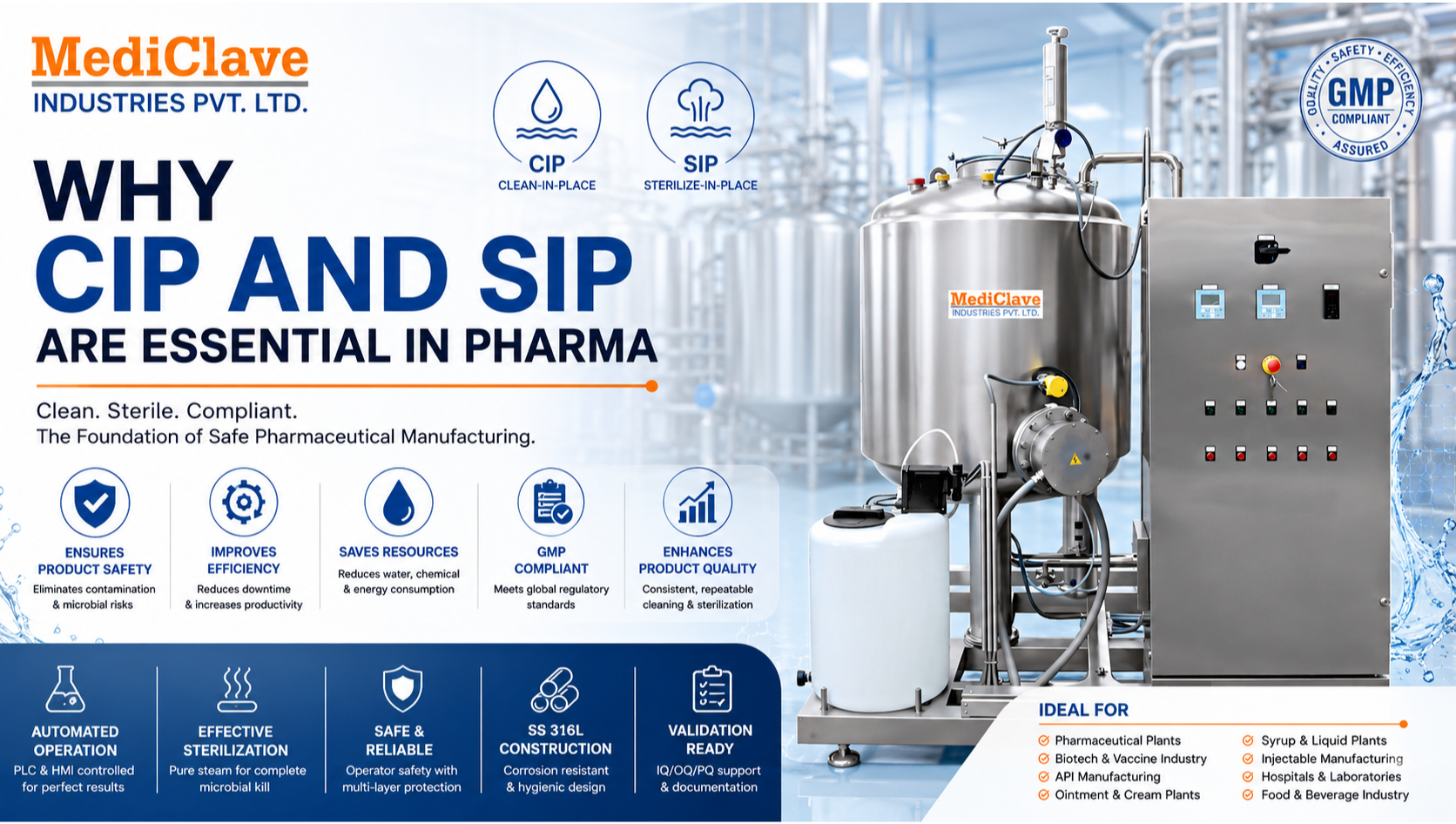
Introduction
The pharmaceutical industry operates under some of the world's strictest hygiene and quality standards. Every manufacturing process must prevent contamination, ensure product consistency, and comply with international regulations such as WHO GMP, US FDA, and EU GMP.
Traditional manual cleaning methods are no longer sufficient for modern pharmaceutical manufacturing because they increase the risk of contamination, consume significant time, and depend heavily on operator performance. To overcome these challenges, pharmaceutical companies have adopted Clean-in-Place (CIP) and Sterilize-in-Place (SIP) systems.
CIP and SIP technologies allow pharmaceutical process equipment to be cleaned and sterilized internally without dismantling machinery. These automated systems improve product quality, reduce downtime, enhance operator safety, and ensure consistent, repeatable cleaning and sterilization cycles.
Today, CIP and SIP systems are essential in manufacturing injectable medicines, vaccines, biological products, ointments, creams, syrups, oral liquids, APIs, and biotechnology products.
What is CIP (Clean-in-Place)?
Clean-in-Place (CIP) is an automated cleaning process that removes product residues, microorganisms, oils, proteins, and contaminants from the internal surfaces of process equipment without disassembling the system.
Cleaning solutions are circulated through tanks, pipelines, valves, filters, heat exchangers, filling lines, and processing vessels under controlled conditions.
A typical CIP process includes:
- Pre-rinse with purified water
- Alkaline cleaning
- Intermediate rinse
- Acid cleaning (if required)
- Final rinse using purified or WFI water
The entire cleaning sequence is automatically controlled using PLC and HMI systems, ensuring repeatability and compliance.
What is SIP (Sterilize-in-Place)?
Sterilize-in-Place (SIP) is the process of sterilizing equipment after cleaning by circulating clean steam throughout the system.
Unlike CIP, which removes contaminants, SIP destroys microorganisms, bacteria, viruses, fungi, spores, and other pathogens.
The sterilization process is performed without dismantling equipment, maintaining a closed and sterile production environment.
SIP commonly uses:
- Pure Steam
- Clean Steam
- Sterile Steam
Modern SIP systems are widely used in:
- Bioreactors
- Fermentation Systems
- Mixing Tanks
- Storage Vessels
- Transfer Pipelines
- Filling Machines
- Vaccine Manufacturing Equipment
Difference Between CIP and SIP
| Feature | CIP | SIP |
|---|---|---|
| Purpose | Cleaning | Sterilization |
| Removes | Residues, dirt, product deposits | Microorganisms and spores |
| Medium | Water & cleaning chemicals | Pure steam |
| Process | Chemical cleaning | Thermal sterilization |
| Outcome | Clean equipment | Sterile equipment |
Both systems work together to ensure hygienic pharmaceutical manufacturing.
Why CIP and SIP Are Essential in Pharma
CIP and SIP systems are indispensable because they:
- Minimize contamination risks
- Improve product quality
- Ensure repeatable cleaning
- Reduce manual intervention
- Increase production uptime
- Support GMP compliance
- Improve operator safety
- Reduce cleaning time
- Lower water and chemical consumption
- Enhance process efficiency
- Maintain sterility between production batches
- Simplify validation and documentation
Working Principle of CIP Systems
The CIP process typically follows these stages:
Step 1 – Pre-Rinse
Purified water removes loose residues from equipment surfaces.
Step 2 – Alkaline Wash
Caustic cleaning solutions dissolve oils, fats, proteins, and organic deposits.
Step 3 – Intermediate Rinse
Residual cleaning chemicals are flushed out with purified water.
Step 4 – Acid Wash (Optional)
Acid solutions remove mineral scales and inorganic deposits.
Step 5 – Final Rinse
Purified Water (PW) or Water for Injection (WFI) ensures all cleaning agents are removed.
Step 6 – Drying (Optional)
Sterile air may be used for drying before sterilization.
Working Principle of SIP Systems
The SIP cycle includes:
- Equipment isolation
- Air removal
- Pure steam injection
- Temperature stabilization
- Sterilization hold time
- Controlled cooling
- Sterility verification
Temperature and pressure are continuously monitored and recorded throughout the process.
Major Components of CIP & SIP Systems
Modern systems generally include:
- CIP Supply Tank
- Return Tank
- Chemical Dosing Unit
- Pure Steam Generator
- Heat Exchanger
- Sanitary Pumps
- Spray Devices
- SS316L Pipelines
- Hygienic Valves
- Flow Meters
- Conductivity Sensors
- Temperature Sensors
- Pressure Transmitters
- PLC Control Panel
- HMI Touch Screen
- Automation Software
- Data Logger
- Validation Ports
Types of CIP Systems
- Single Tank CIP System
- Two Tank CIP System
- Three Tank CIP System
- Multi-Tank CIP System
- Mobile CIP Unit
- Centralized CIP System
- Fully Automatic CIP System
- Semi-Automatic CIP System
Types of SIP Systems
- Pure Steam SIP
- Clean Steam SIP
- Inline SIP System
- Vessel SIP
- Pipeline SIP
- Fermenter SIP
- Bioreactor SIP
- Automatic SIP System
Advantages of CIP & SIP
Modern pharmaceutical facilities benefit from:
- Automated cleaning and sterilization
- Consistent process performance
- Reduced labor costs
- Lower contamination risk
- Faster batch changeover
- Less equipment downtime
- Reduced water consumption
- Reduced chemical usage
- Increased equipment life
- Improved product quality
- Better validation support
- Enhanced regulatory compliance
- Energy-efficient operation
- Improved operator safety
Applications
CIP and SIP systems are widely used in:
- Pharmaceutical Manufacturing
- Biotechnology
- Vaccine Production
- Injectable Manufacturing
- API Plants
- Ointment Manufacturing Plants
- Syrup Manufacturing Plants
- Liquid Oral Manufacturing
- Cosmetic Manufacturing
- Food & Beverage Processing
- Dairy Plants
- Chemical Processing
- Research Laboratories
- Medical Device Manufacturing
GMP & Regulatory Compliance
Modern CIP and SIP systems are designed to meet:
- WHO GMP
- US FDA
- EU GMP Annex 1
- cGMP
- GAMP 5
- ISPE Guidelines
- ASME BPE Standards
- 21 CFR Part 11 (optional)
Compliance features include:
- SS316L product-contact surfaces
- Hygienic sanitary design
- Dead-leg-free piping
- Automated recipe management
- Electronic batch records
- Audit trails
- Alarm history
- Data integrity support
Validation Requirements
Every pharmaceutical CIP & SIP system should be validated through:
- Installation Qualification (IQ)
- Operational Qualification (OQ)
- Performance Qualification (PQ)
- Riboflavin Test
- Cleaning Validation
- Sterilization Validation
- Temperature Mapping
- Steam Quality Testing
- Conductivity Verification
- TOC Testing (where applicable)
How to Choose the Right CIP & SIP System
Before selecting a system, evaluate:
- Production capacity
- Number of process vessels
- Required automation level
- Cleaning chemical compatibility
- Steam availability
- Validation support
- Utility consumption
- PLC & HMI capabilities
- Future expansion requirements
- After-sales service
- Spare parts availability
Why Choose Mediclave Industries Pvt. Ltd.
Mediclave Industries Pvt. Ltd. provides advanced CIP and SIP solutions designed for modern pharmaceutical manufacturing facilities.
Our systems offer:
- GMP-compliant hygienic design
- SS316L construction
- Fully automatic PLC & HMI controls
- Efficient chemical and steam utilization
- Validation-ready documentation
- Custom-built solutions
- Reliable performance
- Low maintenance
- Excellent after-sales support
Our goal is to help pharmaceutical manufacturers achieve consistent cleaning, reliable sterilization, and full regulatory compliance.
Frequently Asked Questions (FAQs)
1. What is the main purpose of a CIP system?
To clean the internal surfaces of pharmaceutical equipment without dismantling it.
2. What is SIP used for?
SIP sterilizes cleaned equipment using pure or clean steam to eliminate microorganisms.
3. Can CIP and SIP be fully automated?
Yes. Modern systems are PLC-controlled with HMI interfaces for automated operation and documentation.
4. Which industries use CIP and SIP systems?
Pharmaceutical, biotechnology, food & beverage, dairy, cosmetics, chemical processing, and medical device manufacturing.
5. Are CIP and SIP systems GMP compliant?
Yes. Properly designed systems comply with WHO GMP, US FDA, EU GMP, and cGMP requirements.
6. What material is used in pharmaceutical CIP & SIP systems?
SS316L stainless steel is commonly used for product-contact components due to its corrosion resistance and hygienic properties.
7. Why are validation studies important?
Validation confirms that cleaning and sterilization processes consistently achieve the required performance and regulatory standards.
8. Can one system handle multiple process vessels?
Yes. Centralized and multi-tank CIP systems can be configured to clean several vessels and pipelines.
Conclusion
CIP and SIP systems have become indispensable in modern pharmaceutical manufacturing by ensuring hygienic production, minimizing contamination risks, and maintaining compliance with global regulatory standards. Their automated cleaning and sterilization capabilities improve operational efficiency, reduce downtime, enhance product quality, and support reliable batch-to-batch consistency.
By investing in advanced, GMP-compliant CIP and SIP solutions from Mediclave Industries Pvt. Ltd., pharmaceutical manufacturers can achieve safer processes, lower operating costs, and greater confidence in delivering high-quality sterile products to the market.