
Introduction
Sterilization is one of the most important processes in pharmaceutical manufacturing, biotechnology, laboratories, hospitals, and medical device production. Every product that comes into direct contact with medicines or patients must be free from microorganisms to ensure safety, quality, and regulatory compliance.
While steam sterilization is widely used, certain materials cannot tolerate moisture. Glassware, metal instruments, powders, oils, and heat-resistant materials require a different sterilization method that eliminates microorganisms without using steam.
This is where the Dry Heat Sterilizer becomes an essential piece of pharmaceutical equipment.
Modern Dry Heat Sterilizers use precisely controlled high temperatures to destroy bacteria, viruses, fungi, spores, and other microorganisms without moisture. These systems are designed to meet stringent GMP standards while providing reliable, repeatable, and contamination-free sterilization.
In this guide, we'll explore the working principle, features, benefits, applications, and selection criteria of modern Dry Heat Sterilizers.
What is a Dry Heat Sterilizer?
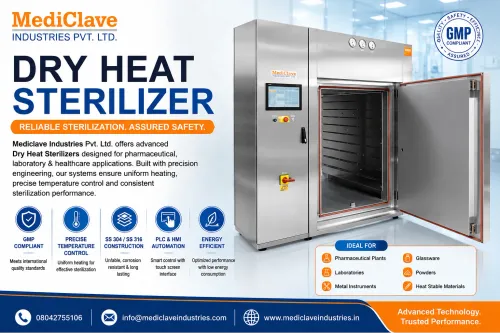
A Dry Heat Sterilizer is a pharmaceutical sterilization system that uses hot air at high temperatures instead of steam to sterilize equipment and materials.
Unlike moist heat sterilization, dry heat removes microorganisms by oxidizing cellular components, making it highly effective for materials that are sensitive to moisture.
It is commonly used for sterilizing:
- Glass bottles
- Glass vials
- Ampoules
- Stainless steel instruments
- Surgical tools
- Pharmaceutical powders
- Oils
- Metal components
- Laboratory glassware
- Empty containers
Principle of Dry Heat Sterilization
Dry heat sterilization works by transferring heat through circulating hot air.
The high temperature gradually destroys microorganisms by:
- Oxidation of cellular proteins
- Protein denaturation
- Cell membrane destruction
- Dehydration of microorganisms
Unlike steam sterilization, no moisture is involved during the sterilization cycle.
Typical operating temperatures include:
- 160°C for 120 minutes
- 170°C for 60 minutes
- 180°C for 30 minutes
The exact cycle depends on validation requirements and product characteristics.
How a Dry Heat Sterilizer Works
The sterilization process consists of several controlled stages:
Step 1 – Loading
Products are placed inside the sterilization chamber.
Step 2 – Chamber Sealing
The chamber door closes securely to maintain controlled conditions.
Step 3 – Heating
Electric heaters raise the chamber temperature gradually.
Step 4 – Hot Air Circulation
High-efficiency blowers distribute filtered hot air uniformly throughout the chamber.
Step 5 – Sterilization Hold Time
The required sterilization temperature is maintained for the validated holding period.
Step 6 – Cooling
The chamber cools under controlled conditions before unloading.
Step 7 – Product Removal
Sterilized materials are removed for further pharmaceutical processing.
Main Components of a Dry Heat Sterilizer
A modern pharmaceutical Dry Heat Sterilizer includes:
- Stainless Steel Sterilization Chamber
- High-Efficiency Air Circulation Blower
- Electric Heating Elements
- HEPA Filter (where applicable)
- PLC Control System
- Touch Screen HMI
- Temperature Sensors
- Air Distribution System
- Safety Interlocks
- Data Logger
- Validation Ports
- Alarm System
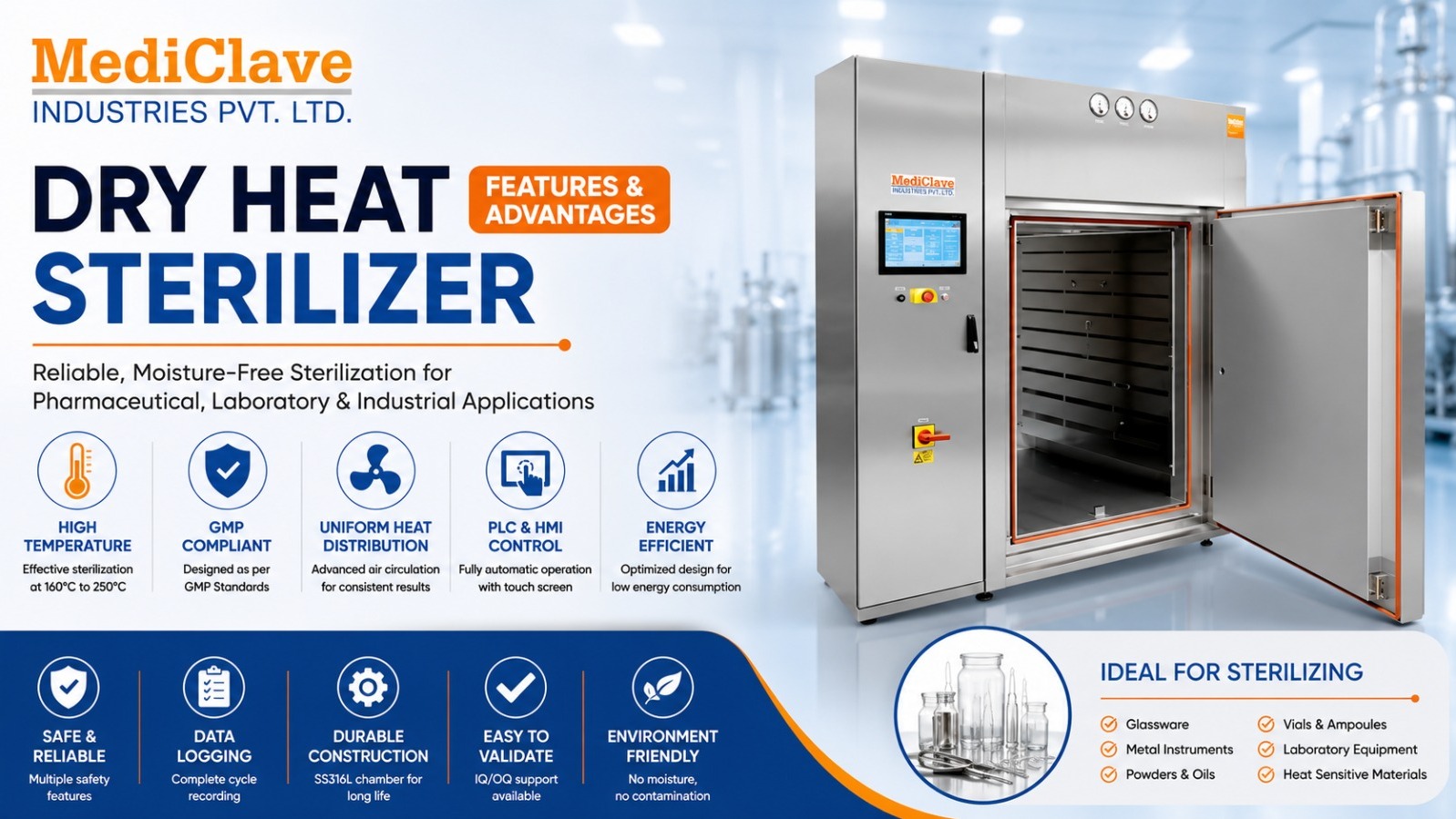
Features of Modern Dry Heat Sterilizers
1. Uniform Heat Distribution
Advanced airflow systems ensure consistent temperature throughout the chamber.
2. High-Temperature Capability
Modern units operate up to 250°C or higher, depending on application requirements.
3. PLC-Based Automation
Automatic cycle control reduces operator intervention and ensures repeatability.
4. Touch Screen HMI
Easy monitoring of temperature, time, alarms, and cycle status.
5. Stainless Steel Construction
SS304 exterior and SS316L product-contact surfaces provide durability and hygienic operation.
6. HEPA Filtered Air
Prevents contamination during cooling by introducing clean, filtered air.
7. Data Logging
Automatic recording of sterilization parameters simplifies audits and validation.
8. Multiple Safety Features
- Over-temperature protection
- Door interlock system
- Alarm notifications
- Emergency shutdown
- Sensor monitoring
9. Energy Efficient Design
Optimized insulation minimizes heat loss and reduces energy consumption.
10. GMP-Compliant Construction
Designed for pharmaceutical environments with easy cleaning and validation support.
Advantages of Dry Heat Sterilization
Modern Dry Heat Sterilizers provide numerous advantages:
- Moisture-free sterilization
- Ideal for glassware and metal components
- Suitable for powders and oils
- Excellent microbial destruction
- Reliable repeatability
- Long equipment life
- Minimal maintenance
- Low operating cost
- Easy validation
- Fully automatic operation
- Reduced contamination risk
- Excellent temperature uniformity
- GMP compliance
- High productivity
- Improved process reliability
Applications
Dry Heat Sterilizers are widely used for sterilizing:
- Glass vials
- Ampoules
- Glass bottles
- Stainless steel utensils
- Surgical instruments
- Metal tools
- Pharmaceutical powders
- Oils
- Laboratory glassware
- Heat-resistant components
- Medical device parts
- Packaging materials
Industries That Use Dry Heat Sterilizers
- Pharmaceutical Manufacturing
- Biotechnology
- Medical Device Industry
- Hospitals
- Research Laboratories
- Vaccine Manufacturing
- API Manufacturing
- Cosmetic Industry
- Food Testing Laboratories
- Quality Control Laboratories
Dry Heat Sterilizer vs Steam Sterilizer
| Feature | Dry Heat Sterilizer | Steam Sterilizer |
|---|---|---|
| Sterilization Medium | Hot Air | Saturated Steam |
| Moisture | No | Yes |
| Best For | Glass, Metal, Powders, Oils | Instruments, Liquids, Textiles |
| Corrosion Risk | Very Low | Possible |
| Operating Temperature | Higher | Lower |
| Suitable for Moisture Sensitive Products | Yes | No |
GMP & Regulatory Compliance
Modern Dry Heat Sterilizers are designed to comply with:
- WHO GMP
- US FDA Guidelines
- EU GMP
- cGMP
- ISO Standards
- 21 CFR Part 11 (optional data integrity features)
Key compliance features include:
- SS316L construction
- Temperature mapping
- Validation support
- IQ/OQ documentation
- Electronic batch records
- Alarm history
- Audit trail (optional)
How to Choose the Right Dry Heat Sterilizer
Before purchasing, consider:
- Chamber size
- Production capacity
- Maximum operating temperature
- Temperature uniformity
- Automation level
- Validation requirements
- Energy consumption
- Utility availability
- Future production expansion
- Service support
Why Choose Mediclave Industries Pvt. Ltd.
Mediclave Industries Pvt. Ltd. manufactures advanced pharmaceutical Dry Heat Sterilizers engineered for precision, reliability, and compliance.
Our systems feature:
- Robust SS316L construction
- PLC & HMI automation
- Uniform hot air circulation
- Energy-efficient insulation
- GMP-compliant design
- Validation-ready architecture
- Custom chamber sizes
- Low maintenance
- Reliable after-sales service
- Long operational life
Frequently Asked Questions (FAQs)
1. What is a Dry Heat Sterilizer?
A sterilization system that uses high-temperature hot air instead of steam to eliminate microorganisms.
2. What products can be sterilized?
Glassware, metal instruments, powders, oils, laboratory equipment, and moisture-sensitive materials.
3. Why choose dry heat over steam?
Dry heat is ideal when moisture could damage the product or affect its quality.
4. What temperature is used?
Typically 160–250°C, depending on the sterilization cycle and application.
5. Is Dry Heat Sterilization GMP compliant?
Yes, modern pharmaceutical units are designed to meet GMP and international regulatory requirements.
6. Is validation required?
Yes. IQ, OQ, PQ, and temperature mapping are generally performed before production use.
7. What is the construction material?
Usually SS316L for product-contact areas and SS304 for external panels.
8. Which industries use Dry Heat Sterilizers?
Pharmaceutical, biotechnology, hospitals, laboratories, medical devices, and cosmetics.
9. Does the machine require steam?
No. It operates using electric heaters and controlled hot air circulation.
10. Why invest in a modern Dry Heat Sterilizer?
It offers reliable sterilization, energy efficiency, automation, regulatory compliance, and long-term operational performance.
Conclusion
Dry Heat Sterilizers remain one of the most dependable sterilization solutions for pharmaceutical and healthcare industries, particularly for moisture-sensitive materials such as glassware, metal instruments, powders, and oils. Their ability to deliver consistent high-temperature sterilization without introducing moisture makes them an indispensable part of modern sterile manufacturing facilities.
With advanced PLC automation, uniform heat distribution, GMP-compliant construction, and validation-ready design, modern Dry Heat Sterilizers help manufacturers improve product quality, regulatory compliance, and operational efficiency. Investing in a high-quality system ensures safe, repeatable, and contamination-free sterilization for years to come.