

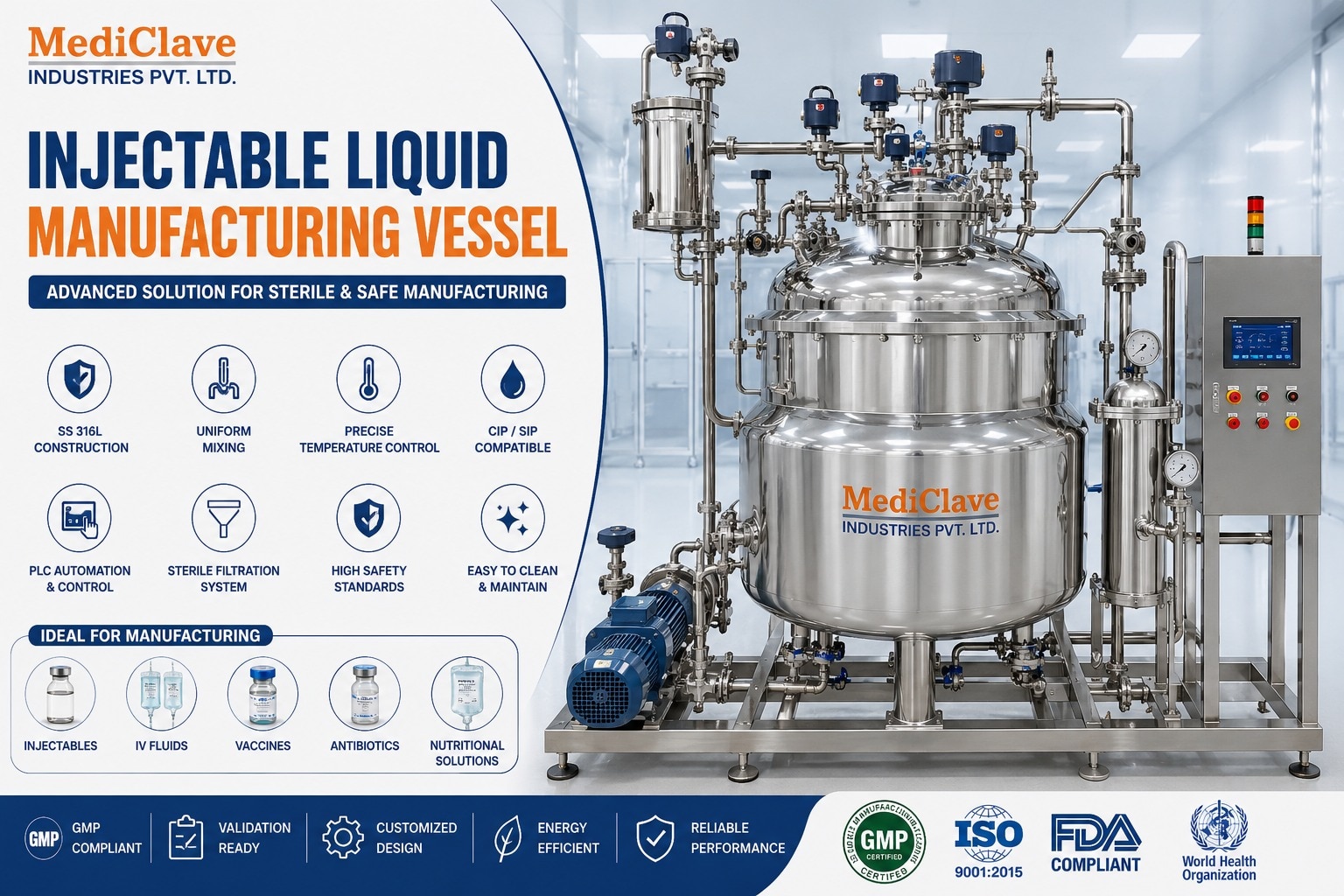
Injectable Liquid Manufacturing Vessel Explained
Introduction
Injectable medicines are among the most sensitive pharmaceutical products because they are administered directly into the human body without passing through the body's natural defense mechanisms. This makes sterility, precision, and contamination control essential throughout the manufacturing process.
An Injectable Liquid Manufacturing Vessel is one of the most critical pieces of equipment used in sterile pharmaceutical production. It is specifically designed to prepare injectable formulations under controlled GMP conditions while maintaining product integrity, batch consistency, and regulatory compliance.
Modern pharmaceutical companies rely on advanced manufacturing vessels equipped with automated control systems, sanitary piping, precision mixing technology, and CIP/SIP capabilities to produce injectable solutions safely and efficiently.
Mediclave Industries manufactures high-quality Injectable Liquid Manufacturing Vessels engineered to meet international pharmaceutical standards and deliver reliable performance for sterile manufacturing applications.
Table of Contents
- What is an Injectable Liquid Manufacturing Vessel?
- Importance in Pharmaceutical Manufacturing
- Working Principle
- Manufacturing Process
- Main Components
- Types of Injectable Manufacturing Vessels
- Applications
- Advantages
- GMP Requirements
- Quality Control
- Selection Guide
- Why Choose Mediclave Industries?
- Frequently Asked Questions
- Conclusion
What is an Injectable Liquid Manufacturing Vessel?
An Injectable Liquid Manufacturing Vessel is a stainless steel pharmaceutical processing tank used to manufacture sterile injectable formulations. The vessel is designed to perform multiple operations including mixing, heating, cooling, agitation, homogenization, ingredient addition, and solution preparation while maintaining aseptic conditions.
These vessels are widely used in pharmaceutical industries for manufacturing:
- Large Volume Parenterals (LVP)
- Small Volume Parenterals (SVP)
- IV Fluids
- Injectable Antibiotics
- Vaccines
- Electrolyte Solutions
- Sterile Water
- Infusion Products
- Injectable Nutritional Solutions
Importance of Injectable Manufacturing Vessels
Sterile injectable products require extremely high manufacturing standards because even minor contamination can compromise patient safety.
A high-quality manufacturing vessel ensures:
- Uniform mixing
- Accurate dosing
- Sterile production
- Product stability
- Batch consistency
- Low contamination risk
- Easy validation
- GMP compliance
- High production efficiency
Working Principle
The manufacturing process begins by transferring purified water or Water for Injection (WFI) into the vessel. Depending on the formulation, heating may be applied through the vessel jacket to dissolve ingredients efficiently.
Active pharmaceutical ingredients (APIs) and excipients are added in a controlled sequence while an agitator continuously mixes the solution. The mixing speed, temperature, and processing time are automatically monitored through a PLC control system.
After complete dissolution and homogenization, the solution undergoes filtration before being transferred to sterile holding tanks or directly to aseptic filling lines.
The entire process is performed inside a closed hygienic system to minimize contamination.
Injectable Liquid Manufacturing Process
Step 1 – Water Preparation
Water for Injection (WFI) is transferred into the manufacturing vessel through sanitary pipelines.
Step 2 – Heating
The jacketed vessel heats the solution to the required processing temperature.
Step 3 – Ingredient Addition
Active pharmaceutical ingredients and excipients are added according to validated manufacturing procedures.
Step 4 – Mixing
The agitator ensures complete dissolution and homogeneous mixing of all ingredients.
Step 5 – Homogenization
High-speed mixing improves product uniformity and stability.
Step 6 – Filtration
The finished solution passes through pharmaceutical-grade filters to remove particulate matter.
Step 7 – Sterile Transfer
The injectable solution is transferred under sterile conditions to storage vessels or aseptic filling machines.
Main Components
A typical Injectable Liquid Manufacturing Vessel includes:
- SS316L Manufacturing Vessel
- Agitator System
- Jacket Heating System
- Cooling Arrangement
- Bottom Entry Mixer
- Load Cell System
- PLC Control Panel
- HMI Touch Screen
- CIP System
- SIP System
- Sterile Filters
- Pressure Gauges
- Temperature Sensors
- Level Indicators
- Sampling Valve
- Sight Glass
- Manhole
- Transfer Pump
- Sanitary Piping
- Hygienic Valves
Construction Material
The vessel is generally manufactured using:
- SS316L product-contact parts
- SS304 external support structure
- Mirror-polished internal surface
- Orbital welded joints
- Hygienic fittings
- Pharmaceutical-grade gaskets
These materials ensure corrosion resistance, easy cleaning, and compliance with pharmaceutical standards.
Types of Injectable Manufacturing Vessels
Depending on production requirements, pharmaceutical companies use:
- Mixing Vessel
- Preparation Vessel
- Holding Vessel
- Jacketed Vessel
- Vacuum Manufacturing Vessel
- Pressure Vessel
- CIP Compatible Vessel
- SIP Compatible Vessel
- Insulated Vessel
- Sterile Manufacturing Vessel
Applications
Injectable Liquid Manufacturing Vessels are widely used in:
- Pharmaceutical Manufacturing
- Vaccine Manufacturing
- Biotechnology Industry
- IV Fluid Production
- Injectable Antibiotic Manufacturing
- Sterile Product Manufacturing
- Research Laboratories
- Healthcare Product Manufacturing
- Contract Manufacturing Organizations (CMOs)
Advantages
Modern Injectable Liquid Manufacturing Vessels provide several benefits:
- Fully automatic operation
- High production efficiency
- Precise mixing
- Uniform batch quality
- Closed sterile process
- Reduced contamination risk
- Easy cleaning
- CIP/SIP compatible
- GMP-compliant design
- Low maintenance
- Long service life
- Energy-efficient operation
- Accurate process control
- Better product quality
- Improved production capacity
GMP & Regulatory Compliance
Injectable manufacturing equipment should comply with international standards including:
- WHO-GMP
- US FDA
- EU GMP
- cGMP
- ISPE Guidelines
- GAMP 5
- ASME BPE Standards
Compliance helps manufacturers meet regulatory requirements and maintain product quality during inspections and audits.
Quality Control
Quality assurance plays a vital role in injectable manufacturing. Common quality checks include:
- Visual inspection
- Temperature monitoring
- Mixing validation
- Conductivity testing
- pH testing
- Bioburden testing
- Sterility testing
- Endotoxin testing
- Pressure testing
- Surface finish inspection
- Documentation review
How to Choose the Right Injectable Liquid Manufacturing Vessel
Before selecting equipment, consider:
- Required batch size
- Vessel capacity
- Material of construction
- Automation level
- Agitation system
- Heating and cooling efficiency
- CIP/SIP compatibility
- Validation documentation
- Utility requirements
- Future expansion
- Maintenance support
- Spare parts availability
A properly selected manufacturing vessel improves efficiency while reducing operating costs.
Why Choose Mediclave Industries?
Mediclave Industries is a trusted manufacturer of pharmaceutical process equipment designed for sterile pharmaceutical production.
Our Injectable Liquid Manufacturing Vessels are built with advanced engineering, hygienic construction, and intelligent automation to meet the demanding requirements of modern pharmaceutical facilities.
Our solutions offer:
- GMP-compliant manufacturing
- SS316L pharmaceutical-grade construction
- PLC-based automation
- Precision mixing technology
- Energy-efficient operation
- Customized vessel capacities
- Easy validation
- Comprehensive documentation
- Excellent after-sales support
- Long operational life
In addition to Injectable Liquid Manufacturing Vessels, Mediclave Industries also manufactures Multi Column Distillation Plants, Pure Steam Generators, Water for Injection (WFI) Systems, Liquid Syrup Manufacturing Plants, Ointment Manufacturing Plants, Storage Vessels, and a complete range of pharmaceutical process equipment for turnkey manufacturing solutions.
Frequently Asked Questions (FAQs)
What is an Injectable Liquid Manufacturing Vessel?
It is a pharmaceutical vessel designed for preparing sterile injectable formulations under controlled GMP conditions.
Which material is used?
SS316L stainless steel is widely used for product-contact parts because of its excellent corrosion resistance and hygienic properties.
Why is WFI used?
Water for Injection ensures the highest purity required for sterile injectable medicines and minimizes contamination risks.
Is CIP/SIP important?
Yes. CIP (Clean-In-Place) and SIP (Sterilize-In-Place) systems simplify cleaning, reduce downtime, and maintain sterile manufacturing conditions.
Which industries use Injectable Manufacturing Vessels?
Pharmaceutical companies, biotechnology firms, vaccine manufacturers, IV fluid producers, research laboratories, and healthcare manufacturers.
Conclusion
An Injectable Liquid Manufacturing Vessel is a critical component of sterile pharmaceutical production, ensuring safe, accurate, and contamination-free preparation of injectable medicines. With advanced automation, hygienic SS316L construction, precision mixing, and compliance with international GMP standards, these vessels help pharmaceutical manufacturers achieve superior product quality and operational efficiency.
Whether producing vaccines, IV fluids, antibiotics, or sterile injectable formulations, investing in a high-quality manufacturing vessel improves productivity, ensures regulatory compliance, and supports long-term manufacturing reliability. Mediclave Industries delivers advanced pharmaceutical process equipment tailored to the evolving needs of modern pharmaceutical manufacturing, helping companies maintain the highest standards of safety, quality, and performance.
