

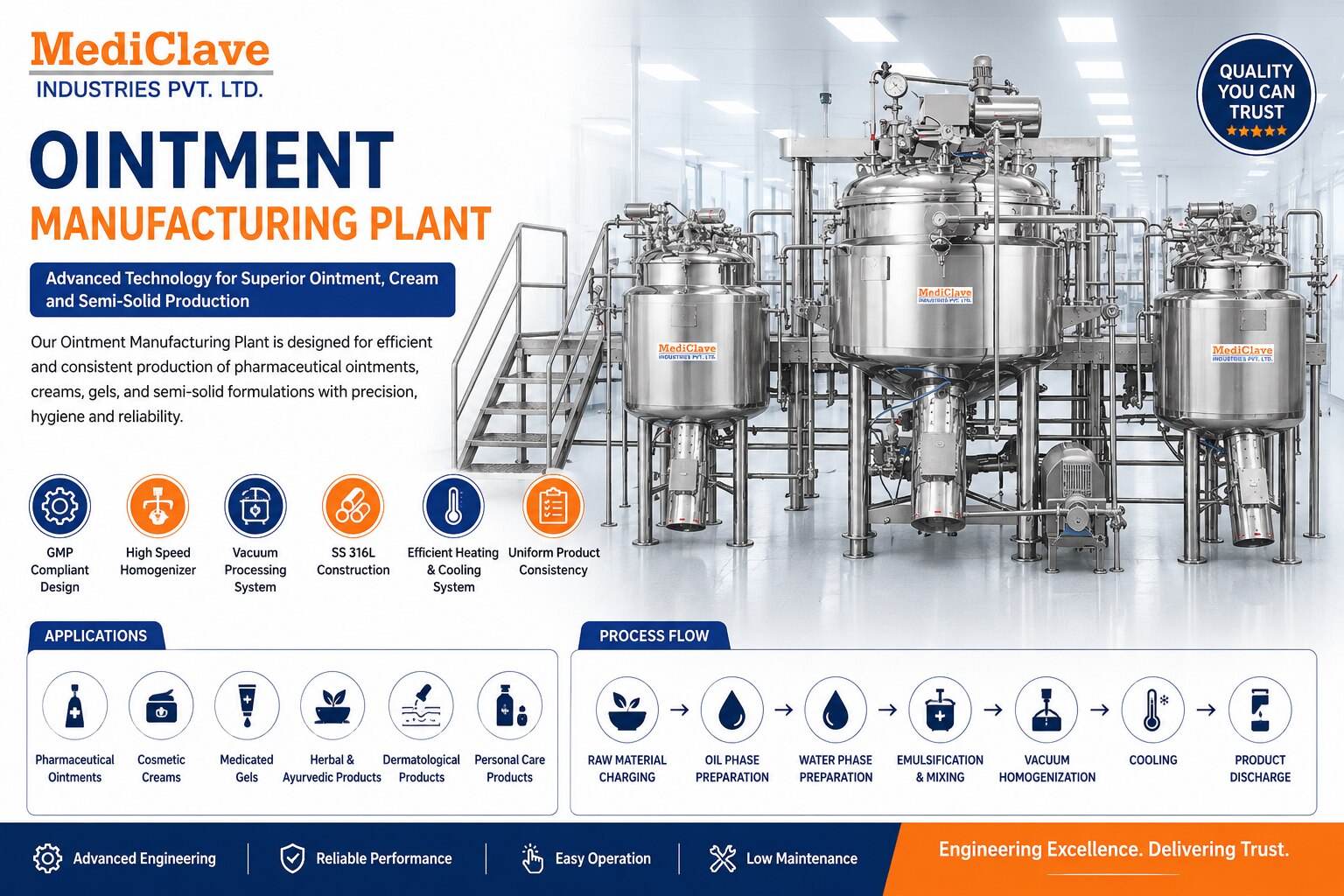
Ointment Manufacturing Plant | Pharmaceutical Cream & Ointment Processing Equipment | @LOCATION
Ointment Manufacturing Plant: Advanced Solution for Consistent Pharmaceutical Cream
and Ointment Production
The pharmaceutical industry depends heavily on high-quality semi-solid products such as ointments, creams, gels, lotions, and medicated topical formulations. Manufacturing these products requires specialized equipment capable of delivering uniform mixing, smooth texture, and consistent product quality.
An Ointment Manufacturing Plant is a complete processing system engineered to handle the preparation, mixing, homogenization, heating, cooling, and transfer of semi-solid pharmaceutical products under controlled conditions.
Modern pharmaceutical manufacturers rely on advanced ointment plants to improve productivity, reduce processing time, and maintain strict GMP standards.
Understanding an Ointment Manufacturing Plant
An Ointment Manufacturing Plant is a combination of interconnected processing equipment designed specifically for semi-solid pharmaceutical manufacturing.
The system typically includes:
- Manufacturing Vessel
- Oil Phase Vessel
- Water Phase Vessel
- Vacuum Homogenizer
- Transfer Pump
- Storage Vessel
- Control Panel
- Product Transfer Line
Together, these components create a streamlined production process that ensures consistent formulation quality from batch to batch.
Why Modern Pharmaceutical Facilities Need Ointment Manufacturing Plants
As pharmaceutical products become more sophisticated, manufacturers require equipment capable of handling complex formulations efficiently.
Uniform Product Texture
Customers expect smooth and consistent ointments without lumps or phase separation.
Improved Product Stability
Proper mixing and homogenization improve shelf life and formulation stability.
Higher Production Capacity
Automated systems increase output while maintaining quality standards.
GMP Compliance
Modern plants are designed to meet pharmaceutical regulatory requirements.
Products Manufactured Using Ointment Manufacturing Plants
A versatile ointment manufacturing plant can produce:
Pharmaceutical Products
- Antibiotic Ointments
- Analgesic Ointments
- Dermatological Creams
- Antifungal Creams
- Medicated Gels
- Steroid-Based Creams
Cosmetic Products
- Moisturizing Creams
- Beauty Creams
- Sunscreen Formulations
- Skin Care Products
Healthcare Products
- Herbal Ointments
- Ayurvedic Creams
- Pain Relief Gels
- Personal Care Formulations
The Manufacturing Process Explained
Step 1: Raw Material Preparation
Ingredients are weighed and prepared according to the approved formulation.
Step 2: Oil Phase Processing
Oil-soluble ingredients are processed separately under controlled temperature conditions.
Step 3: Water Phase Preparation
Water-soluble ingredients are dissolved and prepared in a dedicated vessel.
Step 4: Emulsification
Both phases are combined under controlled conditions to create a stable emulsion.
Step 5: Vacuum Homogenization
High-shear homogenization improves product smoothness and particle distribution.
Step 6: Cooling Process
The batch is gradually cooled to achieve the desired consistency.
Step 7: Transfer and Storage
The finished product is transferred hygienically for filling and packaging.
Key Features of an Advanced Ointment Manufacturing Plant
Vacuum Processing Technology
Vacuum processing minimizes air entrapment and improves product quality.
High-Speed Homogenization
Ensures excellent product smoothness and stability.
GMP-Compliant Construction
Manufactured using pharmaceutical-grade stainless steel.
Automated Process Control
PLC and HMI systems provide accurate process monitoring.
Efficient Heating and Cooling
Improves batch control and manufacturing efficiency.
Hygienic Design
Facilitates cleaning and minimizes contamination risks.
Advantages of Using an Ointment Manufacturing Plant
Superior Product Consistency
Uniform mixing ensures reliable product quality.
Reduced Production Time
Automation accelerates manufacturing operations.
Improved Product Appearance
Homogenization creates a smooth and appealing texture.
Increased Operational Efficiency
Integrated systems reduce manual intervention.
Better Batch Reproducibility
Each batch maintains the same quality standards.
Essential Factors When Selecting an Ointment Manufacturing Plant
Before investing in equipment, manufacturers should evaluate:
- Production Capacity
- Automation Level
- GMP Compliance
- Material of Construction
- Energy Efficiency
- Maintenance Requirements
- Expansion Capability
- Process Flexibility
A properly selected plant supports long-term production growth and operational reliability.
Industry Trends in Semi-Solid Manufacturing
Today's pharmaceutical industry is rapidly adopting:
- Smart Manufacturing Systems
- Digital Batch Monitoring
- Automated Recipe Management
- Energy-Efficient Processing Equipment
- Advanced Process Validation Systems
- Industry 4.0 Integration
These technologies help manufacturers improve quality while reducing operating costs.
Why Choose Mediclave Industries?
Mediclave Industries Pvt. Ltd. manufactures advanced Ointment Manufacturing Plants designed for pharmaceutical, cosmetic, herbal, and healthcare industries.
Our systems offer:
✔ GMP-compliant construction
✔ Efficient homogenization technology
✔ Robust stainless steel fabrication
✔ Reliable process automation
✔ Superior batch consistency
✔ Customized plant configurations
With a focus on performance, quality, and innovation, Mediclave provides dependable solutions for modern semi-solid manufacturing facilities.
Conclusion
An Ointment Manufacturing Plant plays a crucial role in producing high-quality creams, gels, lotions, and ointments. By combining advanced mixing, homogenization, heating, cooling, and automation technologies, these plants help manufacturers achieve consistent quality, regulatory compliance, and operational efficiency.
For pharmaceutical companies looking to enhance semi-solid production capabilities, investing in a modern Ointment Manufacturing Plant is a strategic step toward long-term growth and manufacturing excellence.
