CIP & SIP Systems Price in India: Complete Guide for Pharmaceutical Manufacturing
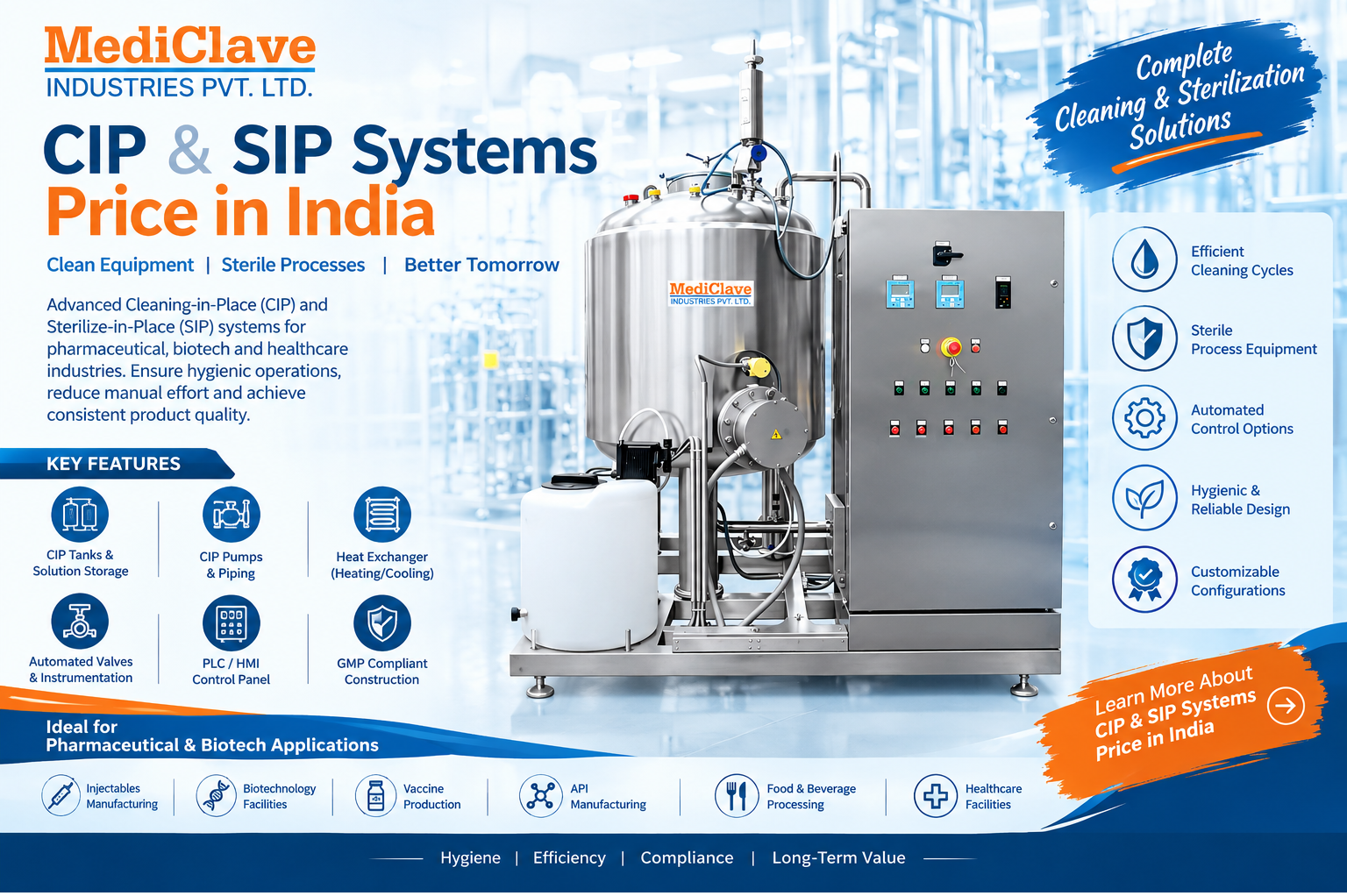
The demand for hygienic, automated, and reliable pharmaceutical processing systems is increasing as manufacturers focus on product quality, contamination control, operational efficiency, and repeatable cleaning and sterilization processes. CIP & SIP Systems are important solutions for pharmaceutical, biotechnology, healthcare, food, and other industries where process equipment must be cleaned and sterilized efficiently.
When searching for CIP & SIP Systems Price in India, buyers should understand that the price is not fixed. The final cost depends on the system capacity, number of tanks, automation level, material of construction, process requirements, heating arrangement, piping configuration, instrumentation, and customization.
A properly designed CIP and SIP system can help manufacturers improve cleaning consistency, reduce manual intervention, optimize production time, and support hygienic manufacturing practices.
What Are CIP & SIP Systems?
CIP stands for Clean-in-Place, while SIP stands for Sterilize-in-Place.
CIP is a cleaning method in which the internal surfaces of process equipment, vessels, pipelines, and associated components are cleaned without dismantling the equipment.
SIP is a sterilization method in which suitable process equipment and connected systems are sterilized in place, commonly using clean or pure steam where appropriate.
Together, CIP & SIP Systems can provide an integrated approach to cleaning and sterilizing pharmaceutical process equipment.
These systems can be designed for applications involving:
-
Manufacturing vessels
-
Storage vessels
-
Process pipelines
-
Transfer lines
-
Filling-related equipment
-
Filters and housings
-
Process skids
-
Pharmaceutical production systems
-
Biotechnology equipment
CIP & SIP Systems Price in India
The CIP & SIP Systems Price in India depends on the technical configuration required for the application. A small semi-automatic system and a large fully automated multi-tank system can have significantly different costs.
Instead of selecting equipment only on the basis of price, pharmaceutical manufacturers should compare the complete system specification.
The major factors affecting price include:
1. System Capacity
The required cleaning and sterilization capacity is one of the most important pricing factors.
Capacity may be determined by:
-
Number of equipment items to be cleaned
-
Vessel size
-
Pipeline length
-
Cleaning solution volume
-
Number of simultaneous circuits
-
Production requirements
-
Frequency of cleaning
-
Required cycle time
A larger system generally requires larger tanks, pumps, piping, valves, instrumentation, and control systems.
2. Number of CIP Tanks
A CIP system may be configured with different numbers of tanks according to the required cleaning process.
Depending on the application, the system may include tanks for:
-
Purified water
-
Cleaning solution
-
Rinse water
-
Recovery solution
The number and capacity of tanks directly influence the overall system configuration and investment.
3. Automation Level
Automation has a significant effect on the CIP & SIP Systems price in India.
A basic system may require more operator intervention, while a fully automated system can control important process parameters automatically.
An automated system may include:
-
PLC control
-
HMI panel
-
Recipe management
-
Automatic valve sequencing
-
Flow monitoring
-
Temperature monitoring
-
Conductivity monitoring
-
Pressure monitoring
-
Cycle-time control
-
Alarm management
-
Data recording
The appropriate level of automation should be selected according to production requirements and documentation needs.
4. Material of Construction
The material used for process-contact components is another important factor.
Pharmaceutical CIP and SIP systems are generally designed with suitable stainless-steel construction according to the application.
Material selection may depend on:
-
Cleaning chemicals
-
Process temperature
-
Product characteristics
-
Corrosion resistance
-
Hygienic requirements
-
Surface finish
-
Customer specifications
Higher material and surface-finish requirements can increase the overall system cost.
How Does a CIP System Work?
A CIP system circulates cleaning media through the internal surfaces of connected equipment and pipelines.
A typical CIP cycle may include the following stages:
Pre-Rinse
Water is circulated through the equipment to remove loose product residues and prepare the system for further cleaning.
Cleaning Solution Circulation
A suitable cleaning solution is circulated through the process equipment at controlled flow, temperature, and concentration conditions.
This helps remove remaining product residues from internal surfaces.
Intermediate Rinse
After cleaning, the system may be rinsed to remove the cleaning solution.
Final Rinse
A final rinse can be performed using an appropriate water source according to the validated cleaning procedure.
Drainage
The remaining liquid is drained from the system through suitable drain arrangements.
The exact CIP recipe varies according to the product, equipment, cleaning chemistry, and validated manufacturing process.
How Does an SIP System Work?
SIP is used to sterilize suitable equipment and process pathways without dismantling them.
A simplified SIP cycle may involve:
-
Preparation of the equipment
-
Preheating where required
-
Introduction of suitable clean or pure steam
-
Removal of air and condensate
-
Controlled exposure to sterilization conditions
-
Monitoring of temperature and pressure
-
Completion of the sterilization cycle
-
Controlled cooling or pressure equalization
The exact cycle parameters should be established and validated for the specific equipment and application.
Main Components of CIP & SIP Systems
The final configuration varies from project to project, but a typical integrated system may include several major components.
CIP Solution Tanks
These tanks hold cleaning media used during the cleaning cycle.
Pure Water or Rinse Tank
A suitable tank can be incorporated for storing water required during rinsing operations.
CIP Pumps
Centrifugal or other suitable pumps circulate cleaning solutions through connected equipment.
Heat Exchanger
A heat exchanger may be used to heat the cleaning solution to the required process temperature.
Valves and Piping
Automated valves and hygienically designed piping direct cleaning media to the selected equipment or circuit.
Spray Devices
Suitable spray balls or spray devices can distribute cleaning media across the internal surfaces of compatible vessels.
Conductivity Sensor
Conductivity monitoring can help identify changes in the circulating solution and may be used as part of automated cleaning-cycle control.
Temperature Sensors
Temperature monitoring helps maintain the required cleaning conditions.
Pressure and Flow Instruments
Flow and pressure monitoring help verify appropriate circulation through the selected cleaning circuit.
SIP Steam Supply
The SIP system can be connected to an appropriate clean-steam or pure-steam source for sterilization of compatible process equipment.
PLC and HMI
The control system allows operators to select recipes, monitor process conditions, control sequences, and review alarms.
Benefits of CIP & SIP Systems
Consistent Cleaning
Automated cleaning cycles can provide greater repeatability compared with entirely manual cleaning procedures.
Reduced Manual Intervention
CIP allows suitable equipment to be cleaned without dismantling it, reducing manual handling.
Improved Productivity
Automated cleaning and sterilization sequences can help reduce equipment turnaround time.
Better Contamination Control
Controlled cleaning and sterilization procedures can support contamination-control strategies.
Process Repeatability
PLC-based systems can execute defined sequences consistently from batch to batch.
Reduced Cleaning Labor
Automated circulation reduces the need for extensive manual cleaning activities.
Improved Equipment Utilization
Faster and more consistent cleaning cycles can help return equipment to production more efficiently.
CIP vs SIP: What Is the Difference?
| Feature | CIP | SIP |
|---|
| Full form | Clean-in-Place | Sterilize-in-Place |
| Main purpose | Cleaning | Sterilization |
| Primary medium | Water and cleaning solutions | Suitable clean/pure steam |
| Removes product residues | Yes | No |
| Microbial reduction/sterilization | Not its primary purpose | Yes |
| Equipment dismantling | Generally not required | Generally not required |
| Typical use | Cleaning vessels and pipelines | Sterilizing vessels and process lines |
CIP and SIP are complementary processes. In applications requiring both cleaning and sterilization, they can be integrated into an overall automated process system.
Applications of CIP & SIP Systems
CIP & SIP Systems are widely applicable to industries where hygienic processing is important.
Pharmaceutical Manufacturing
CIP and SIP systems can be used with pharmaceutical manufacturing vessels, storage tanks, transfer lines, and other suitable process equipment.
Biotechnology
Biotechnology facilities can use automated cleaning and sterilization systems for compatible bioprocessing equipment.
Injectable Manufacturing
Where appropriate, CIP and SIP systems can support the cleaning and sterilization of equipment used in sterile manufacturing processes.
Vaccine Manufacturing
Controlled cleaning and sterilization can be important for suitable vaccine-processing equipment.
API Manufacturing
API manufacturing facilities may use CIP systems for cleaning compatible process equipment and SIP where sterilization is required.
Food and Beverage
CIP is widely used for cleaning hygienic process equipment, tanks, and pipelines in food and beverage production.
Factors to Consider Before Buying CIP & SIP Systems
Before purchasing a system, manufacturers should carefully define their process requirements.
Equipment to Be Cleaned
Identify all vessels, tanks, pipelines, filters, and other equipment that will be connected to the CIP system.
Cleaning Recipe
Define the required cleaning stages, cleaning agents, temperatures, flow rates, and cycle duration.
SIP Requirement
Determine which equipment requires sterilization and the required sterilization method.
Number of Circuits
The number of independent cleaning circuits can affect the design and capacity of the system.
Automation Requirement
Decide whether manual, semi-automatic, or fully automatic operation is appropriate.
Utility Availability
Consider the availability of:
-
Water
-
Purified water
-
Clean steam
-
Electricity
-
Compressed air
-
Drainage
-
Heating utilities
Installation Space
The skid and associated tanks should be designed according to the available installation area and maintenance access.
Why Choose a Customized CIP & SIP System?
Every pharmaceutical manufacturing facility has a different process layout. A standard system may therefore not always provide the most suitable solution.
A customized system can be designed according to:
-
Plant layout
-
Equipment arrangement
-
Vessel capacity
-
Cleaning circuits
-
Production capacity
-
Utility availability
-
Automation requirements
-
Cleaning chemistry
-
Sterilization requirements
-
Documentation requirements
Customization can help ensure that the system integrates efficiently with existing or new pharmaceutical process equipment.
Fully Automatic CIP & SIP Systems
Fully automatic systems are increasingly preferred where manufacturers require repeatable and controlled cleaning and sterilization cycles.
A fully automated system can manage multiple process parameters through a centralized PLC and HMI.
Typical automated functions can include:
-
Automatic recipe selection
-
Automatic valve operation
-
Cleaning sequence control
-
Temperature control
-
Flow monitoring
-
Conductivity monitoring
-
Pressure monitoring
-
Cycle timing
-
Alarm generation
-
Data recording
Automation requirements should be selected according to the facility's process and operational objectives.
Why CIP & SIP Systems Are Important for Pharmaceutical Manufacturing
Pharmaceutical manufacturing requires careful control of contamination, cleaning, and process conditions.
Manual cleaning can involve greater operator dependency and variation. An appropriately designed CIP system can provide controlled circulation of cleaning media, while SIP can provide an automated sterilization method for compatible equipment.
Together, they can help manufacturers establish more consistent equipment preparation between production cycles.
Maintenance of CIP & SIP Systems
Regular maintenance helps maintain system reliability and performance.
Important maintenance activities may include:
-
Pump inspection
-
Valve inspection
-
Sensor calibration
-
Conductivity sensor checks
-
Temperature sensor checks
-
Pressure instrument checks
-
Piping inspection
-
Spray-device inspection
-
Heat-exchanger inspection
-
Control-panel maintenance
-
PLC and HMI checks
Preventive maintenance should be performed according to the manufacturer's recommendations and the facility's maintenance procedures.
Qualification and Validation
For pharmaceutical applications, CIP and SIP processes may require qualification and validation according to the intended use.
Depending on the project, activities can include:
-
Design Qualification (DQ)
-
Installation Qualification (IQ)
-
Operational Qualification (OQ)
-
Performance Qualification (PQ)
-
Cleaning validation
-
SIP cycle validation
-
Temperature mapping
-
Flow verification
-
Instrument calibration
The exact validation strategy should be established based on the equipment, process, facility, and applicable requirements.
How to Get the Best CIP & SIP Systems Price in India
Getting a competitive price does not necessarily mean choosing the cheapest system. A better approach is to compare the complete technical specifications and lifecycle value.
When requesting a quotation, provide:
-
Required CIP capacity
-
Number of tanks
-
Equipment to be cleaned
-
Number of cleaning circuits
-
Required cleaning chemicals
-
Required temperatures
-
Required flow rates
-
SIP requirements
-
Available steam supply
-
Automation level
-
Material-of-construction requirements
-
Installation requirements
-
Documentation requirements
-
Qualification requirements
With these details, a manufacturer can prepare a more accurate technical and commercial proposal.
Conclusion
The CIP & SIP Systems Price in India depends on numerous factors, including system capacity, number of tanks, cleaning circuits, material of construction, pumps, valves, heat exchangers, instrumentation, automation, SIP configuration, and customization.
For pharmaceutical and biotechnology manufacturers, CIP and SIP systems can provide an efficient approach to equipment cleaning and sterilization while reducing manual intervention and improving process repeatability.
The right system should be selected based on the actual manufacturing process rather than price alone. A properly engineered CIP & SIP System can provide reliable cleaning, controlled sterilization, improved equipment turnaround, and better operational consistency.
For an accurate project-specific quotation, manufacturers should provide their equipment capacity, cleaning requirements, number of circuits, SIP requirements, automation level, and utility specifications to a qualified CIP & SIP system manufacturer in India.

 Chat with us
 Chat with us



