

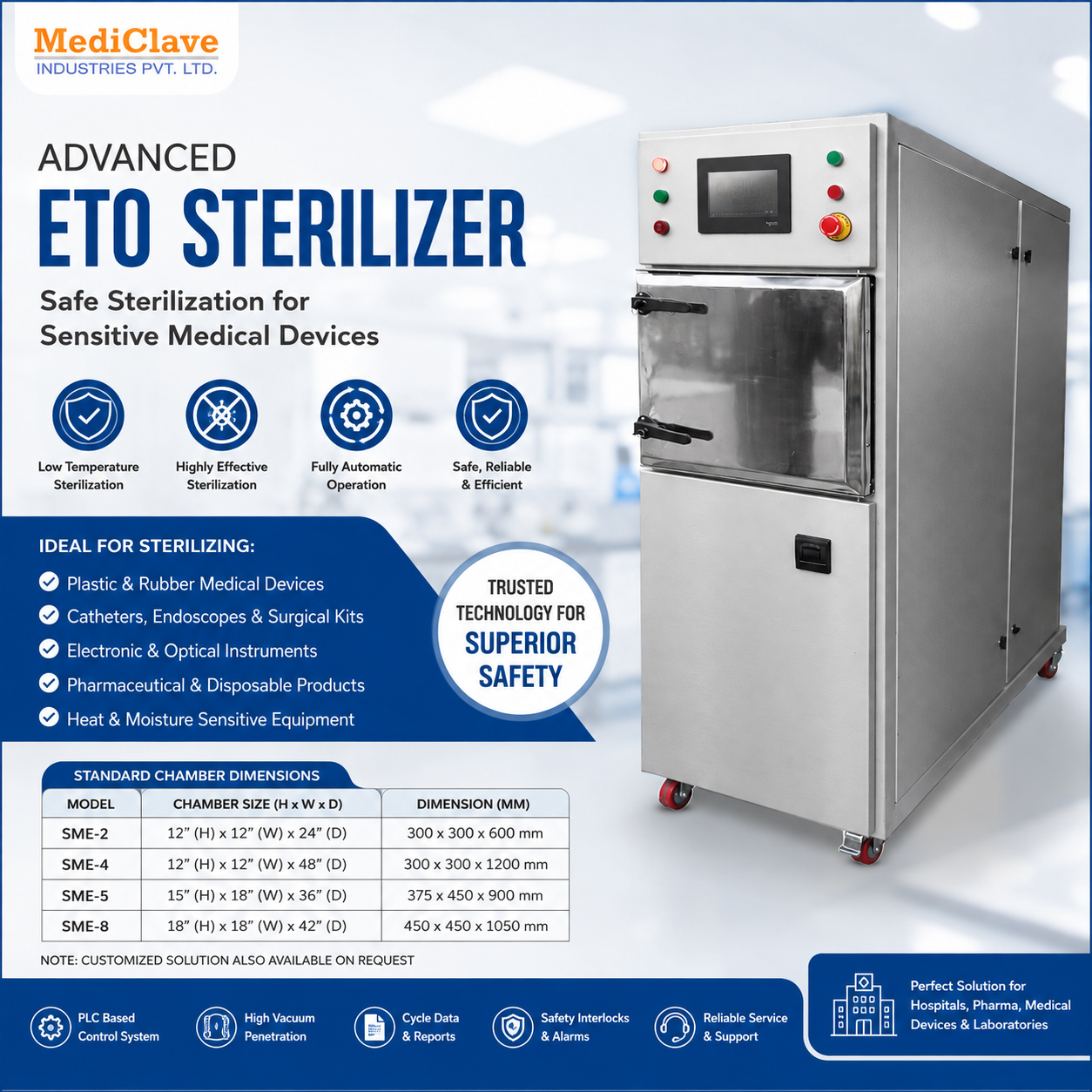
The Complete Guide to ETO Sterilizer – Working Principle, Benefits, Applications, and Buying Guide
In today's healthcare, pharmaceutical, and medical device industries, sterilization plays a critical role in ensuring patient safety and maintaining product quality. Every medical instrument, surgical kit, laboratory device, or pharmaceutical component must be completely free from harmful microorganisms before use. While steam sterilization is the preferred choice for heat-resistant instruments, many medical products cannot withstand high temperatures or moisture. This is where an ETO Sterilizer becomes one of the most reliable sterilization solutions.
An ETO Sterilizer, also known as an Ethylene Oxide Sterilizer, is specially designed to sterilize delicate, heat-sensitive, and moisture-sensitive medical devices without causing damage. It is widely used in hospitals, pharmaceutical manufacturing facilities, medical device manufacturing units, research laboratories, and healthcare institutions across the world.
If you are planning to purchase an ETO sterilizer or simply want to understand how it works, this comprehensive guide will help you make an informed decision.
What is an ETO Sterilizer?
An ETO Sterilizer is a low-temperature sterilization system that uses Ethylene Oxide (EO) gas to eliminate bacteria, viruses, fungi, spores, and other microorganisms from medical equipment and healthcare products.
Unlike steam sterilization, which uses high-temperature saturated steam, EO sterilization works at comparatively lower temperatures, making it suitable for products that cannot tolerate heat or moisture.
The sterilization process is highly effective because Ethylene Oxide gas penetrates deep into packaging materials, narrow lumens, and complex-shaped medical devices that are difficult to sterilize using conventional methods.
Why is ETO Sterilization Important?
Many medical devices are manufactured using materials such as:
Plastic
Rubber
Silicone
Electronics
Optical components
Catheters
Disposable medical products
These materials may become damaged or lose their functionality if exposed to high temperatures inside a steam autoclave.
An ETO Sterilizer provides a safe alternative by sterilizing these products at controlled low temperatures while maintaining their structural integrity and performance.
How Does an ETO Sterilizer Work?
The sterilization cycle consists of several carefully controlled stages.
1. Preconditioning
The products are conditioned under controlled temperature and humidity levels. This prepares microorganisms for effective sterilization.
2. Loading
Medical devices are placed inside the sterilization chamber. Proper spacing ensures complete gas circulation around every item.
3. Vacuum Generation
The chamber creates a vacuum to remove air. This allows EO gas to penetrate even the smallest cavities and complex instrument designs.
4. Gas Injection
Ethylene Oxide gas is introduced into the chamber under controlled pressure, temperature, humidity, and exposure time.
5. Sterilization Exposure
EO gas destroys microorganisms by interfering with their DNA and cellular metabolism, making reproduction impossible.
6. Gas Removal
Multiple vacuum and air washing cycles remove the remaining EO gas from the chamber.
7. Aeration
The sterilized products are aerated to eliminate residual EO gas, ensuring they are safe for handling and clinical use.
Working Principle of Ethylene Oxide Sterilization
Ethylene Oxide is an alkylating agent. It reacts with proteins, DNA, and RNA of microorganisms, preventing their normal metabolic functions.
Because EO gas has excellent penetrating ability, it can sterilize:
Sealed packages
Narrow tubes
Complex instruments
Plastic components
Electrical devices
Multi-layer packaging
This makes ETO sterilization one of the most versatile sterilization methods available.
Applications of ETO Sterilizers
ETO Sterilizers are used in numerous industries.
Hospitals
Hospitals use EO sterilization for:
Catheters
Endoscopes
Respiratory equipment
Plastic surgical accessories
Cardiac devices
Medical tubing
Hospitals also commonly use a Vertical Autoclave for heat-resistant instruments. Learn more about Mediclave's Vertical Autoclave range:
https://www.mediclaveindustries.in/product/vertical-autoclave/
Pharmaceutical Industry
Pharmaceutical companies sterilize:
Packaging materials
Rubber closures
Plastic containers
Disposable accessories
Drug delivery components
For pharmaceutical steam sterilization applications, Mediclave also offers:
https://www.mediclaveindustries.in/product/saturated-steam-sterilizer/
Medical Device Manufacturing
Manufacturers sterilize products before shipping, including:
Syringes
IV sets
Surgical gloves
Disposable kits
Implant accessories
Diagnostic devices
Research Laboratories
Research laboratories use EO sterilization for sensitive laboratory equipment that cannot tolerate high temperatures.
Biotechnology Industry
Biotechnology facilities sterilize disposable culture accessories and specialized laboratory tools.
Advantages of Using an ETO Sterilizer
There are many reasons why healthcare facilities prefer EO sterilization.
Excellent Penetration
EO gas penetrates packaging, plastic materials, narrow lumens, and complex devices with exceptional efficiency.
Low Temperature Process
Sterilization occurs without exposing products to damaging heat.
Suitable for Sensitive Materials
Plastic, rubber, silicone, electronic components, and optical instruments remain protected.
High Sterility Assurance
ETO sterilization effectively destroys:
Bacteria
Viruses
Spores
Fungi
Resistant microorganisms
Sterilization After Packaging
Products can be sterilized inside sealed packages, reducing contamination risks after processing.
Uniform Sterilization
Gas reaches every surface, even in complicated medical devices.
Which Products Can Be Sterilized?
ETO Sterilizers are commonly used for:
Syringes
Surgical kits
Catheters
Endoscopes
Plastic medical devices
Respiratory accessories
Dialysis components
IV sets
Disposable medical devices
Rubber products
Silicone components
Laboratory accessories
Electrical medical devices
Diagnostic instruments
Which Products Should Not Be Sterilized Using EO?
Although EO sterilization is versatile, it is not suitable for every application.
Avoid EO sterilization for:
Liquids
Powders
Food products
Materials incompatible with EO gas
Certain highly absorbent materials without proper aeration
ETO Sterilizer vs Steam Autoclave
Many buyers ask which sterilization method is better.
The answer depends on the application.
Steam sterilization is ideal for stainless steel surgical instruments and heat-resistant equipment.
ETO sterilization is recommended for:
Plastic devices
Rubber products
Electronic medical devices
Disposable products
Heat-sensitive instruments
For high-capacity steam sterilization requirements, Mediclave also manufactures Horizontal Rectangular Autoclaves:
https://www.mediclaveindustries.in/product/horizontal-rectangular-autoclave/
Important Features to Look for in an ETO Sterilizer
Before purchasing an ETO Sterilizer, consider the following features.
Stainless Steel Chamber
A corrosion-resistant SS 304 or SS 316 chamber provides durability and long service life.
PLC-Based Control System
Modern PLC controllers simplify operation and improve process accuracy.
Touch Screen Interface
Easy-to-use HMI displays cycle parameters clearly.
Automatic Cycle Operation
Automation minimizes operator intervention and reduces human errors.
Multiple Safety Systems
Reliable machines include:
Pressure protection
Temperature monitoring
Gas leak detection
Emergency stop systems
Door safety interlocks
Vacuum Pump
A powerful vacuum pump ensures effective gas penetration.
Aeration System
Efficient aeration helps remove residual EO gas from sterilized products.
Data Recording
Cycle reports improve traceability and support regulatory compliance.
Industries That Benefit from ETO Sterilization
Industries using EO Sterilizers include:
Hospitals
Pharmaceutical companies
Medical colleges
Research laboratories
Diagnostic centers
Medical device manufacturers
Biotechnology companies
Healthcare institutions
Safety Measures While Operating an ETO Sterilizer
Because Ethylene Oxide is a specialized sterilizing gas, proper safety practices are essential.
Operators should always:
Follow standard operating procedures.
Ensure adequate ventilation.
Monitor EO gas concentration.
Wear appropriate personal protective equipment.
Maintain the equipment regularly.
Use approved sterilization cycles.
Conduct routine leak testing.
Routine Maintenance Tips
Regular maintenance improves performance and extends machine life.
Maintenance includes:
Cleaning the chamber
Checking vacuum performance
Inspecting door gaskets
Calibrating sensors
Verifying pressure gauges
Servicing valves
Testing safety systems
Replacing worn components when necessary
Why Choose Mediclave Industries for ETO Sterilizers?
Mediclave Industries is a trusted manufacturer of advanced sterilization and pharmaceutical process equipment in India. The company focuses on delivering reliable, high-quality machines designed to meet the needs of hospitals, pharmaceutical companies, laboratories, research institutes, and medical device manufacturers.
In addition to ETO Sterilizers, Mediclave Industries offers a comprehensive range of sterilization solutions, including Horizontal Cylindrical Autoclaves for large healthcare facilities:
https://www.mediclaveindustries.in/product/horizontal-cylindrical-autoclave/
For pharmaceutical manufacturing environments requiring dry heat sterilization, Mediclave also manufactures:
https://www.mediclaveindustries.in/product/dry-heat-sterilizer/
With robust engineering, quality manufacturing, user-friendly controls, and dependable after-sales support, Mediclave aims to provide complete sterilization solutions tailored to diverse industry requirements.
Common Buying Questions
Before investing in an ETO Sterilizer, buyers often ask:
What chamber size is suitable for my workload?
What is the required sterilization cycle time?
Is the machine fully automatic?
Does it include PLC and HMI controls?
What safety features are provided?
Is installation and operator training included?
What maintenance support is available?
Can the machine be customized for specific applications?
Discussing these points with the manufacturer helps ensure the equipment matches your operational needs and compliance requirements.
Frequently Asked Questions (FAQs)
1. What is an ETO Sterilizer used for?
An ETO Sterilizer is used to sterilize heat-sensitive and moisture-sensitive medical devices using Ethylene Oxide gas.
2. Is EO sterilization safe?
Yes. When operated correctly with proper aeration and safety procedures, EO sterilization is a safe and internationally accepted sterilization method.
3. Which products are commonly sterilized using EO?
Catheters, plastic medical devices, surgical kits, electronic medical equipment, IV sets, disposable products, and laboratory accessories.
4. Why choose EO instead of steam sterilization?
EO sterilization is preferred for products that cannot withstand the high temperatures or moisture used in steam sterilization.
5. Does EO gas penetrate sealed packages?
Yes. One of the biggest advantages of Ethylene Oxide sterilization is its excellent penetration through many packaging materials and complex device geometries.
Conclusion
An ETO Sterilizer is an indispensable solution for industries that require safe, reliable, and low-temperature sterilization of sensitive medical and pharmaceutical products. Its ability to sterilize delicate instruments, penetrate complex packaging, and maintain product integrity makes it one of the most trusted sterilization technologies in modern healthcare.
Whether you operate a hospital, pharmaceutical manufacturing facility, research laboratory, or medical device production unit, selecting a high-quality ETO Sterilizer can significantly improve infection control, product safety, and regulatory compliance. By choosing a dependable manufacturer such as Mediclave Industries, you gain access to advanced technology, durable construction, and comprehensive sterilization solutions designed to meet evolving industry standards.



