

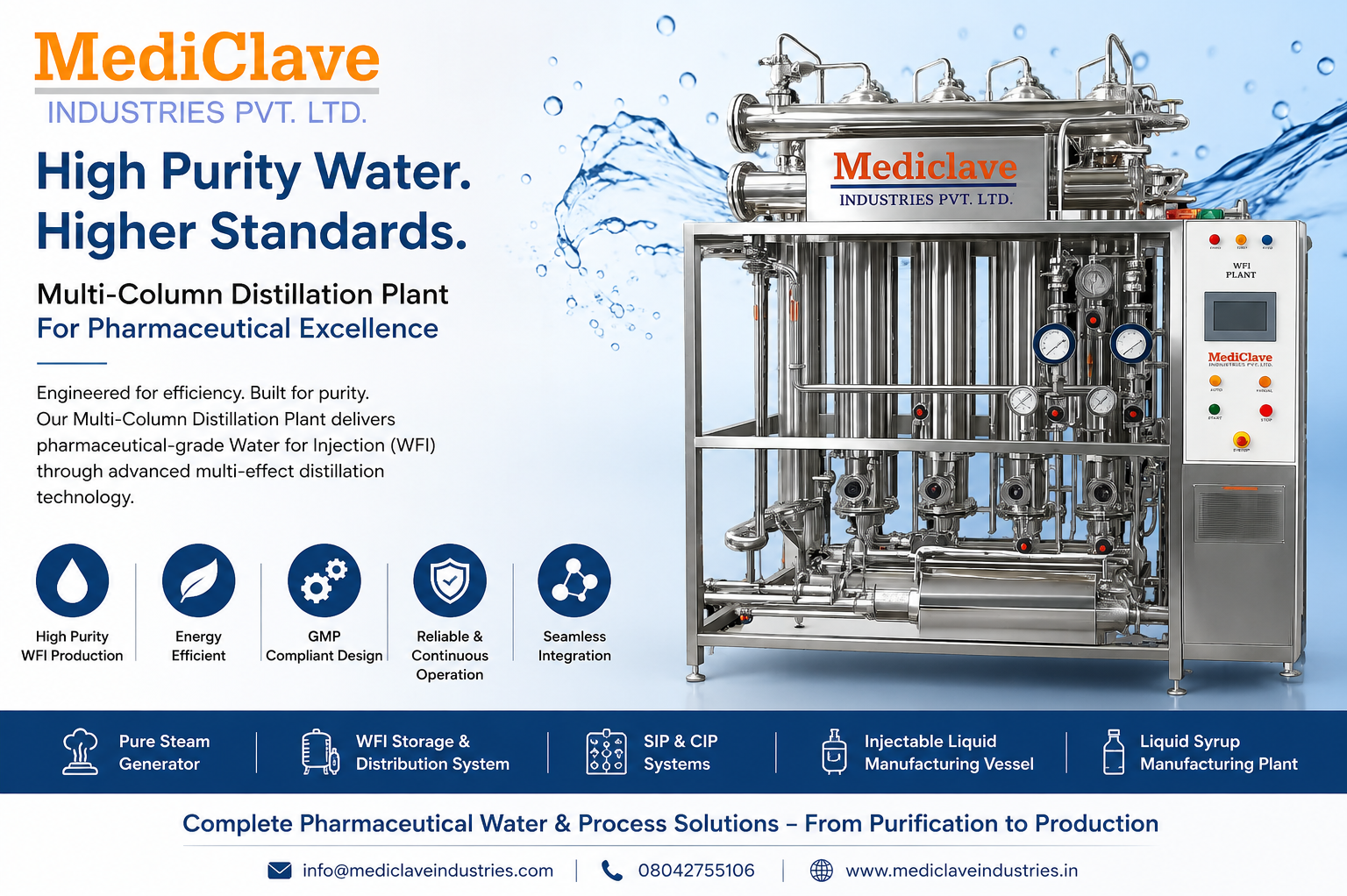
Discover Why Multi-Column Distillation Plants Are Essential for High-Purity Water in Pharmaceutical Manufacturing
Water is one of the most important resources in pharmaceutical manufacturing. It is used in cleaning, formulation, equipment sterilization, laboratory operations, and the production of medicines that must meet extremely strict quality requirements. When the product is injectable or intended for other critical applications, ordinary water is simply not enough. Manufacturers need highly purified water with controlled quality, low microbial contamination, and reliable removal of unwanted impurities.
This is where a Multi-Column Distillation Plant becomes an important part of a modern pharmaceutical water system.
A Multi-Column Distillation Plant is designed to produce high-purity Water for Injection (WFI) through a multi-stage evaporation and condensation process. Instead of depending on a single distillation stage, the system uses several interconnected columns or effects. The heat generated during one stage can be reused in subsequent stages, improving thermal efficiency while maintaining the required water quality.
For pharmaceutical manufacturers, this combination of purity, efficiency, and continuous operation makes multi-column distillation technology an important investment for facilities producing injectable medicines, vaccines, sterile formulations, biotechnology products, and other critical pharmaceutical products.
Mediclave Industries provides pharmaceutical process and water-system solutions designed for modern manufacturing environments. Its Multi Column Distillation Plant is positioned as a specialized solution for pharmaceutical-grade water production, with designs intended to support GMP and other applicable pharmaceutical manufacturing requirements.
What Is a Multi-Column Distillation Plant?
A Multi-Column Distillation Plant is a pharmaceutical water purification system that produces distilled water, commonly used as Water for Injection, through multiple stages of evaporation and condensation.
The basic principle is straightforward. Pre-treated water enters the first distillation column, where heat is applied to generate vapor. The vapor then becomes a heating source for the next stage. This process continues through multiple columns, allowing thermal energy to be reused rather than being wasted after one heating cycle.
During distillation, many unwanted substances remain behind in the feed-water stream rather than passing into the purified vapor. The vapor is subsequently condensed to produce high-purity water.
The multi-stage approach can provide several important benefits:
High-quality distilled water production
Efficient use of thermal energy
Reduced steam consumption compared with simpler single-stage approaches
Continuous water production
Controlled pharmaceutical water quality
Suitable integration with storage and distribution systems
Support for demanding sterile manufacturing environments
The exact configuration, capacity, operating parameters, materials, instrumentation, and automation should always be selected according to the pharmaceutical facility's process requirements and applicable standards.
Why Is High-Purity Water So Important in Pharmaceutical Manufacturing?
Water directly affects pharmaceutical quality. It can become an ingredient, a processing medium, a cleaning medium, or part of a sterilization process. If the water contains undesirable contaminants, the quality of the final product and the manufacturing process can be affected.
This becomes even more important for injectable medicines because the product can enter the body directly. Pharmaceutical manufacturers therefore need water systems designed around controlled quality and validated processes.
A properly designed distillation system can help remove or reduce unwanted substances such as:
Microorganisms
Pyrogens
Endotoxins
Dissolved salts
Organic contaminants
Particulate matter
Heavy metals
Other non-volatile impurities
A Multi-Column Distillation Plant uses repeated evaporation and condensation to achieve the required purification performance. The result is high-purity water that can be used in appropriate pharmaceutical applications after meeting the applicable pharmacopoeial and facility-specific requirements.
How Does a Multi-Column Distillation Plant Work?
The working principle of a Multi-Column Distillation Plant is based on multiple-effect distillation.
The process normally begins with suitably pre-treated feed water. The water quality entering the distillation plant is important because the distillation system is part of a larger pharmaceutical water-treatment chain.
1. Feed Water Enters the First Column
Pre-treated water enters the first evaporation column. Depending on the overall plant design, the feed may originate from a purified-water generation system.
The feed-water quality, temperature, flow, and pressure are controlled according to the plant design.
2. Heating Takes Place
Steam or another approved heating medium supplies the required thermal energy to the first column.
The water is heated until part of it evaporates and produces vapor.
3. Vapor Generation and Separation
As evaporation occurs, many non-volatile impurities remain in the liquid phase. The generated vapor proceeds through the appropriate separation stages.
This is one of the key reasons distillation is valuable for pharmaceutical water production.
4. Heat Is Reused in Subsequent Columns
The vapor generated in the first column can transfer its thermal energy to the next column.
The next column uses this recovered heat to generate additional vapor. The same basic principle continues through subsequent effects.
This is the central advantage of a multi-column arrangement: thermal energy can be reused across multiple stages.
5. Further Purification Takes Place
As the vapor moves through the successive stages, the system continues the separation process.
The plant is engineered to control important operating conditions such as temperature, pressure, flow, and water quality.
6. Condensation Produces Purified Water
At the final stage, the purified vapor is condensed.
The resulting distilled water is collected as the desired high-purity water stream, subject to the specifications and quality controls established for the facility.
7. WFI Is Stored and Distributed
The produced WFI does not simply remain inside the distillation plant. Pharmaceutical facilities normally require a hygienic storage and circulation system so that water quality can be maintained between production and points of use.
This is why a WFI Storage & Distribution System can be an important companion to the distillation plant.
What Makes the Multi-Column Design Efficient?
One of the most important advantages of multi-column distillation is energy recovery.
In a basic single-effect system, much of the heat used for evaporation may not be reused efficiently. In a multiple-effect arrangement, vapor from one stage can provide heating energy for the next stage.
This creates a cascading thermal process.
Instead of continuously supplying completely new heat to every stage, the system makes greater use of energy already introduced into the process.
For pharmaceutical manufacturers, this can help improve:
Steam utilization
Overall thermal efficiency
Production economics
Continuous operation
Resource utilization
However, actual energy consumption depends on the plant configuration, feed-water conditions, production capacity, steam quality, operating parameters, and other site-specific factors.
Major Components of a Multi-Column Distillation Plant
A pharmaceutical distillation plant consists of multiple interconnected components that must work together reliably.
Depending on the design and capacity, the system can include:
Distillation Columns: These form the core of the multi-effect process and provide the different stages of evaporation and heat recovery.
Heat Exchangers: Heat-transfer equipment helps efficiently move thermal energy between process streams.
Steam and Condensate Connections: These manage the heating medium and condensate generated during operation.
Feed-Water System: This controls the entry of suitably pre-treated water into the distillation process.
Vapor Separators: These support effective separation of vapor and entrained droplets.
Instrumentation: Temperature, pressure, flow, conductivity, and other measurements help operators monitor the system.
Control Panel: Modern plants can incorporate PLC-based automation and HMI interfaces for process control and monitoring.
Collection System: The final purified water is directed toward the appropriate storage and distribution arrangement.
Safety and Control Devices: Proper valves, alarms, interlocks, and monitoring systems help support safe and controlled operation.
The exact equipment configuration should be selected according to production capacity, water quality requirements, utility availability, automation expectations, and applicable pharmaceutical standards.
Applications of Multi-Column Distillation Plants
Multi-Column Distillation Plants are particularly useful where high-purity pharmaceutical water is required.
Typical applications include:
Injectable Manufacturing
Injectable pharmaceutical products require carefully controlled water quality. A suitable WFI generation system can form a critical part of the utility infrastructure supporting injectable production.
For facilities manufacturing injectable products, the distillation system can be integrated with equipment such as an Injectable Liquid Manufacturing Vessel with Magnetic Stirrer, depending on the manufacturing process.
Vaccine Manufacturing
Vaccines and other biological products require controlled manufacturing environments. High-purity water is often an important utility in these facilities.
Biotechnology
Biotechnology manufacturing can require highly controlled water and hygienic process conditions. A properly designed pharmaceutical water system can support these requirements.
Sterile Pharmaceutical Production
Sterile manufacturing operations depend on controlled utilities and contamination-prevention strategies. High-purity water can support manufacturing, cleaning, and other process requirements.
Pharmaceutical Formulation
Water may be used in the preparation of liquid pharmaceutical products. Depending on the product and formulation requirements, the appropriate pharmaceutical-grade water system can become a key part of the manufacturing infrastructure.
For example, facilities producing oral liquids can also integrate suitable Liquid Syrup Manufacturing Process Plant solutions with their broader pharmaceutical process setup.
Multi-Column Distillation Plant and WFI Storage
Producing high-purity water is only one part of pharmaceutical water management.
After WFI is generated, it needs to be stored and distributed in a way that helps preserve its quality. Poor storage or distribution practices can compromise the benefits achieved during the purification process.
A properly designed WFI system can support controlled circulation and hygienic delivery to different points of use.
The storage and distribution system may therefore include:
Hygienic storage vessels
Circulation loops
Sanitary piping
Pumps
Valves
Temperature monitoring
Pressure monitoring
Sampling points
Automation and control systems
The distillation plant and WFI distribution system should be considered together when designing a pharmaceutical water infrastructure.
How Does Pure Steam Support Pharmaceutical Water Systems?
Steam is an important utility in many pharmaceutical facilities.
A Pure Steam Generator can generate high-purity steam for suitable sterilization and pharmaceutical utility applications. Pure steam can be used in processes such as Sterilize-In-Place, depending on the facility's validated process requirements.
This creates an important relationship between pharmaceutical water generation and pharmaceutical sterilization.
The water system supplies high-purity water, while pure steam can support sterilization activities and other critical processes.
Integration with CIP and SIP Systems
Pharmaceutical process equipment must be cleaned and, where required, sterilized between batches.
This is where SIP & CIP Systems become highly valuable.
CIP means Clean-In-Place. It allows internal surfaces of tanks, vessels, pipelines, and other process equipment to be cleaned without extensive dismantling.
SIP means Sterilize-In-Place. It uses a suitable sterilization medium, commonly clean or pure steam, to sterilize equipment after cleaning.
When a Multi-Column Distillation Plant is integrated into a broader pharmaceutical utility infrastructure containing WFI storage, pure steam generation, and CIP/SIP systems, the facility can develop a more coordinated approach to water quality, cleaning, and sterilization.
This integration is particularly valuable for modern pharmaceutical plants where repeatability, hygiene, automation, and documentation are important.
Important Features to Consider Before Buying a Multi-Column Distillation Plant
Selecting a distillation plant should not be based only on price or production capacity.
A pharmaceutical manufacturer should consider the complete process requirement.
Production Capacity
Determine the required WFI generation rate based on current consumption and expected future expansion.
Feed-Water Quality
The quality of the water entering the distillation system can affect performance and operating conditions. The upstream purification system should therefore be evaluated carefully.
Material of Construction
Product-contact and critical wetted surfaces should be selected according to pharmaceutical requirements, corrosion resistance, hygienic design, and applicable standards.
Energy Efficiency
Because distillation requires significant thermal energy, the efficiency of heat recovery and steam utilization is an important consideration.
Automation
PLC-based automation, HMI interfaces, alarms, data recording, and process monitoring can improve operational control and documentation.
Validation and Documentation
Pharmaceutical equipment should be supported by suitable documentation and validation considerations according to the user's regulatory and quality requirements.
Maintenance
The plant should be designed for practical inspection, cleaning, maintenance, and service access.
Future Expansion
A system selected only for today's demand may become restrictive as production increases. Capacity planning should therefore consider future requirements.
Benefits of Choosing a Properly Designed Multi-Column Distillation Plant
A well-designed system can offer several advantages to pharmaceutical manufacturers.
High-Purity Water Production: Multiple distillation stages support effective separation of many unwanted contaminants.
Energy Utilization: Heat recovery between effects can improve thermal efficiency.
Continuous Operation: Properly configured systems can support ongoing WFI production for facilities with continuous demand.
Reduced Steam Consumption: Multi-effect operation can reduce the amount of fresh heating steam required compared with less efficient configurations, depending on operating conditions.
Pharmaceutical Applications: The technology is suitable for demanding applications where high-purity water is required.
Automation: Modern control systems can provide improved monitoring and process consistency.
Integration: The plant can form part of a larger pharmaceutical water and utility infrastructure.
Why Manufacturer Selection Matters
A Multi-Column Distillation Plant is not simply a piece of standard equipment that can be selected from a catalogue without considering the facility.
The plant interacts with water-treatment systems, steam utilities, storage tanks, distribution loops, process equipment, drainage, electrical systems, automation, and quality-control procedures.
Therefore, manufacturer selection matters.
A capable pharmaceutical equipment manufacturer should understand the relationship between water quality, thermal processes, hygienic design, automation, maintenance, and pharmaceutical manufacturing requirements.
Mediclave Industries Pvt. Ltd. provides pharmaceutical process equipment and water-system solutions for applications requiring controlled manufacturing conditions. Its portfolio includes distillation systems, pure steam generation, WFI storage and distribution, and CIP/SIP solutions, allowing manufacturers to consider multiple pharmaceutical utilities from a coordinated equipment provider.
Frequently Asked Questions
What is a Multi-Column Distillation Plant?
A Multi-Column Distillation Plant is a pharmaceutical water purification system that uses multiple stages of evaporation and condensation to produce high-purity distilled water, commonly for WFI applications.
Why are multiple columns used?
Multiple columns allow thermal energy to be reused between stages. This can improve energy efficiency and reduce steam consumption compared with simpler distillation arrangements.
Where is a Multi-Column Distillation Plant used?
It is commonly used in pharmaceutical, biotechnology, injectable manufacturing, vaccine, sterile manufacturing, and other facilities requiring high-purity water.
Can the plant produce WFI?
Yes, a suitably designed and operated pharmaceutical distillation system can be used for WFI production when the complete system and water quality meet the applicable pharmacopoeial and regulatory requirements.
Can WFI be stored after production?
Yes. Pharmaceutical facilities generally use a dedicated WFI storage and distribution system to hygienically store and circulate the produced water.
Can a Multi-Column Distillation Plant be integrated with CIP and SIP?
Yes. It can form part of an integrated pharmaceutical utility system. WFI can support appropriate cleaning processes, while pure steam can support SIP applications according to validated process requirements.
Is automation available?
Modern pharmaceutical distillation systems can incorporate PLC-based automation, HMI interfaces, sensors, alarms, monitoring, and data recording. The exact level of automation depends on the project requirements.
How should I choose the capacity of a Multi-Column Distillation Plant?
Capacity should be determined by current and projected WFI demand, peak consumption, storage capacity, distribution requirements, operating hours, and future expansion plans.
Conclusion
High-purity water is fundamental to pharmaceutical manufacturing, especially when the production process involves injectable medicines, vaccines, sterile formulations, and other critical products. A Multi-Column Distillation Plant provides a proven approach to generating pharmaceutical-grade water through multiple stages of evaporation, heat recovery, and condensation.
The biggest advantage of multi-column technology is that it combines purification with efficient thermal utilization. By reusing heat between successive stages, the system can support reliable WFI production while improving energy efficiency.
However, the distillation plant should not be viewed as an isolated machine. Its true value comes when it is properly integrated with WFI storage and distribution, pure steam generation, CIP and SIP systems, and the wider pharmaceutical manufacturing process.
For pharmaceutical manufacturers planning a new facility, expanding an existing plant, or upgrading their water-generation infrastructure, choosing the right distillation technology and manufacturer can make a significant difference to long-term reliability, efficiency, and process control.
Mediclave Industries Pvt. Ltd. offers pharmaceutical water and process equipment solutions designed to support modern manufacturing requirements. To discuss your application, capacity requirement, customization, or complete pharmaceutical utility setup, contact Mediclave Industries Pvt. Ltd.
Email: info@mediclaveindustries.com
Phone: 08042755106
Website: https://www.mediclaveindustries.in/



