
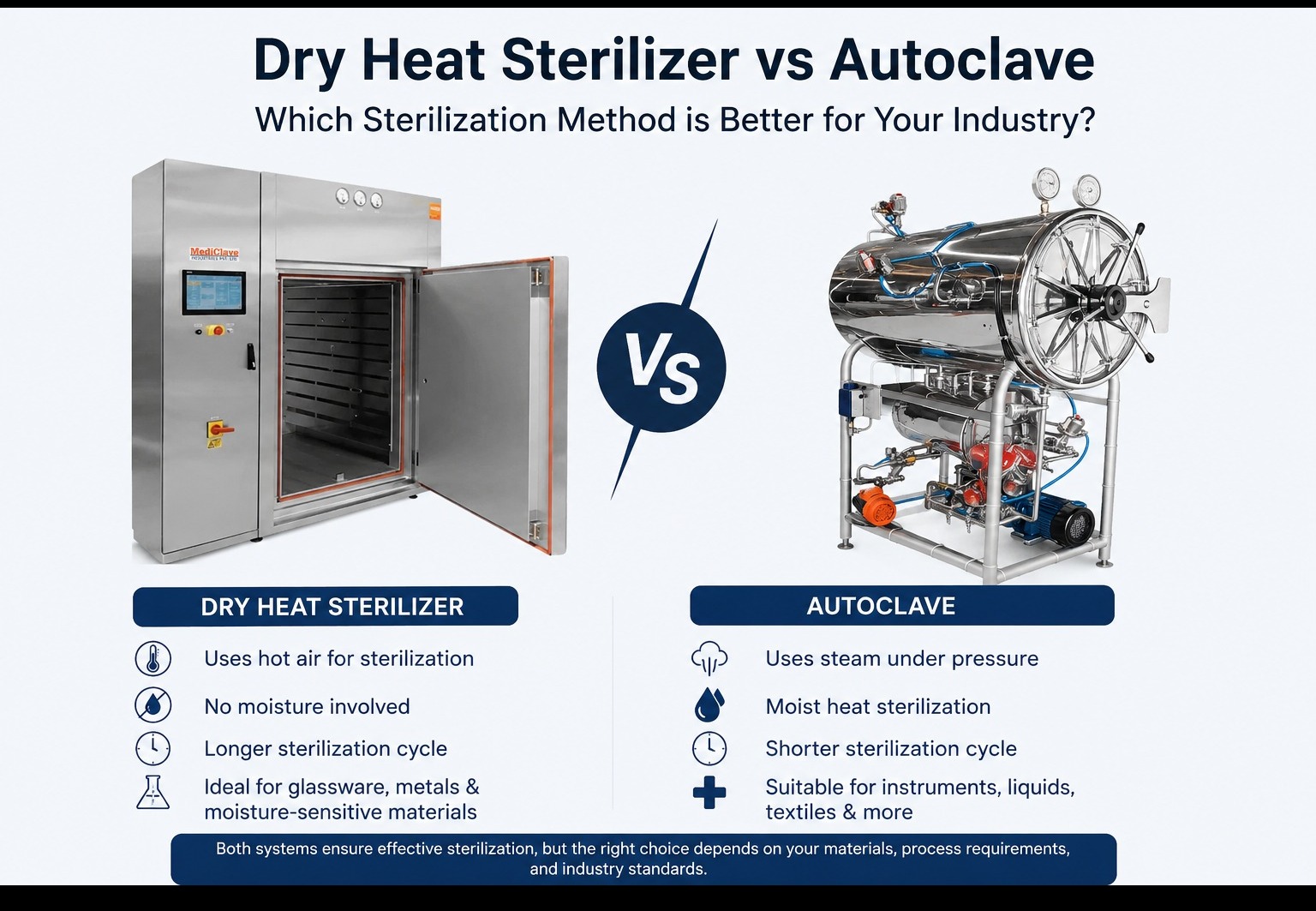
Sterilization plays a critical role in pharmaceutical manufacturing, healthcare facilities, laboratories, biotechnology industries, and research centers. The effectiveness of sterilization directly impacts product quality, patient safety, regulatory compliance, and infection control.
Among the most commonly used sterilization technologies, Dry Heat Sterilizers and Autoclaves are widely accepted across various industries. While both systems are designed to eliminate microorganisms, bacteria, spores, and contaminants, they operate using completely different principles and are suitable for different applications.
Understanding the differences between Dry Heat Sterilization and Steam Sterilization is essential when selecting the right equipment for your facility.
In this article, we compare Dry Heat Sterilizers and Autoclaves in detail to help you determine which solution best meets your operational requirements.
Understanding Dry Heat Sterilization
Dry Heat Sterilization uses high-temperature hot air to destroy microorganisms through oxidation. Unlike steam sterilization, no moisture is involved during the sterilization process.
A Dry Heat Sterilizer typically operates between 160°C and 250°C depending on the application and sterilization cycle requirements.
This method is commonly used for:
- Glassware
- Metal instruments
- Empty glass vials
- Ampoules
- Surgical tools
- Pharmaceutical containers
- Heat-resistant materials
Dry heat sterilization is especially valuable in pharmaceutical industries where moisture-sensitive products and components cannot be exposed to steam.
Understanding Autoclave Sterilization
An Autoclave uses saturated steam under pressure to achieve sterilization. The combination of heat, pressure, and moisture rapidly destroys microorganisms and bacterial spores.
Typical operating conditions include:
- 121°C at 15 PSI
- 134°C high-temperature cycles
Autoclaves are commonly used for:
- Surgical instruments
- Laboratory equipment
- Culture media
- Textiles
- Medical waste
- Stainless steel components
- Pharmaceutical equipment
Steam sterilization is considered one of the most efficient and widely accepted sterilization methods worldwide.
Working Principle Comparison
Dry Heat Sterilizer
The sterilizer circulates filtered hot air throughout the chamber. Heat penetrates the load and destroys microorganisms through oxidation and protein denaturation.
Characteristics include:
- No moisture
- High operating temperatures
- Longer sterilization cycles
- Suitable for moisture-sensitive materials
Autoclave
The autoclave generates saturated steam that penetrates the load under pressure. Steam transfers heat rapidly, resulting in faster and highly effective sterilization.
Characteristics include:
- Moist heat process
- Lower operating temperatures
- Faster cycle times
- Excellent penetration capabilities
Dry Heat Sterilizer vs Autoclave: Key Differences
| Parameter | Dry Heat Sterilizer | Autoclave |
|---|---|---|
| Sterilization Method | Hot Air | Saturated Steam |
| Moisture Requirement | No | Yes |
| Operating Temperature | 160°C–250°C | 121°C–134°C |
| Cycle Duration | Longer | Shorter |
| Energy Consumption | Moderate | Moderate |
| Suitable for Glassware | Excellent | Good |
| Suitable for Liquids | No | Excellent |
| Moisture-Sensitive Products | Excellent | Not Recommended |
| Heat Distribution | Forced Air Circulation | Steam Penetration |
| Pharmaceutical Applications | Extensive | Extensive |
Advantages of Dry Heat Sterilizers
Dry Heat Sterilizers offer several benefits:
Ideal for Moisture-Sensitive Materials
Materials that may corrode, degrade, or become damaged by moisture can be safely sterilized using dry heat.
Suitable for Glass Components
Glass vials, bottles, ampoules, and laboratory glassware can be effectively sterilized without moisture-related contamination.
Depyrogenation Capability
High-temperature dry heat systems can remove pyrogens and bacterial endotoxins, which is essential in pharmaceutical manufacturing.
Minimal Corrosion Risk
Since no moisture is involved, metal instruments experience significantly lower corrosion risk.
Advantages of Autoclaves
Autoclaves remain the preferred sterilization solution for many industries because of their versatility and efficiency.
Faster Sterilization Cycles
Steam transfers heat more efficiently than hot air, resulting in reduced cycle times.
Excellent Microbial Destruction
Autoclaves provide highly reliable sterilization performance and are effective against bacterial spores.
Broad Application Range
They can process:
- Medical instruments
- Laboratory equipment
- Liquids
- Fabrics
- Culture media
Regulatory Acceptance
Steam sterilization is widely accepted by global regulatory agencies and healthcare standards.
Applications in Pharmaceutical Industry
Dry Heat Sterilizer Applications
- Empty vial sterilization
- Ampoule sterilization
- Depyrogenation tunnels
- Glassware processing
- Stainless steel components
- Heat-resistant pharmaceutical accessories
Autoclave Applications
- Media sterilization
- Equipment sterilization
- Component sterilization
- Process accessories
- Biohazard waste treatment
- Sterile manufacturing support operations
Which Sterilizer Should You Choose?
The choice depends entirely on the materials being processed and your manufacturing requirements.
Choose a Dry Heat Sterilizer if:
- You need depyrogenation.
- Products are moisture-sensitive.
- Glassware sterilization is a primary requirement.
- High-temperature processing is acceptable.
Choose an Autoclave if:
- Fast sterilization is required.
- Liquids need sterilization.
- General-purpose sterilization is needed.
- Healthcare and laboratory applications are the primary focus.
Importance of Selecting the Right Sterilization Equipment
Selecting the wrong sterilization technology can result in:
- Product damage
- Reduced equipment lifespan
- Compliance issues
- Increased operational costs
- Inefficient sterilization performance
A proper evaluation of product characteristics, regulatory requirements, and production objectives is essential before investing in sterilization equipment.
Why Choose Mediclave Industries for Sterilization Solutions?
At Mediclave Industries Private Limited, we specialize in designing and manufacturing advanced sterilization systems for pharmaceutical, healthcare, biotechnology, and research industries.
Our solutions are engineered for:
- Regulatory compliance
- High operational efficiency
- Reliable sterilization performance
- GMP-oriented manufacturing environments
- Long-term durability and safety
With extensive experience in pharmaceutical process equipment and sterilization technology, we provide customized solutions that meet the unique requirements of modern manufacturing facilities.
Conclusion
Both Dry Heat Sterilizers and Autoclaves are highly effective sterilization systems, but each serves a different purpose. Dry Heat Sterilizers are ideal for moisture-sensitive materials, glassware, and depyrogenation applications, while Autoclaves excel in fast, reliable steam sterilization for healthcare, laboratory, and pharmaceutical operations.
Understanding the strengths and limitations of each technology helps organizations make informed decisions that improve efficiency, compliance, and product safety.
Frequently Asked Questions (FAQs)
What is the main difference between a Dry Heat Sterilizer and an Autoclave?
A Dry Heat Sterilizer uses hot air without moisture, while an Autoclave uses steam under pressure for sterilization.
Which sterilization method is faster?
Autoclave sterilization is generally faster because steam transfers heat more efficiently than hot air.
Can Dry Heat Sterilizers remove pyrogens?
Yes. High-temperature dry heat sterilization is widely used for depyrogenation of glass containers and pharmaceutical components.
Is an Autoclave suitable for liquids?
Yes. Autoclaves are commonly used for sterilizing liquids, media, and aqueous solutions.
Which sterilization method is better for pharmaceutical glassware?
Dry Heat Sterilization is often preferred for pharmaceutical glassware because it provides effective sterilization and depyrogenation without moisture exposure.