

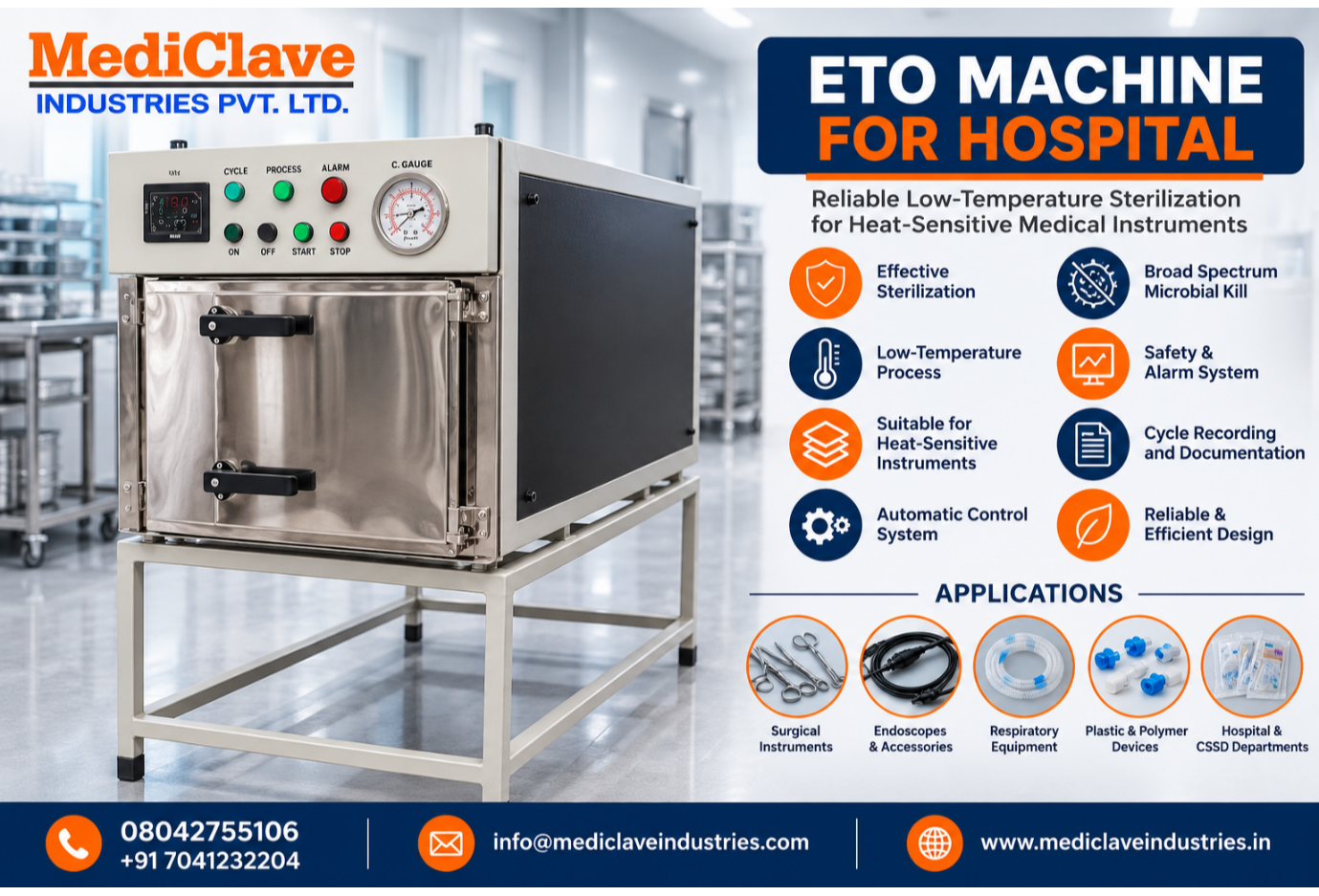
Introduction – Why ETO Machines Are Important for Hospital
Sterilization
In modern healthcare, sterilization is essential for
patient safety, infection prevention, and the safe reuse of medical
instruments. Hospitals, surgical centers, and Central Sterile Supply
Departments (CSSD) handle a wide variety of reusable medical devices, including
instruments made from materials that cannot tolerate high-temperature steam
sterilization.
While steam autoclaves are widely used for heat-resistant
surgical instruments, certain medical devices require low-temperature
sterilization methods.
An ETO Machine for Hospital, also known as an Ethylene
Oxide Sterilizer, is designed to sterilize compatible heat-sensitive and
moisture-sensitive medical devices using ethylene oxide gas under controlled
conditions.
At Mediclave Industries Private Limited, we understand the
importance of reliable sterilization equipment for hospitals and healthcare
facilities. As an Indian manufacturer of sterilization and pharmaceutical
equipment, we provide ETO sterilization solutions for medical and industrial
applications.
An appropriately selected ETO sterilizer can help hospitals
process compatible reusable medical devices that cannot be sterilized using
conventional high-temperature steam methods.
What Is an ETO Machine for Hospital?
An ETO Machine for Hospital is a low-temperature
sterilization system that uses ethylene oxide gas to inactivate microorganisms,
including bacterial spores, on compatible medical devices.
Ethylene oxide is particularly useful because it can
penetrate certain packaging materials and reach difficult-to-access surfaces
within appropriately designed medical devices.
Hospital ETO sterilizers are commonly considered for
compatible devices such as:
·
Heat-sensitive medical
instruments
·
Selected plastic medical
components
·
Certain reusable endoscopic
accessories
·
Medical devices containing
compatible polymer materials
·
Selected tubing and respiratory
accessories
·
Devices with complex internal
structures
·
Other medical instruments
specifically approved for ETO sterilization
Not every plastic, electronic, or delicate instrument is
suitable for ETO processing. Hospitals must follow the medical device
manufacturer's validated reprocessing instructions.
For more information about sterilization equipment, visit Mediclave Industries Private Limited.
How Does an ETO Sterilizer Machine Work?
An ETO sterilizer operates through a controlled
sterilization process involving temperature, humidity, ethylene oxide
concentration, exposure time, and gas removal.
The exact sequence depends on the equipment design and
validated sterilization cycle.
1. Loading the Sterilization Chamber
Previously cleaned, dried, inspected, and appropriately
packaged medical devices are placed inside the sterilization chamber.
Proper loading arrangements are essential for effective gas
penetration and sterilization.
2. Preconditioning
Depending on the sterilization system, the load is brought
to specified temperature and humidity conditions.
Moisture control is important because humidity influences
the effectiveness of ethylene oxide sterilization.
3. Ethylene Oxide Gas Introduction
Ethylene oxide gas is introduced into the sterilization
chamber using a controlled delivery system.
The required gas concentration depends on the validated
sterilization process.
4. Sterilization Exposure
The medical devices remain exposed to the required process
conditions for a specified period.
Sterilization effectiveness depends on the combined control
of gas concentration, temperature, humidity, and exposure time.
5. Gas Evacuation
After the sterilization exposure phase, ethylene oxide is
removed through the equipment's controlled evacuation and gas-handling systems.
Appropriate emissions treatment and workplace exposure
controls are necessary because ethylene oxide is toxic, flammable, and
carcinogenic.
6. Aeration Process
Sterilized devices undergo a validated aeration process to
reduce residual ethylene oxide and its by-products to acceptable levels.
Aeration is an essential part of ETO processing and must
not be omitted or shortened without validation.
7. Cycle Completion
The sterilization records, required monitoring results, and
applicable residual-release criteria are reviewed before the processed devices
are released for use.
Key Features of an ETO Machine for Hospital
Hospital ETO sterilizers should be evaluated for
sterilization performance, safety, monitoring, and compatibility with the
intended medical devices.
Stainless Steel Sterilization Chamber
Suitable stainless steel chamber construction supports
durability, cleanability, and equipment maintenance.
Automatic Control System
Depending on the equipment model, PLC-based control systems
can manage programmed cycle stages, temperature, pressure, and process
monitoring.
Low-Temperature Sterilization
ETO sterilization is suitable for selected heat-sensitive
medical devices that cannot withstand conventional high-temperature steam
processing.
Temperature and Humidity Monitoring
Controlled temperature and humidity conditions are
important for achieving the validated sterilization process.
Gas Concentration Control
Appropriate gas delivery and process control systems help
maintain required sterilization conditions.
Safety Interlocks
Suitable safety systems may include door interlocks,
alarms, emergency controls, and process safeguards.
Gas Evacuation and Emissions Control
ETO equipment requires engineered gas handling, leak
detection, ventilation, and appropriate emissions treatment arrangements.
Cycle Recording System
Printed or electronic records can support process traceability,
sterilization monitoring, and quality documentation.
Individual features depend on the selected equipment
configuration and technical specifications.
Applications of ETO Sterilizer Machines in Hospitals
ETO sterilizers are used for selected medical devices that
are compatible with ethylene oxide sterilization and cannot be appropriately
processed using other available methods.
|
Healthcare
Application |
Typical
Requirement |
|
Hospital CSSD Departments |
Sterilization of compatible heat-sensitive reusable devices |
|
Surgical Departments |
Processing selected temperature-sensitive medical
accessories |
|
Respiratory Care Departments |
Sterilization of approved respiratory accessories |
|
Endoscopy Departments |
Processing selected ETO-compatible devices |
|
Medical Device Reprocessing |
Sterilization of validated reusable devices |
|
Specialty Healthcare Facilities |
Low-temperature sterilization of compatible medical
equipment |
ETO sterilization should be used only where the device
manufacturer permits the method and the hospital has suitable safety
infrastructure and validated procedures.
Benefits of Using an ETO Machine for Hospital
1. Low-Temperature Sterilization
One of the main advantages of ethylene oxide sterilization
is its suitability for certain medical devices that cannot tolerate
high-temperature steam.
2. Penetration into Complex Devices
Ethylene oxide gas can penetrate compatible packaging and
certain complex device structures, making it useful for selected medical
devices with challenging geometries.
3. Compatibility with Selected Materials
ETO processing can be suitable for some plastics, polymers,
and other temperature-sensitive materials when validated for the specific
device.
4. Sterilization of Packaged Devices
Compatible packaging systems can allow ethylene oxide penetration
during sterilization while supporting sterile barrier integrity after
processing.
5. Support for Specialized Hospital Requirements
ETO sterilizers provide an additional processing option for
healthcare facilities that handle suitable heat-sensitive medical instruments.
6. Controlled Sterilization Process
Automated equipment can help maintain programmed process
parameters and support consistent cycle execution when properly qualified and
validated.
ETO Sterilizer vs Steam Autoclave – What Is the Difference?
Both technologies are used for sterilization, but they have
different applications and operating requirements.
|
Parameter |
ETO Sterilizer |
Steam Autoclave |
|
Sterilization Method |
Ethylene Oxide Gas |
Saturated Steam |
|
Operating Temperature |
Low Temperature |
High Temperature |
|
Suitable Devices |
Selected Heat-Sensitive Devices |
Heat- and Moisture-Resistant Devices |
|
Sterilizing Agent |
Ethylene Oxide |
Steam |
|
Aeration Requirement |
Required |
Not Required for ETO Residual Removal |
|
Cycle Duration |
Typically Longer |
Often Shorter |
|
Major Safety Considerations |
Toxic Gas, Residuals, Emissions |
High Temperature and Pressure |
|
Typical Application |
Specialized Medical Devices |
Surgical Instruments and Compatible Healthcare Items |
For most steam-compatible reusable medical instruments,
steam sterilization is generally preferred because it avoids ethylene oxide
exposure and lengthy aeration requirements.
ETO should be selected when the device's validated
reprocessing instructions and clinical requirements justify its use.
Technical Specifications of an ETO Machine for Hospital
ETO sterilizer specifications depend on chamber capacity,
gas delivery method, automation, and the intended application.
|
Technical
Parameter |
General
Configuration |
|
Product Name |
ETO Machine for Hospital |
|
Sterilization Method |
Ethylene Oxide Gas |
|
Chamber Material |
Stainless Steel |
|
Operating Temperature |
Low Temperature, Cycle-Dependent |
|
Control System |
Automatic / PLC-Based Options |
|
Chamber Capacity |
According to Selected Model |
|
Door Configuration |
Single Door / Double Door Options |
|
Process Monitoring |
Temperature, Humidity, Pressure and Other Validated
Parameters |
|
Gas Delivery |
Controlled ETO Gas System |
|
Aeration |
Validated Aeration Arrangement |
|
Safety System |
Interlocks, Alarms and Engineered Gas Safety Controls |
|
Applications |
Compatible Heat-Sensitive Medical Devices |
Note: These are general equipment characteristics, not a
confirmed Mediclave product datasheet. Final technical specifications must be
established through the selected model's documentation.
Importance of ETO Sterilization in Hospital CSSD
Departments
A Central Sterile Supply Department is responsible for the
cleaning, inspection, packaging, sterilization, storage, and distribution of
reusable medical instruments.
While steam sterilizers are commonly used for heat-resistant
instruments, some devices require alternative sterilization methods.
ETO sterilization can support CSSD operations by providing
a validated low-temperature process for suitable medical devices.
However, hospitals must carefully evaluate the practical
requirements of installing and operating ETO equipment.
These include:
·
Dedicated and appropriately
engineered sterilization areas
·
Adequate ventilation and gas
monitoring
·
Controlled ethylene oxide
handling
·
Suitable emissions treatment
·
Validated aeration arrangements
·
Operator training and emergency
procedures
·
Sterilization cycle validation
and routine monitoring
·
Applicable occupational and
environmental compliance
The use of ethylene oxide requires particular attention to
staff safety, environmental controls, and residual gas management.
How to Choose the Best ETO Machine for Hospital
Before purchasing an ETO sterilizer, hospitals should
assess their clinical needs, infrastructure, and operational requirements.
1. Medical Device Compatibility
Confirm that the instruments requiring sterilization are
approved for ETO processing.
2. Chamber Capacity
Determine the quantity and dimensions of instruments to be
processed during each cycle.
3. Sterilization Cycle Requirements
Evaluate the required temperature, humidity, gas
concentration, exposure time, and aeration conditions.
4. Automation and Monitoring
Consider equipment with suitable process controls, alarms,
data recording, and cycle documentation.
5. Safety Infrastructure
Assess ventilation, gas detection, leak prevention,
emissions control, and emergency response requirements.
6. Validation and Compliance
Confirm that the equipment and process can meet applicable
standards, regulatory requirements, and hospital sterilization procedures.
7. Manufacturer Support
Evaluate installation assistance, technical documentation,
operator training, maintenance, and spare-part availability.
ETO Machine for Hospital Price in India
The price of an ETO Machine for Hospital depends on several
technical and commercial factors.
Major pricing considerations include:
·
Sterilization chamber size
·
Chamber construction material
·
Automatic control system
·
Gas delivery arrangement
·
Temperature and humidity
control
·
Safety interlocks and alarms
·
Gas evacuation and emissions
treatment
·
Aeration system requirements
·
Process recording and
documentation
·
Installation and validation
requirements
The total project cost should also account for ventilation,
environmental compliance, gas monitoring, consumables, operator safety, and
ongoing maintenance.
For accurate pricing, customers should share their chamber
capacity requirements, intended medical devices, and installation details.
Why Choose Mediclave Industries for ETO Sterilizer
Machines?
Mediclave Industries Private Limited provides sterilization
and pharmaceutical equipment solutions for healthcare and industrial
applications.
We understand that hospitals require equipment selected
according to their sterilization needs, safety requirements, and operational
infrastructure.
Our equipment solutions focus on:
·
Practical sterilization system
design
·
Suitable stainless steel
construction
·
Appropriate process monitoring
and automation options
·
Equipment configurations based
on application requirements
·
Operational safety
considerations
·
Technical consultation for
equipment selection
·
Support for discussing
project-specific requirements
Whether you are planning a new hospital sterilization
department or evaluating equipment for specialized medical devices, our team
can help you discuss suitable ETO sterilization solutions.
Explore our hospital
sterilization equipment and ETO sterilizer solutions.
Frequently Asked Questions About ETO Machines for
Hospitals
Q1. What is an ETO Machine for Hospital?
An ETO Machine for Hospital is a low-temperature
sterilization system that uses ethylene oxide gas to sterilize compatible
medical devices under controlled conditions.
Q2. What is an ETO sterilizer used for in hospitals?
ETO sterilizers are used for selected heat-sensitive or
moisture-sensitive medical devices that are validated for ethylene oxide
processing.
Q3. Is ETO sterilization safe for medical instruments?
ETO sterilization can be effective for compatible medical
devices when properly validated. However, ethylene oxide is hazardous, and safe
processing requires suitable engineering controls, validated aeration, residual
monitoring, and trained personnel.
Q4. What is the difference between ETO sterilization and
steam sterilization?
ETO uses ethylene oxide gas at relatively low temperatures,
while steam sterilization uses saturated steam at higher temperatures. The
appropriate method depends on medical device compatibility and validated
reprocessing instructions.
Q5. How long does ETO sterilization take?
Cycle duration varies according to the equipment, load, and
validated process. Aeration can add substantial time, so the complete process
is generally longer than conventional steam sterilization.
Q6. What is the price of an ETO Machine for Hospital in
India?
The price depends on chamber capacity, automation, gas
handling, aeration, safety systems, and other technical requirements. Contact
Mediclave Industries for a product-specific quotation.
Q7. Where can I find an ETO Sterilizer Manufacturer in
India?
Mediclave Industries Private Limited provides ETO
sterilization equipment solutions. Customers can contact the company to discuss
equipment specifications, intended applications, and quotations.
Conclusion
An ETO Machine for Hospital is an important low-temperature
sterilization solution for selected heat-sensitive and moisture-sensitive
medical devices.
Its ability to sterilize compatible complex instruments
makes ethylene oxide technology useful in specialized hospital and medical
device reprocessing applications.
However, choosing an ETO sterilizer requires careful
consideration of medical device compatibility, process validation, aeration,
operator safety, and environmental requirements.
At Mediclave Industries Private Limited, we provide
sterilization equipment solutions designed around the needs of healthcare and
pharmaceutical applications.
For equipment information, technical specifications, and
quotations, visit our official
website.
Contact Mediclave Industries Private Limited
MEDICLAVE INDUSTRIES PRIVATE LIMITED
ETO Sterilizers | Hospital Sterilization Equipment |
Pharmaceutical Sterilization Equipment
Phone: 08042755106 / +91 7041232204
Email: info@mediclaveindustries.com
Website: www.mediclaveindustries.in
Contact us for ETO
Machine for Hospital technical details, product information, and quotations.



