

Introduction
Sterilization
plays an essential role in healthcare, pharmaceutical manufacturing, medical
device production, and laboratory operations. Many medical devices and
healthcare products are sensitive to high temperatures and moisture, making
conventional steam sterilization unsuitable for certain applications.
An ETO
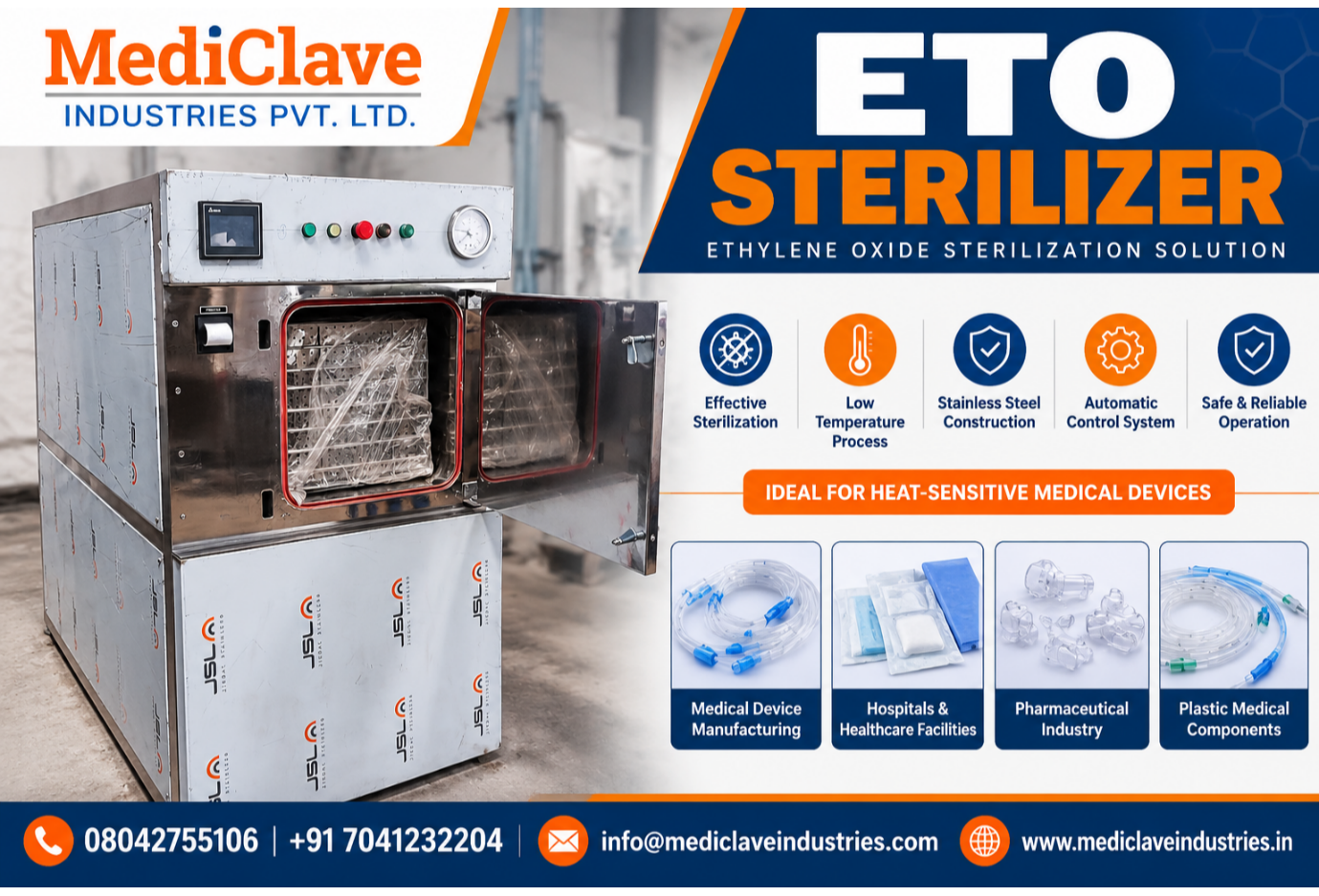
Sterilizer (Ethylene Oxide Sterilizer) is a low-temperature sterilization
system designed for compatible heat-sensitive and moisture-sensitive medical
devices and materials. It uses ethylene oxide gas under controlled conditions
to inactivate microorganisms, including bacterial spores.
Mediclave
Industries Private Limited, an ETO Sterilizer Manufacturer in India, offers
ethylene oxide sterilization equipment solutions for medical device
manufacturers, hospitals, pharmaceutical industries, and healthcare facilities.
Our ETO
sterilizer solutions are designed with a focus on controlled sterilization
processes, operational safety, durable construction, and customer-specific
equipment requirements.
What Is an ETO Sterilizer?
An ETO
Sterilizer is a specialized sterilization machine that uses ethylene oxide gas
to sterilize compatible medical devices and materials that cannot tolerate the
high temperatures associated with steam sterilization.
Ethylene
oxide penetrates many packaging materials and complex device structures, making
it useful for sterilizing certain packaged medical devices and products with
intricate geometries.
ETO
sterilization is widely used in the medical device industry for products such
as plastic medical components, tubing, catheters, and selected healthcare
accessories.
Unlike
conventional steam sterilizers, ETO sterilizers operate at relatively low
temperatures, helping protect suitable temperature-sensitive materials.
Explore
our sterilization
equipment solutions for pharmaceutical and healthcare applications.
Key Features of ETO Sterilizer
Mediclave
Industries offers ETO sterilization solutions with features and configurations
selected according to application requirements.
1. Low-Temperature Sterilization
ETO
sterilizers are designed for materials that may be damaged by high-temperature
steam sterilization.
2. Stainless Steel Sterilization Chamber
Stainless
steel chamber construction can provide durability, corrosion resistance, and
suitability for demanding industrial sterilization environments.
3. Automatic Control System
Depending
on the model, ETO sterilizers may include PLC-based controls, digital displays,
automated cycle sequencing, and process monitoring arrangements.
4. Temperature and Humidity Control
ETO
sterilization requires controlled temperature and humidity conditions to
support an effective validated sterilization process.
5. Vacuum and Gas Management System
Appropriate
vacuum, gas delivery, and evacuation systems help manage the sterilization
atmosphere and support controlled processing.
6. Safety and Monitoring Systems
ETO
sterilizers require engineered safety arrangements such as gas leak monitoring,
ventilation, door interlocks, alarms, and appropriate exhaust treatment
systems.
7. Multiple Chamber Capacities
Different
chamber capacities can be configured according to sterilization load dimensions,
production volume, and customer requirements.
8. Controlled Aeration Process
After
sterilization, compatible products must undergo validated aeration or degassing
to reduce residual ethylene oxide and related substances to acceptable limits.
How Does an ETO Sterilizer Work?
ETO
sterilization is a controlled process that uses ethylene oxide gas to
inactivate microorganisms on compatible products.
The
sterilization process generally includes the following stages:
- Product
Loading: Compatible medical devices and materials are placed inside the
sterilization chamber using appropriate packaging and loading
arrangements.
- Preconditioning:
Products may undergo controlled temperature and humidity conditioning to
prepare the load for sterilization.
- Air
Removal: The system establishes the required chamber conditions using the
equipment's validated process.
- ETO
Gas Introduction: Ethylene oxide gas is introduced into the chamber
through a controlled gas delivery system.
- Sterilization
Exposure: The products remain exposed to the sterilant under validated
temperature, humidity, gas concentration, and exposure-time conditions.
- Gas
Evacuation: Following exposure, ethylene oxide is removed through
controlled evacuation and gas-management processes.
- Aeration:
Products undergo validated aeration to reduce residual ethylene oxide and
related compounds.
- Product
Release: Sterilized products are released only after the applicable
process acceptance criteria and residual limits have been met.
Because
ethylene oxide is toxic, flammable, and carcinogenic, ETO sterilization must be
performed using appropriately engineered equipment, trained personnel,
validated processes, and compliant emission-control systems.
Applications of ETO Sterilizer
1.
Medical Device Manufacturing
ETO sterilization
is widely used for compatible disposable medical devices, catheters, tubing,
and packaged healthcare products.
2.
Hospitals and Healthcare Facilities
ETO
sterilizers can be used for selected heat-sensitive reusable medical devices
when permitted by device instructions and facility safety requirements.
3.
Pharmaceutical and Healthcare Industries
Used for
suitable healthcare components, packaging systems, and other compatible
products requiring validated low-temperature sterilization.
4.
Plastic Medical Components
Suitable
for certain plastic-based medical products that cannot withstand
high-temperature sterilization, subject to material compatibility and residual
testing.
Advantages of ETO Sterilizer
ETO
sterilization offers several advantages for suitable medical and industrial
applications.
- Low-temperature
processing: Suitable for many heat-sensitive medical devices.
- Material
compatibility: Can be used with selected plastics, polymers, and other
compatible materials.
- Packaging
penetration: Ethylene oxide can penetrate certain sterile-barrier
packaging systems.
- Complex
device sterilization: Useful for some devices containing lumens and
intricate components when validated.
- Flexible
chamber capacities: Systems can be selected for different production
volumes.
- Controlled
sterilization cycles: Advanced equipment can support automated monitoring
and process documentation.
- Industrial
applications: Suitable for validated medical device sterilization
workflows.
The
advantages of ETO sterilization must be considered alongside its longer
processing times, residual-management requirements, environmental controls, and
occupational safety obligations.
ETO Sterilizer vs. Steam Sterilizer
|
Feature |
ETO Sterilizer |
Steam Sterilizer |
|
Sterilization agent |
Ethylene oxide gas |
Saturated steam |
|
Temperature |
Relatively low |
Generally higher |
|
Heat-sensitive products |
Often suitable if compatible |
Often unsuitable |
|
Moisture-sensitive products |
May be suitable |
Often unsuitable |
|
Aeration requirement |
Essential |
Generally not required |
|
Processing time |
Often longer |
Generally shorter |
|
Main applications |
Medical devices, heat-sensitive products |
Surgical instruments, laboratory equipment |
|
Safety requirements |
Gas exposure and emission controls |
Pressure, heat, and steam controls |
Both
sterilization technologies serve important roles. The correct choice depends on
product materials, device instructions, sterilization validation requirements,
and applicable safety standards.
ETO Sterilizer Technical Specifications
The
following table describes typical technical parameters to evaluate when
selecting an ETO sterilizer. Final specifications depend on the selected model
and customer requirements.
|
Parameter |
Description |
|||
|
Product Name |
ETO Sterilizer |
|||
|
Sterilization Method |
Ethylene Oxide Gas |
|||
|
Chamber Material |
Stainless Steel, as specified |
|||
|
Chamber Capacity |
As per customer requirements |
|||
|
Operating Temperature |
Controlled low-temperature range |
|||
|
Control System |
PLC or other configured control system |
|||
|
Gas Management |
Controlled ETO delivery and evacuation |
|||
|
Humidity Control |
As required by validated process |
|||
|
Safety System |
Gas monitoring, interlocks and alarms |
|||
|
Aeration |
Validated aeration arrangement |
|||
|
Application |
Medical devices and compatible heat-sensitive
products |
|||
Note:
These are general selection parameters, not confirmed specifications for a
particular Mediclave model.
Why Choose Mediclave Industries for ETO Sterilizer?
Mediclave
Industries Private Limited provides sterilization equipment solutions for
medical device manufacturers, pharmaceutical industries, hospitals, and
healthcare facilities.
Our focus
includes:
- Quality-oriented
sterilization equipment manufacturing
- Customer-specific
chamber capacity options
- Stainless
steel equipment construction
- Industrial
sterilization equipment solutions
- Automatic
control system options
- Technical
consultation for equipment selection
- Equipment
configurations based on customer applications
We
understand that sterilization requirements vary according to product material,
packaging, production volume, and regulatory expectations.
Our
objective is to help customers identify suitable equipment configurations for
their specific sterilization applications.
Visit Mediclave Industries to
explore our pharmaceutical and hospital sterilization equipment solutions.
Important Factors to Consider Before Buying an ETO
Sterilizer
Before
purchasing an ETO sterilizer, customers should evaluate the following factors.
Chamber
Capacity: Select a chamber size based on product dimensions, packaging configuration,
and production requirements.
Material
Compatibility: Confirm that the intended medical devices and packaging
materials are compatible with ETO sterilization.
Process
Validation: Evaluate the requirements of ISO 11135 and other applicable
standards for the intended application.
Residual
Limits: Determine the necessary aeration and residual testing requirements,
including applicable ISO 10993-7 criteria.
Safety
Systems: Confirm appropriate gas detection, ventilation, interlocks, exhaust
treatment, and emergency arrangements.
Environmental
Compliance: Evaluate applicable requirements for ethylene oxide emissions, gas
storage, and workplace exposure.
Technical
Support: Consider equipment commissioning, documentation, maintenance, and
spare-part availability.
Choosing
the right ETO sterilizer is essential for supporting product quality, safe
operation, and reliable sterilization performance.
Conclusion
An ETO
Sterilizer is an important sterilization solution for heat-sensitive medical
devices, healthcare products, and selected pharmaceutical applications. Its
low-temperature sterilization capability and ability to penetrate compatible
packaging make it valuable for many medical device manufacturing processes.
Mediclave
Industries Private Limited offers ETO sterilization equipment solutions for
customers seeking suitable chamber capacities, controlled processing systems,
and application-specific configurations.
If you
are looking for an ETO Sterilizer Manufacturer in India, contact Mediclave
Industries to discuss equipment specifications, sterilization requirements, and
quotations.
Contact Mediclave Industries Private Limited
08042755106
| +91 7041232204
info@mediclaveindustries.com



