

Introduction
In modern
healthcare facilities, sterilization plays an essential role in infection
prevention, patient safety, and maintaining hygienic medical environments.
Hospitals use a wide range of reusable surgical instruments, medical equipment,
and healthcare accessories that must be properly cleaned, disinfected, and
sterilized before reuse.
A
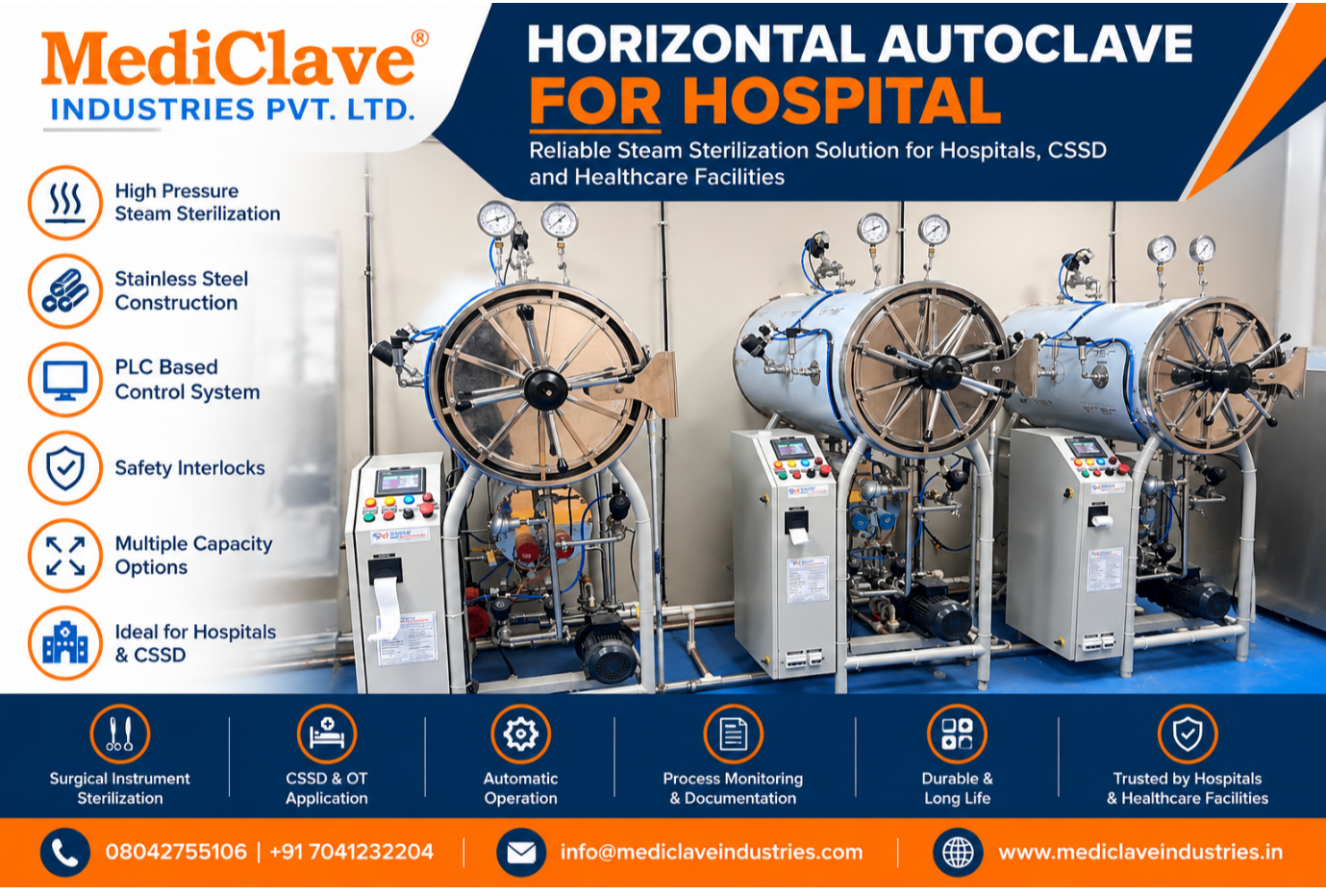
Horizontal Autoclave for Hospital is an important sterilization system used in
Central Sterile Supply Departments (CSSD), operation theatre support areas, and
medical instrument reprocessing facilities.
Mediclave
Industries Private Limited is a manufacturer of hospital sterilization
equipment in India, offering horizontal autoclaves designed to meet different
healthcare sterilization requirements.
Our
horizontal autoclave systems are intended to support reliable steam
sterilization, efficient instrument processing, and controlled operation.
Whether
you are establishing a new hospital, upgrading existing sterilization
equipment, or planning a modern CSSD department, selecting a suitable
horizontal autoclave is essential for safe and efficient healthcare operations.
What Is a Horizontal Autoclave for Hospital?
A
horizontal autoclave is a steam sterilization machine with a horizontally
oriented chamber designed to process compatible medical instruments and other
healthcare materials.
It uses
saturated steam under controlled temperature and pressure conditions to
inactivate microorganisms, including bacterial spores.
Horizontal
autoclaves are commonly used in hospitals because their chamber configuration
can accommodate instrument trays, surgical sets, and other suitable
sterilization loads.
These
machines are particularly useful for healthcare facilities requiring repeated
sterilization cycles and organized instrument processing.
Common Applications
- Surgical
instrument sterilization
- Hospital
CSSD sterilization
- Operation
theatre instrument processing
- Stainless
steel medical equipment sterilization
- Compatible
instrument tray sterilization
- Hospital
laboratory equipment sterilization
- Reusable
medical device sterilization
- Healthcare
instrument reprocessing
All loads
must be compatible with steam sterilization and processed using validated
cycles.
Why Choose Mediclave Industries for Horizontal
Hospital Autoclaves?
Selecting
a reliable horizontal autoclave manufacturer is important for hospital
equipment performance, sterilization quality, and long-term operational
efficiency.
Mediclave
Industries Private Limited offers sterilization equipment designed around
healthcare and industrial applications.
1. Application-Oriented Design
Our
horizontal autoclaves can be selected according to hospital workload, chamber
capacity, instrument dimensions, and sterilization requirements.
2. Stainless Steel Construction
Suitable
stainless steel construction supports equipment durability, cleanability, and
operation in demanding healthcare environments.
3. Temperature and Pressure Monitoring
Horizontal
autoclaves incorporate monitoring arrangements to help operators maintain and
verify the required sterilization conditions.
4. Automated Control Options
Depending
on the selected configuration, PLC-based control systems can support automated
sterilization cycles and process monitoring.
5. Safety-Focused Features
Appropriate
pressure protection, door interlocks, and other safety mechanisms are important
for hospital steam sterilizers.
6. Different Chamber Capacities
Horizontal
autoclaves are available in different chamber configurations to suit the
processing requirements of small, medium, and large healthcare facilities.
For more
information, visit Mediclave Industries Private Limited.
Working Principle of a Horizontal Autoclave
A
horizontal autoclave works by exposing compatible instruments and materials to
saturated steam under controlled conditions.
The
combination of steam temperature, exposure duration, and effective air removal
enables the sterilization process to achieve the required microbial
inactivation.
A typical
horizontal autoclave cycle involves the following stages.
Step 1:
Loading
Cleaned,
inspected, and appropriately packaged instruments are loaded into the
sterilization chamber according to the validated loading pattern.
Step 2:
Air Removal
Air is
removed from the chamber using the process appropriate to the sterilizer design
and load type. This helps steam contact the required surfaces.
Step 3:
Steam Admission
Saturated
steam enters the chamber and raises the load temperature to the required
sterilization conditions.
Step 4:
Sterilization Holding Period
The
sterilizer maintains the validated sterilization conditions for the specified
exposure duration.
Step 5:
Exhaust and Drying
After
exposure, the chamber undergoes controlled exhaust and, where applicable, a
drying phase.
Step 6:
Unloading
After the
cycle is completed and safe unloading conditions are achieved, trained
operators remove the processed instruments.
The
required temperature, exposure time, drying conditions, and loading
configuration depend on the validated cycle and medical device instructions.
Technical Features of Horizontal Autoclave for
Hospital
Hospital
horizontal autoclaves can incorporate various technical features according to
the selected model and equipment specifications.
|
Technical Feature |
Description |
|
Chamber Orientation |
Horizontal |
|
Sterilization Method |
Saturated steam |
|
Chamber Material |
Suitable stainless steel grade |
|
Control System |
Manual or automatic options |
|
Temperature Monitoring |
Process temperature measurement |
|
Pressure Monitoring |
Chamber pressure indication |
|
Door Configuration |
Single-door or double-door options |
|
Safety Features |
Appropriate interlocks and pressure protection |
|
Cycle Recording |
Optional process documentation system |
|
Chamber Capacity |
Application-specific sizes |
|
Drying System |
According to equipment configuration |
|
Applications |
Hospital CSSD and medical instrument processing |
Actual
equipment specifications should be confirmed through the manufacturer's
technical datasheet.
Applications of Horizontal Autoclaves in Hospitals
Central Sterile Supply Department (CSSD)
Horizontal
autoclaves are widely used in CSSD departments for processing reusable medical
instruments.
They
support structured sterilization workflows and help hospitals maintain
instrument availability for clinical procedures.
Operation Theatre Instrument Processing
Surgical
instruments used in operation theatres must undergo appropriate reprocessing
before reuse.
Horizontal
autoclaves are suitable for many heat- and moisture-resistant surgical
instruments when operated according to validated procedures.
Multispecialty Hospitals
Large
hospitals require reliable sterilization equipment to handle instruments used
across multiple departments.
Horizontal
autoclaves can support repeated processing cycles and larger instrument loads.
Medical Colleges and Teaching Hospitals
Teaching
hospitals require sterilization equipment for clinical departments, training
facilities, and associated laboratories.
Healthcare and Surgical Centers
Specialized
surgical centers may use horizontal autoclaves for compatible reusable
instruments based on procedure volume and instrument turnaround requirements.
Advantages of Horizontal Autoclave for Hospital
Horizontal
autoclaves offer several operational benefits for healthcare facilities.
- Suitable
chamber configuration: Horizontal loading supports instrument trays and
larger compatible loads.
- Effective
steam sterilization: Validated cycles can achieve the required
sterilization performance.
- Multiple
capacity options: Equipment can be selected according to hospital
workload.
- Automated
operation: Selected configurations support automatic process control.
- Process
monitoring: Temperature, pressure, and cycle records support sterilization
quality assurance.
- CSSD
integration: Single-door and double-door arrangements can support
different department layouts.
- Durable
construction: Suitable materials and maintenance help support long-term
equipment operation.
Horizontal Autoclave vs Vertical Autoclave for
Hospital
Both
horizontal and vertical autoclaves use steam sterilization, but their chamber
designs and typical applications differ.
|
Feature |
Horizontal Autoclave |
Vertical Autoclave |
|
Chamber Design |
Horizontal |
Vertical |
|
Loading Direction |
Front loading |
Top loading |
|
Typical Application |
CSSD and larger instrument loads |
Smaller laboratory and selected healthcare loads |
|
Chamber Capacity |
Wide range, including large capacities |
Commonly compact capacities |
|
Loading Convenience |
Suitable for trays and carts |
Suitable for smaller loads |
|
Installation Space |
Depends on model and access needs |
Often compact footprint |
|
Automation |
Available depending on model |
Available depending on model |
For
hospitals processing large volumes of reusable surgical instruments, a properly
specified horizontal autoclave may be more suitable than a small vertical
autoclave.
How to Choose the Best Horizontal Autoclave for
Hospital
Before
purchasing a horizontal autoclave, hospital administrators, biomedical
engineers, and CSSD consultants should evaluate the following factors.
Chamber Capacity
Determine
the required chamber size based on daily instrument volume, tray dimensions,
processing frequency, and expected future demand.
Sterilization Cycle Requirements
Confirm
that the machine supports validated cycles suitable for the instruments and
packaging systems used by the hospital.
Equipment Construction
Review
chamber material, insulation, door design, piping, and other technical
specifications.
Control and Monitoring
Evaluate
automatic controls, cycle recording, alarm systems, and process monitoring
requirements.
Safety Features
Confirm
appropriate door interlocks, pressure protection, emergency procedures, and
compliance with applicable safety requirements.
Maintenance and Technical Support
Review
installation requirements, preventive maintenance arrangements, operator
training, and spare parts availability.
Horizontal Autoclave Safety and Sterilization Standards
Sterilization
effectiveness depends on the correct combination of equipment performance,
process validation, routine monitoring, and trained personnel.
Relevant
requirements may include ISO 17665 for moist heat sterilization, applicable
medical device reprocessing guidelines, pressure equipment regulations, and
hospital infection-control procedures.
Healthcare
facilities should maintain documented procedures for:
- Installation
qualification (IQ)
- Operational
qualification (OQ)
- Performance
qualification (PQ)
- Routine
cycle monitoring
- Biological
and chemical indicator use where applicable
- Equipment
calibration and maintenance
- Periodic
requalification
- Sterilization
recordkeeping
Correct
instrument cleaning before sterilization is essential. Steam sterilization does
not replace the cleaning and inspection stages of medical device reprocessing.
Horizontal Autoclave Manufacturer in India for
Hospital Projects
India's
healthcare sector requires dependable sterilization equipment for new
hospitals, medical colleges, surgical centers, and existing healthcare
facilities.
Mediclave
Industries Private Limited offers horizontal autoclave equipment options for
customers planning new sterilization installations or replacing older systems.
Hospital
buyers should consider the complete installation requirements, including steam
supply, electrical utilities, drainage, ventilation, loading access, and CSSD
workflow.
Visit our
official website to
explore our hospital sterilization equipment solutions.
Horizontal Autoclave Price in India
The price
of a horizontal autoclave depends on several technical and commercial factors.
These
include chamber capacity, construction material, control system, door
configuration, steam generation arrangement, automation features, and
additional documentation requirements.
Single-door
and double-door systems may also have different installation and operational
requirements.
For
accurate pricing, hospitals should provide the intended application, chamber
capacity, required technical features, and project location when requesting a
quotation.
Why Quality Hospital Sterilization Equipment
Matters
Reliable
sterilization equipment is an important investment in hospital infrastructure.
A
properly selected, validated, and maintained horizontal autoclave can help
healthcare facilities improve instrument processing consistency, support
infection prevention programs, and maintain efficient CSSD operations.
Hospitals
should prioritize equipment suitability, safety, documentation, and long-term
service requirements when making purchasing decisions.
Conclusion
If you
are looking for a Horizontal Autoclave for Hospital, Mediclave Industries
Private Limited offers horizontal steam sterilization equipment for CSSD departments,
surgical instrument processing, and healthcare applications.
Our
sterilization equipment portfolio is designed to address different hospital
requirements, from compact healthcare facilities to larger sterilization
departments.
Selecting
the right horizontal autoclave helps support reliable instrument reprocessing,
effective sterilization workflows, and patient safety.
Contact
Mediclave Industries today to discuss your hospital horizontal autoclave
requirements and request a quotation.
Contact Mediclave Industries Private Limited
MEDICLAVE
INDUSTRIES PRIVATE LIMITED
08042755106
| +91 7041232204
info@mediclaveindustries.com



