
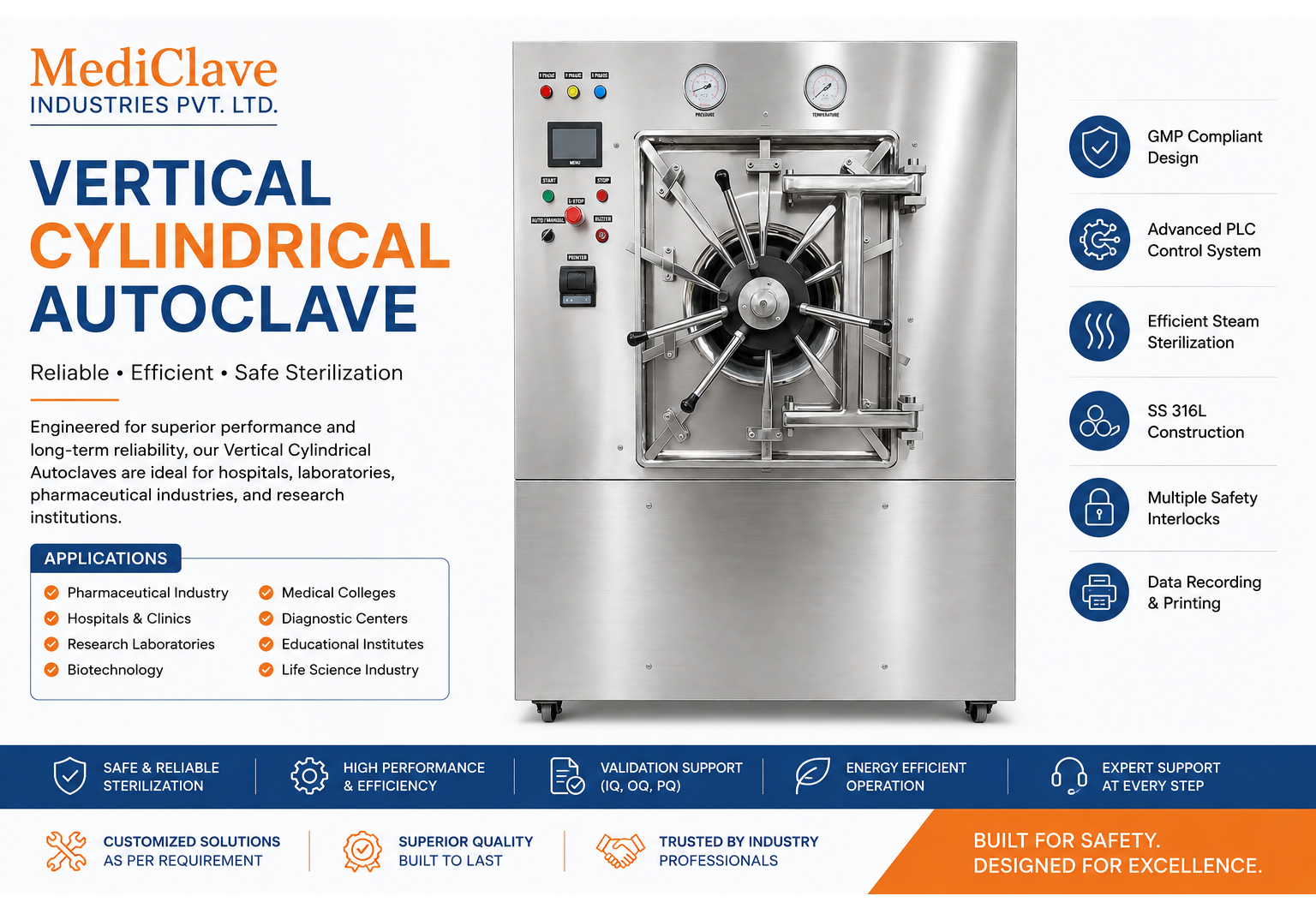
Horizontal Rectangular Autoclave: The Complete Guide to High-Capacity Sterilization
Introduction
Sterilization is a critical process in pharmaceutical manufacturing, healthcare facilities, biotechnology laboratories, research centers, and medical device production units. Among the various sterilization equipment available today, the Horizontal Rectangular Autoclave stands out as one of the most efficient and reliable solutions for large-volume sterilization requirements.
Designed to handle bulk loads and continuous sterilization operations, Horizontal Rectangular Autoclaves are widely used in hospitals, CSSD departments, pharmaceutical industries, microbiology laboratories, and healthcare institutions. Their robust construction, large chamber capacity, and advanced automation make them an essential part of modern sterilization infrastructure.
This article explores the working principle, features, applications, benefits, and selection criteria of Horizontal Rectangular Autoclaves.
What is a Horizontal Rectangular Autoclave?
A Horizontal Rectangular Autoclave is a high-capacity steam sterilizer designed with a horizontally positioned rectangular chamber that allows efficient loading and sterilization of various instruments, equipment, garments, glassware, and other materials.
The sterilization process utilizes saturated steam under controlled temperature and pressure conditions to eliminate bacteria, viruses, fungi, spores, and other microorganisms.
Unlike vertical autoclaves, horizontal rectangular models are specifically engineered for institutions requiring large-scale sterilization with maximum productivity and operational efficiency.
Why Horizontal Rectangular Autoclaves are Important
In industries where sterility is mandatory, even minor contamination can lead to product rejection, operational delays, financial losses, or patient safety risks.
Horizontal Rectangular Autoclaves help organizations by:
Ensuring complete sterilization of critical materials
Supporting regulatory compliance requirements
Increasing sterilization capacity
Improving workflow efficiency
Reducing contamination risks
Maintaining product quality and safety
Enhancing operational productivity
These advantages make them indispensable in high-volume sterilization environments.
Working Principle of Horizontal Rectangular Autoclave
1. Loading of Materials
The sterilization load is placed inside the rectangular chamber using trays, trolleys, racks, or loading carts.
2. Chamber Sealing
The door is securely locked using manual, semi-automatic, or fully automatic locking mechanisms to ensure airtight operation.
3. Air Removal
Air present inside the chamber is removed using gravity displacement or vacuum-assisted systems.
Effective air removal is essential because trapped air can reduce sterilization efficiency.
4. Steam Injection
Pure steam or clean steam enters the chamber and surrounds the load uniformly.
The steam transfers thermal energy directly to the materials being sterilized.
5. Sterilization Phase
The chamber maintains a predefined temperature and pressure for a validated sterilization cycle.
Typical sterilization temperatures include:
121°C
126°C
134°C
These temperatures effectively destroy microorganisms and bacterial spores.
6. Drying Process
After sterilization, vacuum drying removes residual moisture from the load.
7. Unloading
The sterilized materials are removed and transferred for storage or immediate use.
Key Features of Horizontal Rectangular Autoclaves
Large Capacity Chamber
Designed for high-volume sterilization requirements.
Stainless Steel Construction
Manufactured using SS304 and SS316L stainless steel for durability and corrosion resistance.
Advanced PLC Control System
Provides accurate monitoring and control of sterilization cycles.
Touch Screen HMI Interface
Allows easy operation and real-time process monitoring.
Automatic Safety Systems
Includes pressure protection, temperature monitoring, and emergency safety features.
Vacuum Drying System
Ensures dry and ready-to-use sterilized materials.
GMP-Compliant Design
Supports pharmaceutical and healthcare regulatory requirements.
Data Recording and Printing
Cycle reports can be stored, printed, and used for validation documentation.
Types of Horizontal Rectangular Autoclaves
Single Door Horizontal Rectangular Autoclave
Suitable for laboratories, hospitals, and industrial applications where pass-through sterilization is not required.
Applications
Hospitals
Laboratories
Research Centers
Manufacturing Units
Double Door Horizontal Rectangular Autoclave
Designed for cleanroom and sterile production environments.
The double-door configuration prevents cross-contamination between sterile and non-sterile areas.
Applications
Pharmaceutical Industries
Biotechnology Facilities
Injectable Manufacturing Plants
Cleanroom Operations
Vaccine Production Units
Applications of Horizontal Rectangular Autoclaves
Horizontal Rectangular Autoclaves are widely used across multiple industries.
Pharmaceutical Industry
Sterilization of:
Production equipment
Containers
Components
Garments
Process accessories
Hospitals and CSSD
Sterilization of:
Surgical instruments
Linen
Dressing materials
Medical tools
Biotechnology Industry
Sterilization of laboratory equipment and process components.
Research Laboratories
Sterilization of glassware, media, and laboratory accessories.
Medical Device Manufacturing
Sterilization of components before packaging and distribution.
Benefits of Horizontal Rectangular Autoclaves
High Productivity
Large chamber volume enables sterilization of bulk loads in a single cycle.
Reliable Sterilization
Ensures consistent and validated sterilization performance.
Reduced Operational Costs
Higher capacity reduces the number of sterilization cycles required.
Improved Workflow
Faster turnaround times improve overall operational efficiency.
Enhanced Safety
Multiple safety interlocks protect both operators and equipment.
Long Service Life
Heavy-duty construction ensures reliable long-term operation.
Regulatory Compliance
Supports GMP, FDA, WHO-GMP, and international sterilization standards.
Important Parameters in Sterilization
Several factors influence sterilization effectiveness:
Temperature
Higher temperatures reduce sterilization time.
Pressure
Maintains steam saturation and penetration efficiency.
Exposure Time
Ensures complete destruction of microorganisms.
Steam Quality
High-quality steam improves sterilization consistency.
Load Configuration
Proper loading allows uniform steam circulation.
Industries That Commonly Use Horizontal Rectangular Autoclaves
Pharmaceutical Manufacturing
Biotechnology Companies
Hospitals
Medical Colleges
Research Institutions
Vaccine Manufacturing Facilities
Medical Device Industries
Diagnostic Laboratories
Healthcare Organizations
Life Science Industries
How to Choose the Right Horizontal Rectangular Autoclave
Before selecting an autoclave, consider:
Chamber Capacity
Match chamber size with sterilization demand.
Door Configuration
Choose between single-door or double-door systems.
Automation Level
Select manual, semi-automatic, or fully automatic models.
Utility Requirements
Evaluate steam, water, power, and compressed air availability.
Compliance Requirements
Ensure compatibility with GMP and validation standards.
Future Expansion
Consider future production growth when determining capacity.
Why Choose Mediclave Industries?
Mediclave Industries manufactures high-performance Horizontal Rectangular Autoclaves engineered for pharmaceutical, healthcare, biotechnology, and industrial sterilization applications.
Our systems are designed with:
GMP-compliant construction
Advanced PLC automation
Reliable sterilization performance
Energy-efficient operation
Validation-ready documentation
Customized chamber capacities
Robust safety systems
With a commitment to quality, innovation, and customer satisfaction, Mediclave Industries provides sterilization solutions trusted by healthcare and pharmaceutical professionals.
Conclusion
A Horizontal Rectangular Autoclave is one of the most dependable and efficient sterilization systems available for large-scale applications. Its high capacity, advanced automation, reliable performance, and regulatory compliance make it a preferred choice for pharmaceutical industries, hospitals, laboratories, and biotechnology facilities.
Organizations looking to enhance sterilization efficiency, improve safety, and maintain regulatory compliance can significantly benefit from investing in a high-quality Horizontal Rectangular Autoclave.
By choosing a trusted manufacturer like Mediclave Industries, businesses can ensure long-term reliability, superior sterilization performance, and operational excellence.