

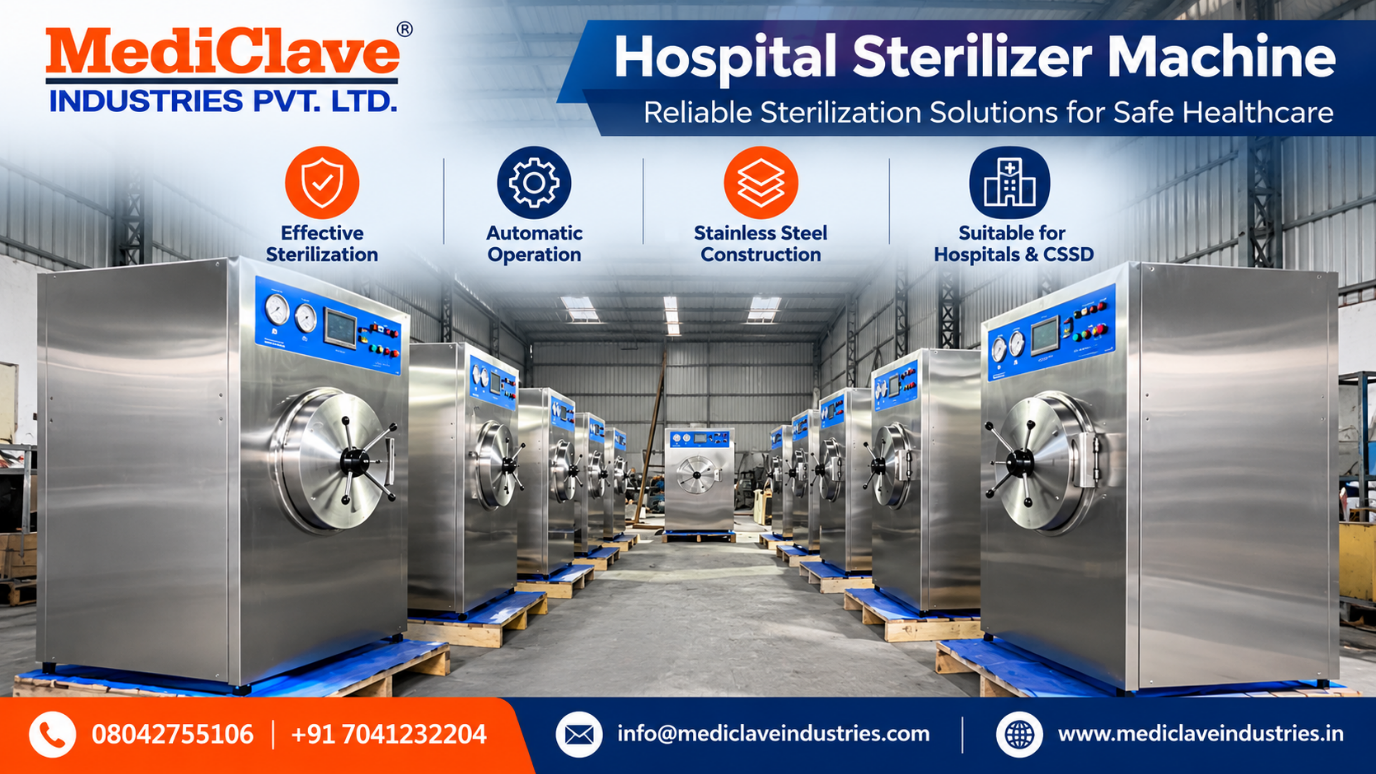
In the healthcare
industry, maintaining a clean and sterile environment is essential for patient
safety and infection prevention. Every day, hospitals use hundreds of surgical
instruments, medical devices, and reusable healthcare tools that require proper
cleaning and sterilization before they can be safely used again. This is where
a Hospital Sterilizer Machine plays a crucial role.
A
hospital sterilizer machine is designed to eliminate microorganisms, including
bacteria, viruses, fungi, and bacterial spores, through a suitable
sterilization process. These machines are widely used in hospitals, nursing
homes, surgical centers, dental clinics, and Central Sterile Supply Departments
(CSSD).
As
healthcare facilities continue to focus on patient safety and efficient instrument
reprocessing, reliable sterilization equipment has become an important part of
hospital infrastructure.
Mediclave
Industries Private Limited, a hospital sterilization equipment manufacturer in
India, provides sterilization solutions for healthcare facilities with
different operational requirements. Our focus is on supplying practical,
durable, and efficient sterilization equipment that supports modern healthcare
operations.
What Is a Hospital Sterilizer Machine?
A
Hospital Sterilizer Machine is specialized equipment used to sterilize reusable
medical instruments and other compatible healthcare materials through
controlled physical or chemical processes.
Sterilization
differs from routine cleaning and disinfection. While cleaning removes visible
contamination and organic material, sterilization is intended to destroy viable
microorganisms, including resistant bacterial spores.
In
hospitals, sterilization is particularly important for surgical instruments and
other critical medical devices that come into contact with sterile tissues or
the vascular system.
Different
sterilization methods are available depending on the instrument material,
intended application, and manufacturer's reprocessing instructions.
Among
these methods, steam sterilization is commonly preferred for heat- and
moisture-resistant medical instruments because it is effective, widely
established, and suitable for routine hospital applications.
Types of Hospital Sterilizer Machines
Hospitals
require different sterilization systems based on instrument types, processing
capacity, and clinical requirements.
1. Horizontal Autoclave Sterilizer
Horizontal
autoclaves are widely used in hospital CSSD departments, operation theatres,
and large healthcare institutions.
These
machines generally feature a horizontally positioned sterilization chamber that
allows convenient loading and unloading of instrument trays and compatible
medical equipment.
Horizontal
autoclaves are suitable for hospitals that process a significant volume of
reusable surgical instruments every day.
2. Vertical Autoclave Sterilizer
Vertical
autoclaves feature an upright chamber with top-loading access. They are
commonly used in laboratories, smaller healthcare facilities, and applications
involving suitable reusable instruments and laboratory materials.
Their
compact construction makes them practical where available installation space is
limited.
3. ETO Sterilizer Machine
Ethylene
Oxide (ETO) sterilizers are designed for certain medical devices that cannot
tolerate high-temperature steam sterilization.
ETO
sterilization can be suitable for compatible heat- and moisture-sensitive
instruments, including selected plastic and electronic medical components.
Because
ethylene oxide is hazardous, these systems require controlled operation,
appropriate ventilation, aeration, and safety procedures.
4. Saturated Steam Sterilizer
Saturated
steam sterilizers use steam under controlled pressure and temperature
conditions to achieve sterilization.
These
machines are commonly used for compatible surgical instruments, stainless steel
medical equipment, and other reusable hospital items.
The
correct cycle parameters depend on the sterilizer design, validated load
configuration, and medical device manufacturer's instructions.
Key Features of a Modern Hospital Sterilizer
Machine
A modern
hospital sterilizer should support reliable processing, convenient operation,
and effective monitoring.
Depending
on the selected model, sterilization equipment may include:
- Stainless
Steel Construction: Durable chamber construction suitable for demanding
healthcare environments.
- Automatic
Control System: PLC- or microprocessor-based controls for managing
sterilization parameters.
- Digital
Monitoring: Display of temperature, pressure, cycle progress, and operating
status.
- Safety
Interlocks: Protection systems designed to prevent unsafe door operation.
- Programmable
Cycles: Cycle selection according to compatible loads and validated
sterilization requirements.
- Process
Documentation: Optional cycle printers or electronic recording systems for
traceability.
- Efficient
Loading Design: Suitable chamber arrangements for processing medical
instruments and trays.
- Pressure
and Temperature Protection: Monitoring and safety mechanisms to support
controlled operation.
The availability
of individual features depends on the equipment configuration and technical
specifications.
Applications of Hospital Sterilizer Machines
Hospital
sterilizers support a wide range of healthcare applications.
Operation
Theatres: Sterilization of compatible surgical instruments, forceps, scissors,
clamps, and reusable operating equipment.
CSSD
Departments: Centralized processing of reusable medical instruments before
distribution to hospital departments.
Dental
Clinics: Sterilization of reusable dental instruments and compatible
accessories.
Medical
Laboratories: Sterilization of suitable laboratory instruments, glassware, and
materials.
Nursing
Homes: Routine instrument sterilization for compatible reusable medical
equipment.
Multispecialty
Hospitals: Sterilization support for departments with different instrument
processing requirements.
Not all
medical devices are suitable for the same sterilization method. Facilities must
follow validated cycles and instrument-specific reprocessing instructions.
Benefits of Using a Hospital Sterilizer Machine
Improved Infection Prevention
Effective
sterilization helps reduce the risk of transmitting infections through
contaminated reusable medical instruments. It forms an essential part of a
hospital's broader infection prevention program.
Efficient Instrument Processing
Appropriate
chamber capacity and automatic cycle controls can help hospitals manage
instrument processing workloads more efficiently.
Consistent Sterilization Processes
Validated
sterilization cycles and routine monitoring support repeatable processing
outcomes.
Better Documentation
Sterilizers
equipped with recording systems can help healthcare facilities maintain cycle
documentation for quality management and traceability.
Long-Term Operational Value
A
properly selected sterilizer, supported by preventive maintenance and operator
training, can provide reliable service over its operational life.
How to Choose the Right Hospital Sterilizer Machine
Choosing
the right sterilizer is an important decision for any healthcare institution.
Hospitals
should consider their daily instrument workload, available space, sterilization
requirements, and operational budget.
Chamber
Capacity: Select equipment with sufficient capacity for the expected number and
size of instrument loads.
Sterilization
Method: Confirm whether the instruments require steam sterilization or another
compatible technology.
Automation:
Consider the benefits of automatic controls, cycle monitoring, and process
documentation.
Safety
Systems: Review door interlocks, alarms, pressure protection, and other safety
features.
Installation
Requirements: Evaluate water, steam, electricity, ventilation, drainage, and
space requirements as applicable.
Service
and Maintenance: Consider the availability of technical support, spare parts,
preventive maintenance, and operator training.
A
suitable hospital sterilizer should be selected based on actual processing
requirements rather than chamber capacity or price alone.
Why Hospital Sterilization Is Important for CSSD
Departments
The
Central Sterile Supply Department (CSSD) is responsible for processing reusable
medical instruments used throughout a hospital.
A
well-organized CSSD workflow includes instrument collection, cleaning,
inspection, packaging, sterilization, and sterile storage.
Hospital
sterilizer machines are essential to this process because they allow healthcare
facilities to sterilize compatible medical instruments under controlled
conditions.
For
hospitals with high instrument processing requirements, horizontal autoclaves
are particularly useful because their chamber designs can accommodate
instrument trays and larger loads.
Mediclave
Industries offers a range of hospital CSSD
equipment and autoclave solutions for healthcare applications.
Why Choose Mediclave Industries for Hospital
Sterilizer Machines?
Mediclave
Industries Private Limited is an Ahmedabad-based manufacturer and supplier of
hospital sterilization equipment, pharmaceutical sterilization systems, and
healthcare processing solutions.
Our
hospital sterilization equipment range includes horizontal cylindrical
high-pressure steam sterilizers, horizontal rectangular autoclaves, vertical
autoclaves, and ETO sterilizers.
We
understand that every healthcare facility has different sterilization
requirements. Whether a hospital requires equipment for routine surgical
instrument processing or a larger sterilization system for its CSSD department,
selecting the appropriate technology and capacity is essential.
Customers
can explore our hospital sterilization
equipment range and learn more about our ETO sterilizer
solutions.
Frequently Asked Questions (FAQs)
1. What is a hospital sterilizer
machine used for?
A
hospital sterilizer machine is used to sterilize compatible reusable surgical
instruments, medical devices, laboratory equipment, and other healthcare
materials.
2. Which sterilizer is best for
hospitals?
The best
sterilizer depends on instrument compatibility, workload, chamber capacity, and
the hospital's reprocessing requirements. Horizontal steam autoclaves are
commonly used in CSSD departments.
3. What temperature is used in
hospital autoclaves?
Common
steam sterilization temperatures include 121°C and 132–134°C. The required
exposure time depends on the validated sterilization cycle and load.
4. What is the difference between
a horizontal and vertical autoclave?
Horizontal
autoclaves feature front-loading chambers and are often suitable for larger
instrument loads. Vertical autoclaves use top-loading chambers and are commonly
selected for smaller-scale applications.
5. What is the price of a
hospital sterilizer machine in India?
The price
depends on chamber size, sterilization technology, automation, safety features,
and optional accessories. Customers can contact Mediclave Industries for a
quotation based on their requirements.
Conclusion
A
Hospital Sterilizer Machine is an essential part of modern healthcare
infrastructure. Reliable sterilization equipment supports patient safety,
effective instrument reprocessing, and organized hospital operations.
Whether a
healthcare facility requires a horizontal autoclave, vertical steam sterilizer,
or specialized ETO sterilization system, choosing suitable equipment is
important for maintaining consistent sterilization practices.
Mediclave
Industries Private Limited provides sterilization equipment solutions for
hospitals, CSSD departments, laboratories, and healthcare institutions.
Visit Mediclave Industries to
explore our product range and discuss your sterilization equipment
requirements.
Contact Mediclave Industries Private Limited
Hospital
Sterilizer Machine Manufacturer & Supplier in India
08042755106
| +91 7041232204
info@mediclaveindustries.com
Ahmedabad,
Gujarat, India



