

How Does a Liquid Manufacturing Vessel With Magnetic Stirrer Improve Injectable Pharmaceutical Production?
In pharmaceutical manufacturing, producing a high-quality injectable medicine requires much more than simply mixing ingredients in a tank. Injectable products must be prepared under carefully controlled conditions where sterility, uniformity, temperature, contamination control, and process consistency are all extremely important. Because injectable medicines are administered directly into the human body, pharmaceutical manufacturers need specialized equipment that can support safe, hygienic, and repeatable production.
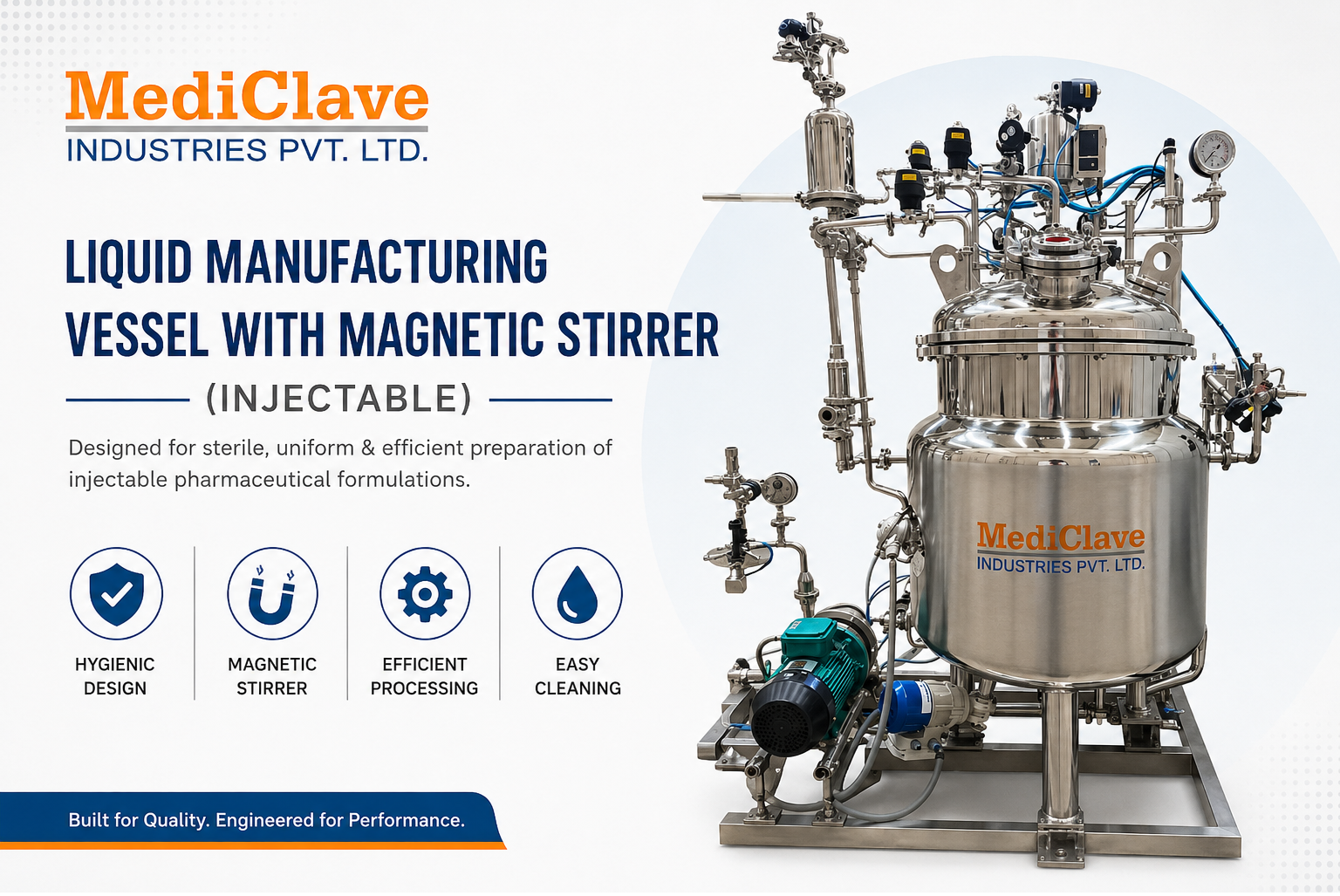
One of the most important pieces of equipment used for this purpose is the Liquid Manufacturing Vessel With Magnetic Stirrer (Injectable). This advanced pharmaceutical process vessel is designed to provide controlled mixing of sterile liquid formulations while reducing contamination risks associated with conventional mechanical stirring systems.
A modern injectable manufacturing vessel can combine several important functions in one system, including liquid preparation, magnetic mixing, heating, cooling, sterile processing, CIP, SIP, and automated process monitoring. This makes it an important part of pharmaceutical, biotechnology, vaccine, IV fluid, and sterile formulation manufacturing facilities.
Mediclave Industries manufactures the Injectable Liquid Manufacturing Vessel With Magnetic Stirrer, designed for applications where hygienic construction, controlled mixing, and sterile processing are essential.
What Is a Liquid Manufacturing Vessel With Magnetic Stirrer?
A Liquid Manufacturing Vessel With Magnetic Stirrer is a specialized pharmaceutical processing vessel used for preparing, dissolving, mixing, heating, cooling, and processing liquid pharmaceutical formulations.
Unlike a conventional mixing vessel that may use a shaft-driven agitator passing through the vessel wall, a magnetic stirring system uses magnetic coupling to transfer rotational movement to the internal impeller. This seal-less arrangement helps reduce the possibility of leakage and contamination.
The vessel is generally manufactured using pharmaceutical-grade stainless steel, particularly SS 316L for product-contact surfaces. Its hygienic construction, smooth internal finish, sanitary connections, and controlled operating environment make it suitable for sterile liquid manufacturing.
Depending on the manufacturing requirement, the vessel can be customized with features such as:
Magnetic stirring system
Heating and cooling jacket
CIP spray ball
SIP capability
PLC-based automation
HMI touchscreen
Temperature monitoring
Pressure monitoring
Level measurement
Sampling valve
Sight glass
Load cells
Vacuum system
Sterile filtration connections
Sanitary Tri-Clamp fittings
The exact configuration can be selected according to the formulation, batch size, production process, and facility requirements.
Why Is Specialized Equipment Important for Injectable Manufacturing?
Injectable manufacturing demands a high level of process control. Unlike many non-sterile pharmaceutical products, injectable formulations require strict attention to contamination control because the finished product may be administered directly into the body.
A manufacturing vessel therefore needs to do more than hold liquid. It must help maintain a controlled and hygienic environment throughout the production process.
Poorly designed equipment can create challenges such as:
Inconsistent mixing
Product residues inside the vessel
Difficult cleaning
Potential contamination points
Temperature variations
Product loss during discharge
Increased manual intervention
Longer cleaning cycles
Higher maintenance requirements
A properly designed injectable liquid manufacturing vessel helps address these challenges through hygienic construction, controlled agitation, automated monitoring, and compatibility with cleaning and sterilization systems.
The objective is simple: prepare every batch consistently while maintaining the required level of cleanliness and process control.
How Does the Magnetic Stirrer Work?
The magnetic stirrer is one of the most important features of this type of manufacturing vessel.
In a conventional agitator, the motor is connected to a shaft that extends into the vessel. Mechanical seals are required where the shaft enters the vessel. In sterile applications, these seals can become an important point requiring careful maintenance and monitoring.
A magnetic stirring system works differently.
The drive mechanism remains outside the product-contact area. Magnetic coupling transfers rotational force to an internal impeller. As the external motor rotates, the magnetic assembly causes the internal stirring element to rotate.
This creates an effective mixing process while maintaining a closed and hygienic product-contact environment.
The major advantages include:
Reduced contamination risk: The seal-less design minimizes potential contamination pathways.
Leak-resistant operation: There is no conventional rotating shaft passing through the vessel wall.
Uniform mixing: The magnetic stirrer provides controlled movement of the liquid throughout the batch.
Lower maintenance: The design can reduce the maintenance requirements associated with traditional shaft seals.
Suitable for sterile processing: The closed arrangement is particularly valuable for injectable and aseptic manufacturing.
Mediclave's vessel specification includes a bottom-mounted magnetic stirrer with seal-less design and variable stirring speed, allowing manufacturers to select operating conditions according to their formulation requirements.
How Does the Injectable Liquid Manufacturing Process Work?
Although the exact manufacturing procedure varies from product to product, a typical process using an injectable liquid manufacturing vessel can involve several controlled stages.
First, the vessel is cleaned and prepared for the manufacturing batch. Where the facility uses automated cleaning and sterilization, the vessel can be integrated with CIP and SIP systems.
Next, purified water or Water for Injection is charged into the vessel according to the approved batch formula. Pharmaceutical ingredients are then added in the required sequence.
The magnetic stirrer operates at the selected speed to promote uniform mixing and dissolution. Depending on the formulation, the jacket may be used for controlled heating or cooling.
During the process, temperature, pressure, level, and mixing speed can be monitored. After the required formulation conditions are achieved, the liquid may undergo sterile filtration before being transferred to the next stage of production.
The complete process is designed around one major objective: consistent and controlled preparation of the formulation while minimizing contamination risks.
What Role Does WFI Play in Injectable Manufacturing?
Water quality is a major consideration in injectable production. Water used for critical pharmaceutical applications must meet the required pharmaceutical quality specifications.
Water for Injection, commonly called WFI, is widely used in injectable manufacturing processes. A pharmaceutical facility may therefore require an appropriate water-generation system alongside its manufacturing vessel.
Mediclave Industries offers a Multi Column Distillation Plant designed for pharmaceutical WFI production. Multiple-effect distillation allows the system to produce high-purity water while improving thermal efficiency through heat reuse.
For an injectable manufacturing facility, the relationship between the water system and process vessel is important. High-quality process equipment can perform effectively only when the supporting utilities are appropriately designed and maintained.
Why Is Pure Steam Important?
Sterile pharmaceutical manufacturing often requires reliable clean or pure steam for equipment sterilization and SIP operations.
A Pure Steam Generator can provide pharmaceutical-grade steam for applications such as sterilizing manufacturing vessels, pipelines, tanks, and other product-contact equipment. Mediclave's Pure Steam Generator systems are designed for pharmaceutical and biotechnology applications and can be integrated into sterile manufacturing facilities.
For example, before starting a sterile manufacturing batch, the process equipment may need to undergo an appropriate sterilization cycle. Pure steam can be supplied to the equipment through an SIP arrangement, helping prepare the equipment for sterile production.
This is why an injectable manufacturing vessel should not always be viewed as an isolated machine. In a modern pharmaceutical plant, it can form part of a larger integrated process system involving WFI, pure steam, CIP/SIP, filtration, storage, transfer, and filling equipment.
What Are CIP and SIP and Why Do They Matter?
Cleaning and sterilization are essential parts of pharmaceutical manufacturing.
CIP means Clean-In-Place. It allows internal surfaces of tanks, vessels, pipelines, and process equipment to be cleaned without dismantling the equipment.
SIP means Sterilize-In-Place. It uses clean or pure steam to sterilize the internal surfaces of compatible pharmaceutical equipment without requiring complete dismantling.
Mediclave's CIP & SIP System is designed for automated cleaning and sterilization of pharmaceutical process equipment. The system can include PLC-based control, hygienic stainless-steel construction, programmable cleaning cycles, temperature and flow monitoring, and data logging.
For an injectable manufacturing vessel, CIP and SIP integration can provide several operational advantages:
Reduced manual cleaning
Consistent cleaning cycles
Reduced contamination risks
Better process repeatability
Lower equipment downtime
Easier validation and documentation
Improved operational efficiency
An integrated approach is particularly useful for pharmaceutical manufacturers producing multiple batches or formulations where cleaning and turnaround time are important.
What Are the Main Construction Features?
The construction of an injectable manufacturing vessel directly affects hygiene, durability, cleanability, and long-term performance.
SS 316L Product-Contact Construction
SS 316L is widely used for pharmaceutical product-contact surfaces because of its corrosion resistance and suitability for hygienic processing.
Smooth Internal Surface
A highly finished internal surface helps reduce product accumulation and makes cleaning easier. Mediclave's product specification lists an electro-polished internal finish in the approximately Ra 0.4–0.6 µm range.
Jacketed Vessel
A heating or cooling jacket can help control product temperature during manufacturing. This is useful when ingredients require controlled heating for dissolution or cooling before subsequent processing.
Sanitary Connections
Tri-Clamp or other sanitary fittings can support hygienic connections between the vessel and associated pipelines.
Bottom Outlet
A hygienically designed outlet allows efficient product discharge and helps minimize product retention.
Instrumentation
Temperature sensors, pressure gauges, level sensors, sampling arrangements, and other instruments allow operators to monitor important process parameters.
What Are the Benefits of a Magnetic Stirrer Vessel?
The Liquid Manufacturing Vessel With Magnetic Stirrer offers several benefits for modern pharmaceutical production.
1. Improved Sterility Assurance
The seal-less magnetic stirring arrangement helps minimize contamination pathways associated with traditional shaft seals.
2. Uniform Mixing
Consistent agitation helps distribute ingredients throughout the liquid and supports batch-to-batch uniformity.
3. Hygienic Processing
Smooth stainless-steel surfaces and sanitary construction make the vessel suitable for controlled pharmaceutical manufacturing.
4. Better Temperature Control
The jacketed design can support controlled heating and cooling according to process requirements.
5. Reduced Manual Intervention
PLC-based automation can allow operators to monitor and control important process parameters from a centralized interface.
6. Easier Cleaning
CIP compatibility can reduce the need for manual dismantling and cleaning.
7. Sterilization Capability
SIP integration can support sterilization of suitable product-contact surfaces before manufacturing.
8. Flexible Applications
The vessel can be configured for different sterile liquid formulations and production capacities.
9. Reduced Maintenance
Magnetic coupling can reduce mechanical seal-related maintenance compared with conventional shaft-driven systems.
10. Long-Term Reliability
High-quality stainless-steel construction combined with appropriate automation and hygienic design can support reliable pharmaceutical production over an extended operating life.
Where Is This Equipment Used?
The Injectable Liquid Manufacturing Vessel With Magnetic Stirrer can be used across several pharmaceutical and biotechnology applications.
Typical applications include:
Injectable medicines
IV fluid manufacturing
Vaccine production
Sterile pharmaceutical solutions
Biopharmaceutical formulations
Biotechnology products
Pharmaceutical research and development
Aseptic liquid processing
Veterinary injectable products
Other critical sterile liquid formulations
The exact vessel configuration should always be selected according to the formulation characteristics, batch size, mixing requirements, temperature range, pressure conditions, cleaning process, sterilization strategy, and applicable regulatory requirements.
How Does Automation Improve the Manufacturing Process?
Automation has become increasingly important in pharmaceutical process equipment.
A PLC and HMI-based system can allow operators to monitor important parameters such as:
Temperature
Pressure
Mixing speed
Batch timing
Level
Process status
Alarm conditions
Automation helps reduce unnecessary manual intervention and can make repeatable processing easier to achieve.
For pharmaceutical manufacturers, automation is not simply about convenience. It can also support process consistency, monitoring, documentation, and operational control.
The right automation level depends on the manufacturing process and facility requirements. Some manufacturers may require a fully automatic system, while others may prefer a semi-automatic configuration.
How Should You Select the Right Injectable Manufacturing Vessel?
Choosing the correct vessel requires more than selecting a capacity.
Manufacturers should consider several factors before purchasing.
Batch Capacity: Determine the required working volume and future production requirements.
Product Characteristics: Viscosity, sensitivity, solids content, foaming tendency, and mixing requirements can influence vessel design.
Material of Construction: Product-contact surfaces should be selected according to pharmaceutical and formulation requirements.
Mixing Requirements: Stirrer type, speed range, impeller design, and mixing pattern should match the formulation.
Heating and Cooling: Determine whether the product requires controlled temperature processing.
CIP/SIP: Evaluate whether automated cleaning and sterilization need to be integrated.
Automation: Select the required PLC, HMI, sensors, alarms, and data-recording capabilities.
Filtration: If sterile filtration is part of the manufacturing process, the vessel should be appropriately configured for the filtration and transfer arrangement.
Validation: Discuss documentation and validation requirements before finalizing the equipment.
Future Expansion: If production is expected to grow, selecting a scalable design can be beneficial.
Mediclave's product range indicates customizable capacity options, with the injectable vessel available from approximately 100 litres to 1000+ litres depending on configuration.
Why Choose Mediclave Industries for Pharmaceutical Process Equipment?
Selecting the right equipment manufacturer is an important decision for any pharmaceutical facility. The equipment must not only perform its primary function but also fit into the larger manufacturing process.
Mediclave Industries focuses on pharmaceutical process equipment and sterile manufacturing solutions. Its Injectable Liquid Manufacturing Vessel With Magnetic Stirrer is designed around hygienic processing, magnetic mixing, automation, and compatibility with pharmaceutical cleaning and sterilization requirements.
The company also offers complementary solutions such as CIP & SIP Systems, Pure Steam Generators, Multi Column Distillation Plants, and pharmaceutical sterilization equipment. This broader product range can help manufacturers plan integrated process and utility solutions instead of treating every piece of equipment as a separate requirement.
For facilities involved in injectable production, having compatible equipment across the manufacturing process can simplify project planning and help create a more coordinated production environment.
What Makes Magnetic Stirring Suitable for Modern Pharmaceutical Manufacturing?
The pharmaceutical industry continues to move toward closed processing, automation, improved contamination control, and repeatable manufacturing.
Magnetic stirring supports these goals by keeping the stirring mechanism isolated from the product-contact environment. This is particularly valuable where sterile processing is critical.
At the same time, modern manufacturing vessels can combine magnetic mixing with jacketed temperature control, CIP/SIP capability, sanitary fittings, automation, monitoring instruments, and sterile transfer arrangements.
The result is not simply a mixing tank. It becomes an important part of an integrated pharmaceutical process.
Final Thoughts
A Liquid Manufacturing Vessel With Magnetic Stirrer (Injectable) is a critical piece of equipment for pharmaceutical manufacturers focused on sterile liquid production. By combining hygienic construction with controlled magnetic mixing, temperature management, automation, and CIP/SIP compatibility, the vessel can support consistent and contamination-controlled manufacturing.
For injectable products, every stage of production matters. The quality of the water, cleanliness of the equipment, mixing performance, temperature control, sterilization process, filtration, and transfer conditions all contribute to the quality of the finished product.
That is why manufacturers should look beyond basic vessel capacity when selecting pharmaceutical process equipment. A well-designed vessel should be considered as part of the complete manufacturing system.
Mediclave Industries provides the Injectable Liquid Manufacturing Vessel With Magnetic Stirrer along with supporting pharmaceutical process and utility equipment. Whether the requirement is for a new injectable manufacturing facility, capacity expansion, or process modernization, the equipment can be configured according to the application's technical requirements.
If you are planning an injectable liquid manufacturing project and need a customized pharmaceutical manufacturing vessel, contact Mediclave Industries Pvt. Ltd. for technical guidance, capacity options, equipment specifications, and project requirements.
Mediclave Industries Pvt. Ltd.
Website: https://www.mediclaveindustries.in/
Email: info@mediclaveindustries.com
Phone: 08042755106
Location: Ahmedabad, Gujarat, India
Build a cleaner, more controlled, and efficient injectable manufacturing process with the right pharmaceutical equipment and engineering solution.



