

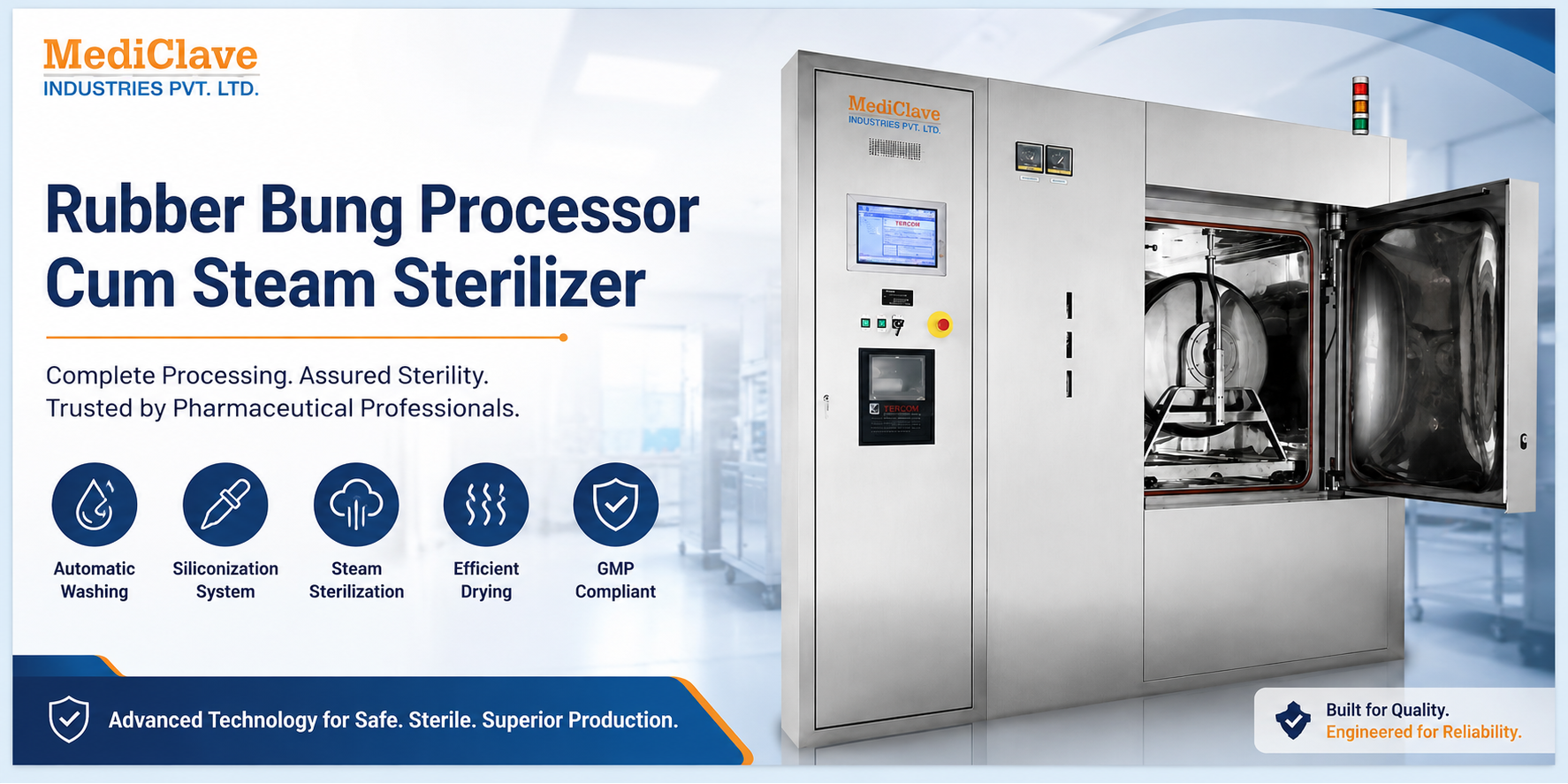
How Does a Rubber Bung Processor Cum Steam Sterilizer Improve Pharmaceutical Manufacturing?
In the pharmaceutical industry, every small component plays a vital role in ensuring the safety and quality of medicines. One such critical component is the rubber bung, also known as a rubber stopper. These bungs are widely used to seal injectable vials, infusion bottles, and other pharmaceutical containers. Since they come into direct contact with sterile medicines, they must be thoroughly cleaned, processed, and sterilized before use.
A Rubber Bung Processor Cum Steam Sterilizer is specially designed to perform all these essential steps in one integrated system. Instead of using separate equipment for washing, siliconization, sterilization, and drying, manufacturers can complete the entire process efficiently in a single machine. This not only improves productivity but also minimizes contamination risks and ensures compliance with international pharmaceutical standards.
Whether you operate a small pharmaceutical production unit or a large-scale manufacturing facility, investing in the right rubber bung processing equipment can significantly improve product quality, reduce operational costs, and increase manufacturing efficiency. In this guide, we will explore everything you need to know about a Rubber Bung Processor Cum Steam Sterilizer, including its working principle, features, benefits, applications, selection tips, maintenance practices, and why it has become an indispensable part of modern pharmaceutical manufacturing.
Understanding a Rubber Bung Processor Cum Steam Sterilizer
A Rubber Bung Processor Cum Steam Sterilizer is an advanced pharmaceutical machine developed for the complete processing of rubber stoppers used in injectable pharmaceutical packaging.
The machine combines multiple operations into one automated cycle, including:
Washing
Rinsing
Siliconization
Sterilization
Drying (depending on machine configuration)
These operations are carried out under controlled conditions using purified water, clean steam, and validated processing parameters to ensure every rubber stopper meets pharmaceutical quality requirements.
Unlike traditional processing methods that require multiple machines and manual handling, an integrated processor greatly reduces human intervention while improving process consistency and sterility assurance.
Why Rubber Bung Processing Is So Important
Rubber stoppers come into direct contact with injectable medicines. If they contain dust, microorganisms, chemical residues, or particulate contamination, they can compromise the sterility of the final pharmaceutical product.
Proper processing ensures:
Complete removal of contaminants
Effective microbial destruction
Uniform siliconization for smooth vial sealing
Reduced particle generation
Improved product safety
Compliance with GMP guidelines
Without proper processing, pharmaceutical companies risk batch rejection, product recalls, regulatory observations, and damage to their reputation.
Working Principle of a Rubber Bung Processor Cum Steam Sterilizer
The machine follows a carefully controlled sequence to process rubber stoppers efficiently.
Loading
Rubber stoppers are loaded into specially designed perforated containers or baskets.
Washing Cycle
Purified water is circulated through the chamber to remove dust, particles, and manufacturing residues from the rubber components.
Multiple Rinsing Stages
Several rinsing cycles ensure complete removal of cleaning agents and remaining contaminants.
Siliconization
Medical-grade silicone is applied uniformly to improve lubrication and sealing performance during vial filling operations.
Steam Sterilization
The processed rubber stoppers are sterilized using saturated steam under precisely controlled temperature and pressure.
Typical sterilization temperatures include:
121°C
124°C
126°C
134°C
The cycle duration depends on validation requirements and pharmaceutical standards.
Cooling
Controlled cooling prevents thermal shock while maintaining sterility.
Drying
Depending on machine design, vacuum drying or filtered air drying removes moisture before unloading.
The processed rubber stoppers are now ready for aseptic filling operations.
Major Components of the Machine
A high-quality Rubber Bung Processor Cum Steam Sterilizer generally includes:
Stainless Steel 316L processing chamber
Sterile water circulation system
Steam distribution system
Silicone dosing system
Pneumatic valves
PLC-based control panel
HMI touchscreen interface
Temperature sensors
Pressure sensors
Vacuum pump
HEPA filtration
Drainage system
Safety interlocks
Validation ports
Every component is designed to meet pharmaceutical GMP standards.
Key Features
Modern Rubber Bung Processor Cum Steam Sterilizers offer numerous advanced features, including:
Fully automatic operation
PLC-controlled processing
Touchscreen HMI
Recipe management
Automatic washing
Automatic rinsing
Automatic siliconization
Automatic sterilization
Automatic drying
GMP-compliant construction
FDA-compliant material contact parts
Low maintenance
High energy efficiency
Batch recording
SCADA compatibility
Data logging
Password protection
Alarm management
Cycle validation
Uniform steam distribution
Efficient water usage
These features ensure consistent pharmaceutical production with minimal operator intervention.
Benefits of Using a Rubber Bung Processor Cum Steam Sterilizer
Improved Sterility Assurance
Integrated processing minimizes contamination risks by reducing manual handling.
Higher Productivity
Multiple processing steps are completed within one machine, saving significant production time.
Reduced Operating Costs
Using one integrated system lowers labor costs, utility consumption, and equipment maintenance expenses.
Consistent Product Quality
Automated cycles eliminate operator variation, ensuring every batch meets the same quality standards.
GMP Compliance
The equipment is specifically designed to comply with current pharmaceutical manufacturing regulations.
Better Validation
Automated control systems simplify IQ, OQ, and PQ validation activities.
Reduced Human Intervention
Automation significantly decreases operator contact with processed rubber stoppers.
Increased Production Capacity
Large chamber capacities enable manufacturers to process more rubber stoppers per batch.
Industries That Use Rubber Bung Processor Cum Steam Sterilizers
These machines are widely used in:
Pharmaceutical manufacturing
Injectable drug production
Vaccine manufacturing
Biotechnology companies
Contract manufacturing organizations (CMOs)
Medical device manufacturing
Research laboratories
Sterile formulation facilities
Any facility producing sterile injectable medicines benefits from this equipment.
Importance of Steam Sterilization
Steam sterilization remains the preferred sterilization method because it offers:
Excellent microbial destruction
Reliable heat penetration
Short processing time
No toxic residues
Cost-effective operation
Easy validation
International regulatory acceptance
Compared to chemical sterilization methods, saturated steam provides safer and more environmentally friendly processing.
For facilities requiring sterilization of finished pharmaceutical products, Mediclave Industries also offers a high-performance Saturated Steam Sterilizer (Autoclave):
https://www.mediclaveindustries.in/saturated-steam-sterilizer-autoclave
Why Stainless Steel 316L Is Preferred
Most pharmaceutical processing equipment uses Stainless Steel 316L because it offers:
Excellent corrosion resistance
Smooth hygienic surfaces
Easy cleaning
High durability
Chemical resistance
Long service life
Low maintenance
The polished internal surfaces also minimize microbial growth and particle retention.
Validation Requirements
Validation is a critical part of pharmaceutical manufacturing.
A Rubber Bung Processor Cum Steam Sterilizer typically supports:
IQ (Installation Qualification)
OQ (Operational Qualification)
PQ (Performance Qualification)
Validation documentation generally includes:
Temperature mapping
Pressure mapping
Sterility testing
Cycle verification
Alarm testing
Sensor calibration
Proper validation demonstrates consistent machine performance and regulatory compliance.
Automation and Smart Controls
Today's pharmaceutical manufacturers increasingly rely on automation.
Modern machines include:
PLC automation
HMI touchscreen operation
Recipe storage
Electronic batch records
Audit trails
SCADA integration
Ethernet connectivity
Remote diagnostics
Automatic alarms
Password-based access
These smart features simplify production management while improving traceability.
Energy Efficiency
New-generation equipment is designed for lower operating costs through:
Efficient steam utilization
Optimized water consumption
Heat recovery systems
Insulated chambers
Reduced cycle times
Intelligent process control
These improvements help pharmaceutical manufacturers reduce utility expenses while maintaining consistent performance.
Choosing the Right Machine
When selecting a Rubber Bung Processor Cum Steam Sterilizer, consider:
Batch capacity
Chamber size
Automation level
Validation support
Utility requirements
Water quality compatibility
Steam quality
Material construction
Control system
Maintenance requirements
Service support
Spare part availability
Working with an experienced manufacturer ensures the equipment matches your production requirements.
Integration with Other Pharmaceutical Equipment
A complete sterile manufacturing facility includes multiple process systems working together.
For example, purified water generated by a Multi Column Distillation Plant is often used during washing and rinsing operations:
https://www.mediclaveindustries.in/multi-column-distillation-plant
Similarly, a Pure Steam Generator supplies high-quality clean steam required for pharmaceutical sterilization processes:
https://www.mediclaveindustries.in/pure-steam-generator
To maintain hygienic process pipelines and manufacturing vessels, pharmaceutical facilities also rely on CIP & SIP Systems, which automate cleaning and sterilization while minimizing downtime:
https://www.mediclaveindustries.in/cip-sip-system
By integrating these systems, manufacturers can build a highly efficient, GMP-compliant production environment.
Maintenance Best Practices
Proper maintenance improves equipment reliability and extends machine life.
Recommended practices include:
Daily chamber cleaning
Regular gasket inspection
Steam trap maintenance
Sensor calibration
Valve inspection
Pump maintenance
Filter replacement
Water quality monitoring
Lubrication of moving components
Software backups
Preventive maintenance scheduling
Routine servicing also reduces unexpected downtime and production interruptions.
Common Challenges and Their Solutions
Some common operational challenges include:
Incomplete washing
Usually caused by improper water pressure or blocked spray nozzles.
Poor sterilization performance
Often results from inadequate steam quality or incorrect cycle parameters.
Uneven siliconization
May occur due to improper silicone dosing or distribution.
Long cycle times
Can often be optimized through process validation and recipe improvements.
High maintenance costs
Preventive maintenance significantly reduces expensive emergency repairs.
Working with experienced equipment suppliers helps resolve these issues quickly.
Future Trends in Rubber Bung Processing
The pharmaceutical industry continues to adopt smarter manufacturing technologies.
Future developments include:
Industry 4.0 integration
AI-assisted process monitoring
Predictive maintenance
Cloud-based production monitoring
Real-time batch analytics
Advanced energy optimization
Remote validation support
Digital documentation
Paperless manufacturing
Improved sustainability
These innovations will further improve productivity, compliance, and operational efficiency.
Why Choose Mediclave Industries?
Mediclave Industries specializes in manufacturing advanced pharmaceutical process and sterilization equipment designed to meet the demanding requirements of modern pharmaceutical production.
The company focuses on:
High-quality engineering
GMP-compliant manufacturing
Stainless Steel 316L construction
Reliable automation
Custom machine configurations
Robust validation support
Energy-efficient designs
Competitive pricing
Excellent after-sales service
Long-term technical support
With extensive experience in pharmaceutical equipment manufacturing, Mediclave Industries provides reliable solutions that help manufacturers improve productivity, maintain product quality, and achieve regulatory compliance.
Conclusion
A Rubber Bung Processor Cum Steam Sterilizer is one of the most important pieces of equipment in sterile pharmaceutical manufacturing. By combining washing, rinsing, siliconization, steam sterilization, and drying into one automated process, it delivers consistent product quality while minimizing contamination risks and improving operational efficiency.
As pharmaceutical manufacturing standards continue to evolve, manufacturers need reliable, validated, and automated processing solutions that ensure every rubber stopper is prepared for safe use in injectable drug production. Investing in a high-quality Rubber Bung Processor Cum Steam Sterilizer not only enhances compliance with GMP and international regulatory requirements but also reduces operating costs, improves productivity, and strengthens overall manufacturing performance.
When integrated with complementary systems such as a Pure Steam Generator, Multi Column Distillation Plant, CIP & SIP System, and Saturated Steam Sterilizer, manufacturers can establish a complete sterile processing environment capable of meeting the highest quality standards. Choosing a trusted manufacturer like Mediclave Industries ensures long-term reliability, advanced technology, and dependable support for the growing needs of the pharmaceutical industry.



