
Introduction
Injectable products are among the most critical pharmaceutical formulations because they are administered directly into the human body. Maintaining sterility, product consistency, and regulatory compliance is therefore essential during manufacturing.
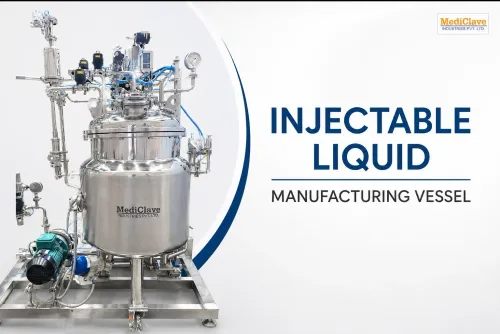
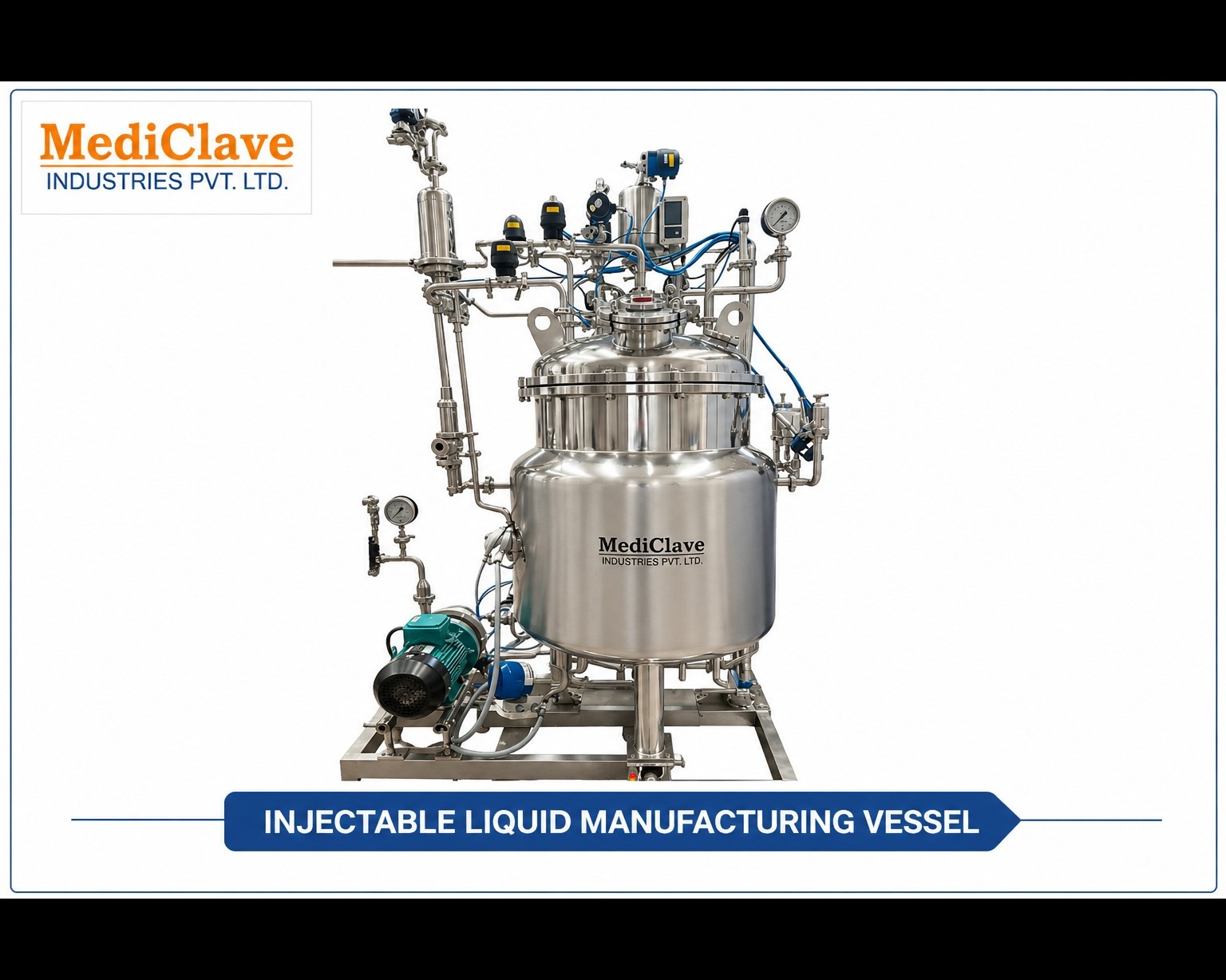
An Injectable Liquid Manufacturing Vessel is specially designed for the preparation, mixing, heating, cooling, and storage of sterile liquid formulations used in pharmaceutical manufacturing. These vessels are engineered to meet stringent GMP and regulatory requirements while ensuring high product quality and contamination-free production.
This article explores the features, working principle, and benefits of Injectable Liquid Manufacturing Vessels used in modern pharmaceutical facilities.
What is an Injectable Liquid Manufacturing Vessel?
An Injectable Liquid Manufacturing Vessel is a stainless-steel processing vessel used for manufacturing sterile pharmaceutical liquids such as:
- Large Volume Parenterals (LVP)
- Small Volume Parenterals (SVP)
- IV Fluids
- Injectable Drug Solutions
- Sterile Pharmaceutical Preparations
- Veterinary Injectables
- Nutritional Solutions
- Biopharmaceutical Liquid Formulations
The vessel is designed to provide controlled mixing, temperature regulation, and hygienic processing conditions required for sterile manufacturing.
Working Principle of Injectable Liquid Manufacturing Vessel
The manufacturing process follows a controlled sequence to ensure product quality and sterility.
Step 1: Charging of Raw Materials
Purified Water or Water for Injection (WFI) is introduced into the vessel. Active ingredients and excipients are added according to the formulation requirements.
Step 2: Mixing Process
An efficient agitator system continuously mixes the solution to ensure complete dissolution of ingredients and uniform product consistency.
Step 3: Heating and Temperature Control
The jacketed vessel allows precise heating when required to facilitate dissolution and processing.
Step 4: Filtration and Circulation
The solution may undergo filtration and recirculation to remove particles and achieve the required quality standards.
Step 5: Sterile Processing
The vessel maintains a closed and hygienic environment, minimizing contamination risks during production.
Step 6: Transfer to Filling Line
The finished solution is transferred through sanitary pipelines to sterile filling machines for final packaging.
Key Features of Injectable Liquid Manufacturing Vessel
1. GMP-Compliant Construction
Manufactured according to pharmaceutical GMP standards for safe and hygienic production.
2. SS316L Product Contact Parts
Product contact surfaces are made from high-grade stainless steel to ensure corrosion resistance and product purity.
3. Jacketed Vessel Design
Supports controlled heating and cooling during the manufacturing process.
4. Efficient Agitation System
Provides uniform mixing and consistent formulation quality.
5. CIP and SIP Compatibility
Supports Clean-In-Place (CIP) and Sterilize-In-Place (SIP) operations for efficient cleaning and sterilization.
6. Closed Processing System
Reduces contamination risks and supports sterile manufacturing requirements.
7. Automated Process Control
PLC and HMI-based control systems can be integrated for monitoring and automation.
Benefits of Injectable Liquid Manufacturing Vessel
Enhanced Product Quality
Provides homogeneous mixing and precise process control for superior formulation consistency.
Improved Sterility Assurance
Designed to minimize contamination risks during manufacturing.
Regulatory Compliance
Supports GMP, WHO-GMP, FDA, and other pharmaceutical standards.
Higher Production Efficiency
Automated operations reduce production time and increase productivity.
Batch-to-Batch Consistency
Ensures reproducible manufacturing results across multiple batches.
Reduced Maintenance Requirements
Sanitary construction and automated cleaning systems simplify maintenance.
Long Equipment Life
High-quality stainless-steel construction offers durability and reliable performance.
Applications of Injectable Liquid Manufacturing Vessel
These vessels are widely used in:
- Pharmaceutical Manufacturing Plants
- Injectable Production Facilities
- IV Fluid Manufacturing Units
- Biopharmaceutical Industries
- Veterinary Pharmaceutical Plants
- Nutraceutical Manufacturing Facilities
- Sterile Formulation Production Units
Factors to Consider When Selecting an Injectable Liquid Manufacturing Vessel
Before purchasing a vessel, manufacturers should evaluate:
- Batch Capacity Requirements
- Material of Construction
- Agitation System Design
- CIP/SIP Compatibility
- Automation Requirements
- Regulatory Compliance Standards
- Surface Finish Quality
- Future Production Expansion Needs
Selecting the right vessel contributes significantly to manufacturing efficiency and product quality.
Conclusion
An Injectable Liquid Manufacturing Vessel Ahmedabad is a critical component of pharmaceutical sterile manufacturing processes. With advanced mixing systems, GMP-compliant construction, temperature control capabilities, and CIP/SIP compatibility, these vessels ensure safe, efficient, and contamination-free production of injectable formulations.
As pharmaceutical manufacturers continue to focus on product quality, sterility assurance, and regulatory compliance, investing in a modern Injectable Liquid Manufacturing Vessel remains essential for achieving reliable and efficient production operations.