
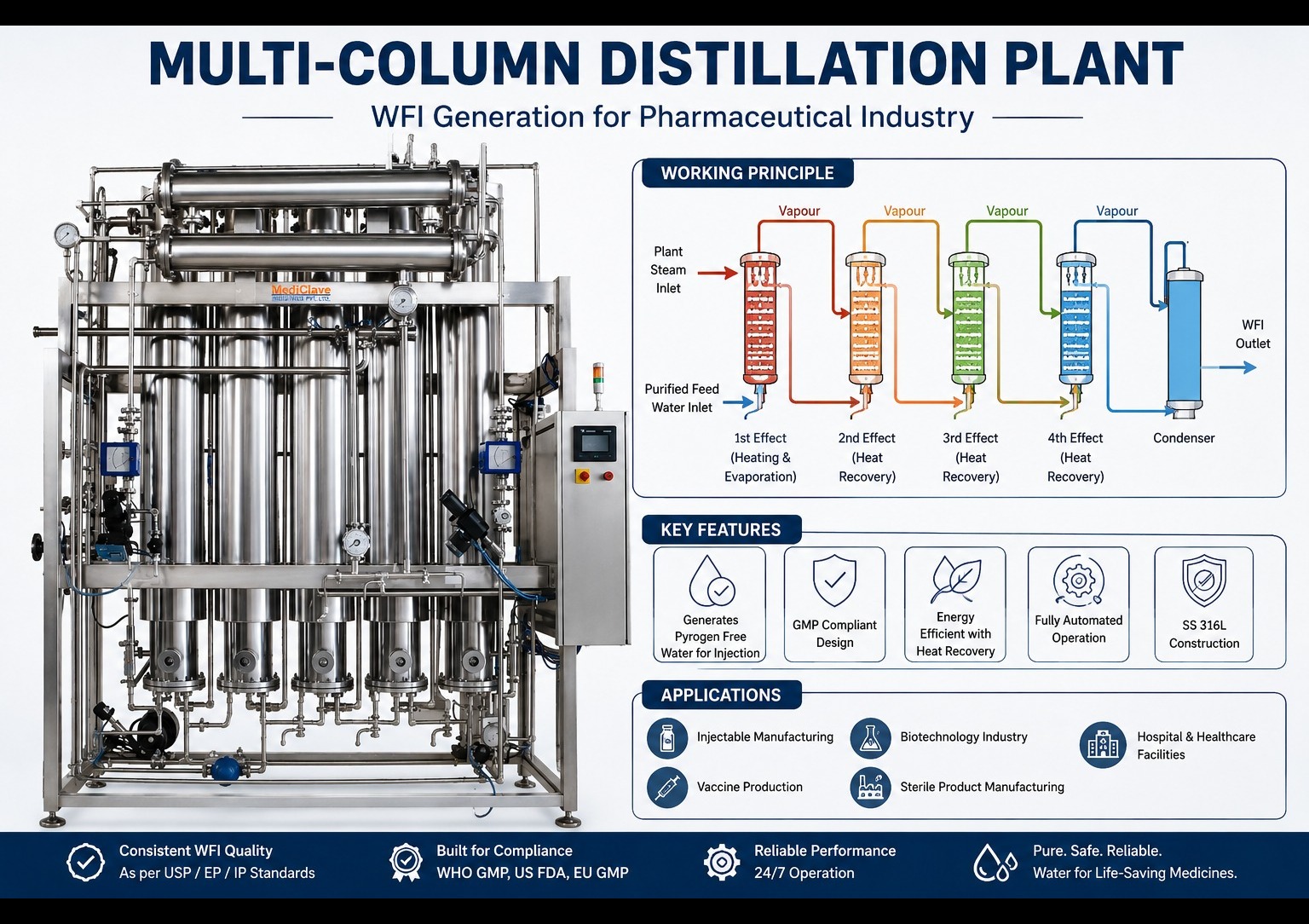
Water quality is one of the most critical factors in pharmaceutical manufacturing. Whether producing injectable medicines, vaccines, sterile formulations, or biotechnology products, pharmaceutical companies require highly purified water that meets stringent regulatory standards. This is where a Multi-Column Distillation Plant (MCD Plant) plays a vital role.
A Multi-Column Distillation Plant is widely used for generating Water for Injection (WFI), the highest grade of pharmaceutical water required for sterile manufacturing processes. By utilizing multiple distillation columns and efficient heat recovery systems, MCD plants produce pyrogen-free, highly purified water while minimizing energy consumption.
In this comprehensive guide, we will explore the working principle, components, advantages, applications, regulatory requirements, and selection criteria of Multi-Column Distillation Plants in the pharmaceutical industry.
What is a Multi-Column Distillation Plant?
A Multi-Column Distillation Plant is an advanced water purification system designed to produce Water for Injection (WFI) through a multi-stage distillation process.
The system uses purified water as feed water and passes it through several distillation columns operating under controlled pressure and temperature conditions. Through evaporation, separation, and condensation, contaminants, microorganisms, endotoxins, and pyrogens are removed, resulting in ultra-pure pharmaceutical-grade water.
The plant is specifically designed to comply with pharmaceutical regulations such as:
- WHO GMP
- US FDA
- EU GMP
- USP
- IP
- EP
Due to its high reliability and consistent output quality, MCD plants are extensively used in pharmaceutical, biotechnology, and healthcare facilities worldwide.
Why is Water for Injection (WFI) Important?
Water for Injection is one of the most critical raw materials used in pharmaceutical manufacturing.
It is used for:
- Injectable drug production
- Vaccine manufacturing
- Sterile product manufacturing
- Parenteral formulations
- Biotechnology processes
- Equipment cleaning
- Clean steam generation
Any contamination in WFI can compromise product quality and patient safety. Therefore, pharmaceutical manufacturers must ensure that the generated water meets strict purity and endotoxin limits.
How Does a Multi-Column Distillation Plant Work?
The working principle of a Multi-Column Distillation Plant is based on multiple-effect distillation and heat recovery.
The process involves several stages:
Step 1: Feed Water Supply
Purified water enters the first distillation column as feed water.
Step 2: Heating and Evaporation
Plant steam is supplied to the first column, causing the feed water to evaporate.
Step 3: Separation of Impurities
Specially designed separators remove:
- Water droplets
- Impurities
- Particulate matter
- Pyrogens
- Endotoxins
Step 4: Heat Recovery
The generated vapor transfers heat to the next column.
This significantly reduces steam consumption and improves energy efficiency.
Step 5: Multiple Distillation Effects
The same process continues across multiple columns.
Each column further improves purification while utilizing recovered energy.
Step 6: Condensation
The purified vapor is condensed into Water for Injection.
Step 7: WFI Collection
The final WFI is collected in a storage and distribution system while maintaining pharmaceutical-grade quality standards.
Major Components of a Multi-Column Distillation Plant
A pharmaceutical-grade MCD Plant consists of several critical components.
1. Evaporator Columns
These columns facilitate the evaporation of feed water using plant steam.
2. Separator Assembly
Separators ensure complete removal of contaminants, droplets, and pyrogens.
3. Condenser
The condenser converts purified steam into Water for Injection.
4. Heat Exchanger
Heat exchangers maximize thermal efficiency and reduce operating costs.
5. Feed Water System
Provides continuous supply of purified feed water.
6. Instrumentation and Controls
Modern systems include:
- PLC Control
- HMI Interface
- Temperature Monitoring
- Pressure Monitoring
- Conductivity Monitoring
- Automation Systems
How Does the Plant Remove Pyrogens and Endotoxins?
One of the biggest advantages of a Multi-Column Distillation Plant is its ability to remove pyrogens and bacterial endotoxins.
Pyrogens are heat-stable substances that can cause fever and severe reactions when injected into the human body.
The plant removes pyrogens through:
- High-temperature distillation
- Vapor-liquid separation
- Multi-stage purification
- Specialized separator design
This ensures the generated WFI complies with pharmaceutical endotoxin requirements.
Advantages of a Multi-Column Distillation Plant
Superior Water Quality
Produces highly purified Water for Injection suitable for critical pharmaceutical applications.
Energy Efficient Design
Multiple-effect distillation significantly reduces steam consumption.
Continuous Operation
Suitable for 24/7 pharmaceutical production environments.
Regulatory Compliance
Designed according to GMP and international pharmaceutical standards.
Low Maintenance
Modern automated systems reduce operational intervention.
Reliable Performance
Ensures consistent WFI quality with minimal variation.
Applications of Multi-Column Distillation Plants
Pharmaceutical Manufacturing
Used for producing Water for Injection for injectable medicines.
Vaccine Production Facilities
Provides highly purified water required for vaccine manufacturing.
Biotechnology Industry
Used in biopharmaceutical and biotech production facilities.
Sterile Manufacturing Units
Supports sterile formulation and aseptic processing.
Healthcare and Research Facilities
Used in research laboratories and advanced healthcare institutions.
Multi-Column Distillation Plant vs Single Effect Distillation Plant
| Feature | Multi-Column Distillation Plant | Single Effect Distillation |
|---|---|---|
| Energy Efficiency | High | Low |
| Steam Consumption | Lower | Higher |
| Production Capacity | Large | Limited |
| Operating Cost | Lower | Higher |
| Pharmaceutical Use | Preferred | Limited |
| Heat Recovery | Excellent | Minimal |
Multi-column systems are generally preferred due to their higher efficiency and lower operating costs.
Multi-Column Distillation Plant vs Pure Steam Generator
Many pharmaceutical companies confuse MCD Plants with Pure Steam Generators.
| Feature | MCD Plant | Pure Steam Generator |
|---|---|---|
| Output | Water for Injection | Pure Steam |
| Primary Use | Injectable Water | Sterilization |
| Final Product | WFI | Clean/Pure Steam |
| Application | Drug Manufacturing | Autoclaves & SIP |
For complete pharmaceutical water systems, MCD Plants and Pure Steam Generators often work together.
GMP and Regulatory Requirements
A pharmaceutical-grade Multi-Column Distillation Plant should comply with:
WHO GMP
Ensures pharmaceutical manufacturing quality standards.
US FDA Guidelines
Supports regulatory compliance for pharmaceutical exports.
European GMP
Required for products supplied to European markets.
USP Standards
Defines Water for Injection quality specifications.
Indian Pharmacopoeia (IP)
Specifies pharmaceutical water quality requirements for India.
How to Choose the Right Multi-Column Distillation Plant?
Before purchasing an MCD Plant, consider the following factors:
Capacity Requirements
Determine daily WFI demand.
Typical capacities include:
- 100 LPH
- 250 LPH
- 500 LPH
- 1000 LPH
- 2000 LPH
- 5000 LPH
- 10000+ LPH
Material of Construction
Pharmaceutical systems should use:
- SS 316L contact parts
- GMP-compliant finishes
Automation Level
Choose PLC-based systems with advanced monitoring capabilities.
Validation Support
Ensure availability of:
- IQ Documentation
- OQ Documentation
- PQ Documentation
Service Support
Select a manufacturer capable of providing installation, commissioning, and after-sales support.
Why Choose Mediclave Industries for Multi-Column Distillation Plants?
At Mediclave Industries, we manufacture high-performance Multi-Column Distillation Plants designed to meet the demanding requirements of pharmaceutical and biotechnology industries.
Our systems offer:
- GMP-Compliant Design
- SS 316L Construction
- Energy-Efficient Operation
- Automated PLC Controls
- Reliable WFI Generation
- Validation Documentation Support
- Customized Capacities
- Installation and Commissioning Assistance
With a strong focus on quality, innovation, and regulatory compliance, Mediclave Industries delivers pharmaceutical water systems that help manufacturers achieve consistent and reliable production.
https://www.mediclaveindustries.in/
Frequently Asked Questions (FAQs)
What is a Multi-Column Distillation Plant?
A Multi-Column Distillation Plant is a pharmaceutical water system used to generate Water for Injection through multiple stages of distillation.
What is the purpose of a Multi-Column Distillation Plant?
Its primary purpose is to produce pyrogen-free Water for Injection for pharmaceutical manufacturing.
What is Water for Injection (WFI)?
WFI is highly purified pharmaceutical-grade water used in injectable drug manufacturing and sterile processes.
How does a Multi-Column Distillation Plant work?
It uses multiple distillation columns, heat recovery systems, evaporation, and condensation to produce purified water.
Why is WFI important in pharmaceutical manufacturing?
WFI is essential for ensuring product safety, sterility, and regulatory compliance.
What industries use Multi-Column Distillation Plants?
Pharmaceutical, biotechnology, healthcare, vaccine manufacturing, and research industries.
What material is used in pharmaceutical MCD Plants?
Typically SS 316L stainless steel is used for all product contact parts.
What capacities are available?
Capacities generally range from 100 LPH to more than 10,000 LPH.
Can the system remove endotoxins?
Yes, properly designed Multi-Column Distillation Plants effectively remove endotoxins and pyrogens.
Is validation required for pharmaceutical use?
Yes, IQ, OQ, and PQ validation documentation is generally required.
Conclusion
A Multi-Column Distillation Plant is a critical component of pharmaceutical water systems, ensuring reliable production of high-purity Water for Injection. With its energy-efficient operation, advanced purification capabilities, and compliance with global pharmaceutical standards, the MCD Plant remains the preferred solution for injectable drug manufacturing, vaccine production, biotechnology applications, and sterile processing facilities.
Choosing a high-quality system from an experienced manufacturer can significantly improve operational efficiency, regulatory compliance, and product safety.
Looking for a GMP-compliant Multi-Column Distillation Plant? Contact Mediclave Industries for customized pharmaceutical water generation solutions tailored to your production requirements.
https://www.mediclaveindustries.in/products/category/pharma-sterilization/1
https://www.mediclaveindustries.in/products/category/pharma-process-equipment/1
https://www.mediclaveindustries.in/products/category/pharma-water-systems/1
https://www.mediclaveindustries.in/products/category/hospital-cssd-equipments/1