

Water
quality is one of the most critical requirements in pharmaceutical
manufacturing. From injectable medicines and vaccines to sterile formulations
and biotechnology products, manufacturers need a reliable source of high-purity
water that can support stringent production and quality requirements.
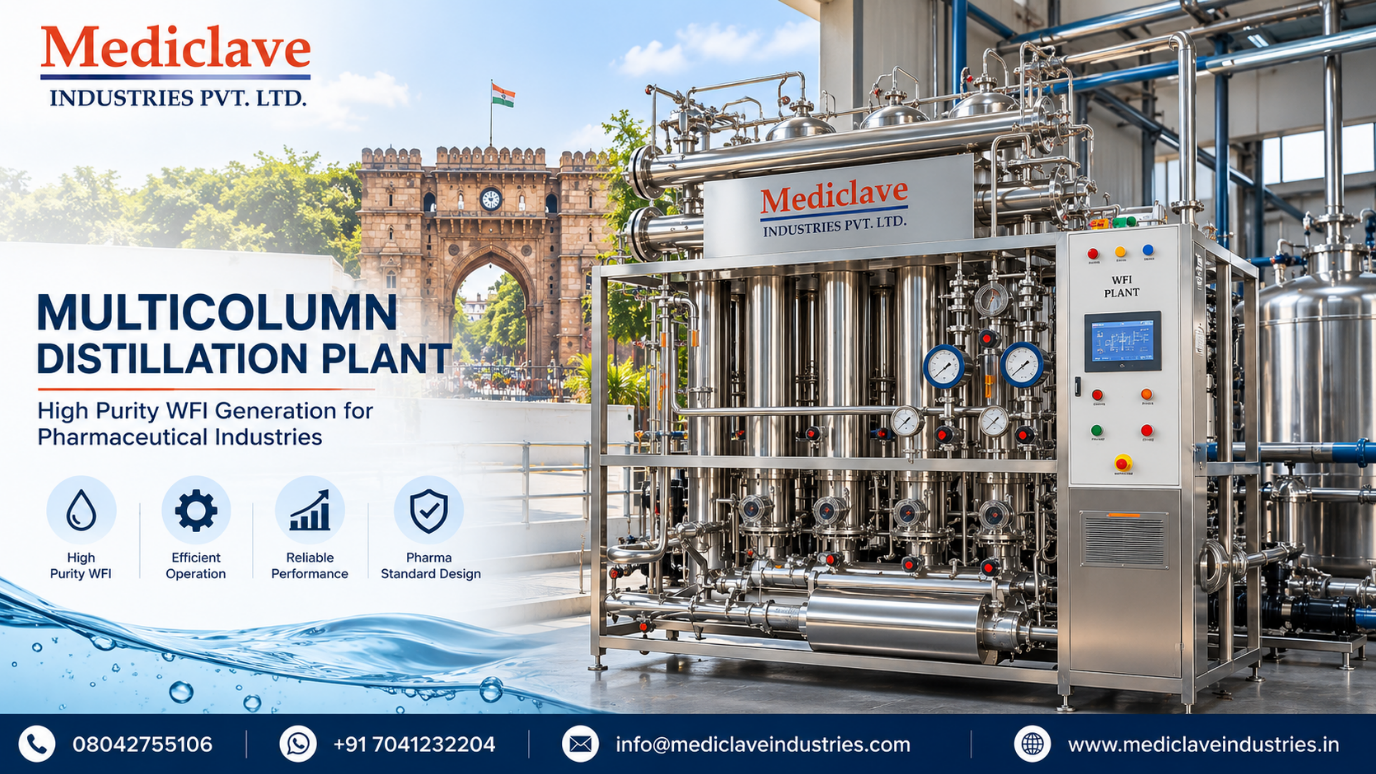
A Multicolumn
Distillation Plant, also known as a Multi Column Distillation Plant
(MCDP), is designed for the generation of Water for Injection (WFI)
through an efficient multiple-effect distillation process.
At Mediclave
Industries Private Limited, we provide pharmaceutical processing and
utility equipment designed to support modern manufacturing facilities. Our Multicolumn
Distillation Plant solutions are developed with a focus on hygienic
construction, operational reliability, energy efficiency, process control, and
pharmaceutical applications.
What Is a Multicolumn Distillation Plant?
A
Multicolumn Distillation Plant is a pharmaceutical water-generation system used
to produce high-purity Water for Injection (WFI).
As the
name suggests, the system consists of multiple distillation columns or effects
connected in sequence. Purified feed water is heated and converted into vapor.
Through successive evaporation, separation, heat recovery, and condensation
stages, the system separates unwanted contaminants and produces high-quality
distillate suitable for pharmaceutical applications.
One of the
important advantages of multicolumn technology is its efficient utilization of
thermal energy. Instead of continuously supplying fresh heating energy to every
column, vapor generated in one stage can be used as a heating medium for the
following stage.
This
makes the system suitable for pharmaceutical facilities requiring consistent
WFI production with efficient utility consumption.
Why Is WFI Important in Pharmaceutical
Manufacturing?
Water for
Injection is a critical pharmaceutical utility, particularly where water is
used in sterile and parenteral manufacturing.
WFI is
commonly associated with applications such as:
- Injectable
pharmaceutical formulations
- Vaccine
manufacturing
- IV
and parenteral products
- Sterile
manufacturing processes
- Biotechnology
products
- Ampoule
and vial production
- Critical
equipment cleaning
- Pharmaceutical
process preparation
The
required water quality depends on the intended application and applicable
pharmacopoeial and regulatory requirements. For this reason, WFI generation
should not be viewed simply as a water-treatment process. It is an important
part of the pharmaceutical manufacturing and quality system.
How Does a Multicolumn Distillation Plant Work?
The basic
working principle of a Multicolumn Distillation Plant for WFI generation
is multiple-effect distillation.
1. Purified Feed Water Supply
Properly
treated purified water is supplied to the system. Feed-water quality is
important for reliable operation and long-term performance of the plant.
2. Heating and Evaporation
In the
first column, thermal energy is supplied to heat the feed water and generate
vapor.
During
evaporation, non-volatile impurities remain separated from the generated vapor.
3. Vapor Separation
Efficient
vapor-water separation is an important part of the distillation process. The
design helps prevent entrained water droplets and associated impurities from
carrying over with the clean vapor.
4. Multiple-Effect Distillation
The vapor
generated in one column transfers thermal energy to the next effect.
Because
this heat is reused rather than wasted after a single evaporation stage,
multiple-effect operation can improve overall thermal efficiency and reduce
utility requirements compared with less efficient single-stage arrangements.
5. Condensation
After the
required separation and distillation stages, purified vapor is condensed to
produce WFI.
6. WFI Collection and Distribution
The
generated WFI can then be transferred to an appropriately designed
pharmaceutical-grade storage and distribution system for use at required points
throughout the facility.
Major Components of a Multicolumn Distillation
Plant
A
well-designed MCD plant is more than a group of stainless-steel columns. Its
overall performance depends on proper integration of mechanical components, instrumentation
and process controls.
Typical
sections may include:
- Multiple
distillation columns
- Evaporator
assemblies
- Vapor-liquid
separation system
- Condenser
- Heat
exchangers
- Feed-water
arrangement
- Process
piping
- Sanitary
valves and fittings
- Temperature
instruments
- Pressure
instruments
- Flow
monitoring
- Conductivity
monitoring, where specified
- Control
panel
- PLC/HMI-based
automation, depending on configuration
- Safety
interlocks
- Drain
and sampling arrangements
The exact
configuration should always be selected according to required capacity,
feed-water conditions, WFI demand, utility availability and customer-specific
requirements.
Advantages of a Multicolumn Distillation Plant
Consistent WFI Generation
A
properly engineered system is designed to provide repeatable water quality
under defined operating conditions.
Efficient Heat Recovery
One of
the strongest advantages of multiple-effect distillation is energy recovery
between successive columns.
Reduced Utility Consumption
Reuse of
thermal energy can help reduce steam and cooling requirements, depending on
plant design, capacity and operating conditions.
Hygienic Design
Product-contact
sections can be designed using pharmaceutical-grade materials and hygienic
construction practices appropriate for the intended application.
Automated Process Control
PLC/HMI-based
controls can simplify operation while providing monitoring of critical process
parameters.
Reliable Continuous Operation
For
facilities with significant WFI demand, a correctly sized Multicolumn Distillation
Plant can support continuous pharmaceutical manufacturing operations.
Applications of Multicolumn Distillation Plants
Multicolumn
Distillation Plants are commonly used in industries and facilities such as:
Pharmaceutical Manufacturing: WFI for injectable, sterile and
other critical pharmaceutical processes.
Vaccine Manufacturing: High-purity water for production and associated
sterile processes.
Biotechnology Facilities: Pharmaceutical-grade water for sensitive biotech
operations.
Injectable Manufacturing Plants: WFI for ampoules, vials and
parenteral preparations.
IV Fluid Manufacturing: Reliable high-purity water supply for parenteral
manufacturing.
Research and Healthcare Applications: High-purity water where
appropriate process and quality requirements demand it.
What Should You Consider Before Buying a
Multicolumn Distillation Plant?
Choosing
an MCD plant only on the basis of price can lead to higher operating costs and
process problems later.
Before
selecting a Multicolumn Distillation Plant manufacturer, buyers should
consider several factors.
Required WFI Capacity
Determine
the required output in litres per hour based on present consumption as well as
reasonable future expansion.
Feed-Water Quality
The
manufacturer should understand the characteristics and quality of water
entering the distillation system.
Material of Construction
Materials
for product-contact parts should be selected according to pharmaceutical
process requirements, corrosion resistance, hygienic design and the applicable
project specification.
Surface Finish and Fabrication Quality
For
pharmaceutical applications, attention should be given to internal surface
finish, welding quality, drainability, sanitary connections and avoidance of
unnecessary dead legs.
Automation Level
Depending
on the facility, requirements may range from basic controls to PLC/HMI-based
automated systems with alarms, interlocks and process monitoring.
Documentation
Pharmaceutical
buyers should discuss documentation requirements at the quotation stage,
including drawings, material certificates, instrument documentation, operating
manuals, testing records and qualification-related documentation where
applicable.
Utility Consumption
Steam,
cooling water, electrical requirements and feed-water consumption directly
affect the long-term operating cost of the plant.
Service and Technical Support
After-sales
support, spare-parts availability and technical assistance should also be
considered before finalizing a supplier.
Multicolumn Distillation Plant vs Conventional
Distillation
The key
advantage of a multicolumn or multiple-effect system is energy reuse.
In a
basic single-stage process, much of the available thermal energy can be lost
after one evaporation-condensation cycle. In a multicolumn arrangement, energy
from an earlier effect is utilized by subsequent effects.
This
approach can improve energy efficiency while maintaining the repeated
evaporation and separation required for high-purity water generation.
For
pharmaceutical plants with regular or high WFI demand, this can translate into
meaningful operational benefits over the life of the equipment.
Importance of Hygienic Design
Hygienic
engineering is critical in pharmaceutical water systems.
A good
Multicolumn Distillation Plant should be designed to minimize areas where
stagnant water can remain and should facilitate effective operation, drainage,
inspection and maintenance.
Important
considerations can include:
- Suitable
pharmaceutical-grade product-contact materials
- Hygienic
piping layout
- Proper
drainage
- Controlled
surface finish
- High-quality
welding
- Sanitary
valves and fittings
- Suitable
instrumentation
- Accessible
maintenance points
- Appropriate
cleaning and sanitization philosophy
The final
design should always be based on the user's process requirements and applicable
quality standards.
Why Choose Mediclave Industries for a Multicolumn
Distillation Plant?
Choosing
a pharmaceutical equipment supplier requires more than comparing the initial
equipment price.
At Mediclave
Industries Private Limited, our focus is on providing equipment solutions
developed around the customer's pharmaceutical process requirements.
Our
approach emphasizes:
- Pharmaceutical-oriented
equipment design
- Hygienic
construction
- Quality
stainless-steel fabrication
- Reliable
process operation
- User-friendly
controls
- Energy-efficient
system design
- Customized
capacities and configurations
- Technical
support
- Documentation
according to agreed project requirements
- Solutions
for pharmaceutical and sterile manufacturing facilities
Along
with Multicolumn Distillation Plants, Mediclave Industries provides
pharmaceutical utility and sterilization solutions for modern production
facilities.
Explore
more pharmaceutical equipment and solutions from Mediclave Industries:
Official Website: https://www.mediclaveindustries.in/
You can
also learn about our Pure Steam Generator and pharmaceutical utility
solutions for integrated sterile manufacturing requirements.
Maintenance of a Multicolumn Distillation Plant
Preventive
maintenance helps maintain equipment reliability and consistent performance.
A
maintenance program should consider:
- Periodic
inspection of columns and heat-transfer surfaces
- Monitoring
of feed-water quality
- Inspection
of valves, seals and gaskets
- Calibration
of critical instruments
- Verification
of temperature and pressure readings
- Checking
pumps and utility connections
- Monitoring
conductivity and other specified quality parameters
- Inspection
of control-system alarms and interlocks
- Periodic
cleaning or sanitization according to approved procedures
Maintenance
frequency should be established according to equipment design, operating hours,
feed-water conditions, manufacturer recommendations and the facility's
validated procedures.
Frequently Asked Questions
What is a Multicolumn Distillation Plant?
A
Multicolumn Distillation Plant is a pharmaceutical water-generation system that
uses multiple-effect distillation to produce high-purity water, commonly Water
for Injection.
What is the main purpose of an MCD Plant?
Its
primary purpose in pharmaceutical facilities is reliable generation of WFI for
critical manufacturing and process applications.
How does a Multicolumn Distillation Plant save
energy?
Vapor and
thermal energy generated in one effect are utilized in subsequent effects,
improving heat recovery and reducing the amount of new energy required
throughout the process.
What feed water is required for an MCD Plant?
The
system typically receives appropriately treated purified water. The exact
feed-water specification should be established according to the plant design
and required final water quality.
Where is WFI commonly used?
WFI is
commonly required in injectable medicines, vaccines, parenteral products and
other pharmaceutical processes where the applicable manufacturing specification
requires it.
Can the capacity of a Multicolumn Distillation
Plant be customized?
Yes.
Capacity and configuration can be engineered according to WFI demand, utility
availability, operating conditions and project requirements.
What should I provide when requesting a quotation?
For an
accurate quotation, provide the required WFI production capacity, feed-water
details, available steam and cooling utilities, automation requirements,
applicable standards, documentation requirements and installation location.
Looking for a Multicolumn Distillation Plant
Manufacturer?
If you
are planning a new pharmaceutical facility, expanding WFI generation capacity
or upgrading an existing pharmaceutical water system, selecting the correct
equipment and capacity is essential.
Mediclave Industries Private Limited provides pharmaceutical
equipment solutions designed around customer-specific production and utility
requirements.
For
technical discussions, plant capacity selection or a commercial quotation for a
Multicolumn Distillation Plant, contact our team.
Contact Mediclave Industries Private Limited
Phone: 08042755106
Mobile: +91 7041232204
Email: info@mediclaveindustries.com
Website: https://www.mediclaveindustries.in/
Mediclave Industries Private Limited – Pharmaceutical Equipment &
Sterilization Solutions



