
Introduction
In the pharmaceutical, cosmetic, and healthcare industries, ointments, creams, gels, and lotions are among the most widely used dosage forms. To ensure consistent product quality, homogeneous mixing, and compliance with GMP standards, manufacturers rely on advanced Ointment Manufacturing Plants.
An Ointment Manufacturing Plant is a complete processing system designed for the preparation, mixing, homogenization, heating, cooling, and storage of semi-solid products. These plants help pharmaceutical companies achieve high production efficiency, product uniformity, and regulatory compliance while minimizing manual intervention.
This article explores the features, working principle, and benefits of an Ointment Manufacturing Plant and why it is an essential investment for modern pharmaceutical manufacturing facilities.
What is an Ointment Manufacturing Plant?
An Ointment Manufacturing Plant is an integrated pharmaceutical processing system used for manufacturing:
- Ointments
- Creams
- Gels
- Lotions
- Cosmetic creams
- Medicated creams
- Herbal formulations
- Topical pharmaceutical products
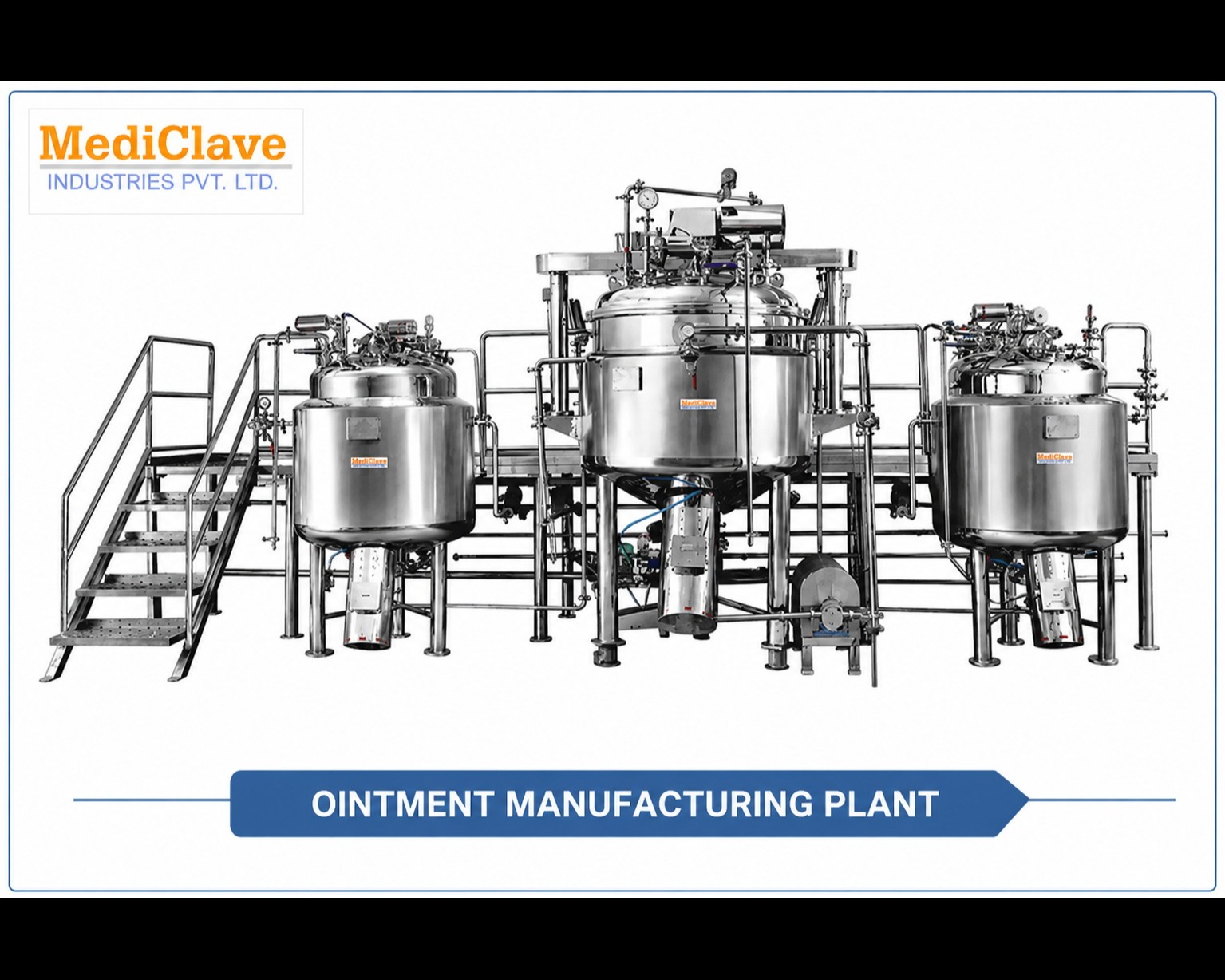
The plant typically consists of:
- Oil Phase Vessel
- Water Phase Vessel
- Manufacturing Vessel
- Vacuum System
- Homogenizer
- Transfer Pump
- Control Panel
- Product Storage Vessel
These components work together to produce high-quality semi-solid formulations with excellent consistency and stability.
Working Principle of an Ointment Manufacturing Plant
The manufacturing process begins with the preparation of separate oil and water phases.
Step 1: Preparation of Water Phase
Purified water and water-soluble ingredients are charged into the water phase vessel and heated to the required temperature.
Step 2: Preparation of Oil Phase
Oils, waxes, emulsifiers, and other oil-soluble materials are loaded into the oil phase vessel and heated until completely melted.
Step 3: Transfer to Manufacturing Vessel
Both phases are transferred into the main manufacturing vessel under controlled conditions.
Step 4: Mixing and Homogenization
The product is mixed using an agitator while a high-shear homogenizer reduces particle size and creates a smooth, uniform emulsion.
Step 5: Vacuum Processing
A vacuum system removes entrapped air from the product, preventing foaming and improving product stability.
Step 6: Cooling Process
The formulation is cooled gradually while mixing continues to maintain consistency and prevent phase separation.
Step 7: Product Transfer
The finished ointment or cream is transferred to storage tanks or filling machines for packaging.
Key Features of an Ointment Manufacturing Plant
1. Vacuum Processing System
The vacuum system eliminates air bubbles and improves product texture, appearance, and shelf life.
2. High-Shear Homogenizer
A powerful homogenizer ensures uniform particle distribution and smooth product consistency.
3. GMP-Compliant Design
The equipment is designed according to pharmaceutical GMP requirements, ensuring hygiene and easy cleaning.
4. Jacketed Vessel Construction
Heating and cooling jackets allow accurate temperature control throughout the manufacturing process.
5. Stainless Steel Construction
Typically manufactured using SS316L for product contact parts and SS304 for non-contact parts.
6. PLC-Based Automation
Modern plants can be equipped with PLC and HMI systems for automated operation and process monitoring.
7. CIP Compatibility
Clean-In-Place systems simplify cleaning procedures and reduce production downtime.
Benefits of an Ointment Manufacturing Plant
Superior Product Quality
Advanced mixing and homogenization produce highly uniform formulations with excellent stability.
Increased Production Efficiency
Automated processing reduces production time and enhances operational productivity.
Reduced Human Intervention
Automation minimizes operator dependency and reduces the risk of contamination.
GMP Compliance
The plant supports pharmaceutical regulatory requirements and validation protocols.
Improved Batch Consistency
Every batch maintains the same quality, texture, and composition.
Enhanced Product Stability
Vacuum processing and efficient homogenization improve shelf life and product performance.
Easy Maintenance and Cleaning
Sanitary design and CIP systems reduce maintenance efforts and cleaning time.
Applications of Ointment Manufacturing Plants
Ointment Manufacturing Plants are widely used in:
- Pharmaceutical Industries
- Cosmetic Manufacturing Units
- Herbal Product Manufacturing
- Personal Care Product Manufacturing
- Veterinary Pharmaceutical Industries
- Ayurvedic Medicine Production Facilities
The plant is suitable for manufacturing various semi-solid products with different viscosities and formulations.
Factors to Consider When Selecting an Ointment Manufacturing Plant
Before investing in an Ointment Manufacturing Plant, manufacturers should evaluate:
- Production Capacity Requirements
- Material of Construction
- Automation Level
- Homogenization Efficiency
- GMP Compliance
- Cleaning System Availability
- Utility Consumption
- Future Expansion Requirements
Selecting the right equipment ensures long-term productivity and reliable manufacturing performance.
Conclusion
An Ointment Manufacturing Plant plays a critical role in the production of pharmaceutical and cosmetic semi-solid formulations. With advanced mixing technology, vacuum processing, homogenization capabilities, and GMP-compliant construction, it helps manufacturers achieve superior product quality, operational efficiency, and regulatory compliance.
As demand for high-quality creams, ointments, and topical formulations continues to grow, investing in a modern Ointment Manufacturing Plant is essential for pharmaceutical companies seeking reliable and efficient production solutions.
@Ahmedabad @Mumbai @Delhi @NewDelhi @Bangalore @Hyderabad @Chennai @Pune @Surat @Vadodara @Rajkot @Gandhinagar @Kolkata @Jaipur @Udaipur @Jodhpur @Indore @Bhopal @Nagpur @Nashik @Aurangabad @Lucknow @Kanpur @Patna @Ranchi @Bhubaneswar @Raipur @Chandigarh @Ludhiana @Amritsar @Jammu @Srinagar @Dehradun @Noida @Gurgaon @Faridabad @Sonipat @Panipat @Visnagar @Mehsana @Anand @Bhavnagar @Jamnagar @Morbi @Vapi @Silvassa @Goa @Kochi @Trivandrum @Coimbatore @Madurai @Vijayawada @Visakhapatnam @Mysore @Hubli @Belgaum @Tirupati @Salem @Tiruppur @Bikaner @Ajmer @Alwar @Haridwar @Shimla @Manali @Agra @Varanasi @Prayagraj @Guwahati @Shillong @Imphal @Aizawl @Itanagar @Gangtok @Dibrugarh @Siliguri @Jabalpur @Gwalior @Kolhapur @Solapur @Thane @NaviMumbai @Kalyan @Palghar @Rewari @Hisar @Rohtak @Karnal @Bhilai @Durg @Cuttack @Jamshedpur @Hosur @Kakinada @Warangal @Nellore @Kota @Sikar @Bharuch @Junagadh @Porbandar @Kutch @Dwarka @Amravati @Akola @Yavatmal @Satara @Sangli @Ratnagiri @Ahmednagar @Latur @Nanded @Beed @Jalgaon @Dhule @Parbhani @Osmanabad @Wardha @Chandrapur @Gondia @Bhandara @Malegaon @Ujjain @Ratlam @Dewas @Sagar @Satna @Rewa @Chhindwara @Sehore @Vidisha @Betul @Bilaspur @Korba @Ambikapur @Jagdalpur @Rourkela @Sambalpur @Balasore @Puri @Berhampur @Muzaffarpur @Gaya @Darbhanga @Bhagalpur @Purnia @Hajipur @Begusarai @Dhanbad @Bokaro @Hazaribagh @Giridih @Asansol @Durgapur @Howrah @Kharagpur @Malda @Murshidabad @Darjeeling @Aligarh @Meerut @Ghaziabad @Moradabad @Bareilly @Saharanpur @Mathura @Firozabad @Jhansi @Gorakhpur @Faizabad @Ayodhya @Sitapur @Unnao @Barabanki @Raebareli @Etawah @Muzaffarnagar @Bulandshahr @Rampur @Basti @Bahraich @Shahjahanpur @Haldwani @Rudrapur @Nainital @Rishikesh @Pathankot @Patiala @Mohali @Bathinda @Jalandhar @Hoshiarpur @Ambala @Yamunanagar @Kurukshetra @Sirsa @Bhiwani @Jhajjar @Panchkula @Dharamshala @Mandi @Kullu @Leh @Anantnag @Baramulla @Pulwama @Udhampur @Samba @Kathua @Guntur @Rajahmundry @Eluru @Kadapa @Anantapur @Karimnagar @Nizamabad @Khammam @Mahbubnagar @Secunderabad @Kurnool @Ballari @Davanagere @Shimoga @Mangalore @Udupi @Bijapur @Tumkur @Chikmagalur @Karwar @Erode @Vellore @Thoothukudi @Kanchipuram @Namakkal @Dindigul @Karur @Cuddalore @Pondicherry @Palakkad @Thrissur @Kannur @Alappuzha @Kollam @Kottayam @Pathanamthitta @Bhilwara @Chittorgarh @Pali @Barmer @SriGanganagar @Hanumangarh @Tonk @Bundi @Neemuch @Godhra @Patan @Surendranagar @Botad @Amreli @Valsad @Navsari @Dahod @Nadiad @Kalol @Mundra @Veraval @Somnath @Diu @Daman Ahmedabad