
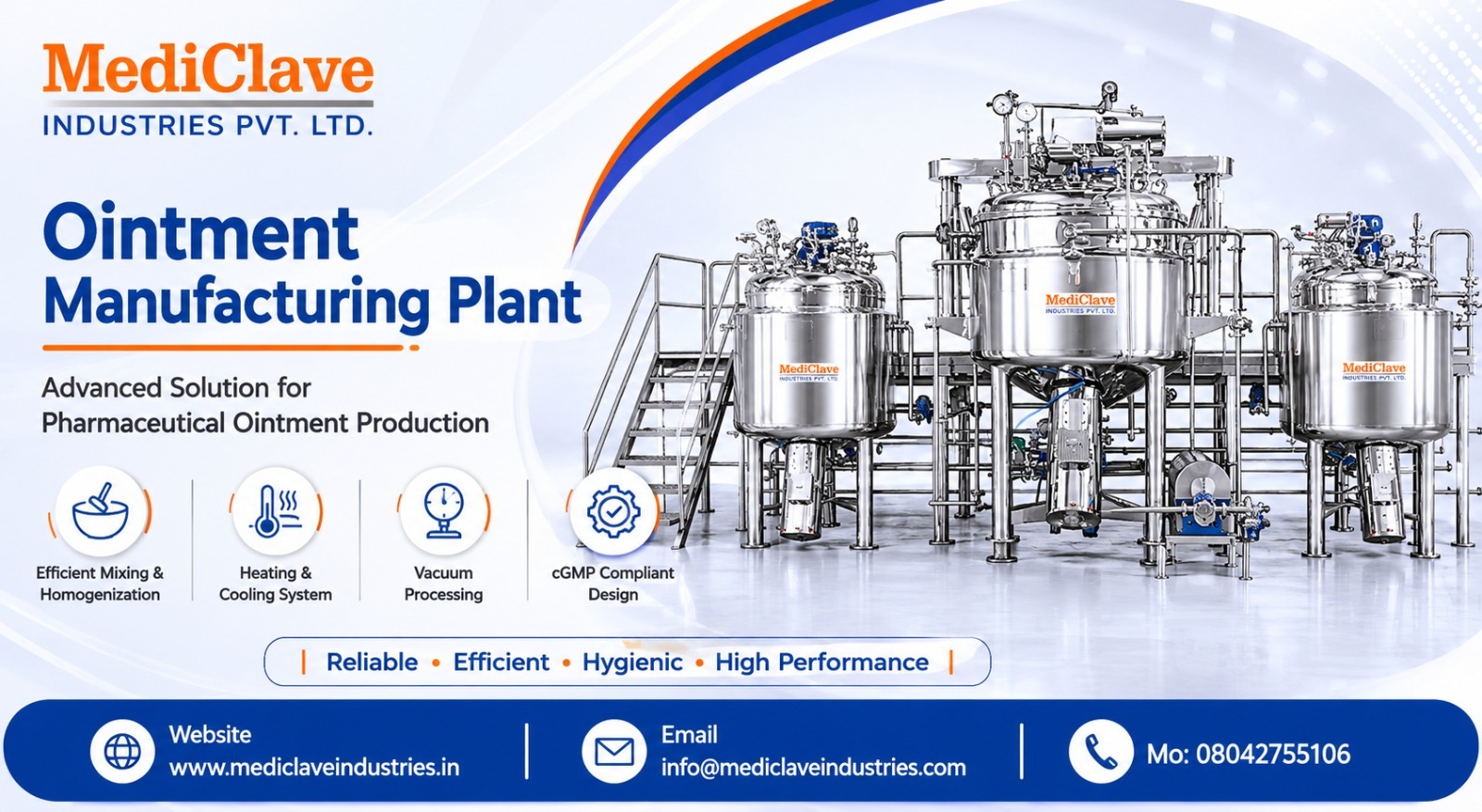
Ointment Manufacturing Plant: Complete Guide to Pharmaceutical Ointment Production
Meta Title
Ointment Manufacturing Plant Manufacturer in India | Pharmaceutical Ointment Production Equipment
Meta Description
Discover how an Ointment Manufacturing Plant improves pharmaceutical production with advanced mixing, homogenization, heating, cooling, and cGMP-compliant processing technology.
Introduction
In the pharmaceutical industry, the production of high-quality ointments, creams, gels, and topical formulations requires precision, consistency, and strict compliance with quality standards. An Ointment Manufacturing Plant is designed to meet these requirements by providing controlled mixing, homogenization, heating, cooling, and transfer processes within a single integrated system.
As pharmaceutical manufacturers continue to increase production capacity while maintaining product quality, modern ointment manufacturing equipment has become essential. A well-designed plant not only improves productivity but also ensures batch-to-batch consistency, product stability, and compliance with cGMP regulations.
Whether manufacturing medicated ointments, cosmetic creams, herbal formulations, or dermatological products, choosing the right ointment manufacturing plant plays a critical role in achieving efficient and reliable production.
What is an Ointment Manufacturing Plant?
An Ointment Manufacturing Plant is a complete processing system used for manufacturing pharmaceutical ointments, creams, gels, lotions, and other semi-solid formulations.
The plant typically includes:
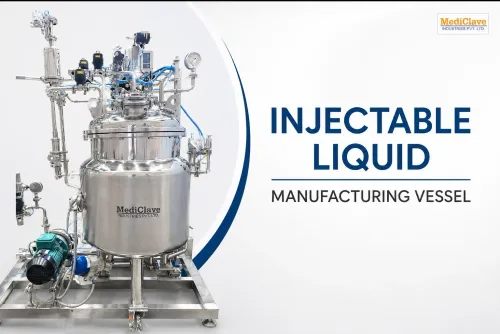
Manufacturing Vessel
Oil Phase Vessel
Water Phase Vessel
Vacuum System
Homogenizer
Transfer Pump
Control Panel
Product Storage Tank
These components work together to ensure uniform mixing, proper emulsification, and consistent product quality throughout the manufacturing process.
For detailed specifications, you can explore our Ointment Manufacturing Plant Product Page:
Ointment / Cream / Toothpaste / Gel Manufacturing Plant
Why is an Ointment Manufacturing Plant Important?
Modern pharmaceutical production demands high-quality formulations that are smooth, stable, and free from contamination. Manual manufacturing methods often lead to inconsistencies in texture, viscosity, and product performance.
An automated ointment manufacturing plant offers several advantages:
Uniform product consistency
Faster production cycles
Reduced human intervention
Improved hygiene standards
Better process control
Enhanced product quality
Compliance with pharmaceutical regulations
These benefits make the equipment indispensable for pharmaceutical, cosmetic, and healthcare manufacturers.
Working Principle of an Ointment Manufacturing Plant
The manufacturing process begins with the preparation of different phases of the formulation.
Step 1: Raw Material Loading
Ingredients are loaded into separate vessels according to the formulation requirements.
Step 2: Heating Process
Oil and water phases are heated individually to the desired temperature.
Step 3: Mixing & Emulsification
The heated phases are transferred into the manufacturing vessel where mixing and emulsification occur.
Step 4: Homogenization
A high-speed homogenizer breaks down particles into finer sizes, creating a smooth and stable product.
Step 5: Vacuum Processing
Vacuum technology removes entrapped air bubbles and improves product quality.
Step 6: Cooling Cycle
The product is cooled under controlled conditions to maintain stability and consistency.
Step 7: Product Transfer
The finished product is transferred to storage tanks or filling machines for packaging.
This process ensures efficient production while maintaining pharmaceutical quality standards.
Main Components of an Ointment Manufacturing Plant
Manufacturing Vessel
The primary vessel where mixing and homogenization take place.
Features:
SS316L Product Contact Parts
Jacketed Construction
Agitator System
Vacuum Capability
Oil Phase Vessel
Used for preparing oil-based ingredients before transfer to the main vessel.
Water Phase Vessel
Used for heating and preparing water-soluble ingredients.
Homogenizer
The homogenizer ensures uniform particle distribution and smooth texture.
Benefits:
Better Product Stability
Improved Appearance
Enhanced Product Quality
Vacuum System
Vacuum processing eliminates air pockets and improves shelf life.
Control Panel
Modern PLC-based control systems provide precise control over:
Temperature
Mixing Speed
Vacuum Level
Processing Time
Applications of Ointment Manufacturing Plant
The versatility of the plant allows manufacturers to produce a wide range of products.
Pharmaceutical Products
Antibiotic Ointments
Antifungal Creams
Pain Relief Gels
Dermatological Products
Cosmetic Products
Beauty Creams
Moisturizers
Face Gels
Body Lotions
Healthcare Products
Herbal Ointments
Medical Gels
Therapeutic Creams
Skin Care Formulations
Benefits of Vacuum Ointment Manufacturing Technology
One of the most important features of modern systems is vacuum processing.
Improved Product Stability
Vacuum conditions reduce oxidation and improve formulation stability.
Bubble-Free Product
Air removal creates a smooth and premium-quality product.
Better Shelf Life
Reduced air content helps improve product preservation.
Enhanced Appearance
The final product has a superior texture and visual quality.
Importance of cGMP Compliance
Pharmaceutical manufacturers must follow strict cGMP guidelines to ensure product safety and quality.
A cGMP-compliant ointment manufacturing plant provides:
Hygienic Design
Easy Cleaning
Validation Support
Process Documentation
Consistent Product Quality
Manufacturers seeking regulatory compliance should always invest in equipment designed according to pharmaceutical standards.
To understand pharmaceutical sterilization and quality assurance processes, you can also read:
Mediclave Industries Private Limited—Pharmaceutical Sterilization Solution
Factors to Consider When Selecting an Ointment Manufacturing Plant
Before purchasing equipment, manufacturers should evaluate several important factors.
Production Capacity
Choose a capacity that matches current production needs while allowing future expansion.
Product Type
Different formulations require different processing capabilities.
Automation Level
PLC and HMI-based systems improve process control and productivity.
Material of Construction
SS316L contact parts are recommended for pharmaceutical applications.
Validation Requirements
Ensure the equipment supports IQ, OQ, and PQ validation processes.
Service Support
Reliable technical support is critical for long-term operation.
How Automation Improves Pharmaceutical Manufacturing
Automation has transformed pharmaceutical production by increasing efficiency and reducing process variations.
Key advantages include:
Reduced Human Error
Improved Productivity
Accurate Batch Records
Better Process Repeatability
Faster Production Cycles
As production demands continue to grow, automated ointment manufacturing plants provide a competitive advantage for manufacturers.
To learn more about pharmaceutical process equipment, you may also read:
Pharmaceutical Process Equipment—Mediclave Industries Private Limited
Why Choose Mediclave Industries?
Mediclave Industries provides advanced pharmaceutical processing equipment designed to meet modern manufacturing requirements.
Our solutions offer:
Robust Construction
cGMP Compliance
Advanced Automation
Energy-Efficient Design
Reliable Performance
Customizable Capacities
With a focus on quality, innovation, and customer satisfaction, Mediclave Industries supports pharmaceutical manufacturers across India and international markets.
Conclusion
An Ointment Manufacturing Plant is one of the most important investments for pharmaceutical and cosmetic manufacturers seeking efficient, hygienic, and high-quality production. By integrating mixing, homogenization, vacuum processing, heating, and cooling into a single system, these plants deliver consistent product quality while improving operational efficiency.
For manufacturers aiming to increase productivity, maintain regulatory compliance, and produce premium-quality ointments, creams, and gels, a modern ointment manufacturing plant provides a reliable and future-ready solution.
FAQ
What is an Ointment Manufacturing Plant?
An Ointment Manufacturing Plant is a pharmaceutical processing system used to manufacture ointments, creams, gels, and semi-solid formulations.
What products can be manufactured in an Ointment Manufacturing Plant?
Ointments, creams, gels, lotions, cosmetic products, and topical pharmaceutical formulations.
Why is vacuum technology used in ointment manufacturing?
Vacuum processing removes air bubbles, improves product stability, and enhances product quality.
Is an Ointment Manufacturing Plant cGMP compliant?
Modern pharmaceutical plants are designed according to cGMP requirements and support validation processes.
What industries use Ointment Manufacturing Plants?
Pharmaceutical, cosmetic, herbal, healthcare, and personal care industries use these systems extensively.
@Ahmedabad @Mumbai @Delhi @NewDelhi @Bangalore @Hyderabad @Chennai @Pune @Surat @Vadodara @Rajkot @Gandhinagar @Kolkata @Jaipur @Udaipur @Jodhpur @Indore @Bhopal @Nagpur @Nashik @Aurangabad @Lucknow @Kanpur @Patna @Ranchi @Bhubaneswar @Raipur @Chandigarh @Ludhiana @Amritsar @Jammu @Srinagar @Dehradun @Noida @Gurgaon @Faridabad @Sonipat @Panipat @Visnagar @Mehsana @Anand @Bhavnagar @Jamnagar @Morbi @Vapi @Silvassa @Goa @Kochi @Trivandrum @Coimbatore @Madurai @Vijayawada @Visakhapatnam @Mysore @Hubli @Belgaum @Tirupati @Salem @Tiruppur @Bikaner @Ajmer @Alwar @Haridwar @Shimla @Manali @Agra @Varanasi @Prayagraj @Guwahati @Shillong @Imphal @Aizawl @Itanagar @Gangtok @Dibrugarh @Siliguri @Jabalpur @Gwalior @Kolhapur @Solapur @Thane @NaviMumbai @Kalyan @Palghar @Rewari @Hisar @Rohtak @Karnal @Bhilai @Durg @Cuttack @Jamshedpur @Hosur @Kakinada @Warangal @Nellore @Kota @Sikar @Bharuch @Junagadh @Porbandar @Kutch @Dwarka @Amravati @Akola @Yavatmal @Satara @Sangli @Ratnagiri @Ahmednagar @Latur @Nanded @Beed @Jalgaon @Dhule @Parbhani @Osmanabad @Wardha @Chandrapur @Gondia @Bhandara @Malegaon @Ujjain @Ratlam @Dewas @Sagar @Satna @Rewa @Chhindwara @Sehore @Vidisha @Betul @Bilaspur @Korba @Ambikapur @Jagdalpur @Rourkela @Sambalpur @Balasore @Puri @Berhampur @Muzaffarpur @Gaya @Darbhanga @Bhagalpur @Purnia @Hajipur @Begusarai @Dhanbad @Bokaro @Hazaribagh @Giridih @Asansol @Durgapur @Howrah @Kharagpur @Malda @Murshidabad @Darjeeling @Aligarh @Meerut @Ghaziabad @Moradabad @Bareilly @Saharanpur @Mathura @Firozabad @Jhansi @Gorakhpur @Faizabad @Ayodhya @Sitapur @Unnao @Barabanki @Raebareli @Etawah @Muzaffarnagar @Bulandshahr @Rampur @Basti @Bahraich @Shahjahanpur @Haldwani @Rudrapur @Nainital @Rishikesh @Pathankot @Patiala @Mohali @Bathinda @Jalandhar @Hoshiarpur @Ambala @Yamunanagar @Kurukshetra @Sirsa @Bhiwani @Jhajjar @Panchkula @Dharamshala @Mandi @Kullu @Leh @Anantnag @Baramulla @Pulwama @Udhampur @Samba @Kathua @Guntur @Rajahmundry @Eluru @Kadapa @Anantapur @Karimnagar @Nizamabad @Khammam @Mahbubnagar @Secunderabad @Kurnool @Ballari @Davanagere @Shimoga @Mangalore @Udupi @Bijapur @Tumkur @Chikmagalur @Karwar @Erode @Vellore @Thoothukudi @Kanchipuram @Namakkal @Dindigul @Karur @Cuddalore @Pondicherry @Palakkad @Thrissur @Kannur @Alappuzha @Kollam @Kottayam @Pathanamthitta @Bhilwara @Chittorgarh @Pali @Barmer @SriGanganagar @Hanumangarh @Tonk @Bundi @Neemuch @Godhra @Patan @Surendranagar @Botad @Amreli @Valsad @Navsari @Dahod @Nadiad @Kalol @Mundra @Veraval @Somnath @Diu @Daman Ahmedabad