Thank you for writing to us. One of our executive will reach back to you through your submitted medium. In case there’s an urgency, feel free to connect over WhatsApp for faster response.
Prefer calling? Dial +917041232204 (International callers) or +917041232204 (Indian callers).
Ointment Manufacturing Plant: The Backbone of Pharmaceutical Cream and Ointment Production Ahmedabad
Ointment Manufacturing Plant – Complete Guide to Ointment Production Equipment | Ahmedabad
In today's pharmaceutical industry, the demand for high-quality ointments, creams, gels, lotions, and topical formulations continues to grow rapidly. Whether it is a medicated skin cream, antiseptic ointment, cosmetic lotion, or dermatological gel, manufacturers require precision, consistency, and compliance throughout the production process. This is where an Ointment Manufacturing Plant plays a crucial role.
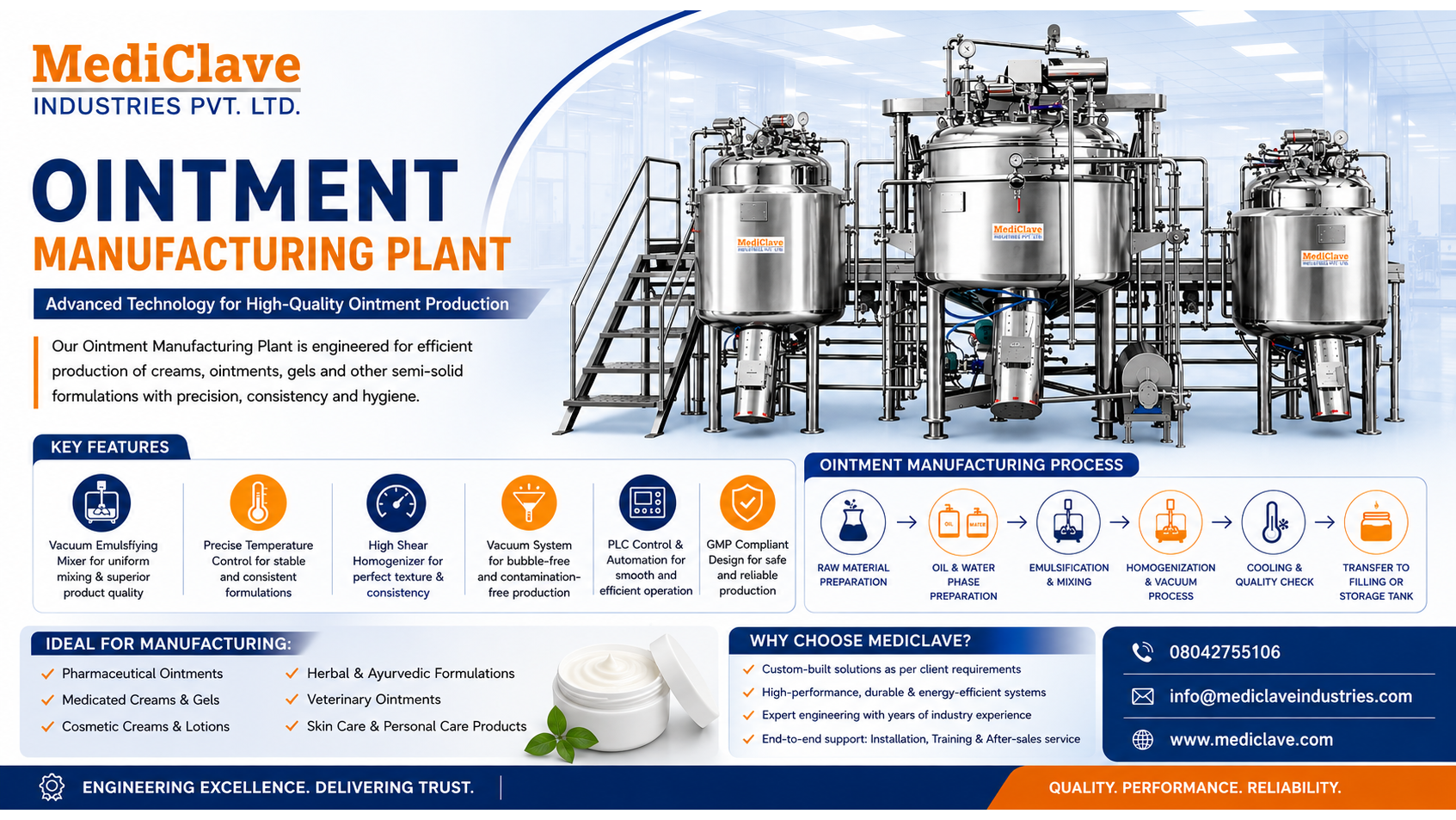
An Ointment Manufacturing Plant is an integrated processing system specifically designed for the manufacturing of semi-solid pharmaceutical and cosmetic products. These plants combine advanced mixing, homogenization, heating, cooling, vacuum processing, and transfer systems to ensure uniform product quality while meeting stringent GMP requirements.
Modern ointment manufacturing plants are engineered to deliver efficient production, reduce contamination risks, improve batch consistency, and maximize operational productivity.
What is an Ointment Manufacturing Plant?
An Ointment Manufacturing Plant is a complete production setup used to manufacture semi-solid products such as:
Pharmaceutical ointments
Medicated creams
Cosmetic creams
Skin care lotions
Dermatological formulations
Herbal creams
Antiseptic gels
Moisturizers
Sunscreen formulations
Veterinary ointments
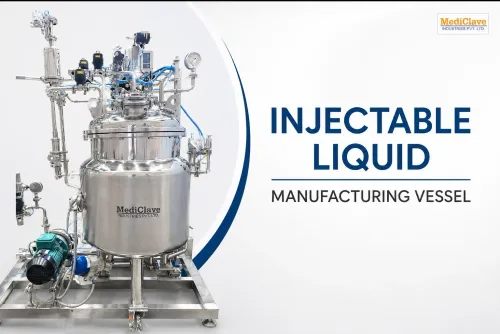
The plant consists of multiple interconnected vessels and processing equipment designed to prepare, mix, homogenize, process, and transfer the final product under controlled conditions.
By integrating automation and advanced processing technologies, manufacturers can achieve superior product quality while maintaining compliance with international pharmaceutical standards.
Manufacturers can produce larger batches efficiently.
Lower Operational Costs
Optimized processing reduces energy and labor requirements.
Industries That Use Ointment Manufacturing Plants
Pharmaceutical Industry
Production of medicinal creams and ointments.
Cosmetic Industry
Manufacturing beauty creams, lotions, and moisturizers.
Personal Care Industry
Production of skincare and wellness products.
Herbal Industry
Preparation of herbal and Ayurvedic formulations.
Veterinary Industry
Manufacturing animal healthcare ointments and creams.
Key Features to Look for in an Ointment Manufacturing Plant
When selecting a plant, manufacturers should consider:
GMP-compliant design
Stainless steel construction
Vacuum processing capability
PLC-based automation
CIP (Clean-In-Place) system
High-shear homogenizer
Energy-efficient operation
User-friendly HMI controls
Easy maintenance
Batch recording and data logging
These features contribute to improved efficiency and regulatory compliance.
The Future of Ointment Manufacturing
The pharmaceutical industry is rapidly moving toward smart manufacturing and automation. Modern Ointment Manufacturing Plants now incorporate:
Industry 4.0 technologies
Automated recipe management
Real-time process monitoring
Advanced data analytics
Remote diagnostics
Energy-efficient systems
These innovations help manufacturers improve productivity while maintaining the highest standards of quality and safety.
Why Choose Mediclave Industries for Ointment Manufacturing Plants?
At Mediclave Industries Pvt. Ltd., we design and manufacture advanced Ointment Manufacturing Plants tailored to the evolving needs of pharmaceutical, cosmetic, and healthcare manufacturers.
Our systems are engineered to provide:
✔ Superior mixing performance
✔ Efficient homogenization
✔ Vacuum processing technology
✔ GMP-compliant construction
✔ Reliable automation systems
✔ Consistent product quality
✔ High operational efficiency
Whether you manufacture pharmaceutical ointments, cosmetic creams, gels, or lotions, Mediclave delivers complete processing solutions designed for long-term performance and regulatory compliance.
Conclusion
An Ointment Manufacturing Plant is far more than a mixing system—it is a complete production solution that ensures product consistency, quality, safety, and efficiency. As the demand for pharmaceutical and cosmetic semi-solid products continues to increase, investing in a modern, automated ointment manufacturing plant becomes essential for manufacturers seeking competitive advantage and regulatory compliance.
With advanced vacuum processing, homogenization technology, and GMP-focused design, modern Ointment Manufacturing Plants provide the foundation for reliable, high-quality production in today's fast-evolving pharmaceutical and cosmetic industries.

 Chat with us