
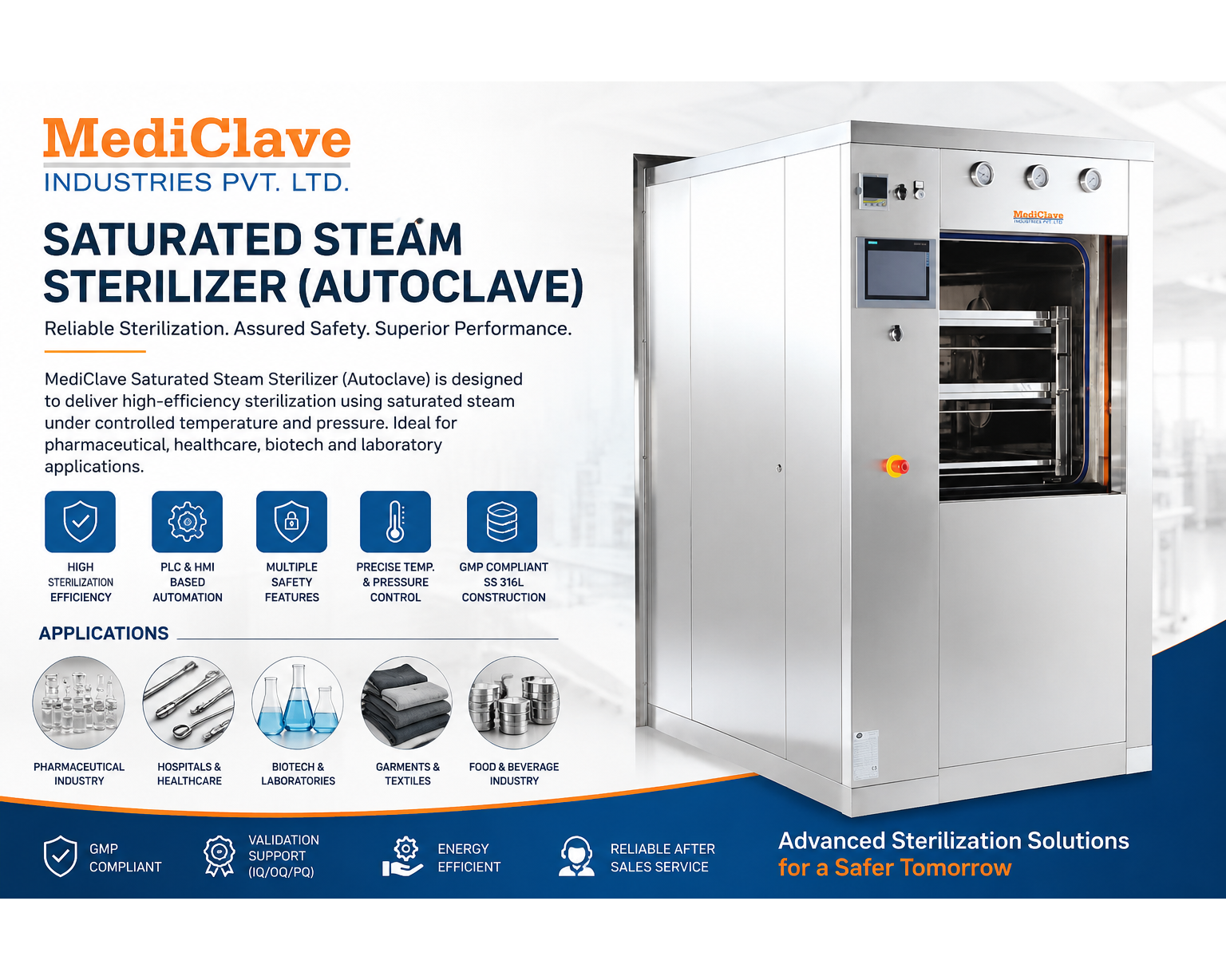
In pharmaceutical manufacturing, healthcare facilities, biotechnology laboratories, and research industries, sterilization is one of the most critical processes for maintaining product safety and contamination control. As industries continue to demand higher sterility standards and regulatory compliance, the importance of reliable sterilization equipment has increased significantly.
Among the most trusted and widely used sterilization technologies, the Saturated Steam Sterilizer (Autoclave) stands out as an efficient, safe, and validated solution for sterilizing pharmaceutical equipment, laboratory instruments, culture media, garments, glassware, and healthcare products.
Known for its powerful sterilization performance, uniform heat penetration, and dependable operation, the Saturated Steam Sterilizer has become an essential part of modern pharmaceutical and medical infrastructure.
What is a Saturated Steam Sterilizer (Autoclave)?
A Saturated Steam Sterilizer, commonly known as an Autoclave, is a sterilization system that uses saturated steam under controlled pressure and temperature conditions to eliminate bacteria, viruses, fungi, and microbial spores.
The sterilization process works by exposing materials to high-temperature saturated steam for a specific holding time, ensuring complete destruction of harmful microorganisms.
Saturated steam sterilization is considered one of the most reliable and effective sterilization methods because steam provides excellent heat transfer and deep penetration into sterilized materials.
Working Principle of Saturated Steam Sterilizer
The autoclave operates on the principle of moist heat sterilization using saturated steam.
Basic Sterilization Process:
-
Loading Phase
Materials or products are loaded into the sterilization chamber. -
Air Removal Process
Air inside the chamber is removed using vacuum or steam flushing systems. -
Steam Injection
Saturated steam enters the chamber under controlled pressure. -
Sterilization Holding Time
Temperature and pressure are maintained for a validated cycle duration. -
Exhaust & Drying
Steam is exhausted and drying process begins. -
Cooling & Unloading
Sterilized materials are safely unloaded after cycle completion.
This controlled process ensures highly effective sterilization with repeatable and validated results.
Why Saturated Steam is Preferred for Sterilization
Saturated steam is highly effective because it contains maximum thermal energy and transfers heat rapidly to the surface of materials.
Benefits of Saturated Steam:
- Excellent heat penetration
- Faster sterilization cycles
- Uniform temperature distribution
- Reliable microbial destruction
- Safe for pharmaceutical applications
- Environment-friendly sterilization method
Due to these advantages, saturated steam sterilization is widely accepted in pharmaceutical and healthcare industries worldwide.
Key Features of Saturated Steam Sterilizer (Autoclave)
1. High Sterilization Efficiency
The system effectively destroys microorganisms, bacterial spores, and pathogens using high-temperature saturated steam.
Common sterilization temperatures include:
- 121°C
- 126°C
- 134°C
This ensures reliable sterilization performance for critical applications.
2. PLC & HMI Based Automation
Modern autoclaves are equipped with advanced PLC control systems and touchscreen HMI interfaces.
Automation features include:
- Automatic cycle operation
- Recipe storage
- Alarm systems
- Real-time monitoring
- Batch recording
- Password protection
- Data logging
These features improve operational safety and process accuracy.
3. Uniform Temperature Distribution
Advanced chamber design ensures uniform steam circulation and heat penetration throughout the chamber.
Benefits include:
- Consistent sterilization results
- Reduced cold spots
- Improved process validation
- Better sterility assurance
Uniform sterilization is essential for pharmaceutical compliance and product safety.
4. Vacuum & Drying System
Many advanced autoclaves include vacuum drying systems that help remove moisture after sterilization.
Advantages include:
- Faster drying process
- Reduced contamination risk
- Improved material handling
- Better productivity
Vacuum-assisted systems are especially useful for porous loads and garments.
5. GMP-Compliant Stainless Steel Construction
Saturated Steam Sterilizers are manufactured using high-quality stainless steel materials such as SS 316L and SS 304.
Key hygienic features include:
- Smooth mirror finish
- Corrosion resistance
- Crevice-free construction
- Sanitary piping
- Easy cleaning and maintenance
These features support GMP and FDA compliance requirements.
6. Safety Interlock Systems
Modern sterilizers are designed with multiple safety systems for secure operation.
Safety features include:
- Door safety interlocks
- Pressure protection systems
- Temperature safety alarms
- Emergency stop systems
- Low water level protection
These systems ensure operator safety and equipment reliability.
Applications of Saturated Steam Sterilizer
Pharmaceutical Industry
Used for sterilizing:
- Glassware
- Vials
- Ampoules
- Culture media
- Machine parts
- Stainless steel utensils
- Garments
- Filters
Healthcare & Hospitals
Used for sterilizing:
- Surgical instruments
- Medical devices
- Dressing materials
- Hospital linen
- Laboratory equipment
Biotechnology & Research Laboratories
Ideal for sterilizing:
- Media preparation
- Lab instruments
- Biohazard waste
- Research materials
Food & Beverage Industry
Used for sterilization and microbial control in food processing applications.
Advantages of Saturated Steam Sterilizer
Reliable Sterilization
Provides highly effective microbial destruction.
Faster Processing
Steam offers rapid heat transfer and reduced cycle times.
Eco-Friendly Operation
No harmful chemicals are used in the process.
Cost-Effective Solution
Low operational and maintenance costs.
Better Validation Support
Supports pharmaceutical validation and documentation.
Long Equipment Life
Durable stainless steel construction ensures long-term reliability.
Why Pharmaceutical Industries Prefer Steam Sterilization
Pharmaceutical industries prefer saturated steam sterilization because it provides:
- High sterility assurance
- Excellent process repeatability
- Regulatory compliance
- Safe operation
- Reliable validation
- Efficient batch processing
As pharmaceutical regulations become stricter, steam sterilization remains one of the most trusted sterilization methods globally.
Important Factors to Consider Before Buying
Before selecting a Saturated Steam Sterilizer, industries should evaluate:
Chamber Capacity
Choose according to production volume and load size.
Automation Level
PLC-based systems improve process control.
Material Construction
SS 316L contact parts are preferred for pharma applications.
Validation Support
Ensure availability of IQ, OQ, and PQ documentation.
Utility Requirements
Evaluate steam, water, and power consumption.
After-Sales Service
Reliable support is essential for uninterrupted operation.
Future of Steam Sterilization Technology
Modern sterilization technology is continuously evolving with innovations such as:
- IoT-enabled monitoring
- Smart automation systems
- Remote diagnostics
- AI-based process optimization
- Energy-efficient sterilization cycles
- Advanced data recording systems
These advancements are helping industries achieve higher productivity, safety, and compliance standards.
Conclusion
The Saturated Steam Sterilizer (Autoclave) remains one of the most reliable and efficient sterilization solutions for pharmaceutical, healthcare, biotechnology, and research industries. Its ability to deliver uniform, validated, and contamination-free sterilization makes it an essential part of modern industrial operations.
With advanced automation, GMP-compliant construction, safety systems, and superior sterilization performance, modern autoclaves help industries maintain product quality, regulatory compliance, and operational efficiency.
As industries continue to focus on safety, sterility assurance, and process automation, Saturated Steam Sterilizers will continue to play a vital role in ensuring reliable and effective sterilization processes worldwide.
@Ahmedabad @Mumbai @Delhi @NewDelhi @Bangalore @Hyderabad @Chennai @Pune @Surat @Vadodara @Rajkot @Gandhinagar @Kolkata @Jaipur @Udaipur @Jodhpur @Indore @Bhopal @Nagpur @Nashik @Aurangabad @Lucknow @Kanpur @Patna @Ranchi @Bhubaneswar @Raipur @Chandigarh @Ludhiana @Amritsar @Jammu @Srinagar @Dehradun @Noida @Gurgaon @Faridabad @Sonipat @Panipat @Visnagar @Mehsana @Anand @Bhavnagar @Jamnagar @Morbi @Vapi @Silvassa @Goa @Kochi @Trivandrum @Coimbatore @Madurai @Vijayawada @Visakhapatnam @Mysore @Hubli @Belgaum @Tirupati @Salem @Tiruppur @Bikaner @Ajmer @Alwar @Haridwar @Shimla @Manali @Agra @Varanasi @Prayagraj @Guwahati @Shillong @Imphal @Aizawl @Itanagar @Gangtok @Dibrugarh @Siliguri @Jabalpur @Gwalior @Kolhapur @Solapur @Thane @NaviMumbai @Kalyan @Palghar @Rewari @Hisar @Rohtak @Karnal @Bhilai @Durg @Cuttack @Jamshedpur @Hosur @Kakinada @Warangal @Nellore @Kota @Sikar @Bharuch @Junagadh @Porbandar @Kutch @Dwarka @Amravati @Akola @Yavatmal @Satara @Sangli @Ratnagiri @Ahmednagar @Latur @Nanded @Beed @Jalgaon @Dhule @Parbhani @Osmanabad @Wardha @Chandrapur @Gondia @Bhandara @Malegaon @Ujjain @Ratlam @Dewas @Sagar @Satna @Rewa @Chhindwara @Sehore @Vidisha @Betul @Bilaspur @Korba @Ambikapur @Jagdalpur @Rourkela @Sambalpur @Balasore @Puri @Berhampur @Muzaffarpur @Gaya @Darbhanga @Bhagalpur @Purnia @Hajipur @Begusarai @Dhanbad @Bokaro @Hazaribagh @Giridih @Asansol @Durgapur @Howrah @Kharagpur @Malda @Murshidabad @Darjeeling @Aligarh @Meerut @Ghaziabad @Moradabad @Bareilly @Saharanpur @Mathura @Firozabad @Jhansi @Gorakhpur @Faizabad @Ayodhya @Sitapur @Unnao @Barabanki @Raebareli @Etawah @Muzaffarnagar @Bulandshahr @Rampur @Basti @Bahraich @Shahjahanpur @Haldwani @Rudrapur @Nainital @Rishikesh @Pathankot @Patiala @Mohali @Bathinda @Jalandhar @Hoshiarpur @Ambala @Yamunanagar @Kurukshetra @Sirsa @Bhiwani @Jhajjar @Panchkula @Dharamshala @Mandi @Kullu @Leh @Anantnag @Baramulla @Pulwama @Udhampur @Samba @Kathua @Guntur @Rajahmundry @Eluru @Kadapa @Anantapur @Karimnagar @Nizamabad @Khammam @Mahbubnagar @Secunderabad @Kurnool @Ballari @Davanagere @Shimoga @Mangalore @Udupi @Bijapur @Tumkur @Chikmagalur @Karwar @Erode @Vellore @Thoothukudi @Kanchipuram @Namakkal @Dindigul @Karur @Cuddalore @Pondicherry @Palakkad @Thrissur @Kannur @Alappuzha @Kollam @Kottayam @Pathanamthitta @Bhilwara @Chittorgarh @Pali @Barmer @SriGanganagar @Hanumangarh @Tonk @Bundi @Neemuch @Godhra @Patan @Surendranagar @Botad @Amreli @Valsad @Navsari @Dahod @Nadiad @Kalol @Mundra @Veraval @Somnath @Diu @Daman Ahmedabad