
Introduction
In today’s pharmaceuticals, sterilization is not just a process—it’s a critical requirement for safety, compliance, and product quality. Among various sterilization technologies, the Superheated Water Sterilizer stands out as one of the most efficient and reliable methods, especially for liquid products and heat-sensitive materials.
What is a Superheated Water Sterilizer?
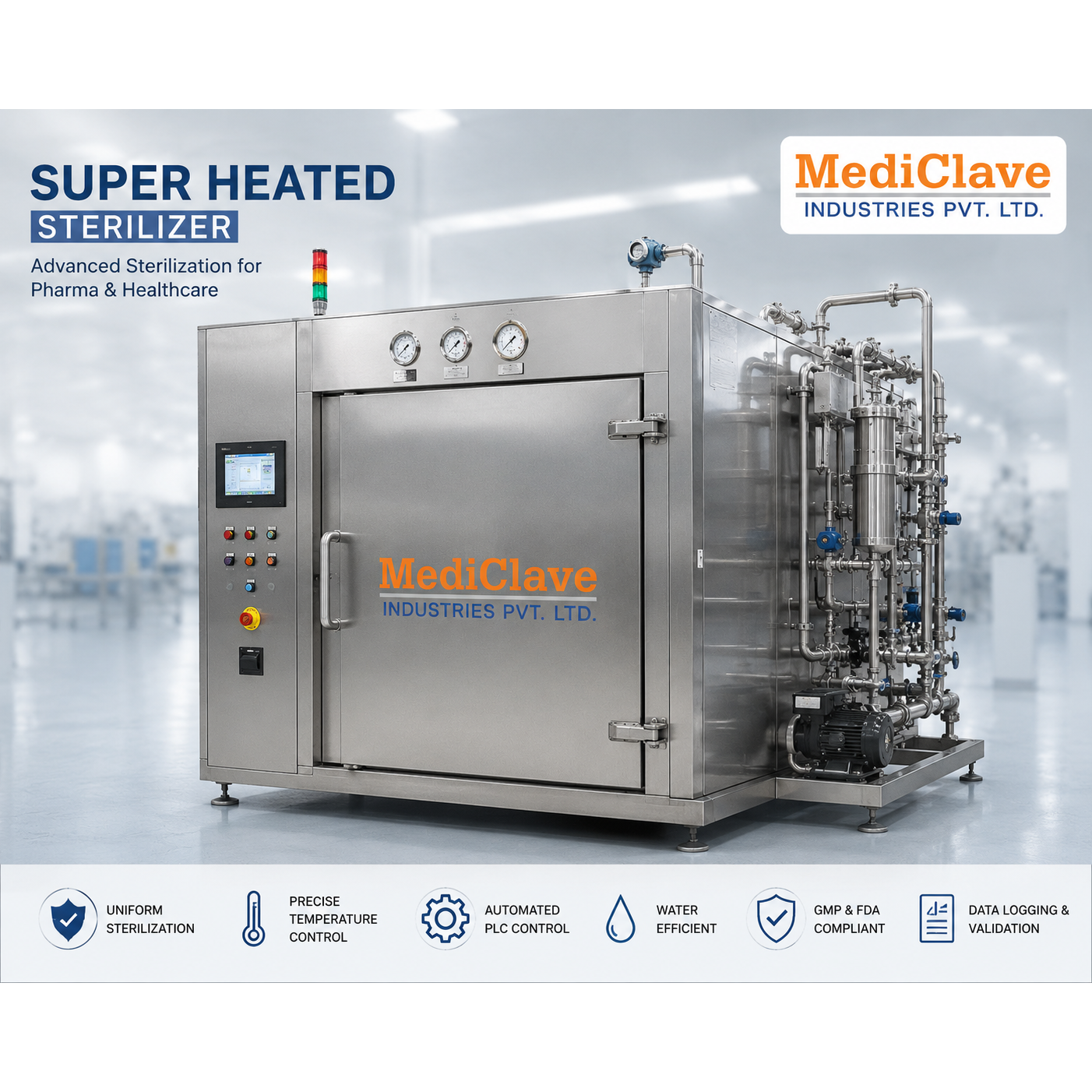
A Superheated Water Sterilizer is a high-performance sterilization system that uses water heated above its boiling point under controlled pressure conditions. This ensures uniform heat distribution and precise sterilization of products without causing damage.
It is widely used for:
- Injectable liquids
- IV fluids
- Glass bottles & vials
- Plastic containers
- Sealed pharmaceutical products
How Does It Work?
The system operates by circulating superheated water inside a sealed chamber.
Process Flow:
- Chamber loading with products
- Air removal and pressure control
- Superheated water circulation
- Uniform heat transfer
- Cooling cycle
This method ensures:
✔ No cold spots
✔ Consistent sterilization
✔ Product integrity maintained
Key Features of Superheated Water Sterilizer
✔ Uniform Heat Distribution
Advanced water circulation system ensures even temperature throughout the chamber.
✔ Gentle on Products
Ideal for sensitive materials like plastic bottles and sealed liquids.
✔ PLC-Based Automation
Fully automatic system with programmable cycles for easy operation.
✔ Energy Efficient
Water-based heat transfer reduces energy consumption compared to traditional methods.
✔ GMP & FDA Compliance
Designed as per international pharmaceutical standards.
✔ Data Logging & Validation
Supports batch recording, validation, and audit requirements.
Advantages Over Traditional Autoclaves
| Feature | Superheated Water Sterilizer | Traditional Autoclave |
|---|---|---|
| Heat Distribution | Excellent | Moderate |
| Product Safety | High | Medium |
| Suitable for Liquids | Highly Suitable | Limited |
| Uniformity | Very High | Variable |
| Container Damage Risk | Minimal | Higher |
Applications
The Superheated Water Sterilizer is extensively used in:
- Pharmaceutical manufacturing
- Injectable production units
- Food & beverage industries
- Hospitals & CSSD departments
- Biotechnology labs
Why Choose Our Superheated Water Sterilizer?
At Mediclave Industries, we provide advanced sterilization solutions designed for performance, reliability, and compliance.
What makes us different:
- Custom-built solutions
- High-quality stainless steel construction
- Advanced control systems
- Reliable after-sales support
- Competitive pricing
Conclusion
A Superheated Water Sterilizer is the perfect solution for industries that require safe, uniform, and efficient sterilization—especially for liquid products and sealed containers.
If you are looking to upgrade your sterilization process, this technology offers unmatched performance and reliability.
🔹 Call to Action
👉 Looking for the best Superheated Water Sterilizer for your facility?
Contact us today for expert consultation and customized solutions.
📞 Call Now | 📩 Email Us | 🌐 Visit Our Website
❓ FAQs – Superheated Water Sterilizer
Q1. What is a Superheated Water Sterilizer?
A: It is a sterilization system that uses pressurized hot water above boiling point for uniform and effective sterilization.
Q2. Where is it used?
A: Mainly in the pharmaceutical, healthcare, and food industries for liquid and sealed products.
Q3. What products can be sterilized?
A: IV fluids, vials, bottles, ampoules, and other sealed containers.
Q4. Is it safe for plastic containers?
A: Yes, it is ideal for plastic bottles as it provides gentle and uniform heating.
Q5. How is it better than a traditional autoclave?
A: It offers better heat distribution, reduced damage risk, and higher efficiency.
Q6. Does it ensure uniform sterilization?
A: Yes, the water circulation system eliminates cold spots.
Q7. Is the system automatic?
A: Yes, it comes with PLC-based fully automatic operation.
Q8. Does it support GMP standards?
A: Yes, it is designed to meet GMP and regulatory requirements.
Q9. Is validation possible?
A: Yes, it supports data logging and validation processes.
Q10. Is it energy efficient?
A: Yes, it consumes less energy compared to conventional systems.