

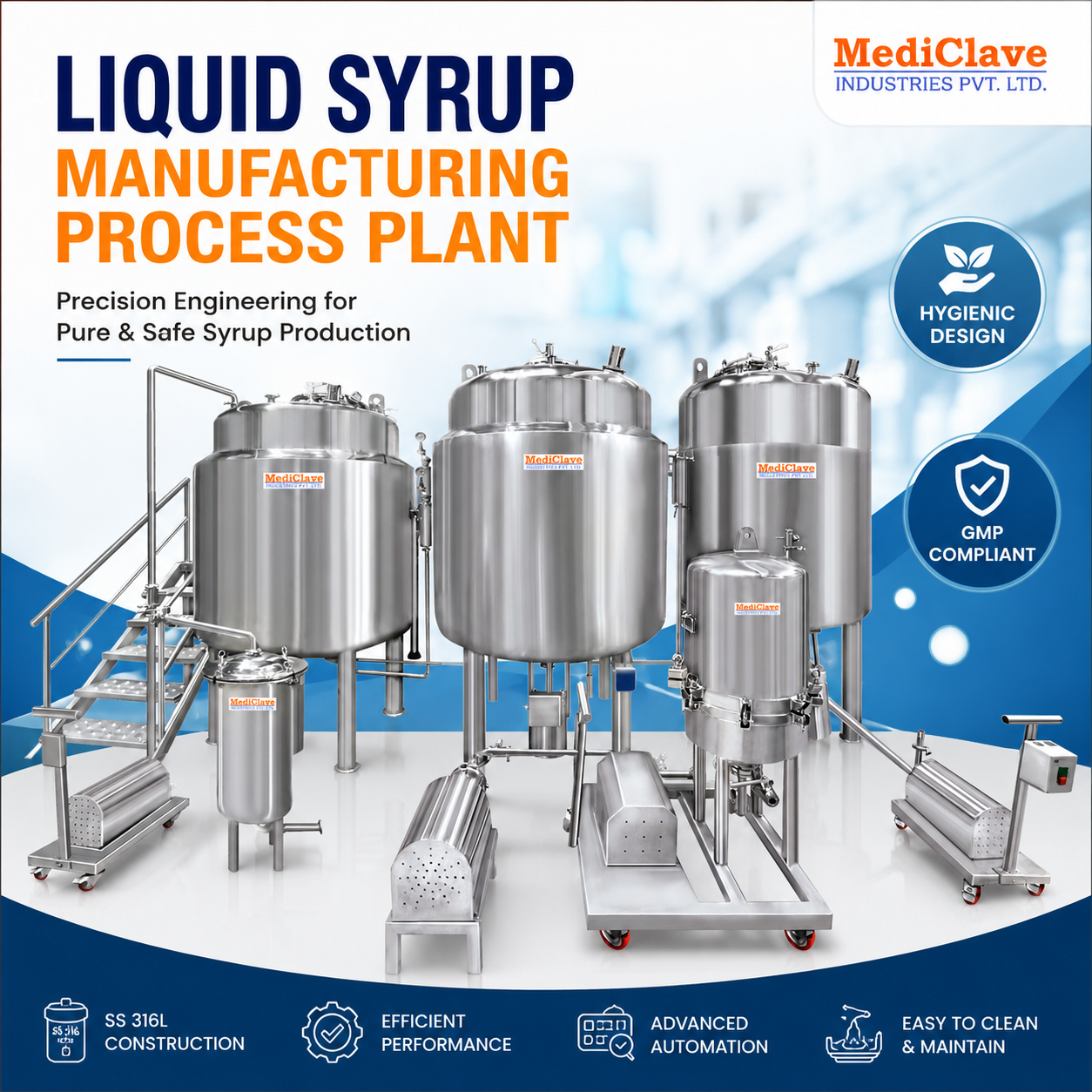
Liquid Syrup Manufacturing Process Plants Ahmedabad | Modern Pharmaceutical Production | Ahmedabad
The pharmaceutical industry depends on precision, hygiene, and consistency to produce safe and effective medicines. Among the many dosage forms available, liquid syrups remain one of the most preferred options for pediatric, geriatric, and general healthcare applications. Their pleasant taste, ease of administration, and accurate dosing make them an essential product in every pharmaceutical manufacturing facility.
To achieve high-quality syrup production, pharmaceutical companies require advanced equipment that ensures efficient mixing, controlled processing, contamination-free production, and compliance with international quality standards. This is where a Liquid Syrup Manufacturing Process Plant plays a crucial role.
A modern Liquid Syrup Manufacturing Process Plant is designed to automate and streamline every stage of syrup manufacturing, from ingredient preparation to mixing, filtration, storage, and transfer. It not only improves production efficiency but also guarantees product consistency, reduces manual intervention, and maintains the highest level of hygiene.
At Mediclave Industries Pvt. Ltd., we manufacture high-performance pharmaceutical process equipment that helps pharmaceutical companies meet stringent GMP, WHO-GMP, FDA, and other regulatory requirements. Our Liquid Syrup Manufacturing Process Plant is engineered with advanced technology, robust stainless-steel construction, and user-friendly automation to deliver reliable performance for years.
Whether you are establishing a new pharmaceutical manufacturing unit or upgrading your existing production facility, understanding the working principles and advantages of a Liquid Syrup Manufacturing Process Plant can help you make the right investment decision.
Understanding a Liquid Syrup Manufacturing Process Plant
A Liquid Syrup Manufacturing Process Plant is a complete integrated system specially developed for manufacturing pharmaceutical syrups, oral liquids, suspensions, herbal formulations, nutraceutical syrups, veterinary medicines, and other liquid formulations.
Instead of using multiple standalone machines, a complete process plant combines various equipment into one efficient production system. This integration minimizes contamination risks, shortens production time, improves cleaning efficiency, and increases productivity.
The manufacturing process generally includes:
- Water preparation
- Sugar syrup preparation
- Heating and cooling
- Mixing of active pharmaceutical ingredients (API)
- Addition of flavors and colors
- Homogenization
- Filtration
- Storage
- Transfer to filling machines
Every step is carefully controlled to maintain product quality throughout production.
Why Pharmaceutical Companies Prefer Automated Syrup Manufacturing Plants
Automation has transformed pharmaceutical manufacturing over the last decade. Manual production methods are gradually being replaced by automated process plants because they provide higher accuracy and significantly reduce production errors.
Some major reasons pharmaceutical companies prefer automated systems include:
- Consistent product quality
- Faster production cycles
- Reduced manpower requirement
- Improved hygiene
- Lower contamination risk
- Accurate ingredient dosing
- Better batch repeatability
- Reduced production cost
- Easier documentation
- Compliance with GMP standards
Modern automation also enables manufacturers to monitor temperature, pressure, mixing speed, and processing time with exceptional precision.
Major Components of a Liquid Syrup Manufacturing Process Plant
Although different manufacturers offer customized configurations, a complete syrup manufacturing plant generally consists of several interconnected units.
Manufacturing Vessel
The manufacturing vessel serves as the heart of the entire process. It is where ingredients are mixed under controlled temperature and agitation.
High-quality manufacturing vessels are generally fabricated from SS316L contact parts and SS304 non-contact parts to ensure corrosion resistance and pharmaceutical-grade hygiene.
Sugar Melting Vessel
Sugar forms the primary base for most pharmaceutical syrups. A dedicated sugar melting vessel dissolves sugar uniformly before it enters the main manufacturing vessel.
Uniform dissolution prevents crystallization and improves product stability.
Storage Vessel
Once the syrup is prepared, it is transferred to a storage vessel before filling operations begin.
Proper storage maintains product quality while preventing contamination during intermediate handling.
Transfer Pump
Sanitary transfer pumps move the liquid safely between vessels without affecting formulation quality.
These pumps are specially designed to minimize product loss while maintaining hygienic operation.
Filtration System
Filtration removes unwanted particles and ensures the final syrup remains crystal clear.
Multiple filtration stages improve product appearance and quality.
Control Panel
The control panel acts as the brain of the complete system.
Modern PLC-based panels allow operators to monitor:
- Temperature
- Pressure
- Mixing speed
- Batch timing
- Pump operation
- Valve control
- Cleaning cycles
Automation significantly reduces operator dependency.
Step-by-Step Syrup Manufacturing Process
Understanding the manufacturing workflow helps pharmaceutical companies appreciate the importance of each system component.
Step 1: Purified Water Preparation
The process begins with pharmaceutical-grade purified water.
Many pharmaceutical companies use a Pure Steam Generator, Multi Column Distillation Plant, and WFI Storage & Distribution System to maintain pharmaceutical water quality across production. These systems help ensure that water used during manufacturing meets stringent industry standards.
Step 2: Sugar Syrup Preparation
Sugar is mixed with purified water inside the sugar melting vessel.
Controlled heating speeds up dissolution while preventing caramelization.
The solution is continuously agitated until complete dissolution occurs.
Step 3: Transfer to Manufacturing Vessel
The prepared sugar syrup is transferred into the main manufacturing vessel through sanitary pipelines.
The closed transfer system prevents contamination and maintains hygiene.
Step 4: Addition of Active Ingredients
Pharmaceutical APIs are gradually added into the manufacturing vessel.
The agitator ensures uniform dispersion throughout the batch.
Precise mixing guarantees consistent drug concentration in every bottle.
Step 5: Mixing and Homogenization
High-efficiency mixing systems create a perfectly uniform formulation.
Depending on product requirements, homogenization may be used to achieve excellent stability.
Step 6: Addition of Flavors and Preservatives
Flavors, colors, sweeteners, preservatives, and stabilizers are introduced during this stage.
Accurate dosing ensures consistent taste and appearance across every production batch.
Step 7: Filtration
The finished syrup passes through pharmaceutical-grade filters.
Filtration removes microscopic particles and improves product clarity before storage.
Step 8: Storage and Filling
The finished syrup is transferred into storage vessels before being sent to automatic filling and packaging machines.
This completes the manufacturing cycle efficiently while maintaining pharmaceutical hygiene.
Industries That Use Liquid Syrup Manufacturing Plants
Liquid syrup manufacturing systems are widely used across multiple industries, including:
- Pharmaceutical companies
- Nutraceutical manufacturers
- Herbal medicine manufacturers
- Ayurvedic medicine manufacturers
- Veterinary medicine manufacturers
- Food supplement manufacturers
- Healthcare product manufacturers
Their versatility makes them an essential investment for modern production facilities.
Key Features of a Modern Liquid Syrup Manufacturing Process Plant
A high-quality process plant should include several advanced features that improve both production efficiency and product quality.
Some important features include:
- Stainless Steel SS316L product contact parts
- GMP-compliant construction
- Mirror polished internal surfaces
- Fully automatic PLC control
- User-friendly HMI interface
- CIP compatibility
- Low maintenance design
- Jacketed vessels for heating and cooling
- High-efficiency agitator
- Sanitary pipeline system
- Precision temperature control
- Hygienic valves and fittings
- Compact footprint
- Energy-efficient operation
- Easy cleaning and validation
These features help pharmaceutical manufacturers achieve reliable and repeatable production results.
Advantages of Installing a Liquid Syrup Manufacturing Process Plant
Investing in a modern syrup manufacturing system offers long-term operational benefits.
Some major advantages include:
Higher Production Capacity
Automated plants can produce significantly larger batches with consistent quality.
Better Product Consistency
Every batch maintains identical composition, viscosity, taste, and appearance.
Reduced Human Error
Automation minimizes manual intervention and improves process reliability.
Improved Hygiene
Closed manufacturing systems reduce contamination risks throughout production.
Lower Operating Costs
Efficient equipment consumes less energy and requires fewer operators.
Regulatory Compliance
Modern process plants simplify compliance with GMP and pharmaceutical regulations.
Easy Cleaning
Integrated cleaning systems reduce downtime between production batches.
Increased Productivity
Continuous workflow improves overall manufacturing efficiency and output.
Importance of GMP Compliance in Syrup Manufacturing
Pharmaceutical manufacturing is governed by strict regulatory requirements to ensure patient safety. A Liquid Syrup Manufacturing Process Plant must therefore be designed with Good Manufacturing Practice (GMP) principles in mind.
Key GMP considerations include stainless steel contact parts, crevice-free construction, sanitary piping, validated cleaning procedures, proper documentation, and easy inspection of critical process areas. These design elements help manufacturers produce safe, high-quality syrups while reducing the risk of contamination or batch rejection.
Modern pharmaceutical companies also benefit from automated process recording, which improves traceability and simplifies quality audits.
Quality Control in Liquid Syrup Manufacturing
Producing a pharmaceutical syrup is not only about mixing ingredients—it is about ensuring that every bottle leaving the production facility meets the same high standards. Quality control is therefore an essential part of the manufacturing process.
During production, several quality parameters are monitored, including:
- Appearance and clarity
- Color consistency
- pH value
- Viscosity
- Density
- Active ingredient concentration
- Microbial limits
- Preservative effectiveness
- Filling accuracy
- Stability over time
By using an advanced Liquid Syrup Manufacturing Process Plant, manufacturers can closely monitor these parameters throughout the production cycle. Automated control systems reduce batch variations and help maintain consistent product quality.
Why Cleaning and Sterilization Are Critical
One of the biggest challenges in pharmaceutical manufacturing is preventing cross-contamination between different batches. Proper cleaning and sterilization of equipment are essential for maintaining product purity and meeting regulatory standards.
Modern pharmaceutical plants use automated cleaning and sterilization systems that minimize manual intervention while improving efficiency.
For effective equipment cleaning, Mediclave Industries offers advanced CIP & SIP Systems, which automatically clean and sterilize tanks, pipelines, and processing equipment without dismantling the system. Learn more here:
CIP & SIP Systems: https://www.mediclaveindustries.in/cip-sip-systems/
These systems help manufacturers:
- Reduce cleaning time
- Save water and chemicals
- Improve production efficiency
- Ensure repeatable cleaning results
- Meet GMP validation requirements
Importance of Pharmaceutical Water Systems
Water is one of the most important raw materials in syrup manufacturing. Any impurities in water can directly affect product quality and patient safety.
A reliable pharmaceutical water generation system is therefore essential.
Mediclave Industries manufactures advanced Multi Column Distillation Plants, which produce high-purity distilled water suitable for pharmaceutical manufacturing.
Multi Column Distillation Plant: https://www.mediclaveindustries.in/multi-column-distillation-plant/
For sterile manufacturing applications, companies also rely on a Pure Steam Generator, which generates pharmaceutical-grade pure steam for sterilization.
Pure Steam Generator: https://www.mediclaveindustries.in/pure-steam-generator/
After purification, pharmaceutical water is safely stored and circulated using the WFI Storage & Distribution System, ensuring water quality is maintained until it reaches the manufacturing process.
WFI Storage & Distribution System: https://www.mediclaveindustries.in/wfi-storage-distribution-system/
Together, these systems form the backbone of a reliable pharmaceutical manufacturing facility.
Integration with Other Pharmaceutical Equipment
A Liquid Syrup Manufacturing Process Plant is often part of a complete pharmaceutical production line. Integrating compatible equipment improves efficiency, minimizes material handling, and creates a seamless manufacturing workflow.
For manufacturers producing creams, ointments, gels, or toothpaste in addition to syrups, Mediclave Industries also offers the Ointment/Cream/Toothpaste/Gel Manufacturing Plant, designed for hygienic and efficient processing of semi-solid formulations.
Ointment/Cream/Toothpaste/Gel Manufacturing Plant: https://www.mediclaveindustries.in/ointment-cream-toothpaste-gel-manufacturing-plant/
Using equipment from the same manufacturer ensures better compatibility, easier maintenance, and simplified technical support.
Applications of Liquid Syrup Manufacturing Process Plants
Modern Liquid Syrup Manufacturing Process Plants are highly versatile and can manufacture a wide range of products, including:
- Pharmaceutical syrups
- Cough syrups
- Antacid syrups
- Vitamin syrups
- Pediatric medicines
- Iron tonics
- Herbal syrups
- Ayurvedic formulations
- Nutraceutical syrups
- Veterinary liquid medicines
- Oral suspensions
- Health supplements
Their flexible design allows manufacturers to produce different formulations with minimal changeover time.
Factors to Consider Before Purchasing a Liquid Syrup Manufacturing Process Plant
Selecting the right equipment is a long-term investment. Before making a purchase, pharmaceutical companies should evaluate several important factors.
Production Capacity
Choose a plant that matches your current production requirements while allowing room for future expansion.
Material of Construction
Always prefer pharmaceutical-grade SS316L for product contact parts to ensure corrosion resistance and product safety.
Automation Level
PLC and HMI-based automation improves process control, reduces manual errors, and simplifies operation.
GMP Compliance
The equipment should comply with GMP, WHO-GMP, and other applicable pharmaceutical regulations.
Cleaning System
Integrated compatibility with CIP & SIP Systems reduces downtime and simplifies equipment validation.
Energy Efficiency
Modern equipment should be designed to minimize power consumption while maximizing productivity.
Service Support
Choose a manufacturer with strong technical support, installation assistance, spare parts availability, and after-sales service.
Why Choose Mediclave Industries?
Mediclave Industries Pvt. Ltd. has established itself as a trusted manufacturer of pharmaceutical process equipment by combining engineering excellence with a commitment to quality.
Customers choose Mediclave Industries because of:
- High-quality stainless-steel construction
- Advanced manufacturing technology
- GMP-compliant equipment
- Customized plant solutions
- Reliable automation systems
- Experienced engineering team
- Excellent after-sales support
- Competitive pricing
- Timely project execution
- Focus on customer satisfaction
Whether you are setting up a new pharmaceutical facility or upgrading an existing one, Mediclave Industries offers dependable solutions tailored to your production needs.
Future Trends in Syrup Manufacturing
The pharmaceutical industry is rapidly embracing Industry 4.0 technologies, and syrup manufacturing is no exception. Future-ready manufacturing plants are expected to include:
- Smart PLC automation
- IoT-enabled process monitoring
- Remote diagnostics
- Predictive maintenance
- Digital batch recording
- Advanced energy management
- Improved process validation
- Real-time production analytics
These innovations help manufacturers increase productivity, reduce operational costs, and maintain superior product quality.
Frequently Asked Questions (FAQs)
1. What is a Liquid Syrup Manufacturing Process Plant?
It is an integrated pharmaceutical system used to manufacture liquid syrups, oral medicines, nutraceuticals, and other liquid formulations under controlled hygienic conditions.
2. Which industries use these plants?
They are widely used in pharmaceutical, nutraceutical, herbal, Ayurvedic, veterinary, and healthcare manufacturing industries.
3. What material is used for product contact parts?
Most pharmaceutical plants use SS316L stainless steel because of its excellent corrosion resistance and hygienic properties.
4. Why is automation important?
Automation improves production accuracy, reduces human error, increases productivity, and ensures consistent product quality.
5. Can the plant produce different types of syrups?
Yes. Modern plants can manufacture cough syrups, vitamin syrups, pediatric formulations, herbal syrups, nutraceutical liquids, and many other products.
6. Why are CIP & SIP Systems important?
They automatically clean and sterilize equipment, reducing contamination risks and ensuring compliance with pharmaceutical manufacturing standards.
7. How does a pharmaceutical water system improve production?
Purified water systems such as Multi Column Distillation Plants, Pure Steam Generators, and WFI Storage & Distribution Systems ensure that the water used in production meets pharmaceutical quality requirements.
Conclusion
A Liquid Syrup Manufacturing Process Plant is much more than a collection of processing vessels—it is the foundation of safe, efficient, and high-quality pharmaceutical liquid production. From precise ingredient mixing and temperature control to hygienic filtration, storage, and automated process management, every stage contributes to producing syrups that meet stringent quality standards.
As pharmaceutical manufacturing continues to evolve, investing in advanced, GMP-compliant equipment becomes essential for improving productivity, maintaining product consistency, and meeting global regulatory expectations. By integrating complementary systems such as CIP & SIP Systems, Pure Steam Generators, Multi Column Distillation Plants, WFI Storage & Distribution Systems, and Ointment/Cream/Toothpaste/Gel Manufacturing Plants, manufacturers can build a complete and efficient production ecosystem.
If you are looking for a reliable, high-performance Liquid Syrup Manufacturing Process Plant, Mediclave Industries Pvt. Ltd. offers expertly engineered solutions designed to meet the diverse needs of modern pharmaceutical manufacturers. With a focus on quality, innovation, and customer satisfaction, Mediclave Industries is committed to helping businesses achieve efficient, hygienic, and compliant pharmaceutical production while preparing them for future growth.



