

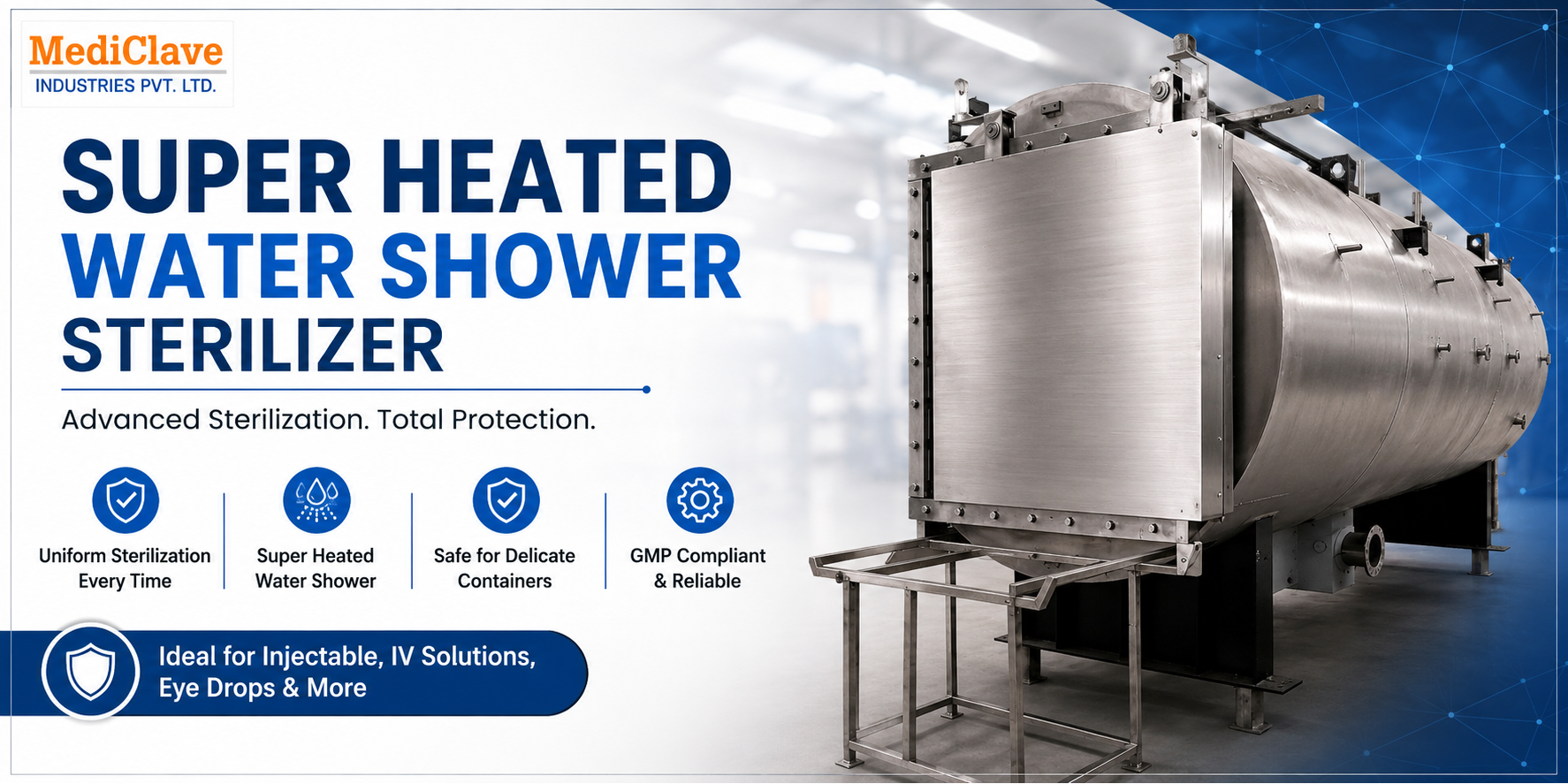
In the pharmaceutical industry, sterilization is one of the most important processes for ensuring product quality, patient safety, and regulatory compliance. Every injectable medicine, IV fluid, eye drop, vaccine, infusion bottle, and many other pharmaceutical products must undergo a validated sterilization process before reaching the market. Choosing the right sterilization equipment directly impacts product integrity, production efficiency, and compliance with GMP, WHO, US FDA, and EU GMP guidelines.
Among the various sterilization technologies available today, the Super Heated Water Shower Sterilizer has become one of the most trusted solutions for terminal sterilization of heat-sensitive pharmaceutical products. Its advanced design provides uniform heat distribution, precise temperature control, and gentle treatment of containers, making it ideal for products packaged in glass bottles, plastic bottles, ampoules, vials, IV bags, and pre-filled syringes.
At Mediclave Industries Pvt. Ltd., we manufacture high-performance Super Heated Water Shower Sterilizers designed to meet the demanding requirements of modern pharmaceutical and biotechnology industries. Our systems combine advanced automation, reliable sterilization performance, and GMP-compliant construction to help pharmaceutical manufacturers achieve consistent and validated sterilization results.
In this comprehensive guide, you will learn everything about Super Heated Water Shower Sterilizers, including their working principle, construction, applications, advantages, validation requirements, maintenance practices, and how to choose the right system for your facility.
What is a Super Heated Water Shower Sterilizer?
A Super Heated Water Shower Sterilizer is an advanced pharmaceutical sterilization system designed to sterilize sealed pharmaceutical products using superheated water circulated at controlled pressure and temperature.
Unlike traditional steam sterilizers, which use saturated steam as the primary sterilizing medium, this system continuously sprays superheated sterile water over the products from multiple directions. The circulating water ensures every container receives uniform heating regardless of its position inside the chamber.
Because the pressure inside the chamber is independently controlled using compressed air, the sterilizer prevents deformation, leakage, or breakage of delicate pharmaceutical containers during the sterilization cycle.
This makes the equipment particularly suitable for terminal sterilization of:
- Plastic bottles
- Glass bottles
- IV infusion bottles
- Ampoules
- Vials
- Eye drops
- Injectable solutions
- Large volume parenterals (LVP)
- Small volume parenterals (SVP)
- Pre-filled syringes
Why Terminal Sterilization is Important
Terminal sterilization is the process of sterilizing pharmaceutical products after they have been completely filled and sealed.
Unlike aseptic manufacturing, where sterility depends heavily on maintaining a sterile environment during production, terminal sterilization provides an additional level of assurance by destroying microorganisms present after packaging.
Benefits include:
- Improved patient safety
- Higher sterility assurance level (SAL)
- Reduced contamination risk
- Better regulatory compliance
- Longer product shelf life
- Consistent product quality
For injectable products, terminal sterilization is often the preferred method whenever the formulation can tolerate the required temperature.
Working Principle of a Super Heated Water Shower Sterilizer
The Super Heated Water Shower Sterilizer operates using a recirculating water system combined with steam heating and compressed air pressure control.
The process consists of several carefully controlled stages.
Step 1: Loading the Chamber
Filled and sealed pharmaceutical products are loaded into specially designed stainless steel trays or trolleys.
Proper loading ensures uniform water circulation throughout the sterilization cycle.
Step 2: Chamber Sealing
Once loaded, the chamber door is securely locked using an automatic safety locking system.
The PLC verifies that all safety conditions have been met before the sterilization cycle begins.
Step 3: Water Circulation
Purified water is continuously circulated through high-capacity pumps.
This water acts as the heat transfer medium.
Step 4: Steam Heating
Plant steam heats the circulating water through an external heat exchanger.
The water reaches sterilization temperature while maintaining precise control.
Unlike direct steam sterilization, the steam never comes into direct contact with the pharmaceutical products.
Step 5: Water Shower
Specially designed spray nozzles shower the superheated water uniformly over every product.
Multiple spray zones ensure even temperature distribution throughout the chamber.
Step 6: Pressure Control
Compressed air maintains chamber pressure above the vapor pressure of the product.
This prevents:
- Bottle deformation
- Plastic container collapse
- Glass bottle breakage
- Leakage
- Seal damage
Step 7: Cooling Cycle
After sterilization, cooled sterile water circulates through the chamber.
The cooling process is gradual to avoid thermal shock.
Step 8: Drying and Unloading
Once cooling is complete, products are ready for unloading and subsequent inspection.
Major Components of a Super Heated Water Shower Sterilizer
Modern pharmaceutical sterilizers consist of numerous precision-engineered components.
Sterilization Chamber
Manufactured from SS316L stainless steel, the chamber is designed to withstand high pressure while maintaining hygienic conditions.
Water Circulation Pump
The pump continuously circulates sterilization water throughout the chamber.
Consistent flow ensures uniform heat transfer.
Heat Exchanger
The heat exchanger transfers thermal energy from plant steam to circulating water.
Indirect heating improves temperature control and energy efficiency.
Spray Nozzles
High-performance spray nozzles distribute water evenly across every product.
Uniform spraying eliminates hot and cold spots.
PLC Control System
Modern sterilizers feature fully automated PLC systems with touchscreen HMI interfaces.
Operators can monitor:
- Temperature
- Pressure
- Cycle status
- Alarm history
- Water circulation
- Sterilization time
- Trend graphs
Automation improves repeatability and reduces operator dependency.
Temperature Sensors
Multiple RTDs continuously monitor chamber temperature during the sterilization cycle.
This ensures precise process control.
Pressure Sensors
Pressure transmitters maintain proper chamber pressure throughout heating and cooling.
Safety Valves
Pressure safety valves protect both equipment and operators during abnormal operating conditions.
Applications of Super Heated Water Shower Sterilizers
These sterilizers are widely used across pharmaceutical and biotechnology industries.
Typical applications include:
- Injectable pharmaceuticals
- IV infusion bottles
- Eye drops
- Vaccines
- Plastic bottles
- Glass bottles
- Large volume parenterals
- Small volume parenterals
- Prefilled syringes
- Biological products
- Veterinary injectables
- Diagnostic solutions
Because of their gentle sterilization process, they are ideal for products packaged in pressure-sensitive containers.
Industries Using Super Heated Water Shower Sterilizers
The equipment is commonly installed in:
- Pharmaceutical companies
- Biotechnology facilities
- Vaccine manufacturing plants
- Injectable manufacturing units
- Veterinary pharmaceutical companies
- Cosmetic manufacturing
- Nutraceutical production
- Research laboratories
- Healthcare manufacturing facilities
Advantages of Super Heated Water Shower Sterilizers
One reason for the increasing popularity of Super Heated Water Shower Sterilizers is their ability to deliver reliable sterilization while protecting sensitive pharmaceutical products.
Some of the major benefits include:
Uniform Heat Distribution
The recirculating water shower ensures even heating across every product, reducing temperature variations within the chamber.
Excellent Product Protection
Independent pressure control prevents damage to plastic bottles, IV bags, glass containers, and other delicate packaging materials.
High Sterility Assurance
The controlled sterilization cycle helps achieve a high Sterility Assurance Level (SAL), making it suitable for critical pharmaceutical applications.
Reduced Risk of Thermal Shock
Gradual heating and cooling protect heat-sensitive containers from cracking or deformation.
GMP Compliance
The hygienic design, automated controls, and validation-friendly features help manufacturers meet GMP, WHO, US FDA, and EU GMP requirements.
Energy Efficiency
Modern heat exchangers and optimized water circulation improve thermal efficiency while reducing utility consumption.
Fully Automated Operation
PLC and HMI systems simplify operation, minimize human error, and improve process repeatability.
Reliable Performance
Robust stainless steel construction and high-quality components ensure long-term reliability with minimal downtime.
Difference Between Super Heated Water Shower Sterilizer and Saturated Steam Sterilizer
Although both systems perform sterilization, they are designed for different applications.
A Super Heated Water Shower Sterilizer is ideal for sealed liquid products packaged in plastic bottles, glass bottles, IV bags, and other pressure-sensitive containers because it provides controlled pressure and uniform water-based heating.
On the other hand, a Saturated Steam Sterilizer is commonly used for sterilizing equipment, utensils, garments, porous loads, glassware, and pharmaceutical components using saturated steam.
Depending on the production process, many pharmaceutical manufacturers install both systems to meet different sterilization requirements.
You can also explore Mediclave Industries' Saturated Steam Sterilizer:
https://www.mediclaveindustries.in/saturated-steam-sterilizer/
Integration with Other Pharmaceutical Equipment
A Super Heated Water Shower Sterilizer performs best when integrated into a complete pharmaceutical production system.
For example, the sterilizer relies on high-quality purified water generated through a Multi Column Distillation Plant, ensuring contamination-free water for pharmaceutical applications.
Product Link:
https://www.mediclaveindustries.in/multi-column-distillation-plant/
Similarly, pharmaceutical-grade water is stored and circulated using a WFI Storage & Distribution System, maintaining water quality until it is required for production or sterilization.
Product Link:
https://www.mediclaveindustries.in/wfi-storage-distribution-system/
The sterilizer can also be integrated with a Pure Steam Generator, which supplies pharmaceutical-grade steam for heating processes and other sterile manufacturing applications.
Product Link:
https://www.mediclaveindustries.in/pure-steam-generator/
For automated cleaning and sterilization of manufacturing equipment, many facilities also install CIP & SIP Systems, creating a fully integrated and efficient pharmaceutical utility setup.
Product Link:
https://www.mediclaveindustries.in/cip-sip-system/
How to Choose the Right Super Heated Water Shower Sterilizer
Selecting the right Super Heated Water Shower Sterilizer is essential for achieving reliable sterilization, protecting product quality, and ensuring long-term operational efficiency. Since every pharmaceutical manufacturing facility has unique production requirements, evaluating the following factors before purchasing a sterilizer can help ensure the right investment.
1. Chamber Capacity
The sterilizer should match your production volume and batch size. Choosing the appropriate chamber size helps optimize productivity without unnecessary energy consumption. Consider:
- Daily production requirements
- Batch sizes
- Future production expansion
- Available installation space
2. Product Type
Different pharmaceutical products require different sterilization conditions. The sterilizer should be suitable for the packaging material and product characteristics.
Typical products include:
- Injectable solutions
- IV infusion bottles
- Plastic bottles
- Glass bottles
- Eye drops
- Vaccines
- Ampoules
- Vials
- Pre-filled syringes
3. Automation and Control System
Modern pharmaceutical plants require intelligent automation to improve productivity and minimize operator intervention.
Look for features such as:
- PLC-based automation
- Touchscreen HMI
- Recipe management
- Automatic cycle recording
- Alarm history
- Password protection
- Data logging
- SCADA compatibility
Automation also simplifies validation and audit documentation.
4. Temperature Uniformity
Uniform heat distribution is one of the most important performance indicators of a sterilizer.
A high-quality system should provide:
- Consistent temperature throughout the chamber
- Uniform water circulation
- Multiple temperature sensors
- Validated heat distribution
This ensures every product receives the required sterilization exposure.
5. Pressure Control
Independent pressure control protects delicate pharmaceutical containers during sterilization.
An efficient pressure management system prevents:
- Bottle collapse
- Plastic deformation
- Glass breakage
- Cap leakage
- Product loss
6. Material of Construction
All product-contact components should be manufactured from pharmaceutical-grade stainless steel.
Recommended materials include:
- SS316L for product-contact parts
- SS304 for external structures
Electropolished surfaces further improve hygiene and corrosion resistance.
7. Compliance with International Standards
Ensure the sterilizer complies with major pharmaceutical regulations such as:
- GMP
- WHO Guidelines
- US FDA
- EU GMP
- ASME (where applicable)
- 21 CFR Part 11 (for electronic records, if required)
Compliance helps simplify audits and regulatory inspections.
GMP Design Features
Modern pharmaceutical sterilizers are designed according to Good Manufacturing Practice (GMP) guidelines to ensure hygienic operation and easy validation.
Key GMP features include:
- Fully welded hygienic construction
- SS316L product-contact surfaces
- Electropolished internal finish
- Dead-leg-free piping
- Self-draining design
- Sanitary diaphragm valves
- Hygienic spray nozzles
- Automatic cycle recording
- CIP compatibility
- Easy maintenance access
- Validated temperature mapping capability
- Comprehensive documentation package
These features reduce contamination risk and improve long-term equipment reliability.
Validation of a Super Heated Water Shower Sterilizer
Validation is a mandatory requirement in pharmaceutical manufacturing. It confirms that the sterilizer consistently performs according to predefined specifications and produces repeatable sterilization results.
A complete validation process typically consists of three qualification stages.
Installation Qualification (IQ)
IQ verifies that the equipment has been installed correctly according to approved engineering drawings and manufacturer specifications.
It includes verification of:
- Utility connections
- Stainless steel material certificates
- Instrument calibration
- Piping installation
- Electrical wiring
- Documentation
- Safety devices
- Component identification
Operational Qualification (OQ)
OQ confirms that the sterilizer operates correctly under all specified operating conditions.
Tests generally include:
- Temperature control verification
- Pressure control testing
- Spray system performance
- Alarm testing
- Safety interlocks
- PLC functionality
- Door locking verification
- Cycle programming
Performance Qualification (PQ)
PQ demonstrates that the sterilizer consistently achieves the required sterilization performance during actual production conditions.
Typical PQ activities include:
- Heat distribution study
- Heat penetration study
- Biological indicator testing
- Temperature mapping
- Sterility assurance verification
- Repeated cycle validation
Successful completion of IQ, OQ, and PQ provides documented evidence that the sterilizer is suitable for pharmaceutical production.
Preventive Maintenance
Routine preventive maintenance helps maximize equipment life while ensuring reliable sterilization performance.
Daily Checks
Operators should inspect:
- Chamber cleanliness
- Water level
- Pressure readings
- Temperature display
- Pumps
- Spray nozzles
- Alarm messages
Weekly Maintenance
Recommended inspections include:
- Valve operation
- Water circulation
- Gasket condition
- HMI functionality
- Drain system
- Pressure gauges
Monthly Maintenance
Maintenance activities include:
- Pump inspection
- Sensor verification
- Safety valve inspection
- Electrical connections
- Water filtration system
- Spray nozzle cleaning
Annual Preventive Maintenance
Annual servicing generally includes:
- Instrument calibration
- Temperature sensor calibration
- Pressure transmitter calibration
- Complete chamber inspection
- Heat exchanger inspection
- Pump overhaul
- PLC backup
- Performance testing
A structured preventive maintenance program significantly reduces unexpected downtime and extends equipment life.
Common Problems and Troubleshooting
Even with proper maintenance, occasional operational issues may arise. Identifying the root cause quickly helps minimize production interruptions.
Uneven Temperature Distribution
Possible Causes:
- Blocked spray nozzles
- Pump malfunction
- Improper loading
- Low water circulation
Solution:
Clean spray nozzles, inspect the circulation pump, and ensure proper product loading.
Low Chamber Pressure
Possible Causes:
- Air leakage
- Faulty pressure valve
- Sensor malfunction
Solution:
Inspect pressure control components, repair leaks, and recalibrate sensors if necessary.
Incomplete Sterilization Cycle
Possible Causes:
- Incorrect recipe settings
- PLC programming errors
- Steam supply issues
Solution:
Verify sterilization parameters and utility connections before restarting the cycle.
Water Leakage
Possible Causes:
- Damaged door gasket
- Loose piping connections
- Worn seals
Solution:
Replace damaged seals and tighten all sanitary connections.
Pump Failure
Possible Causes:
- Mechanical wear
- Motor issues
- Lack of preventive maintenance
Solution:
Inspect bearings, motor alignment, and lubrication according to the maintenance schedule.
Best Practices for Efficient Sterilization
To maintain consistent performance and extend equipment life, pharmaceutical manufacturers should follow these best practices:
- Use validated sterilization cycles.
- Avoid overloading the chamber.
- Perform routine calibration of sensors and instruments.
- Use only purified or validated process water.
- Maintain accurate batch records.
- Conduct periodic temperature mapping.
- Train operators regularly on SOPs.
- Follow preventive maintenance schedules.
- Use genuine spare parts for replacements.
- Review sterilization data after every production cycle.
These practices help ensure reliable sterilization results and support continuous regulatory compliance.
Future Trends in Pharmaceutical Sterilization
As pharmaceutical manufacturing continues to evolve, sterilization technology is becoming smarter, more efficient, and increasingly automated.
Industry 4.0 Integration
Modern sterilizers now feature:
- Remote monitoring
- Predictive maintenance
- Cloud connectivity
- Real-time diagnostics
- Production analytics
Advanced Automation
Future systems will include:
- Artificial Intelligence (AI)-assisted cycle optimization
- Automatic recipe recommendations
- Self-diagnostic maintenance alerts
- Enhanced cybersecurity features
Sustainable Manufacturing
Manufacturers are focusing on:
- Lower water consumption
- Reduced steam usage
- Energy-efficient heat recovery
- Eco-friendly operation
- Reduced carbon footprint
Digital Validation
Electronic batch records and digital validation reports simplify audits and improve data integrity while reducing paperwork.
Why Choose Mediclave Industries?
Mediclave Industries Pvt. Ltd. is committed to delivering world-class pharmaceutical process and sterilization equipment designed to meet international quality standards.
Our Super Heated Water Shower Sterilizers are engineered for:
- Reliable terminal sterilization
- Uniform temperature distribution
- GMP-compliant construction
- PLC-based automation
- Energy-efficient performance
- Easy validation
- Long operational life
- Low maintenance requirements
- Excellent after-sales support
In addition to Super Heated Water Shower Sterilizers, Mediclave Industries offers a comprehensive range of pharmaceutical equipment to build complete sterile manufacturing facilities, including:
- Pure Steam Generator – https://www.mediclaveindustries.in/pure-steam-generator/
- Multi Column Distillation Plant – https://www.mediclaveindustries.in/multi-column-distillation-plant/
- WFI Storage & Distribution System – https://www.mediclaveindustries.in/wfi-storage-distribution-system/
- CIP & SIP System – https://www.mediclaveindustries.in/cip-sip-system/
- Saturated Steam Sterilizer – https://www.mediclaveindustries.in/saturated-steam-sterilizer/
- Liquid Syrup Manufacturing Plant – https://www.mediclaveindustries.in/liquid-syrup-manufacturing-plant/
- Cream/Ointment Manufacturing Plant – https://www.mediclaveindustries.in/ointment-manufacturing-plant/
These integrated solutions help pharmaceutical manufacturers achieve efficient production, regulatory compliance, and long-term operational excellence.
Frequently Asked Questions (FAQs)
1. What is a Super Heated Water Shower Sterilizer used for?
It is used for terminal sterilization of sealed pharmaceutical products such as injectable solutions, IV fluids, eye drops, vaccines, ampoules, vials, and plastic or glass bottles.
2. How does it differ from a Saturated Steam Sterilizer?
A Super Heated Water Shower Sterilizer uses recirculated superheated water with controlled air pressure, making it suitable for delicate sealed containers. A Saturated Steam Sterilizer primarily uses saturated steam and is commonly used for equipment, garments, glassware, and porous loads.
3. Why is pressure control important?
Pressure control prevents deformation, leakage, and breakage of pharmaceutical containers during heating and cooling.
4. Is the sterilizer suitable for plastic bottles?
Yes. It is specifically designed to sterilize plastic bottles, IV bags, and other pressure-sensitive packaging without causing deformation.
5. What validation documents are required?
The system typically undergoes Installation Qualification (IQ), Operational Qualification (OQ), and Performance Qualification (PQ), along with heat distribution and heat penetration studies.
6. How often should preventive maintenance be performed?
Routine inspections should be carried out daily, weekly, and monthly, while comprehensive preventive maintenance and calibration are generally recommended annually.
7. Can the sterilizer be integrated with other pharmaceutical systems?
Yes. It integrates seamlessly with Pure Steam Generators, Multi Column Distillation Plants, WFI Storage & Distribution Systems, and CIP & SIP Systems to create a complete pharmaceutical utility solution.
8. What industries commonly use this equipment?
Pharmaceutical manufacturing, biotechnology, vaccine production, veterinary pharmaceuticals, medical device manufacturing, cosmetics, nutraceuticals, and research laboratories all benefit from this advanced sterilization technology.
Conclusion
A Super Heated Water Shower Sterilizer is one of the most advanced and dependable sterilization systems available for pharmaceutical manufacturing. Its ability to provide uniform heat distribution, precise pressure control, and gentle handling of sensitive containers makes it the preferred choice for terminal sterilization of injectable products, IV fluids, vaccines, eye drops, and other sterile pharmaceutical formulations.
By combining reliable sterilization performance with GMP-compliant design, advanced PLC automation, and validation-friendly features, these systems help manufacturers improve product quality, maintain regulatory compliance, and enhance production efficiency.
When integrated with complementary systems such as a Pure Steam Generator, Multi Column Distillation Plant, WFI Storage & Distribution System, CIP & SIP System, and Saturated Steam Sterilizer, a Super Heated Water Shower Sterilizer becomes an essential part of a modern pharmaceutical manufacturing facility.
At Mediclave Industries Pvt. Ltd., we are dedicated to providing innovative, high-quality pharmaceutical equipment that supports safe, efficient, and compliant production. Our complete portfolio of sterilization systems, pharmaceutical water systems, and process equipment is designed to meet the evolving needs of pharmaceutical, biotechnology, healthcare, and life science industries worldwide. Whether you are establishing a new manufacturing plant or upgrading an existing facility, our advanced solutions help you achieve consistent performance, regulatory confidence, and long-term operational success.



